Circular economy solution for India’s cooking crisis

For the past decade, India’s clean cooking revolution was symbolised by a powerful image in the form of a woman in a rural village receiving her first LPG connection under the Pradhan Mantri Ujjwala Yojana (PMUY). It represented dignity, health, convenience, and liberation from the unpaid drudgery of firewood collection, respiratory illness, and smoky kitchens where women spent hours inhaling toxic fumes while cooking over firewood and dung cakes. And to be fair, it was a transformational policy intervention because it solved a critical access problem by expanding LPG connections to millions of low-income households. But as is often the case with development policy, solving access did not fully solve sustainability. 

The recent conflict in West Asia has disrupted global energy supply chains and exposed India’s dangerous dependence on imported cooking fuel. With tensions around Iran and the closure of the Strait of Hormuz, India, where nearly 60% of LPG demand is met through imports, and over 90% of those imports typically transit through Hormuz, has found itself in an avoidable crisis. LPG supplies have tightened, transportation costs have increased, and delays in refill deliveries have become common in many rural districts and smaller towns. In several places, households are reportedly waiting over 40 days for a cylinder refill. Prices have surged, black market sales have flourished, and many low-income families are being pushed back toward firewood, charcoal, and kerosene. India is facing its first wave of ‘energy migrants’ as LPG shortages and soaring fuel prices have triggered reverse migration from cities to villages, especially from the major industrial hubs, including Delhi, Mumbai and Surat. A clean cooking transition built on imported fossil fuel has suddenly begun to look alarmingly vulnerable.

India imports a substantial share of its LPG requirements, and a large portion of these imports move through geopolitically sensitive shipping routes. While India is considered a leader in clean cooking access, millions of households remain dependent on an international supply chain shaped by wars, shipping disruptions, currency fluctuations, and global oil politics. The rural poor, as always, bear the highest burden of this volatility. A delayed LPG refill in an urban apartment may be an inconvenience, but in rural India, it often means a family returns to collecting wood, spending additional hours on unpaid labour, or cutting back on cooked meals altogether. Small roadside eateries reduce their menu options, and migrant workers spend more on food. Development gains achieved over the years begin reversing quietly, one delayed cylinder at a time.

Today, the villages struggling with LPG shortages often possess enormous untapped energy resources sitting in plain sight. Across rural India, cattle dung, agricultural residue, poultry waste, kitchen scraps, and other organic materials are abundantly available. India has one of the world’s largest livestock populations, producing massive quantities of dung every single day. Much of this waste is either left to decompose openly, releasing methane into the atmosphere, or converted into traditional dung cakes that burn inefficiently and create harmful smoke. What if this waste could instead become a reliable source of clean cooking fuel? That is precisely where biogas emerges not merely as an alternative, but as a strategic necessity.

Biogas is produced through anaerobic digestion, a process where organic waste decomposes in oxygen-free chambers and releases methane-rich gas that can be used for cooking. The leftover slurry becomes high-quality organic fertiliser. This is an excellent circular economy model where households generate fuel from waste while simultaneously reducing fertiliser costs for farming. For rural families, this means lower dependence on LPG refills, lower household expenditure, improved sanitation, reduced smoke exposure, and additional agricultural benefits. Unlike LPG, biogas is hyperlocal as it does not depend on international shipping routes, refinery outputs, or geopolitical stability. Unlike firewood, it burns cleanly. Unlike solar cookers, it works regardless of weather or time of day. Unlike electric induction stoves, it does not depend on stable electricity supply, which remains inconsistent in many rural areas. In a world increasingly shaped by supply chain disruptions, biogas offers resilience.

India does not need to invent this model from scratch because proven examples already exist. In parts of Rajasthan, Maharashtra, Gujarat, Karnataka, Punjab, and several other Indian states, communities have successfully adopted household and community biogas systems. Villages linked to dairy cooperatives have demonstrated how cattle waste can be transformed into reliable cooking fuel. Some communities have significantly reduced their dependence on LPG altogether. During recent supply disruptions, such villages and farming households were largely insulated from shortages because their cooking fuel was produced locally. No waiting for gas agencies, no inflated black-market prices, and no dependence on international conflict. Their kitchens continue to function because their fuel is local.

What makes India’s underinvestment in biogas particularly frustrating is that the policy architecture already exists. The government has long operated biogas programs through the Ministry of New and Renewable Energy, and initiatives like Sustainable Alternative Towards Affordable Transportation (SATAT) have promoted compressed biogas (CBG). Yet these efforts have often remained fragmented, underfunded, and treated as niche rural welfare programs rather than core components of national energy security. India tends to think big when discussing energy with large refineries, strategic petroleum reserves, international supply agreements, and mega infrastructure. These are important; however, true resilience often comes from decentralisation. A household biogas unit in a rural village may seem small compared to an oil refinery, but millions of such units can collectively create enormous national resilience.

Imagine if even a quarter of India’s livestock-owning rural households had access to functional biogas systems. Or village-level community digesters serving clusters of homes where individual ownership is not feasible. Imagine schools, Anganwadis, hostels, and community kitchens using biogas generated from local organic waste. Think of self-help groups running maintenance services for biogas units as local enterprises. Imagine MGNREGA funding village-level renewable energy infrastructure. Suddenly, biogas can move from being a sustainability experiment to becoming a serious economic and strategic asset.

The climate benefits further strengthen this strategy. Methane emissions from unmanaged livestock waste contribute significantly to global warming. Capturing this methane for productive use helps reduce greenhouse gas emissions. Every cubic meter unit of biogas reduces 2 tons CO2e/year. Reduced firewood usage can lower deforestation pressures. Bio-slurry reduces dependence on chemical fertilisers, moving towards sustainable agriculture. Lower LPG consumption reduces fossil fuel imports. Biogas sits at the intersection of climate policy, rural livelihoods, women’s empowerment, waste management, and energy security, a rare policy intervention that solves multiple problems simultaneously. Biogas directly contributes to SDG 5 (Gender Equality), SDG 7 (Affordable and Clean Energy), and Sustainable Energy for All (SE4ALL). It also delivers results that contribute to SDG 1 (Poverty Eradication), SDG 3 (Good Health and Well-being), and SDG 13 (Climate Action).

The current LPG crisis should serve as a warning. The war in the Middle East did not create India’s vulnerability, merely exposed it. A country aspiring to become a global economic power cannot allow millions of household kitchens to remain hostage to international conflict. Energy security cannot only be discussed in terms of crude oil imports and electricity generation. It must also include the daily cooking needs of ordinary citizens. The woman waiting 40 days for an LPG cylinder in a rural village is experiencing energy insecurity in its most human form. India’s future energy strategy must become far more diversified. LPG will continue to play an important role, particularly in urban areas and transitional markets. But it cannot remain the singular answer for rural cooking energy. Biogas offers India local control that imported LPG can never provide. It transforms waste into wealth, dependency into resilience, and vulnerability into self-reliance. In a century likely to be shaped by geopolitical instability, climate disruptions, and fragile global supply chains, the most strategic energy resource may not be buried deep underground or shipped across oceans. It may be sitting quietly in rural backyards, waiting for India to finally recognise its potential.

The cost of ‘free’ in India

The word ‘free’ carries a unique emotional and political charge in India. It signals relief, generosity, access, and sometimes even justice. In a country marked by deep inequality and historical deprivation, the idea of receiving something without having to pay for it feels not just attractive but morally right. Free school meals, free healthcare camps, free ration, free mobile data, free apps, free advice—these are not fringe phenomena but central features of everyday life. Yet as ‘free’ becomes more pervasive, it becomes more urgent to interrogate what it actually costs in reality. Because nothing in this world is truly free. Even when money is not exchanged, value is still transferred, quietly, unevenly, and often invisibly.

The digital revolution has made ‘free’ feel natural, even inevitable. India’s smartphone explosion, driven by affordable devices and some of the world’s cheapest mobile data, has brought hundreds of millions online in a short span of time. For first-time internet users, free apps are often the internet itself. Messaging platforms, video-sharing apps, digital wallets, navigation tools, shopping platforms, and learning apps promise unlimited access at zero cost. Downloading them requires no financial transaction, only a tap on a screen. This apparent absence of cost masks a different economy altogether, one where data, attention, and behaviour are the currencies being traded.

Every free app extracts value as it collects personal information, tracks usage patterns, studies preferences, and monitors behaviour across platforms. In return for convenience and access, we surrender fragments of our digital selves, often without fully understanding the implications. In India, where digital literacy has not kept pace with digital adoption, this exchange is especially asymmetrical. We routinely accept terms and conditions that we cannot realistically read or comprehend, granting permissions that would be alarming if framed in simpler language. Location data, contact lists, browsing habits, voice samples, and even biometric identifiers become assets in a vast data economy. We do not pay in rupees, but we pay in terms of our privacy, autonomy, and long-term exposure.

This is not a small concern, as data is power, and not merely information. When aggregated at scale, it allows companies to predict behaviour, shape consumption, influence opinion, and nudge decision-making. In India, where hundreds of millions engage daily with free digital platforms, this concentration of behavioural data in private hands has far-reaching consequences. It affects what we see, what we buy, how we think, and even how we vote. The cost of free apps is not just about individual privacy but collective vulnerability to influence and manipulation. What appears to be a harmless trade in terms of free services for data becomes a structural imbalance when we lack meaningful choice or awareness.

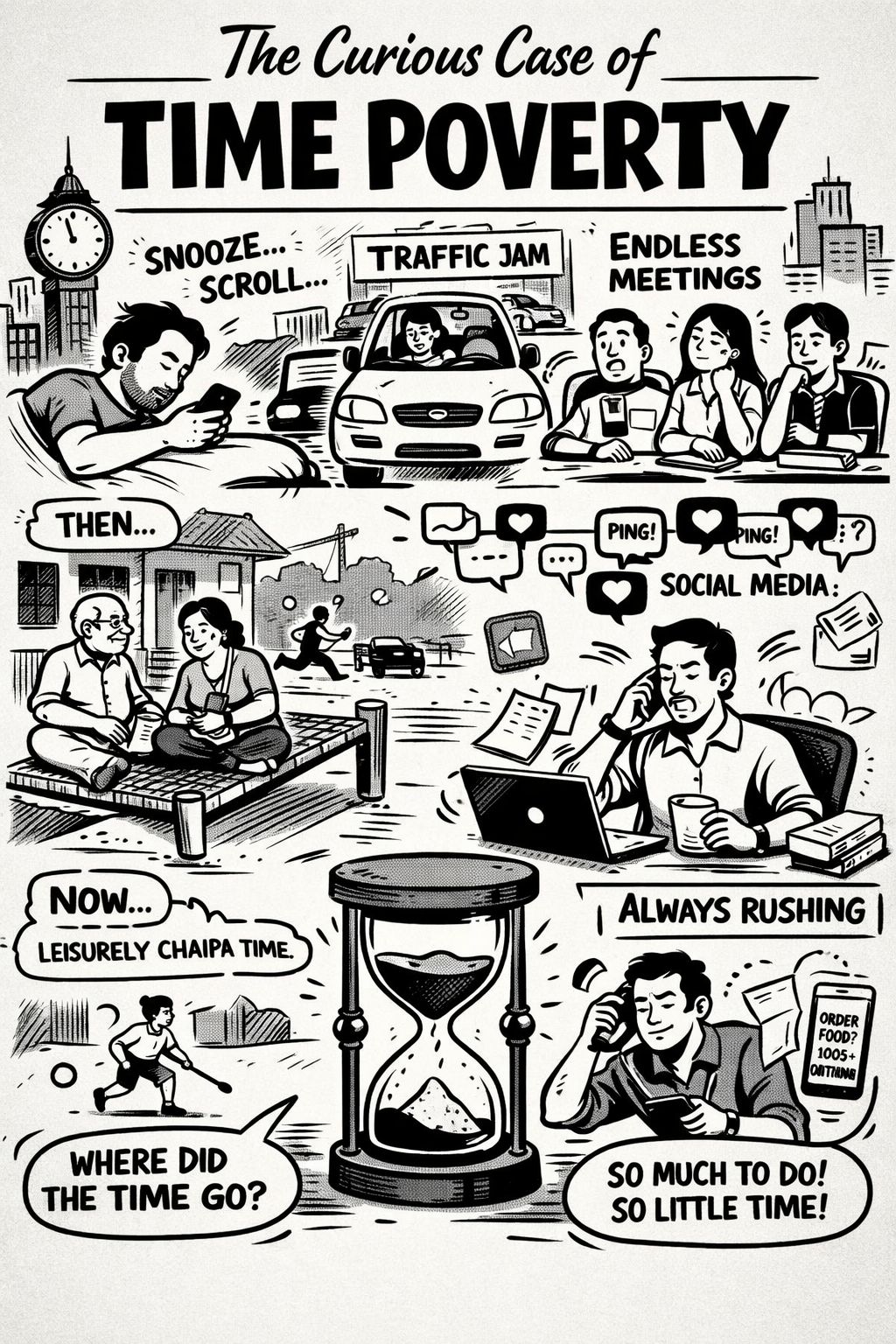
Free apps are designed to maximise engagement because engagement drives advertising revenue. Endless scrolling, autoplay videos, push notifications, algorithmic recommendations, and gamified feedback loops are not accidental features; instead, they are engineered mechanisms to capture and hold attention. Time spent on these platforms is monetised elsewhere, converted into impressions, clicks, and behavioural insights. For us, this translates into hours lost daily to digital consumption. The opportunity cost is immense in terms of time not spent on learning, work, rest, relationships, or reflection. In a country where time poverty is already acute for large sections of the population, the extraction of attention is a high but rarely acknowledged cost of ‘free.’

Alongside free apps, free government schemes occupy a central place in India’s public imagination. Welfare programs offering free food, free electricity, free healthcare, free education, and direct cash transfers are often framed as moral imperatives in a society with widespread poverty. And indeed, many such schemes have had transformative impacts. Free school meals have improved nutrition and attendance. Subsidised healthcare has saved lives. Social security schemes have provided safety nets in times of crisis. To dismiss free schemes outright would be both inaccurate and unjust.

However, the scale and politics of ‘free’ in governance demand scrutiny. Government schemes are funded by public money, either through taxation or borrowing. When services are offered for free, the cost is distributed across society, including future generations. Fiscal resources are finite, and every rupee allocated to a subsidy is a rupee not spent elsewhere. The real question is not whether the state should provide support, but how that support is designed, targeted, and sustained. Poorly designed free schemes can strain public finances, crowd out long-term investments, and create distortions that are difficult to reverse.

One of the most persistent risks associated with free government schemes is the shift from empowerment to dependency. When benefits are delivered without clear pathways to capability-building, translating into skills, livelihoods, ownership, or agency, they can trap beneficiaries in cycles of reliance. This is not a failure of intent but of design. Welfare that does not evolve into opportunity risks becoming permanent relief rather than temporary support. Over time, political incentives can encourage the expansion of free entitlements without corresponding investments in productivity, institutional capacity, or economic growth. The cost, then, is borne in slower development, rising debt, and reduced fiscal flexibility.

There is also a less visible social cost when citizens begin to relate to the state primarily as a provider of free goods rather than as a facilitator of opportunity, and expectations shift. Accountability becomes transactional, and long-term policy thinking gives way to short-term appeasement. This dynamic can erode democratic deliberation, reducing complex governance challenges to simplistic promises of free distribution. In such an environment, the language of rights is often mixed with the politics of giveaways, weakening the deeper idea of citizenship rooted in participation, contribution, and shared responsibility.

In India, ‘free’ advice is abundant and rarely priced. Friends, relatives, colleagues, social media influencers, and anonymous online forums dispense guidance on everything from investments and careers to health, parenting, and mental well-being. At one level, this reflects strong social bonds and collective problem-solving. Knowledge-sharing has always been part of Indian society. But in the contemporary context, the proliferation of free advice, especially online, has begun to undermine the value of expertise itself. Professional knowledge is produced through years of education, training, practice, and ethical accountability. When expert advice is expected to be free, its perceived value diminishes. Professionals are pressured to give away labour without compensation, while advice-seekers are encouraged to treat complex problems as easily solvable through quick opinions. The result is often superficial guidance applied to situations that demand nuance. In fields like finance, law, and health, the consequences can be serious, resulting in misdiagnoses, financial losses, legal complications, and long-term harm.

Digital platforms have amplified this problem dramatically. Social media rewards confidence, not competence. Algorithms favour content that is engaging, simplified, and emotionally charged. As a result, the loudest voices often drown out the most qualified ones. Free advice becomes entertainment, stripped of context and accountability. Influencers monetise indirectly through advertising, brand deals, or lead generation, while audiences consume advice under the illusion that it is altruistic. The hidden cost here is the ability to distinguish reliable knowledge from persuasive noise.

Behavioural economics shows that people disproportionately favour free options, even when they are inferior to low-cost alternatives. The absence of price triggers a sense of gain that overrides rational evaluation. In India, this bias plays out repeatedly when users choose free digital services with weak privacy protections over modestly priced, safer alternatives,  beneficiaries prefer immediate free benefits over long-term investments in capability, or individuals trust free advice over paid expertise because payment itself is mistaken for bias. These patterns are not signs of ignorance but of how human psychology interacts with scarcity and aspiration.

Free social media platforms, while enabling connection, intensify comparison. Carefully curated images of success, beauty, and happiness circulate endlessly, shaping aspirations and insecurities. The cost is stress, anxiety, and diminished self-worth, especially among young users. These effects are not accidental side-effects but structural outcomes of platforms designed to maximise engagement rather than well-being.

When platforms subsidise services to gain scale, smaller players struggle to compete. Local businesses, creators, and service providers are often forced into ecosystems where they generate value but capture little of it. Revenue flows upward and outward, concentrating power in a few large entities. Price signals weaken, making it difficult for sustainable, high-quality alternatives to emerge. Over time, consumers accustomed to free access become resistant to paying for quality, undermining the viability of independent work and innovation.

Yet it would be a mistake to conclude that free is inherently harmful. Free education, free public healthcare, free libraries, and free public infrastructure have historically been among the most powerful tools for social progress. The issue is not free versus paid, but opaque free versus conscious free. When free services are transparent about costs, respectful of users, and oriented toward empowerment rather than extraction, they create genuine public value. When free becomes a strategy to harvest data, attention, votes, or dependency, its costs far outweigh its benefits.

The challenge for India is to develop a more mature relationship with ‘free.’ This requires stronger regulation of digital platforms, particularly around data protection, transparency, and competition. It requires better design and evaluation of welfare schemes, ensuring they build capabilities and not just deliver consumption. It requires cultural shifts that restore respect for expertise and recognise that paying for knowledge is not exploitation but investment. And most importantly, it requires citizens to ask harder questions when something is offered at no cost.

Who is paying for this? What am I giving up? Who benefits in the long run? Is this making me more capable or more dependent? These questions are not cynical, but are of utmost importance. In a complex society, the absence of price does not mean the absence of cost. It only means the cost has been displaced onto privacy, time, dignity, judgment, or the future. India’s relationship with ‘free’ will shape its developmental trajectory in profound ways. If used wisely, then free access can level the playing field and unlock human potential; else it can deepen inequalities, hollow out institutions, and quietly extract value from those least equipped to see it. Free is never just an economic choice; instead, it is a moral, political, and social one. And in a country as large and consequential as India, the true cost of free is something we can no longer afford to ignore.

Ghost Eye

Author: Amitav Ghosh | 336 Pages | Genre: Fiction | Publisher: HarperCollins | Year: 2025 | My Rating: 8/10

Ghost Eye by Amitav Ghosh is an intriguing addition to his body of work, blending his characteristic climate change concerns with elements of magical realism, memory, and metaphysical inquiry. Known for novels such as The Shadow Lines, River of Smoke and Jungle Nama, Ghosh has consistently explored the intersections of history, migration, and environment. In Ghost-Eye, he extends this exploration into more experimental terrain, weaving together reincarnation, psychological investigation, and climate activism into a multi-layered non-linear narrative that spans continents and decades.

At the heart of the novel lies a deceptively simple yet deeply unsettling premise of a young girl named Varsha Gupta, raised in a strict vegetarian Marwari household in late-1960s Calcutta, who suddenly insists on eating fish, which is entirely alien to her upbringing. More disturbingly, she claims to remember a past life in which fish was part of her staple diet, suggesting that she may be a ‘case of the reincarnation type.’ This premise immediately situates the novel within a liminal space between rationality and spiritual belief, a tension that drives much of the narrative.

In the early sections of the book, Ghosh meticulously constructs the world of the Gupta household, capturing the cultural rigidity and social milieu of Calcutta’s elite Marwari community. The disruption caused by Varsha’s insistence on fish is not merely dietary but existential as it challenges the family’s worldview and opens a door to questions they are ill-equipped to answer. Enter Dr Shoma Bose, a psychologist studying reincarnation cases, whose rational framework is gradually destabilised by Varsha’s revelations. Through Shoma, Ghosh explores the limits of scientific reasoning when confronted with phenomena that resist empirical categorisation.

What elevates Ghost Eye beyond a simple psychological mystery is its expansive temporal and spatial scope. The narrative moves fluidly between 1960s Calcutta, Sundarbans, and contemporary Brooklyn, where the story resurfaces decades later through Shoma’s nephew, Dinu. This dual timeline allows Ghosh to play with past and present, tradition and modernity, belief and scepticism. The transition is seamless, and the intergenerational narrative adds depth to the central mystery, transforming it into a broader meditation on memory and continuity.

Ghosh uses the motif of reincarnation not merely as a plot device but as a lens through which to examine ecological and ethical questions. The idea of cyclical existence mirrors the cycles of nature, suggesting an interconnectedness between human lives and the environment. As the narrative unfolds, it becomes increasingly clear that Varsha’s story is linked to larger concerns about environmental degradation and climate change. The involvement of environmental activists in the latter part of the novel underscores this connection, tying the metaphysical elements of the story to urgent real-world issues.

Ghosh’s descriptions of Calcutta and the Sundarbans are vivid and immersive, evoking a strong sense of place. The sensory richness in the depiction of food, landscapes, and everyday life grounds the more fantastical elements of the narrative, making them feel plausible within the world he has created. The novel’s magical realism is subtle rather than overt, emerging organically from the characters’ experiences rather than being imposed upon them.While the buildup is compelling and the thematic layers are rich, the ending feels somewhat rushed and less satisfying than the preceding narrative. The resolution of the central mystery, which promises a profound revelation, instead arrives with a sense of abruptness, leaving some threads insufficiently explored. Despite this limitation, Ghost Eye succeeds in pushing the boundaries of Ghosh’s narrative style. It represents a departure from his more historically anchored novels, venturing into speculative and metaphysical boundaries between science and spirituality, memory and imagination, human life and the natural world. The blending of genres creates a unique reading experience that is both engaging and thought-provoking. 

Why India needs a circular textile reuse revolution

The clothes we wear have a hidden afterlife. Even after a garment is worn a few times and forgotten at the back of a wardrobe, its environmental footprint remains in landfills, waterways, and the atmosphere. The global fashion industry today has a material and emissions footprint so large that it rivals that of entire nations. Each year, around 92 million tonnes of textile waste are generated worldwide, most of it ending up in landfills or incinerators, even though a large share of it is still wearable or recyclable. This is not just a lifestyle problem; it is a climate, water, and waste crisis rolled into one. In countries like India, Brazil, and the United States, the scale of textile waste varies, but the pattern remains the same, with fast fashion fuelling overconsumption, linear disposal systems leaking value, and communities paying the price through polluted land, stressed water systems, and rising emissions.

A practical alternative exists, and it is already visible in the reuse models emerging across cities and communities. The ‘collection-sorting-reuse-recycling model’, where clothes donated by households are graded and channelled into resale, regional redistribution, or material recycling, offers a rare triple win. It can save energy and water by avoiding virgin production, reduce landfill pressure and carbon emissions, and create dignified livelihoods across the value chain. In a world searching for climate solutions that also create jobs, textile reuse is a low-hanging fruit hiding in plain sight.

The environmental logic of reuse is powerful. Producing new clothing is energy and water-intensive, especially when fibres are grown, dyed, finished, shipped, and marketed across continents. Cotton alone accounts for massive freshwater use, while polyester is derived from fossil fuels and contributes to microplastic pollution. The fashion sector contributes an estimated 2–8% of global greenhouse gas emissions, making it one of the most carbon-intensive consumer industries.[i] When a garment is reused even once, a large portion of that embedded energy, water, and carbon footprint is avoided. Lifecycle assessments consistently show that resale and reuse pathways can cut emissions per garment by more than half compared to producing a new equivalent, while also sparing thousands of litres of water per kilogram of clothing.[ii] In practical terms, every shirt reused is a shirt not produced, and every kilogram diverted from landfill is methane not emitted during decomposition.

India’s case illustrates both the urgency of the problem and the promise of the solution. The country generates around eight million tonnes of textile waste every year, which is 8.5% of global post-consumer textile discards. India’s textile and apparel sector generates close to four million tonnes of post-consumer textile waste annually, making it one of the country’s largest contributors to landfill, water consumption, and greenhouse gas emissions. While an estimated 57% of used textiles are reused or recycled, these processes take place almost entirely through informal, fragmented, and unregulated channels. The remaining 43% ends up in landfills or is incinerated, reflecting an unsustainable linear ‘buy-use-discard’ consumption pattern that continues to accelerate with the growth of fast fashion[iii].

While India has long traditions of repair and hand-me-downs, rapid urbanisation and fast fashion consumption are overwhelming these cultural buffers. The result is a growing stream of clothing waste in municipal dumps, often mixed with organic waste, making recycling harder and environmental harm more acute. Yet India also hosts some of the world’s most innovative reuse ecosystems. Organisations such as Humana People to People India is demonstrating how urban surplus clothing can be collected and sold through retail channels, and income used for funding social development outcomes[iv], and Goonj collection channelled to rural communities in dignified ways, linking redistribution to community development and livelihoods.[v] Informal networks of sorters, repairers, and traders already keep a significant portion of textiles in circulation, proving that reuse is culturally and economically viable when supported by the right infrastructure. 

Brazil presents a parallel story shaped by urban consumerism and rising awareness. The country generates millions of tonnes of textile waste annually, with a large fraction still going to landfills due to limited formal recycling and reuse systems.[vi] Yet a growing thrift and resale movement, especially among younger Brazilians, is reframing second-hand fashion as both affordable and aspirational.[vii] Community cooperatives and small recyclers are beginning to integrate textile waste into circular micro-economies, creating jobs in sorting, resale, and upcycling. The lesson from Brazil is that cultural acceptance of reuse can shift quickly when affordability, sustainability narratives, and local entrepreneurship align.

The United States, often seen as the epicentre of fast fashion consumption, offers a different scale of lessons. Tens of millions of tonnes of textiles are discarded each year, but the country also has one of the world’s most established second-hand markets, supported by charities, social enterprises, and commercial resale platforms. Organisations collecting used clothing divert billions of pounds from landfills annually, channelling them into domestic resale, international reuse markets, and recycling streams.[viii] Even in a high-consumption society, reuse systems demonstrate that scale is possible when logistics, sorting infrastructure, and consumer awareness are aligned. The American experience shows that reuse is not marginal, but can be commercially viable, and environmentally meaningful at the national scale.

There could be lessons learnt from Brazil and the USA, and good practices replicated in India. Beyond environmental benefits, reuse models unlock employment that matters deeply for India. Every stage of the circular value chain creates work, from collection crews and logistics managers, sorting centre workers trained in grading and repair, retail staff in reuse shops, resellers in Tier II and III towns, and recycling technicians handling end-of-life textiles. Unlike capital-intensive manufacturing, reuse and sorting are labour-intensive, making them ideal for employment generation in peri-urban and rural contexts. India’s textile and apparel ecosystem already employs tens of millions of people, and circular extensions of this value chain can add new layers of income while formalising parts of the informal economy.[ix] For women and youth, especially in low-income communities, reuse enterprises can offer accessible entry points into entrepreneurship and wage work, from operating neighbourhood collection hubs to running small resale outlets.

Such models fit well within India’s national climate adaptation priorities. The National Action Plan on Climate Change[x]emphasises sustainable consumption, waste reduction, and resource efficiency as pillars of climate resilience. Textile reuse contributes to mitigation by cutting emissions embedded in production and avoiding landfill methane, while also supporting adaptation by reducing pressure on water systems and urban waste infrastructure. In water-stressed cities, every litre saved through avoided textile production matters. In flood-prone regions, reducing landfill volume lowers the risk of waste-choked drainage and secondary pollution. Circular textile systems thus become part of urban resilience, not just waste management.

The social enterprise model further adds public value, where profits from resale and recycling can cover operating costs and fund social programs. By reinvesting surpluses into community education, skills training, or local environmental projects, reuse systems can close the loop between consumption and social impact. This can become an excellent example of regenerative economics, where waste becomes a revenue stream that sustains both the enterprise and the communities it serves. When scaled across cities through partnerships with RWAs, municipalities, and CSR programmes, such models can become a distributed infrastructure for circularity, embedded in everyday life rather than confined to pilot projects.

While reuse alone cannot solve fashion’s environmental crisis, overproduction must be addressed, and durable design, extended producer responsibility, and recycling innovation are all necessary. But reuse is the fastest, cheapest, and most socially inclusive solution available today. It requires no new technology breakthroughs, only better organisation of what already exists and conscious consumerism. 

Embracing circular textile reuse at scale in India is not just an environmental choice, but an essential development strategy. It aligns climate action with employment, urban resilience with rural markets, and consumer behaviour with community benefit. Brazil’s cultural shift towards thrift and the USA’s large-scale reuse infrastructure show that such transitions are possible across income levels and cultures. The question is no longer whether reuse works, but whether policy, capital, and civic will can come together to make it the norm rather than the exception. If India gets this right, it will not only reduce its textile footprint but also demonstrate how climate action can be woven into the fabric of everyday economic life.

References 


[i] https://news.un.org/en/story/2025/03/1161636#:~:text=The%20fashion%20industry%20is%20one,of%20global%20greenhouse%20gas%20emissions

[ii] Number Analytics. “The Impact of Recycled Textiles on the Environment.” Lifecycle assessment review, 2024.

[iii] https://reports.fashionforgood.com/report/sorting-for-circularity-india-wealth-in-waste/chapterdetail?reportid=813&chapter=3

[iv] Humana People to People India. “Reuse and Circularity in Textiles”, 2026

[v] Goonj (India). Organisational model and impact summaries, publicly available reports.

[vi] Upcycle4Better. “Textile Recycling in Brazil.” Country brief, 2023.

[vii] Greenbook. “The Thrifting Revolution in Brazil.” Market insight report, 2024.

[viii] Planet Aid

[ix] CSTEP. “India’s Textile and Apparel Sector: Ecosystem and Readiness for EPR.” Policy report, 2024.

[x] National Action Plan on Climate Change (NAPCC), Govt. of India

Economics is not about money

Most people think economics is about money, but it’s not. If it were, your life would make far more sense than it does. Economics begins much earlier than money, as it starts the moment you realise that you cannot have everything at once. You cannot have a high-paying job and abundant free time. You cannot have absolute security and complete freedom. You cannot say yes to every opportunity without saying no to something else. Economics is not about how much you earn, but what you give up for it. That invisible sacrifice, ‘what you could have done but didn’t, ‘ is the true currency of economics. We seldom talk about it, but it quietly shapes every decision we make.

Think of any random normal day of your life. You wake up earlier than you would like because traffic can be unpredictable. You scroll your phone while sipping morning tea, not because you want to, but because silence feels uncomfortable. You choose a quicker breakfast over a healthier one. You delay a difficult conversation at home. You tolerate a job you dislike because it pays the bills. None of these choices feels ‘economic.’ They feel personal. But every choice that you make is a trade-off. When you choose speed over health, comfort over honesty, income over meaning, you are doing economics. You are allocating scarce resources, such as time, energy, attention, and emotional capacity. Money enters later, as a convenient measuring tool, but the logic is already at work.

In India and several other similar developing countries, we live in a constant state of trade-offs. Long commutes to work steal hours from families. Overcrowded classrooms dilute learning. Low wages are compensated by the promise of stability. We accept these compromises so routinely that they stop feeling like choices at all and begin to feel like fate. Economics helps us see that they are not.

No matter how rich or poor you are, time is always in limited supply. A billionaire has the same twenty-four hours as a daily-wage worker. A student in Delhi and a farmer in Bihar both face limited days and uncertain futures. What differs is not scarcity itself but how it is managed and who bears its cost. Scarcity forces choices, which create trade-offs, and ultimately, trade-offs determine winners and losers.

If economics is about trade-offs, then the most important question is not about what we want, but what we are willing to give up, and who decides? This is where economics moves from being a personal lens to a political one. In democracies, these decisions are meant to be collective, negotiated through debate, budgets, and votes.  When a government invests heavily in urban infrastructure but underfunds primary healthcare, it is not simply prioritising growth over welfare, but is choosing whose time matters. The commuter stuck in traffic benefits from a flyover, while the woman who walks kilometres to a hospital pays the price. These outcomes are often defended as efficiency, but efficiency for whom is rarely asked. Economics reminds us that aggregate gains can coexist with deep individual losses, and that averages hide pain as effectively as they reveal progress.

This way of thinking also changes how we view success. Growth figures, income levels, and productivity rates dominate economic conversations, but they measure outputs, not experiences. A country can grow richer while its people grow more anxious. A company can become more profitable while its workers burn out. A household can earn more while spending less time together. When we ignore these costs, we risk building systems that look successful on paper but feel unbearable in practice. 

There is also a moral dimension to trade-offs that markets alone cannot resolve. Markets are excellent at responding to purchasing power, but often silent about need. They reward those who can pay, not those who suffer most. That is why leaving everything to ‘the market’ is itself a choice, one that often shifts costs onto the weakest. When clean air, safe housing, or quality education are treated purely as commodities, inequality is not an accident, but it is an outcome. Economics helps us see that fairness is not automatic, but must be designed.

This is the uncomfortable truth economics insists on. Every policy, every system, every personal decision benefits one and burdens someone else. There is no free lunch, only cleverly hidden bills. When a city prioritises flyovers over footpaths, it chooses cars over pedestrians. When an education system rewards rote learning, it sacrifices curiosity. When a company celebrates long working hours, it quietly taxes family life. These are not moral failures but are economic decisions. However, pretending they are natural or inevitable prevents us from questioning them.

The most dangerous costs are the ones we don’t notice. When an app is free, we assume there is no price. When a government scheme promises something for nothing, we rarely ask who is paying. When a product is cheap, we celebrate efficiency, not exploitation. But every benefit has a cost. If you don’t see it, it’s probably being paid by someone else, or even by your future self. Cheap food often means underpaid farmers. Free social media means monetised attention. Low taxes can mean broken public services. Fast growth can mean polluted air and exhausted bodies. Economics trains us to ask an unfashionable question: compared to what? Without this lens, we mistake convenience for progress.

At an individual level, thinking economically can be liberating. It replaces guilt with clarity. If you understand that your exhaustion is not just a personal failure but the result of incentives that reward overwork, you can begin to question those incentives. If you recognise that your inability to save is linked to rising living costs rather than laziness, you can demand better policies instead of harsher self-judgment. Awareness does not eliminate constraints, but it changes how we respond to them.

One of the quiet cruelties of modern life is how easily individuals are blamed for structural problems. If you are unemployed, you are told to upskill. If you are stressed, you are told to meditate. If you are poor, you are told to work harder. But you are rarely told to examine the system that made these outcomes likely in the first place. Economics reveals patterns where we see only personal failure. It shows how incentives shape behaviour, how power hides behind ‘market outcomes,’ and how rules written long ago continue to decide who gets ahead today. This does not absolve individuals of responsibility, but it does bring honesty to the conversation. You cannot fix what you refuse to name.

Economics is not about predicting stock prices or defending ideologies, but is more about clarity. About seeing how choices are shaped, how costs are distributed, and how power operates quietly through everyday decisions. You do not need equations to think economically. Instead, you need curiosity and courage to ask uncomfortable questions. And you need the humility to accept that every solution creates new problems. Once you start seeing life this way, it becomes difficult to unsee. You begin to notice the price tags on things that never claimed to be for sale, like time, trust, dignity, and attention. That awareness does not make life easier, but it makes it more honest. And honesty, in the long run, is the most valuable currency we have. When we see costs clearly, we can finally argue about whether they are worth paying, and whether the bill is being shared fairly. India is a masterclass in everyday economics. Families choose stability over passion, young people choose migration over belonging, villages trade environment for employment, and women trade ambition for safety. These are not random decisions but often are rational responses to constraints. When options are limited, even painful choices begin to make sense. Understanding this limitation is empowerment.