Circular economy solution for India’s cooking crisis

For the past decade, India’s clean cooking revolution was symbolised by a powerful image in the form of a woman in a rural village receiving her first LPG connection under the Pradhan Mantri Ujjwala Yojana (PMUY). It represented dignity, health, convenience, and liberation from the unpaid drudgery of firewood collection, respiratory illness, and smoky kitchens where women spent hours inhaling toxic fumes while cooking over firewood and dung cakes. And to be fair, it was a transformational policy intervention because it solved a critical access problem by expanding LPG connections to millions of low-income households. But as is often the case with development policy, solving access did not fully solve sustainability. 

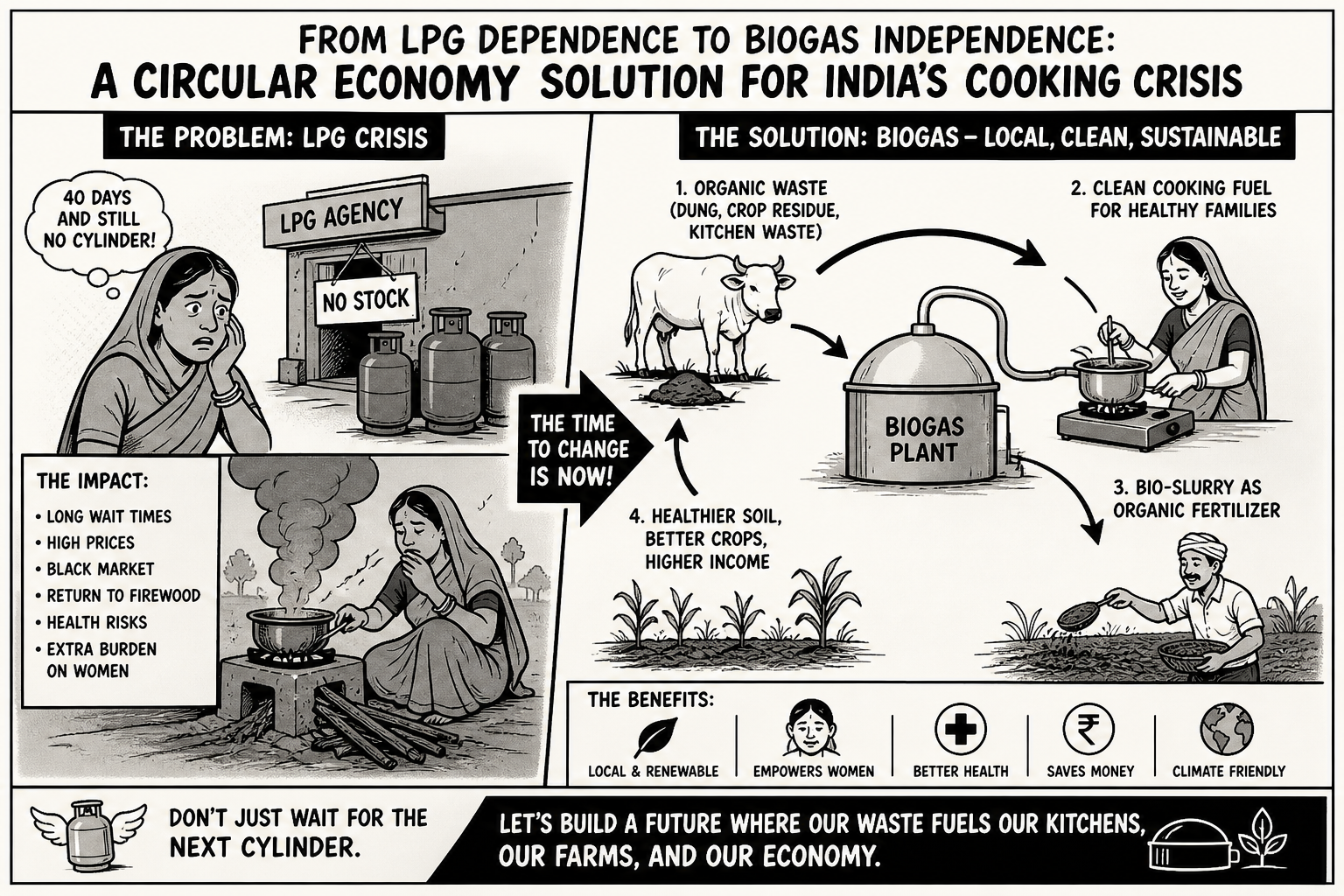
The recent conflict in West Asia has disrupted global energy supply chains and exposed India’s dangerous dependence on imported cooking fuel. With tensions around Iran and the closure of the Strait of Hormuz, India, where nearly 60% of LPG demand is met through imports, and over 90% of those imports typically transit through Hormuz, has found itself in an avoidable crisis. LPG supplies have tightened, transportation costs have increased, and delays in refill deliveries have become common in many rural districts and smaller towns. In several places, households are reportedly waiting over 40 days for a cylinder refill. Prices have surged, black market sales have flourished, and many low-income families are being pushed back toward firewood, charcoal, and kerosene. India is facing its first wave of ‘energy migrants’ as LPG shortages and soaring fuel prices have triggered reverse migration from cities to villages, especially from the major industrial hubs, including Delhi, Mumbai and Surat. A clean cooking transition built on imported fossil fuel has suddenly begun to look alarmingly vulnerable.

India imports a substantial share of its LPG requirements, and a large portion of these imports move through geopolitically sensitive shipping routes. While India is considered a leader in clean cooking access, millions of households remain dependent on an international supply chain shaped by wars, shipping disruptions, currency fluctuations, and global oil politics. The rural poor, as always, bear the highest burden of this volatility. A delayed LPG refill in an urban apartment may be an inconvenience, but in rural India, it often means a family returns to collecting wood, spending additional hours on unpaid labour, or cutting back on cooked meals altogether. Small roadside eateries reduce their menu options, and migrant workers spend more on food. Development gains achieved over the years begin reversing quietly, one delayed cylinder at a time.

Today, the villages struggling with LPG shortages often possess enormous untapped energy resources sitting in plain sight. Across rural India, cattle dung, agricultural residue, poultry waste, kitchen scraps, and other organic materials are abundantly available. India has one of the world’s largest livestock populations, producing massive quantities of dung every single day. Much of this waste is either left to decompose openly, releasing methane into the atmosphere, or converted into traditional dung cakes that burn inefficiently and create harmful smoke. What if this waste could instead become a reliable source of clean cooking fuel? That is precisely where biogas emerges not merely as an alternative, but as a strategic necessity.

Biogas is produced through anaerobic digestion, a process where organic waste decomposes in oxygen-free chambers and releases methane-rich gas that can be used for cooking. The leftover slurry becomes high-quality organic fertiliser. This is an excellent circular economy model where households generate fuel from waste while simultaneously reducing fertiliser costs for farming. For rural families, this means lower dependence on LPG refills, lower household expenditure, improved sanitation, reduced smoke exposure, and additional agricultural benefits. Unlike LPG, biogas is hyperlocal as it does not depend on international shipping routes, refinery outputs, or geopolitical stability. Unlike firewood, it burns cleanly. Unlike solar cookers, it works regardless of weather or time of day. Unlike electric induction stoves, it does not depend on stable electricity supply, which remains inconsistent in many rural areas. In a world increasingly shaped by supply chain disruptions, biogas offers resilience.

India does not need to invent this model from scratch because proven examples already exist. In parts of Rajasthan, Maharashtra, Gujarat, Karnataka, Punjab, and several other Indian states, communities have successfully adopted household and community biogas systems. Villages linked to dairy cooperatives have demonstrated how cattle waste can be transformed into reliable cooking fuel. Some communities have significantly reduced their dependence on LPG altogether. During recent supply disruptions, such villages and farming households were largely insulated from shortages because their cooking fuel was produced locally. No waiting for gas agencies, no inflated black-market prices, and no dependence on international conflict. Their kitchens continue to function because their fuel is local.

What makes India’s underinvestment in biogas particularly frustrating is that the policy architecture already exists. The government has long operated biogas programs through the Ministry of New and Renewable Energy, and initiatives like Sustainable Alternative Towards Affordable Transportation (SATAT) have promoted compressed biogas (CBG). Yet these efforts have often remained fragmented, underfunded, and treated as niche rural welfare programs rather than core components of national energy security. India tends to think big when discussing energy with large refineries, strategic petroleum reserves, international supply agreements, and mega infrastructure. These are important; however, true resilience often comes from decentralisation. A household biogas unit in a rural village may seem small compared to an oil refinery, but millions of such units can collectively create enormous national resilience.

Imagine if even a quarter of India’s livestock-owning rural households had access to functional biogas systems. Or village-level community digesters serving clusters of homes where individual ownership is not feasible. Imagine schools, Anganwadis, hostels, and community kitchens using biogas generated from local organic waste. Think of self-help groups running maintenance services for biogas units as local enterprises. Imagine MGNREGA funding village-level renewable energy infrastructure. Suddenly, biogas can move from being a sustainability experiment to becoming a serious economic and strategic asset.

The climate benefits further strengthen this strategy. Methane emissions from unmanaged livestock waste contribute significantly to global warming. Capturing this methane for productive use helps reduce greenhouse gas emissions. Every cubic meter unit of biogas reduces 2 tons CO2e/year. Reduced firewood usage can lower deforestation pressures. Bio-slurry reduces dependence on chemical fertilisers, moving towards sustainable agriculture. Lower LPG consumption reduces fossil fuel imports. Biogas sits at the intersection of climate policy, rural livelihoods, women’s empowerment, waste management, and energy security, a rare policy intervention that solves multiple problems simultaneously. Biogas directly contributes to SDG 5 (Gender Equality), SDG 7 (Affordable and Clean Energy), and Sustainable Energy for All (SE4ALL). It also delivers results that contribute to SDG 1 (Poverty Eradication), SDG 3 (Good Health and Well-being), and SDG 13 (Climate Action).

The current LPG crisis should serve as a warning. The war in the Middle East did not create India’s vulnerability, merely exposed it. A country aspiring to become a global economic power cannot allow millions of household kitchens to remain hostage to international conflict. Energy security cannot only be discussed in terms of crude oil imports and electricity generation. It must also include the daily cooking needs of ordinary citizens. The woman waiting 40 days for an LPG cylinder in a rural village is experiencing energy insecurity in its most human form. India’s future energy strategy must become far more diversified. LPG will continue to play an important role, particularly in urban areas and transitional markets. But it cannot remain the singular answer for rural cooking energy. Biogas offers India local control that imported LPG can never provide. It transforms waste into wealth, dependency into resilience, and vulnerability into self-reliance. In a century likely to be shaped by geopolitical instability, climate disruptions, and fragile global supply chains, the most strategic energy resource may not be buried deep underground or shipped across oceans. It may be sitting quietly in rural backyards, waiting for India to finally recognise its potential.

Why India needs a circular textile reuse revolution

The clothes we wear have a hidden afterlife. Even after a garment is worn a few times and forgotten at the back of a wardrobe, its environmental footprint remains in landfills, waterways, and the atmosphere. The global fashion industry today has a material and emissions footprint so large that it rivals that of entire nations. Each year, around 92 million tonnes of textile waste are generated worldwide, most of it ending up in landfills or incinerators, even though a large share of it is still wearable or recyclable. This is not just a lifestyle problem; it is a climate, water, and waste crisis rolled into one. In countries like India, Brazil, and the United States, the scale of textile waste varies, but the pattern remains the same, with fast fashion fuelling overconsumption, linear disposal systems leaking value, and communities paying the price through polluted land, stressed water systems, and rising emissions.

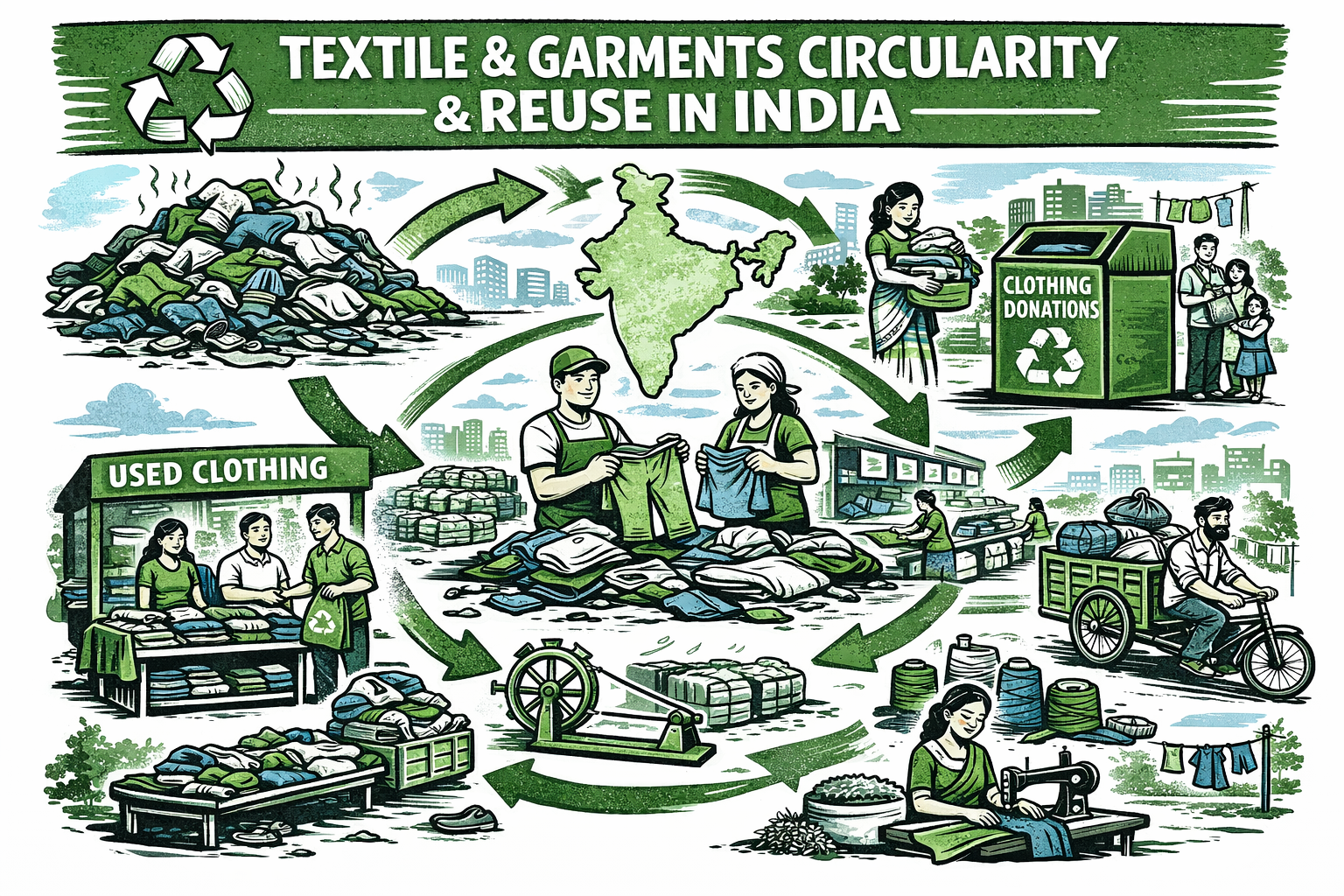
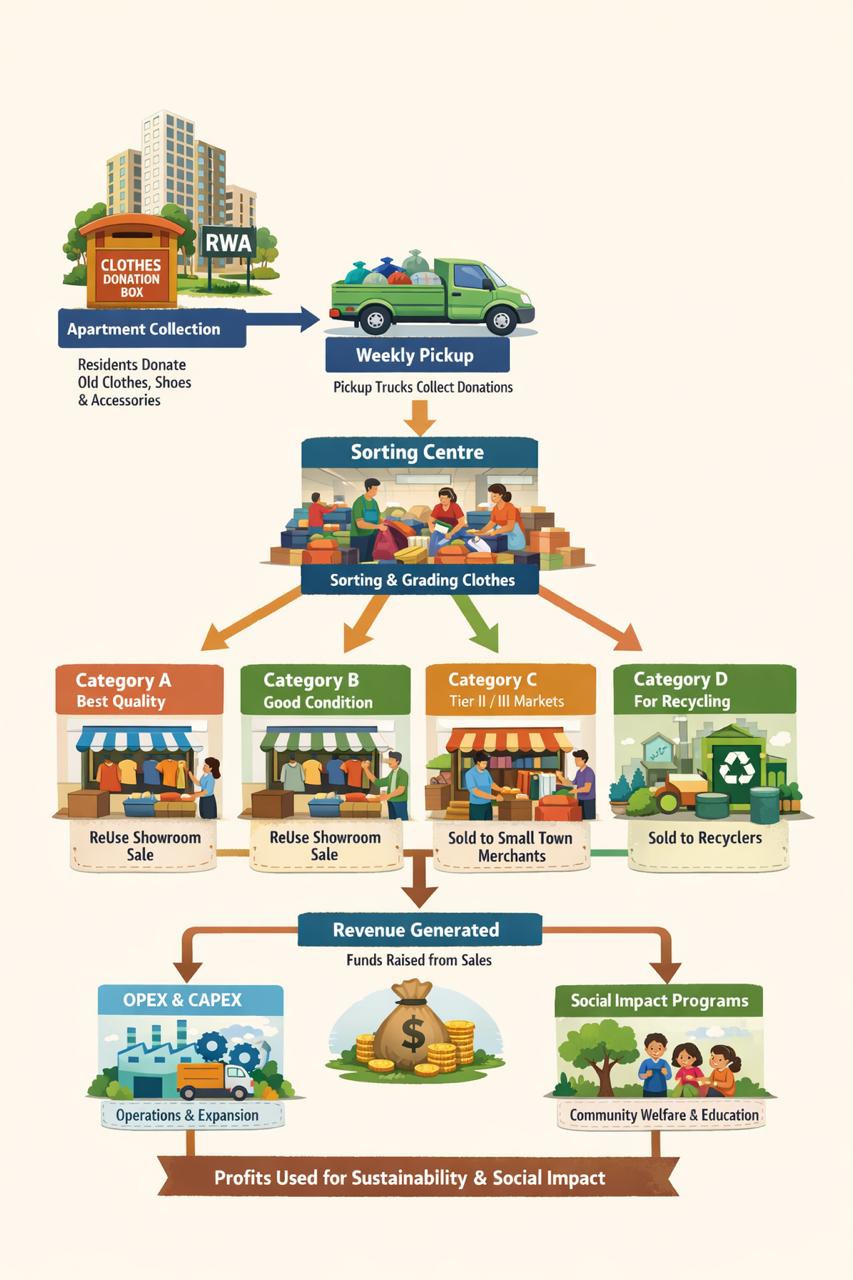
A practical alternative exists, and it is already visible in the reuse models emerging across cities and communities. The ‘collection-sorting-reuse-recycling model’, where clothes donated by households are graded and channelled into resale, regional redistribution, or material recycling, offers a rare triple win. It can save energy and water by avoiding virgin production, reduce landfill pressure and carbon emissions, and create dignified livelihoods across the value chain. In a world searching for climate solutions that also create jobs, textile reuse is a low-hanging fruit hiding in plain sight.

The environmental logic of reuse is powerful. Producing new clothing is energy and water-intensive, especially when fibres are grown, dyed, finished, shipped, and marketed across continents. Cotton alone accounts for massive freshwater use, while polyester is derived from fossil fuels and contributes to microplastic pollution. The fashion sector contributes an estimated 2–8% of global greenhouse gas emissions, making it one of the most carbon-intensive consumer industries.[i] When a garment is reused even once, a large portion of that embedded energy, water, and carbon footprint is avoided. Lifecycle assessments consistently show that resale and reuse pathways can cut emissions per garment by more than half compared to producing a new equivalent, while also sparing thousands of litres of water per kilogram of clothing.[ii] In practical terms, every shirt reused is a shirt not produced, and every kilogram diverted from landfill is methane not emitted during decomposition.

India’s case illustrates both the urgency of the problem and the promise of the solution. The country generates around eight million tonnes of textile waste every year, which is 8.5% of global post-consumer textile discards. India’s textile and apparel sector generates close to four million tonnes of post-consumer textile waste annually, making it one of the country’s largest contributors to landfill, water consumption, and greenhouse gas emissions. While an estimated 57% of used textiles are reused or recycled, these processes take place almost entirely through informal, fragmented, and unregulated channels. The remaining 43% ends up in landfills or is incinerated, reflecting an unsustainable linear ‘buy-use-discard’ consumption pattern that continues to accelerate with the growth of fast fashion[iii].

While India has long traditions of repair and hand-me-downs, rapid urbanisation and fast fashion consumption are overwhelming these cultural buffers. The result is a growing stream of clothing waste in municipal dumps, often mixed with organic waste, making recycling harder and environmental harm more acute. Yet India also hosts some of the world’s most innovative reuse ecosystems. Organisations such as Humana People to People India is demonstrating how urban surplus clothing can be collected and sold through retail channels, and income used for funding social development outcomes[iv], and Goonj collection channelled to rural communities in dignified ways, linking redistribution to community development and livelihoods.[v] Informal networks of sorters, repairers, and traders already keep a significant portion of textiles in circulation, proving that reuse is culturally and economically viable when supported by the right infrastructure. 

Brazil presents a parallel story shaped by urban consumerism and rising awareness. The country generates millions of tonnes of textile waste annually, with a large fraction still going to landfills due to limited formal recycling and reuse systems.[vi] Yet a growing thrift and resale movement, especially among younger Brazilians, is reframing second-hand fashion as both affordable and aspirational.[vii] Community cooperatives and small recyclers are beginning to integrate textile waste into circular micro-economies, creating jobs in sorting, resale, and upcycling. The lesson from Brazil is that cultural acceptance of reuse can shift quickly when affordability, sustainability narratives, and local entrepreneurship align.

The United States, often seen as the epicentre of fast fashion consumption, offers a different scale of lessons. Tens of millions of tonnes of textiles are discarded each year, but the country also has one of the world’s most established second-hand markets, supported by charities, social enterprises, and commercial resale platforms. Organisations collecting used clothing divert billions of pounds from landfills annually, channelling them into domestic resale, international reuse markets, and recycling streams.[viii] Even in a high-consumption society, reuse systems demonstrate that scale is possible when logistics, sorting infrastructure, and consumer awareness are aligned. The American experience shows that reuse is not marginal, but can be commercially viable, and environmentally meaningful at the national scale.

There could be lessons learnt from Brazil and the USA, and good practices replicated in India. Beyond environmental benefits, reuse models unlock employment that matters deeply for India. Every stage of the circular value chain creates work, from collection crews and logistics managers, sorting centre workers trained in grading and repair, retail staff in reuse shops, resellers in Tier II and III towns, and recycling technicians handling end-of-life textiles. Unlike capital-intensive manufacturing, reuse and sorting are labour-intensive, making them ideal for employment generation in peri-urban and rural contexts. India’s textile and apparel ecosystem already employs tens of millions of people, and circular extensions of this value chain can add new layers of income while formalising parts of the informal economy.[ix] For women and youth, especially in low-income communities, reuse enterprises can offer accessible entry points into entrepreneurship and wage work, from operating neighbourhood collection hubs to running small resale outlets.

Such models fit well within India’s national climate adaptation priorities. The National Action Plan on Climate Change[x]emphasises sustainable consumption, waste reduction, and resource efficiency as pillars of climate resilience. Textile reuse contributes to mitigation by cutting emissions embedded in production and avoiding landfill methane, while also supporting adaptation by reducing pressure on water systems and urban waste infrastructure. In water-stressed cities, every litre saved through avoided textile production matters. In flood-prone regions, reducing landfill volume lowers the risk of waste-choked drainage and secondary pollution. Circular textile systems thus become part of urban resilience, not just waste management.

The social enterprise model further adds public value, where profits from resale and recycling can cover operating costs and fund social programs. By reinvesting surpluses into community education, skills training, or local environmental projects, reuse systems can close the loop between consumption and social impact. This can become an excellent example of regenerative economics, where waste becomes a revenue stream that sustains both the enterprise and the communities it serves. When scaled across cities through partnerships with RWAs, municipalities, and CSR programmes, such models can become a distributed infrastructure for circularity, embedded in everyday life rather than confined to pilot projects.

While reuse alone cannot solve fashion’s environmental crisis, overproduction must be addressed, and durable design, extended producer responsibility, and recycling innovation are all necessary. But reuse is the fastest, cheapest, and most socially inclusive solution available today. It requires no new technology breakthroughs, only better organisation of what already exists and conscious consumerism. 

Embracing circular textile reuse at scale in India is not just an environmental choice, but an essential development strategy. It aligns climate action with employment, urban resilience with rural markets, and consumer behaviour with community benefit. Brazil’s cultural shift towards thrift and the USA’s large-scale reuse infrastructure show that such transitions are possible across income levels and cultures. The question is no longer whether reuse works, but whether policy, capital, and civic will can come together to make it the norm rather than the exception. If India gets this right, it will not only reduce its textile footprint but also demonstrate how climate action can be woven into the fabric of everyday economic life.

References 


[i] https://news.un.org/en/story/2025/03/1161636#:~:text=The%20fashion%20industry%20is%20one,of%20global%20greenhouse%20gas%20emissions

[ii] Number Analytics. “The Impact of Recycled Textiles on the Environment.” Lifecycle assessment review, 2024.

[iii] https://reports.fashionforgood.com/report/sorting-for-circularity-india-wealth-in-waste/chapterdetail?reportid=813&chapter=3

[iv] Humana People to People India. “Reuse and Circularity in Textiles”, 2026

[v] Goonj (India). Organisational model and impact summaries, publicly available reports.

[vi] Upcycle4Better. “Textile Recycling in Brazil.” Country brief, 2023.

[vii] Greenbook. “The Thrifting Revolution in Brazil.” Market insight report, 2024.

[viii] Planet Aid

[ix] CSTEP. “India’s Textile and Apparel Sector: Ecosystem and Readiness for EPR.” Policy report, 2024.

[x] National Action Plan on Climate Change (NAPCC), Govt. of India