The Paradox of Choice

Today when we can open a trading account in minutes using multitudes of apps on our smartphones, start a side hustle overnight, and invest in everything from mutual funds to crypto, it’s easy to assume that greater financial freedom leads to greater happiness and security. After all, classical economics taught us that more choice expands utility and that having more options allows individuals to maximise satisfaction according to their preferences.

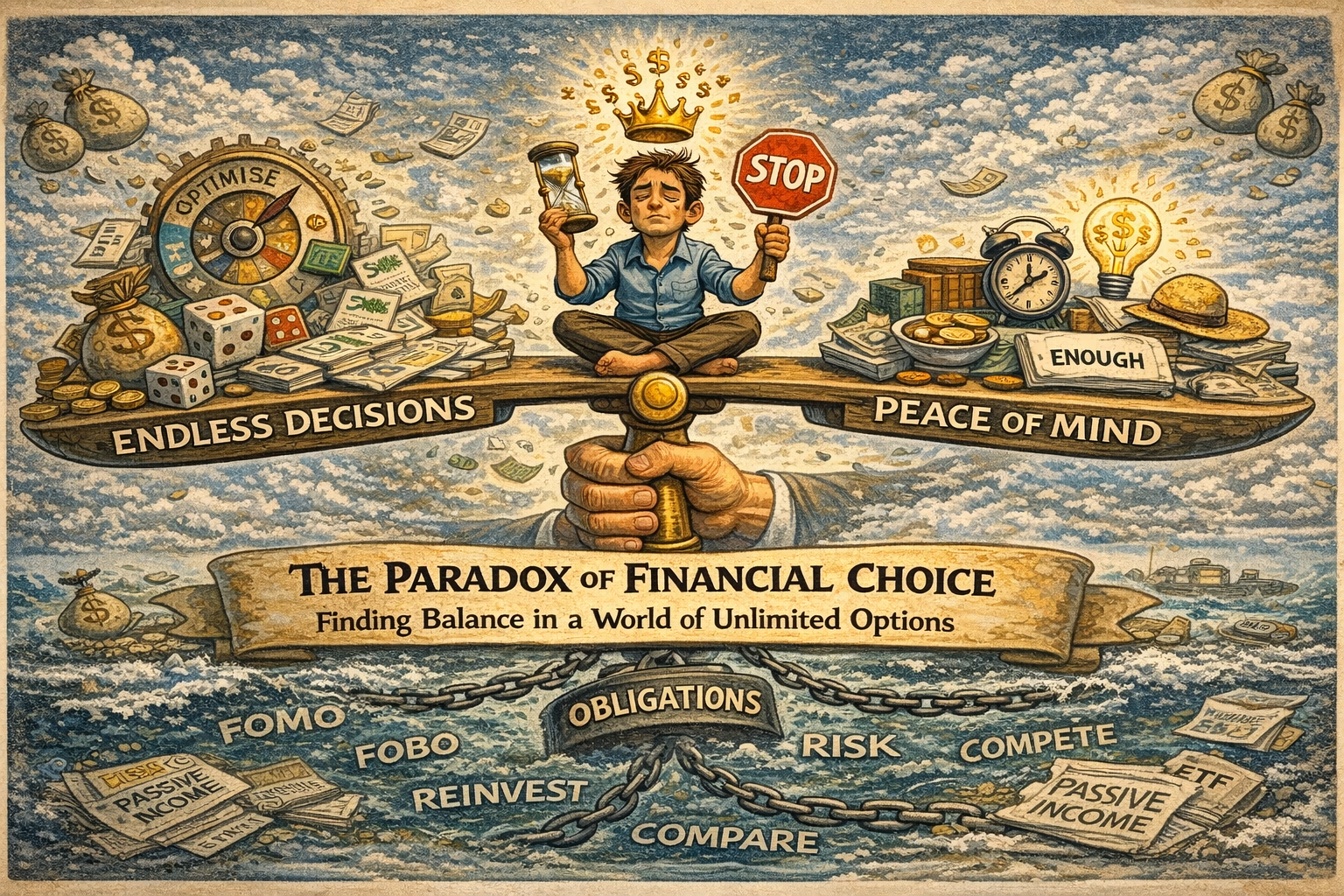
However, paradoxically, the modern reality is quite the opposite. The very availability of multiple financial choices, from investment platforms and passive income streams to flexible careers, has made us more anxious, instead of more secure. This tension between freedom and fatigue is at the core of what psychologist Barry Schwartz famously called The Paradox of Choice, that when faced with too many options, people often experience paralysis, regret, and dissatisfaction. In the financial world, this paradox is amplified by behavioural biases, social pressures, and the illusion of control. The promise of ‘financial freedom’ is increasingly becoming a source of stress and decision fatigue.

At the core of neoclassical economics lies the assumption of the rational consumer, an individual seeking to maximise utility given available resources and information. In theory, having more options allows a person to reach a higher indifference curve, implying greater satisfaction. However, this theory assumes two conditions of perfect information and bounded rationality that modern life rarely satisfies. In reality, our capacity to process and evaluate financial information is limited. According to Nobel laureate Herbert Simon, bounded rationality doesn’t really exist as people settle for ‘good enough’ decisions given cognitive constraints.

When applied to financial decisions of choosing mutual funds, stocks, insurance policies, side gigs, or career shifts, the cognitive load of evaluating multiple dimensions (returns, risk, time, opportunity cost, tax impact, and ethical values) becomes overwhelming. And, eventually, this results in anxiety, procrastination, and in many cases, decision paralysis.

Behavioural economics has consistently challenged the rational agent model by introducing psychological realism. The ‘overchoice effect,’ as demonstrated in Sheena Iyengar and Mark Lepper’s famous “jam experiment” (formally published in 2000), found that too many options reduce the likelihood of making any decision at all, instead of motivating consumers.

Translating this into financial behaviour, investors today face an explosion of options:

  • Thousands of mutual funds and ETFs, each claiming a unique advantage
  • Multiple investment apps with different algorithms and influencers
  • Gig economy trends from freelancing to affiliate marketing to AI content creation
  • Cryptocurrencies, NFTs, index funds, and more

Every new choice promises empowerment but demands research, comparison, and ongoing monitoring. Instead of creating financial autonomy, it traps individuals in a constant state of vigilance, which is the fear of missing out (FOMO) combined with the fear of making the wrong call (FOBO). The result is not empowerment but exhaustion or decision fatigue. Each micro-decision (Should I invest this month? Which stock to pick? Should I switch careers or start a podcast?) depletes mental energy. Over time, this erodes not just financial confidence but emotional well-being.

Daniel Kahneman’s Prospect Theory helps explain why financial freedom can be anxiety-inducing. The theory suggests that people are loss averse as the pain of losing 100 rupees is psychologically twice as intense as the pleasure of gaining the same amount. In an environment overflowing with options, every choice implies multiple foregone alternatives. Every decision carries not just the risk of loss but the weight of opportunity cost. This constant mental simulation of missed opportunities amplifies anticipated regret, a core feature of financial anxiety. Ironically, the very flexibility that defines financial freedom multiplies the avenues for potential regret. The ideology of ‘financial freedom’ is closely tied to neoliberal individualism, which believes that individuals are solely responsible for their economic success or failure. The gig economy and self-investing culture are framed as the democratisation of opportunity, but in practice, they shift systemic risk from institutions to individuals.

In the past, financial security was linked to stable employment, pensions, and collective risk-sharing. Today’s economy glorifies personal agency: ‘be your own boss,’ ‘invest smart, ‘create multiple income streams.’ This narrative sounds empowering, but simultaneously imposes a moral burden that if you are not financially thriving, it’s because you didn’t hustle enough or make the right investments. Digital technology has magnified this paradox. Social media and fintech apps blur the line between information and manipulation. Platforms gamify investing (colourful charts, animations, notifications) to keep users engaged. Influencers promote ‘hot’ stocks on popular social media or ‘passive income secrets’ that fuel financial comparison and insecurity.

The attention economy transforms finance from a domain of prudence into one of performance. People aren’t just managing money, instead they’re managing an identity. The psychological cost is immense and full of information overload, impulsive trading, and the erosion of long-term financial discipline. It is a proven fact that dopamine spikes from small gains, mimicking gambling behaviour, creating cycles of thrill and despair. 

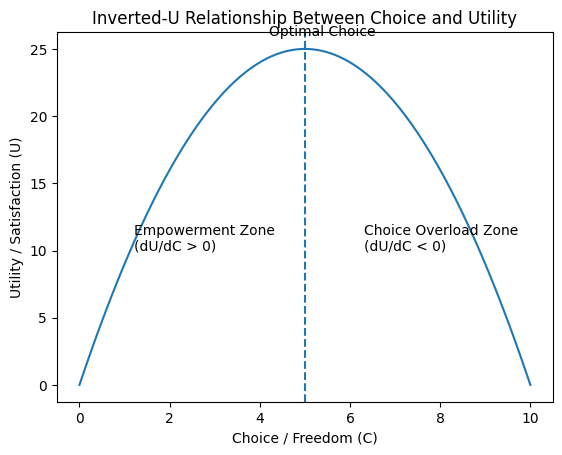
This anxiety can be visualised through diminishing marginal utility of choice. Initially, increasing options enhances utility as people enjoy flexibility. However, beyond a threshold, the utility curve flattens and then declines as cognitive costs exceed the benefits of freedom.

Mathematically, if U = f(C) represents utility derived from choice (C), then

            for small CdU/dC > 0 (freedom increases satisfaction),

            for large CdU/dC < 0 (freedom decreases satisfaction).

This inverted-U relationship illustrates that optimal well-being arises not from maximum freedom but from structured freedom, where choice is curated, meaningful, and bounded by context or expertise.

The paradox of financial choice reveals a deeper human truth that enjoying freedom without boundaries can be as imprisoning as constraint. The promise of financial autonomy has mutated into an obligation to constantly optimise, compare, and compete. It seems like we are drowning in option value as every unrealised choice weighs on our psyche. We are victims of decision fatigue as we are living through the privatisation of financial risk disguised as empowerment. True financial freedom, therefore, is not about multiplying options but mastering them and knowing when to choose, when to stop, and when to rest. As with most paradoxes, the solution lies in the balance of the freedom to simplify, ignore, and define what ‘enough’ means in a world that always demands more.

Payback: Debt and the Shadow Side of Wealth

Author: Margaret Atwood | 240 Pages | Genre: Non-Fiction | Publisher: Bloomsbury Publishing PLC | Year: 2008 | My Rating: 8/10

“Without debt, there would be no such thing as credit, and without credit, economies would not exist. But equally, without debt, there would be no such thing as forgiveness.”

-Margaret Atwood, Payback

Payback: Debt and the Shadow Side of Wealth was originally presented as the Massey Lectures in 2008. It is not a book about economics in the traditional sense, as it does not include balance sheets, market trends, or policy prescriptions. Instead, it is a work of literary and moral imagination, a wide-ranging meditation on what debt means, which is not only as a financial construct but as a moral, psychological, and even mythical one. Atwood has shared an idea that governs much of modern life, the idea of owing and being owed. The book’s tone is conversational yet filled with insights, blending history, literature, religion, and personal reflection. It says that debt is an idea that is created by humanity, and that it is closely connected to our concepts of justice, sin, and morality. 

The book is structured into five chapters: Ancient Balances, Debt and Sin, The Shadow Side, Payback, and Payback: The Shadow Side. Each chapter explores debt from a different perspective—cultural, literary, economic, and ecological, slowly building toward a conclusion about the balance between taking and giving, destruction and renewal.

The book traces the origins of debt to ancient times, where it was not only a financial but also a moral and spiritual one. In many cultures, debt has been synonymous with guilt. For example, the language of ‘redemption’ and ‘forgiveness’ in Christianity has deep economic roots. This moral overlap is not accidental. Instead, it reflects a psychological need for balance, for settling accounts not only in terms of money but in life.

Ancient systems of justice were often modelled on an eye for an eye, or a life for a life. The idea of fairness was inherently transactional. Thus, debt becomes a metaphor for all human obligations, between individuals, between human beings and gods, and eventually between humanity and the planet. Therefore, economic debt, moral guilt, and ecological imbalance all stem from the same root: the failure to honour reciprocity.

Atwood moves seamlessly through the Bible, Shakespeare, Dickens, Marlowe, and even pop culture, treating each as a kind of moral ledger. Ebenezer Scrooge, the most famous debtor and creditor in fiction, becomes a recurring figure. She also references Dr. Faustus, who sells his soul to the devil as a literal debt contract. Debt stories are also about identity, who owes whom, and what kind of person it makes you to owe or to be owed. These examples highlight how debt has long served as a narrative to explore human frailty, justice, and redemption.

In the third chapter, ‘The Shadow Side,’ Atwood dives into the psychology of debt and how it can enslave, corrupt, and distort. She talks about Jung’s idea of the hidden moral darkness within every person and society. In this way, debt is like the shadow side of wealth, showing the unseen costs of accumulating riches. Atwood uses historical examples, from debtors’ prisons in Victorian England to the 2008 global financial crisis, to show how societies often ignore moral responsibility. When people or institutions borrow more than they can handle, they’re not just taking financial risks but moral ones too. The book, published just before the 2008 crash, eerily predicts the crisis that was about to happen. Modern capitalism relies on the constant creation of debt, which is both the system’s driving force and its curse. Debt is everywhere, yet we rarely stop to think about its harmful effects.

In the book’s final chapter, a contemporary ‘Scrooge Corporation’ is visited by the Spirit of Earth Day Future. This eco-fable weaves together Atwood’s arguments into a narrative of humanity’s reckoning with the natural world. The spirit unveils to Scrooge the dire consequences of his unbalanced ledger, which comprises a planet drained of resources, tainted by waste, and devoid of moral responsibility. By reinterpreting a well-known moral story through an ecological lens, the book compels the reader to understand that the language of debt is synonymous with the language of survival. When we speak of ‘owing the Earth’ or ‘repaying our debts to future generations,’ these expressions are not merely metaphorical, as they represent literal truths.

Atwood’s writing is witty, elegant, sharp and ironic. Her ability to seamlessly transition from ancient myths to modern finance is truly remarkable, and she always reminds the reader that behind every number, there’s a story. There are moments of satire, especially when she targets corporate greed or political hypocrisy, but also passages of lyrical reflection that showcase her poetic sensibility.

The book is a mix of essay, cultural history, and allegory. Its interdisciplinary approach mirrors the complexity of its subject. Debt isn’t just about economics; it shapes our moral and social worlds. However, Atwood’s digressions and literary references, while enlightening, can sometimes overwhelm readers who aren’t familiar with them. Each chapter feels like a conversation with a brilliant, slightly mischievous teacher who loves turning assumptions upside down. The book is a moral reckoning disguised as a literary essay. It’s a call to remember that every ledger, no matter how abstract, has a human cost. Atwood’s lesson through this book is that living ethically means recognizing one’s debts, not just in money, but in gratitude, care, and responsibility.

Navigating the Road to Sustainability for Nonprofits in India

Source: Idea taken from Foraker group model

Sustainability has become a buzzword across industries, and for nonprofits in India, it’s more than just a trend—it’s a necessity! Sustainability in the nonprofit sector is a critical issue that encompasses not only environmental stewardship but also financial stability, organizational resilience, and long-term impact. Nonprofits, by their nature, are dedicated to addressing social, economic, and environmental challenges, often with limited resources and high expectations. With India’s rapid economic shifts and evolving social landscape, understanding and overcoming these hurdles is essential for nonprofits striving to make a lasting difference.

Key Challenges Facing Nonprofits in India

1. Funding Instability:  One of the most significant challenges facing nonprofits is financial instability. Nonprofits rely heavily on donor contributions, government grants, and CSR grants, which can be unpredictable and subject to economic fluctuations. Furthermore, many donors prefer to fund specific projects rather than general operations, leaving nonprofits vulnerable to financial shortfalls. The global economy, changing donor priorities, and a lack of diversified income streams often impact an organization’s ability to plan and execute long-term projects. This gets further compounded by competition among nonprofits for limited resources.

Nonprofits must constantly innovate and demonstrate their impact to attract and retain donors. This requires significant investment in fundraising and partnership strategies, donor relations, and marketing, which are resource-intensive and divert attention from core mission activities, often resulting in chicken-egg situations.

2. Administrative and Operational Inefficiencies:  Many nonprofits in India struggle with limited administrative resources and inefficient operational practices. Limited resources lead to outdated technologies, inefficient processes, and a lack of professional expertise. Inefficiencies in management, compliance, accounting, and reporting undermine the effectiveness of programs and reduce transparency, negatively impacting stakeholders and donors’ trust. This is more challenging for smaller organizations with limited administrative capacity.

3. Regulatory and Compliance Maze: Managing the complex regulatory landscape in India is challenging for nonprofits. Compliance with legal requirements, such as the Foreign Contribution Regulation Act (FCRA) and the Goods and Services Tax (GST), requires careful attention to detail and significant administrative effort. Changes in regulations and stringent reporting requirements add to the administrative burden. Staying compliant while adapting to new regulations can strain organizational resources and divert attention from mission-critical activities.

4. Capacity Building and Skill Gaps: The nonprofit sector often faces challenges related to human resources. There is a growing need for skilled professionals who can handle strategic planning, fundraising, and program management, leading to organizational sustainability. The sector often faces challenges in attracting and retaining skilled professionals due to budget constraints and lower salaries compared to the private sector.

Capacity building requires investing in learning and development for employees. However, many organizations lack the resources to provide comprehensive training programs or to hire experienced professionals. This often limits their ability to effectively manage programs, drive strategic initiatives, and ensure organizational growth.

5. Measuring Impact: Measuring and presenting evidence-backed impact is essential for donor confidence and organizational effectiveness. Nonprofits need to develop robust monitoring and evaluation frameworks to assess the outcomes and effectiveness of their programs. However, many organizations struggle with setting up these systems due to limited resources and expertise.

 Strategies for Enhancing Sustainability

1. Diversifying Funding Sources: To address funding instability, nonprofits need to explore multiple revenue streams. This includes engaging in social entrepreneurship and blended finance opportunities, establishing partnerships with businesses, leveraging online crowdfunding platforms, and digital fundraising. Creating a diversified funding base helps in reducing dependency on a single source and enhances financial stability.

2. Leveraging and Embracing Technology: Technology offers significant opportunities for enhancing operational efficiency and reach. Digital tools can streamline administrative processes, improve data management, and facilitate better communication with stakeholders through online platforms and social media. Adopting technology also opens avenues for online fundraising and virtual program delivery such as webinars, workshops, and training.

3. Building Stronger Partnerships: Collaboration with other nonprofits, governmental agencies, and private sector organizations can amplify the impact of initiatives and improve sustainability. Strategic partnerships can provide access to additional resources, expertise, and networks. Strategic alliances can also lead to cost savings through shared services and joint initiatives. By working together, organizations can leverage each other’s strengths, reduce duplication of efforts, and achieve greater impact.

4. Investing in Human Capital: Prioritizing the development of human resources is crucial for organizational growth and sustainability. Nonprofits should invest in training and capacity-building programs for their staff and volunteers through training programs, workshops, and professional development opportunities. Creating a culture of continuous learning and career advancement opportunities can enhance program delivery, improve management practices, organizational resilience, and employee retention. Leadership development is particularly important for long-term sustainability. Cultivating strong leaders within the organization can drive strategic planning, innovation, and effective decision-making.

5. Enhancing Transparency and Accountability: Building trust with stakeholders through transparency and accountability is essential for long-term success. Nonprofits should adopt the best practices in financial management, regularly publish impact reports, and engage in open communication with donors and stakeholders. Transparency not only attracts more funding but also strengthens community support. Implementing robust internal controls and conducting regular audits can help maintain financial integrity and accountability. Additionally, engaging stakeholders in decision-making processes and soliciting feedback can enhance organizational credibility and responsiveness.

6. Adopting Sustainable Practices: Integrating sustainability into program design and organizational operations can drive long-term impact. Nonprofits should consider the environmental impact of their activities and seek to minimize their footprint. This might involve adopting green practices, such as reducing waste, conserving energy, and promoting eco-friendly initiatives. Sustainable practices also include ensuring the long-term viability of programs. This involves designing initiatives that can be sustained over time, building local capacity, and fostering community ownership. By promoting sustainability within programs, nonprofits can create a transformative impact.

The road to nonprofit sustainability is full of challenges, but with innovation, partnership, and a commitment to continuous improvement, nonprofits can navigate these challenges and continue to make a meaningful impact on society.  As the sector is continuously evolving, embracing sustainability will be key to ensuring that nonprofits can adapt to changing circumstances continue to remain steadfast in their mission, and drive positive social change for years to come.

Disclaimer: The opinions expressed are those of the author and do not purport to reflect the views or opinions of any organization, foundation, CSR, non-profit or others

Competitive analysis for your startup

Businesses happen in highly complex and competitive environment. It’s important to understand strengths and weaknesses your current and potential competitors.  This makes it very important for startups to understand and analyze their competitors and frame their growth strategies [both offensive and defensive] accordingly. In order to understand your competitors thoroughly, it’s impertinent that you do a systematic analysis and assessment rather than relying on informal knowledge and chunks of data that you might ‘know’.

Things that you need to know about your competitors include,

  • List of direct and potential competitors [make a list of 5 each]
  • Their strengths and weaknesses
  • What are their products/services and their USP
  • How does their product differs from your offering
  • What are their key operations strategy and how do they advertise
  • What’s the state of their business? How has been their growth in past 3 years?

In order to answer these questions, you need to develop separate competitor profile for each one of them. This kind of in-depth information will give you competitive advantage over them. You can deploy strategies through product differentiation, price discrimination, focussed advertising and sales promotions to get successful with your product offering. The competitor’s profile should include information on the,

  • Company’s background and structure
  • Financial info on their growth
  • Complete product information comprising of array of products, rate of new products development, R & D, patents and IPs, brand strength, etc.
  • Marketing strategies and their market share, alliances and geographic coverage, distribution channels, and their pricing strategies
  • Production process and operational strategies
  • Key composition in terms of human capital

You will have to get such information from both within the company and outside. Some sources for gathering information could be,

  1. Look for their website on the internet and study all the information given carefully. Also look on internet if anyone else is talking about them. Google them extensively to find info about their offerings. Check web-logs for reviews.
  2. Talk to their customers. Conduct a small survey to understand their customer satisfaction and behavior.
  3. Analyze their advertisements in different media to learn about their target audience, product features, benefits, etc.
  4. Read their promotional materials and annual reports to understand their operational strategies and growth patterns.

Doing a competitive analysis can be a challenging and interesting piece of work. You’ll learn a lot about your industry, and your insights will help you position your product better and make your Startup successful.

5 key bootstrapping strategies

I have been a bootstrapper from day one since I got bitten by the entrepreneurial bug. I learnt important key lessons from my first Startup that I applied in the next to optimize the chances of its success. Based on my learning, am sharing the following strategies for bootstrapped startups,

  1. Network hard and get connected, but work the ways on your own. Look for business mentors, hire experts, and the rest ‘Do It Yourself’. Remember that all other kinds of help and support costs money that you don’t have. It’s fine that you are a rocket scientist, a specialist, but you can train yourself to do marketing, sales pitch, finance, websites, and other work that will help your Startup grow.
  2. Rent for office space is one of the biggest expenses for any Startup. Till you start making money from your business, try to work from a home office. Rent that garage the Bill Gates way. Work virtually. Spend the rock bottom minimum money to keep your Startup running. Look for innovative ways through which you can cut down your costs, be it setting up fees or the operational costs.
  3. You don’t need to start taking huge CXO salaries the moment your Startup starts making money. Take out survival money and re-invest the rest of profits back in your Startup. Before you get into the bootstrapping mode, plan your survival finances for 12 months, instead of the mythical 6 months break even period. Believe me, in most of the cases you are not going to see any real money coming to your Startup in its first year.
  4. You will have to constantly find ways to market your Startup creatively. Use social media to its fullest. Don’t go for the glittering marketing expenses, which are huge and will eat up your initial money that may not bring results to keep you and your confidence afloat for a long time. Either find interns from graduate schools around who can do marketing for you through twitter, Facebook, e-mail, LinkedIn etc. or just do it yourself.
  5. They key to any bootstrapped Startup is perseverance. If you don’t have patience and want to strike the jackpot from the word go then either you have to be the luckiest person around or you are living in a utopian world. For the real people, steady persistence with focused course of action leads to desirable results and success.

So keep a tight lid on your costs, trust your gut feeling, and march forward with all the passion in your dream. The growth may be slower with bootstrapping, but it’s all yours. All the very best in your endeavors!