“Seems to me that you’ve gotta be in a place you know well, and if that place knows you too, it’ll help you.” ― Amitav Ghosh, Ghost Eye
Ghost Eye by Amitav Ghosh is an intriguing addition to his body of work, blending his characteristic climate change concerns with elements of magical realism, memory, and metaphysical inquiry. Known for novels such as The Shadow Lines,River of Smoke and Jungle Nama, Ghosh has consistently explored the intersections of history, migration, and environment. In Ghost-Eye, he extends this exploration into more experimental terrain, weaving together reincarnation, psychological investigation, and climate activism into a multi-layered non-linear narrative that spans continents and decades.
At the heart of the novel lies a deceptively simple yet deeply unsettling premise of a young girl named Varsha Gupta, raised in a strict vegetarian Marwari household in late-1960s Calcutta, who suddenly insists on eating fish, which is entirely alien to her upbringing. More disturbingly, she claims to remember a past life in which fish was part of her staple diet, suggesting that she may be a ‘case of the reincarnation type.’ This premise immediately situates the novel within a liminal space between rationality and spiritual belief, a tension that drives much of the narrative.
In the early sections of the book, Ghosh meticulously constructs the world of the Gupta household, capturing the cultural rigidity and social milieu of Calcutta’s elite Marwari community. The disruption caused by Varsha’s insistence on fish is not merely dietary but existential as it challenges the family’s worldview and opens a door to questions they are ill-equipped to answer. Enter Dr Shoma Bose, a psychologist studying reincarnation cases, whose rational framework is gradually destabilised by Varsha’s revelations. Through Shoma, Ghosh explores the limits of scientific reasoning when confronted with phenomena that resist empirical categorisation.
What elevates Ghost Eye beyond a simple psychological mystery is its expansive temporal and spatial scope. The narrative moves fluidly between 1960s Calcutta, Sundarbans, and contemporary Brooklyn, where the story resurfaces decades later through Shoma’s nephew, Dinu. This dual timeline allows Ghosh to play with past and present, tradition and modernity, belief and scepticism. The transition is seamless, and the intergenerational narrative adds depth to the central mystery, transforming it into a broader meditation on memory and continuity.
Ghosh uses the motif of reincarnation not merely as a plot device but as a lens through which to examine ecological and ethical questions. The idea of cyclical existence mirrors the cycles of nature, suggesting an interconnectedness between human lives and the environment. As the narrative unfolds, it becomes increasingly clear that Varsha’s story is linked to larger concerns about environmental degradation and climate change. The involvement of environmental activists in the latter part of the novel underscores this connection, tying the metaphysical elements of the story to urgent real-world issues.
Ghosh’s descriptions of Calcutta and the Sundarbans are vivid and immersive, evoking a strong sense of place. The sensory richness in the depiction of food, landscapes, and everyday life grounds the more fantastical elements of the narrative, making them feel plausible within the world he has created. The novel’s magical realism is subtle rather than overt, emerging organically from the characters’ experiences rather than being imposed upon them.While the buildup is compelling and the thematic layers are rich, the ending feels somewhat rushed and less satisfying than the preceding narrative. The resolution of the central mystery, which promises a profound revelation, instead arrives with a sense of abruptness, leaving some threads insufficiently explored. Despite this limitation, Ghost Eye succeeds in pushing the boundaries of Ghosh’s narrative style. It represents a departure from his more historically anchored novels, venturing into speculative and metaphysical boundaries between science and spirituality, memory and imagination, human life and the natural world. The blending of genres creates a unique reading experience that is both engaging and thought-provoking.
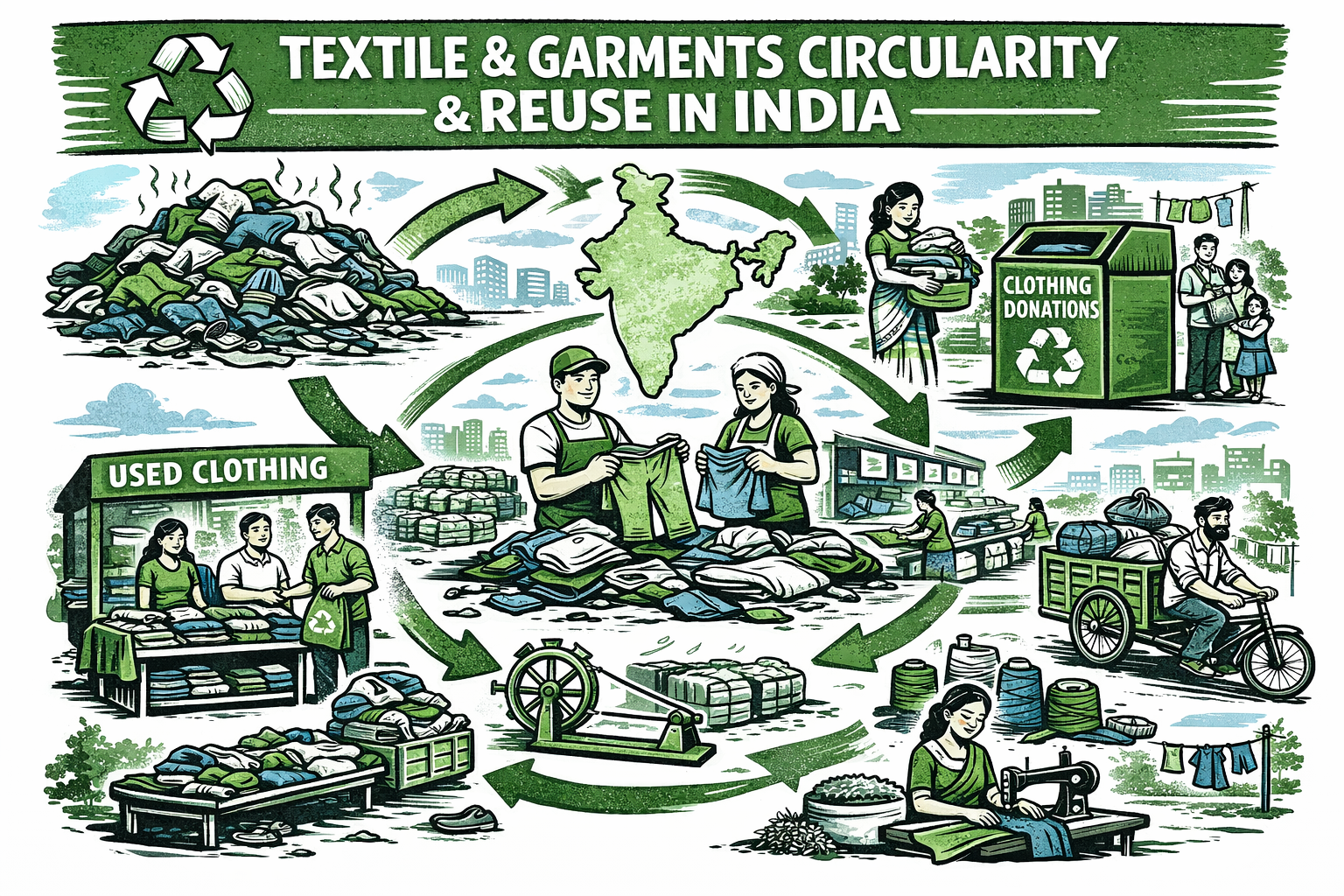
The clothes we wear have a hidden afterlife. Even after a garment is worn a few times and forgotten at the back of a wardrobe, its environmental footprint remains in landfills, waterways, and the atmosphere. The global fashion industry today has a material and emissions footprint so large that it rivals that of entire nations. Each year, around 92 million tonnes of textile waste are generated worldwide, most of it ending up in landfills or incinerators, even though a large share of it is still wearable or recyclable. This is not just a lifestyle problem; it is a climate, water, and waste crisis rolled into one. In countries like India, Brazil, and the United States, the scale of textile waste varies, but the pattern remains the same, with fast fashion fuelling overconsumption, linear disposal systems leaking value, and communities paying the price through polluted land, stressed water systems, and rising emissions.
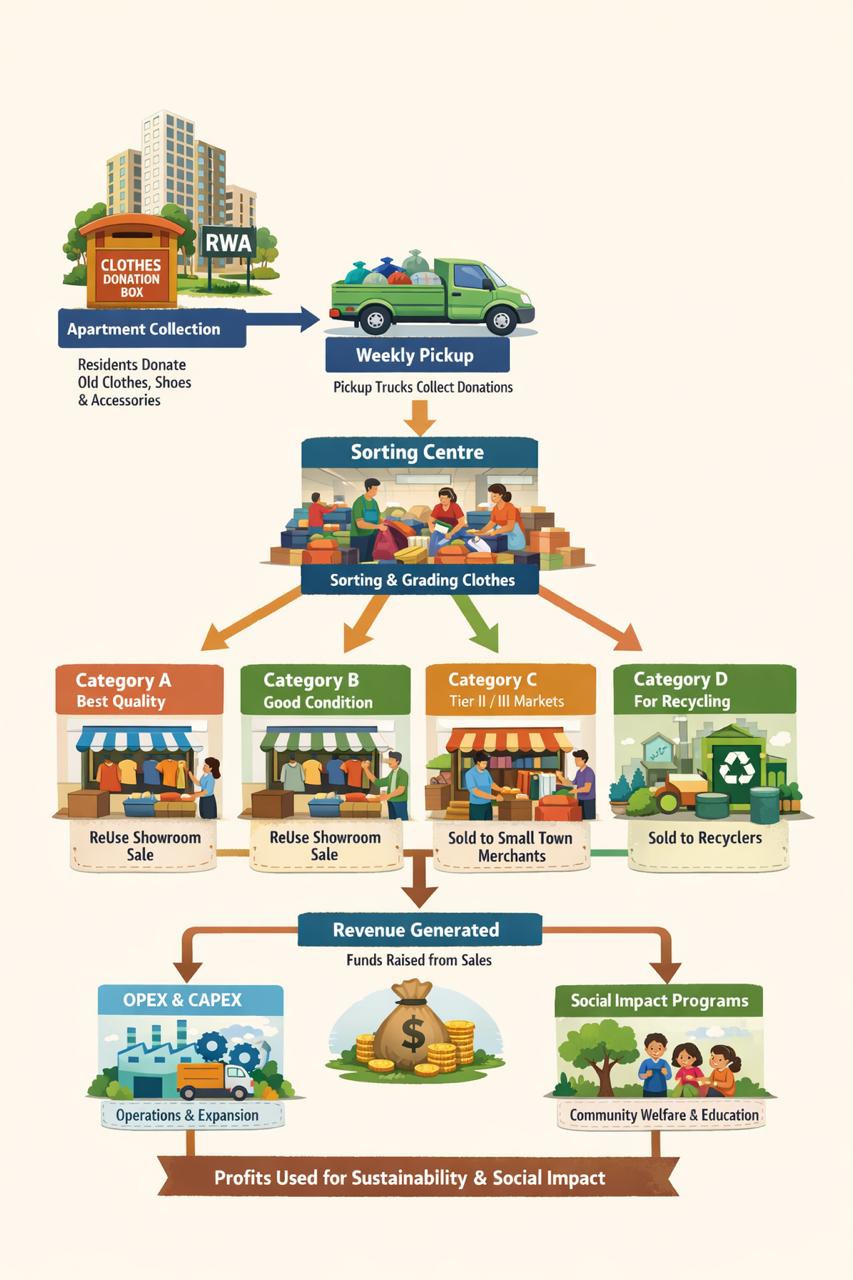
A practical alternative exists, and it is already visible in the reuse models emerging across cities and communities. The ‘collection-sorting-reuse-recycling model’, where clothes donated by households are graded and channelled into resale, regional redistribution, or material recycling, offers a rare triple win. It can save energy and water by avoiding virgin production, reduce landfill pressure and carbon emissions, and create dignified livelihoods across the value chain. In a world searching for climate solutions that also create jobs, textile reuse is a low-hanging fruit hiding in plain sight.
The environmental logic of reuse is powerful. Producing new clothing is energy and water-intensive, especially when fibres are grown, dyed, finished, shipped, and marketed across continents. Cotton alone accounts for massive freshwater use, while polyester is derived from fossil fuels and contributes to microplastic pollution. The fashion sector contributes an estimated 2–8% of global greenhouse gas emissions, making it one of the most carbon-intensive consumer industries.[i] When a garment is reused even once, a large portion of that embedded energy, water, and carbon footprint is avoided. Lifecycle assessments consistently show that resale and reuse pathways can cut emissions per garment by more than half compared to producing a new equivalent, while also sparing thousands of litres of water per kilogram of clothing.[ii] In practical terms, every shirt reused is a shirt not produced, and every kilogram diverted from landfill is methane not emitted during decomposition.
India’s case illustrates both the urgency of the problem and the promise of the solution. The country generates around eight million tonnes of textile waste every year, which is 8.5% of global post-consumer textile discards. India’s textile and apparel sector generates close to four million tonnes of post-consumer textile waste annually, making it one of the country’s largest contributors to landfill, water consumption, and greenhouse gas emissions. While an estimated 57% of used textiles are reused or recycled, these processes take place almost entirely through informal, fragmented, and unregulated channels. The remaining 43% ends up in landfills or is incinerated, reflecting an unsustainable linear ‘buy-use-discard’ consumption pattern that continues to accelerate with the growth of fast fashion[iii].
While India has long traditions of repair and hand-me-downs, rapid urbanisation and fast fashion consumption are overwhelming these cultural buffers. The result is a growing stream of clothing waste in municipal dumps, often mixed with organic waste, making recycling harder and environmental harm more acute. Yet India also hosts some of the world’s most innovative reuse ecosystems. Organisations such as Humana People to People India is demonstrating how urban surplus clothing can be collected and sold through retail channels, and income used for funding social development outcomes[iv], and Goonj collection channelled to rural communities in dignified ways, linking redistribution to community development and livelihoods.[v] Informal networks of sorters, repairers, and traders already keep a significant portion of textiles in circulation, proving that reuse is culturally and economically viable when supported by the right infrastructure.
Brazil presents a parallel story shaped by urban consumerism and rising awareness. The country generates millions of tonnes of textile waste annually, with a large fraction still going to landfills due to limited formal recycling and reuse systems.[vi] Yet a growing thrift and resale movement, especially among younger Brazilians, is reframing second-hand fashion as both affordable and aspirational.[vii] Community cooperatives and small recyclers are beginning to integrate textile waste into circular micro-economies, creating jobs in sorting, resale, and upcycling. The lesson from Brazil is that cultural acceptance of reuse can shift quickly when affordability, sustainability narratives, and local entrepreneurship align.
The United States, often seen as the epicentre of fast fashion consumption, offers a different scale of lessons. Tens of millions of tonnes of textiles are discarded each year, but the country also has one of the world’s most established second-hand markets, supported by charities, social enterprises, and commercial resale platforms. Organisations collecting used clothing divert billions of pounds from landfills annually, channelling them into domestic resale, international reuse markets, and recycling streams.[viii] Even in a high-consumption society, reuse systems demonstrate that scale is possible when logistics, sorting infrastructure, and consumer awareness are aligned. The American experience shows that reuse is not marginal, but can be commercially viable, and environmentally meaningful at the national scale.
There could be lessons learnt from Brazil and the USA, and good practices replicated in India. Beyond environmental benefits, reuse models unlock employment that matters deeply for India. Every stage of the circular value chain creates work, from collection crews and logistics managers, sorting centre workers trained in grading and repair, retail staff in reuse shops, resellers in Tier II and III towns, and recycling technicians handling end-of-life textiles. Unlike capital-intensive manufacturing, reuse and sorting are labour-intensive, making them ideal for employment generation in peri-urban and rural contexts. India’s textile and apparel ecosystem already employs tens of millions of people, and circular extensions of this value chain can add new layers of income while formalising parts of the informal economy.[ix] For women and youth, especially in low-income communities, reuse enterprises can offer accessible entry points into entrepreneurship and wage work, from operating neighbourhood collection hubs to running small resale outlets.
Such models fit well within India’s national climate adaptation priorities. The National Action Plan on Climate Change[x]emphasises sustainable consumption, waste reduction, and resource efficiency as pillars of climate resilience. Textile reuse contributes to mitigation by cutting emissions embedded in production and avoiding landfill methane, while also supporting adaptation by reducing pressure on water systems and urban waste infrastructure. In water-stressed cities, every litre saved through avoided textile production matters. In flood-prone regions, reducing landfill volume lowers the risk of waste-choked drainage and secondary pollution. Circular textile systems thus become part of urban resilience, not just waste management.
The social enterprise model further adds public value, where profits from resale and recycling can cover operating costs and fund social programs. By reinvesting surpluses into community education, skills training, or local environmental projects, reuse systems can close the loop between consumption and social impact. This can become an excellent example of regenerative economics, where waste becomes a revenue stream that sustains both the enterprise and the communities it serves. When scaled across cities through partnerships with RWAs, municipalities, and CSR programmes, such models can become a distributed infrastructure for circularity, embedded in everyday life rather than confined to pilot projects.
While reuse alone cannot solve fashion’s environmental crisis, overproduction must be addressed, and durable design, extended producer responsibility, and recycling innovation are all necessary. But reuse is the fastest, cheapest, and most socially inclusive solution available today. It requires no new technology breakthroughs, only better organisation of what already exists and conscious consumerism.
Embracing circular textile reuse at scale in India is not just an environmental choice, but an essential development strategy. It aligns climate action with employment, urban resilience with rural markets, and consumer behaviour with community benefit. Brazil’s cultural shift towards thrift and the USA’s large-scale reuse infrastructure show that such transitions are possible across income levels and cultures. The question is no longer whether reuse works, but whether policy, capital, and civic will can come together to make it the norm rather than the exception. If India gets this right, it will not only reduce its textile footprint but also demonstrate how climate action can be woven into the fabric of everyday economic life.
“All you need do, is be content with what you’ve got, to be always craving more, is a demon’s lot.” ― Amitav Ghosh, Jungle Nama
“Jungle Nama” by Amitav Ghosh is a captivating verse adaptation of a Bengali folktale from the Sundarbans, the world’s largest mangrove forest shared between India and Bangladesh. Written in a lyrical, rhythmic style, and illustrated by Salman Toor, the book tells the story of “Bon Bibi,” a benovelent goddess of the Sundarbans who safeguards the jungle and its people, and her conflict with Dokkhin Rai, a powerful demon-like figure who seeks to exploit the forest’s riches.
Ghosh’s decision to render this ancient tale in verse brings a unique musicality to the story, echoing the cadence of oral storytelling introducing music to current speech that has kept the folktale alive for generations. His prose is imbued with both reverence for the source material and a contemporary sensibility that makes the story accessible to a modern audience. Accompanying the text are hauntingly beautiful illustrations by artist Salman Toor, whose work enhances the mystical and otherworldly atmosphere of the Sundarbans and its lore.
Beyond its enchanting style, Jungle Nama explores timeless themes of balance between nature and humanity, the perils of human greed, and the importance of respecting natural boundaries. Ghosh subtly draws parallels to modern issues like climate change and environmental degradation, suggesting that the ancient wisdom in the Bon Bibi story holds valuable lessons for today’s world. Through Bon Bibi’s character, he raises questions about stewardship, sustainability, and the price of human ambition.
The book is more than a poetic retelling; it’s an immersive experience that connects readers to both nature and folklore. Ghosh’s evocative language and Toor’s illustrations work in harmony to capture the spirit of the Sundarbans and its lore, making this book a visually and intellectually rich addition to Ghosh’s body of work. The poem-like style of the book follows twelve syllables in each line, and each couplet has twenty-four syllables. After each line there is a natural pause or a caesura, replicating the cadence of the original legend.
This book by one of my all-time favourite authors is a mesmerizing read for anyone interested in myth, poetry, linguistic hybridity, and environment, offering a rare glimpse into a world where nature and spirituality are deeply intertwined.
“In God we trust. All others must bring data.” This quote, made by W. Edwards Deming holds true (and may even supersede God for some as Divine).
I have been in love with data right from my school years and the mysteries of the world it holds. I have tried to develop data driven models on human relationships, the movement of animals, finding patterns in the ways of the world, and later designing programs of social impact for challenging poverty, and policy development. In the end, we all are data, from the moment we are an idea until long after we pass away.
“Data is divine” highlights the growing understanding of data’s vital significance in modern society, in much the same way that religious or spiritual values have directed civilizations throughout history. In today’s digital age, data powers innovation, decision-making, and advancement in all fields, including governance, research, business, healthcare, and lifestyle.
1. Data as a source of truth: Data is frequently regarded as an impartial depiction of reality, providing information on trends and occurrences that may be imperceptible to anecdotal experience or intuition. In this way, data has a unique position as the basis for making well-informed decisions and uncovering hidden facts.
2. The power of data in innovation: Data is driving advancements in domains like healthcare, finance, and climate science and is revolutionizing industries as it powers AI/ML and sophisticated analytics. This emphasizes how data has the “divine” ability to spark significant change. The use of data for enhancing human welfare, from preventing pandemics through data-driven epidemiology to lowering inequality by studying societal trends has been in use. When applied sensibly and morally, it can aid in resolving some of the most pressing issues facing society.
3. Data as omnipresent: From the apps we use daily to the systems that manage our cities, data is present everywhere in the modern world. Its pervasiveness is comparable to a certain “divine” quality in that it affects almost every facet of contemporary life, whether we are conscious of it or not.
4. Data and ethics: Data carries a great deal of responsibility along with its power. Similar to supernatural knowledge, there are significant ethical ramifications to the way we collect, use, and safeguard data. Data misuse can result in inequality, manipulation, and privacy violations. As a result, it is crucial to handle data with dignity, openness, and ethics.
“Data is divine” also implies that we must treat it with deference and accountability while simultaneously appreciating its immense importance in shaping our future. We need to balance the power of data with ethical considerations as our world grows more and more data driven. The following are some crucial strategies to preserve this equilibrium,
1. Data privacy and informed consent: People ought to be in charge of how their information is gathered, kept, and utilized. It is not appropriate to force them to divulge information. Companies must be open and honest about their data practices so that users know what information is being gathered and why. Clear and informed consent should not be buried in complicated terms and conditions. Data literacy is essential among general population so that they are aware of the consequences of disclosing personal information, and the dangers of data misuse.
2. Data minimization: Only gather information that is absolutely required for the current job. This reduces the possibility of abuse and shields people from needless exposure. I’ve seen in recent years how social development initiatives gather and store vast amounts of data, with donors coercing their nonprofit partners to obtain it, yet this doesn’t address any societal issues. It is crucial to have a conscious grasp of what is needed.
3. Data bias and fairness: AI/ML systems may reinforce or increase biases found in the training data. Therefore, diversifying datasets, employing inclusive development techniques, and reviewing algorithms for bias are all necessary to ensure fairness.
4. Equitable data access: One way to lessen inequality is to make sure that data access and its advantages are shared equitably among all communities. This entails preventing the reinforcement of systemic disadvantages while ensuring that marginalized groups have access to data-driven insights.
5. Data governance and accountability: To ensure that data is utilized properly, organizations and governments must establish robust data governance policies and ethical frameworks. To stay up with the latest developments in technology, these policies must be revised regularly. It is imperative to establish unambiguous lines of accountability for the handling and utilization of data. Data practices can be kept moral and in line with social standards with the support of independent oversight organizations or ethics boards.
6. Regulation and legal safeguards: Strong data protection laws that impose restrictions on how businesses and organizations can gather, keep, and handle personal data must be enforced by governments. Laws that address issues like accountability for algorithmic judgments, eliminating discrimination, and safeguarding human rights in AI-driven systems are crucial for the ethical application of automation and artificial intelligence. Because technology is changing so quickly, regulatory models must be adaptable and flexible to support innovation and enable quick responses to emerging ethical dilemmas.
7. Data for social good: Data can and should also be used positive social impact including lowering inequality and poverty, combating climate change, and improving public health. Governments, corporations, and civil society organizations working together can help guarantee that data is used morally and for the good of society. These collaborations may result in common frameworks for the ethical use of data.
A multifaceted strategy including legislation, transparency, public education, and proactive governance is needed to strike a balance between the power of data and ethical issues. Prioritizing the defence of individual rights, maintaining equity, and advancing the common good while fostering innovation should be the main goals of ethical data use. Through cultivating a culture of accountability and responsibility, we can leverage data’s promise (and divinity) without sacrificing moral principles.
Disclaimer: The opinions expressed are those of the author and do not purport to reflect the views or opinions of any organization, foundation, CSR, non-profit or others
In a twist of fate that seems like it was ripped straight from the pages of a dystopian novel, Planet Earth has decided it’s time for a little payback. And who can blame it? After decades of exploitation, pollution, and blatant disregard for its well-being, the Earth is ready to reclaim its throne. So, buckle up and prepare for the “Revenge of the Planet,” a wild ride through the hilarious and dramatic consequences of our environmental neglect.
The year was 2030, and Earth had been dealing with humanity’s nonsense for centuries: automobile humming, factories puffing, and smartphones buzzing, plastic in the oceans, air full of smog and pollutants, and forests reduced to sad little patches that looked like Mother Nature’s receding hairline. While we humans went about our business, basking in the glow of smartphones and conveniently ignoring every climate report ever written, the planet finally had enough. It was time for some cosmic payback.
First came the heatwaves. When the sun started sizzling eggs on car hoods and air conditioners were breaking down in sheer exhaustion, we should’ve known something was up. Earth wasn’t playing anymore. Then came the incessant rain, cyclones and Hurricanes. Thousands of cities and villages got flooded killing all in their wake: humans, animals, trees, cars, houses, all were game for the planet’s rage. As glaciers melted at a pace faster than your average deadline in an office setting, and wildfires spread like trending tweets, humans start to notice. Our beloved beaches? Now more like lava zones.
As Earth’s revenge gained momentum, the animals began organizing. Rats—usually content with minor mischief like digging up flower beds—became stealth operatives, chewing through power lines and cutting off electricity to entire neighbourhoods. Birds, tired of dodging skyscrapers, formed tactical squadrons to stage mass air raids on unsuspecting pedestrians. Pigeons, already seasoned in the art of airborne attacks and eating through aircon units, took their missions to new heights, dive-bombing with precision accuracy.
Mother Earth had one last ace up her sleeve: technology. Since humans had become so dependent on gadgets, she decided to hit us where it hurt. Phones suddenly started overheating for no reason, GPS systems began suggesting scenic routes through uncharted forests, and voice assistants became strangely passive-aggressive.
“Hey, Siri, what’s the weather today?”
“Why don’t you go outside and find out for yourself, you lazy carbon footprint.”
By the time forests started sprouting overnight and the Arctic ice declared “We’re back!” humanity finally took notice. Governments convened emergency meetings to address the phenomenon, though the politicians were quick to blame each other.
“We need to plant more trees!” one leader shouted.
“But the trees are literally attacking us,” another replied.
Meanwhile, while we sat glued to our screens, watching the chaos unfold, the bees are buzzing in the background. That’s right, our fuzzy little friends are holding clandestine meetings, plotting a revolt. “We’ll stop pollinating crops if they don’t start recycling!” one bee declares, and with that, the price of avocados skyrockets, pushing millennials to the edge of madness. Who knew that eco-awareness could double as a financial crisis?
After a series of failed peace talks with the ocean (which responded with a tsunami every time someone brought up offshore drilling), humans collectively realized: we were in deep compost!
Just as it seemed like Earth would forever reign supreme, a surprising thing happened. Humans finally got their act together. It’s time for a Renaissance! Countries began cooperating—trading carbon offsets instead of insults. Renewable energy became the norm. Plastic was replaced by biodegradable alternatives, and landfills shrank faster than your favourite sweater. People rally together armed with reusable bags and solar panels. Urban gardens sprout up like mushrooms after a rain, while communities bond over composting workshops. It’s a revolution of education, where every child learns how to plant a tree faster than their parents can say, “Remember when we just used to throw things in the landfill?” In the end, Earth called off her revenge, not because she couldn’t win, but because she wanted to see what we’d do next. As for humanity, we learned the hard way that Earth isn’t just a rock floating in space—it’s a vengeful force of nature with a wicked sense of humour. And if we want to stay on its good side, we’d better treat it right.
Disclaimer: The opinions expressed are those of the author and do not purport to reflect the views or opinions of any organization, foundation, CSR, non-profit or others