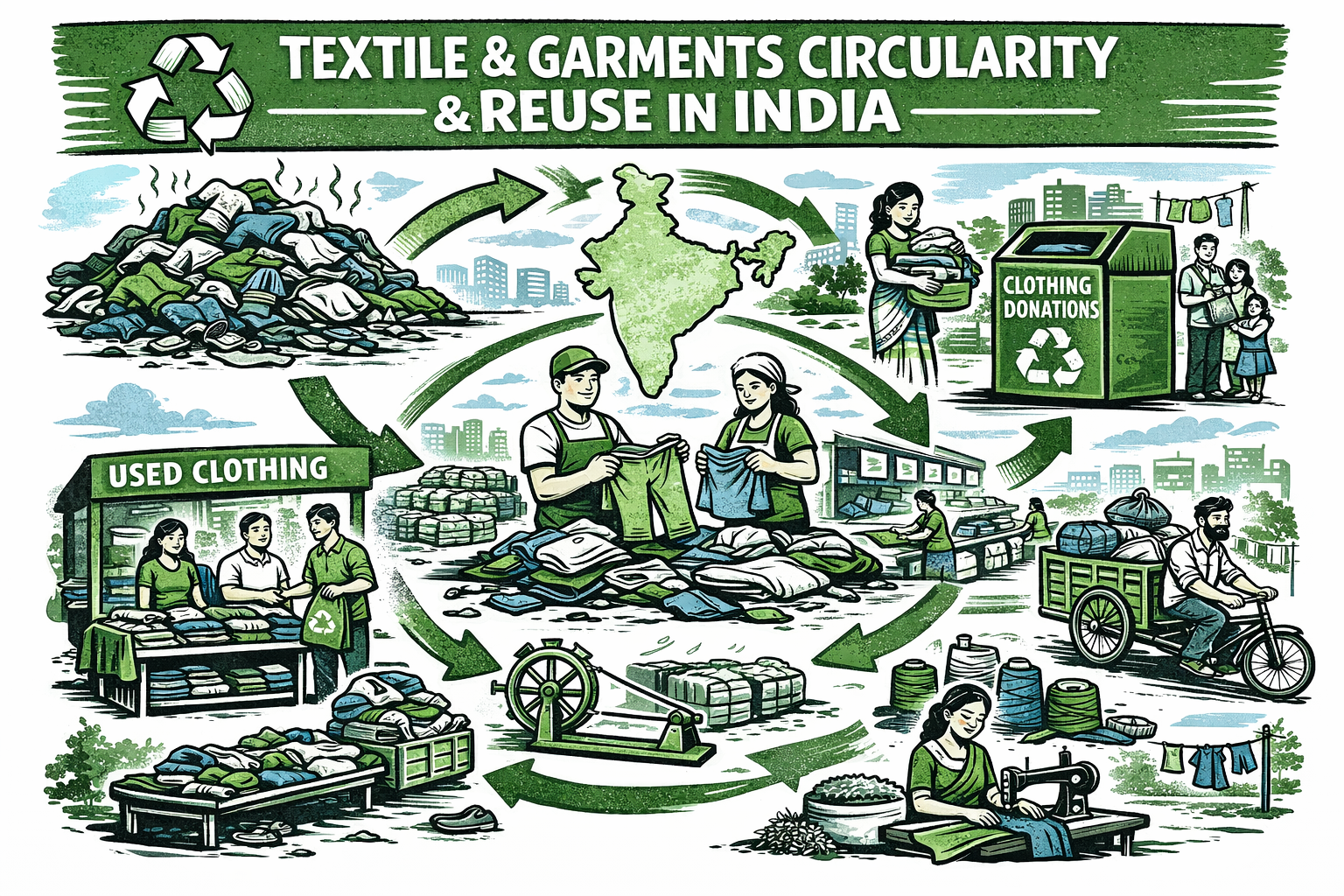
Why India needs a circular textile reuse revolution

The clothes we wear have a hidden afterlife. Even after a garment is worn a few times and forgotten at the back of a wardrobe, its environmental footprint remains in landfills, waterways, and the atmosphere. The global fashion industry today has a material and emissions footprint so large that it rivals that of entire nations. Each year, around 92 million tonnes of textile waste are generated worldwide, most of it ending up in landfills or incinerators, even though a large share of it is still wearable or recyclable. This is not just a lifestyle problem; it is a climate, water, and waste crisis rolled into one. In countries like India, Brazil, and the United States, the scale of textile waste varies, but the pattern remains the same, with fast fashion fuelling overconsumption, linear disposal systems leaking value, and communities paying the price through polluted land, stressed water systems, and rising emissions.

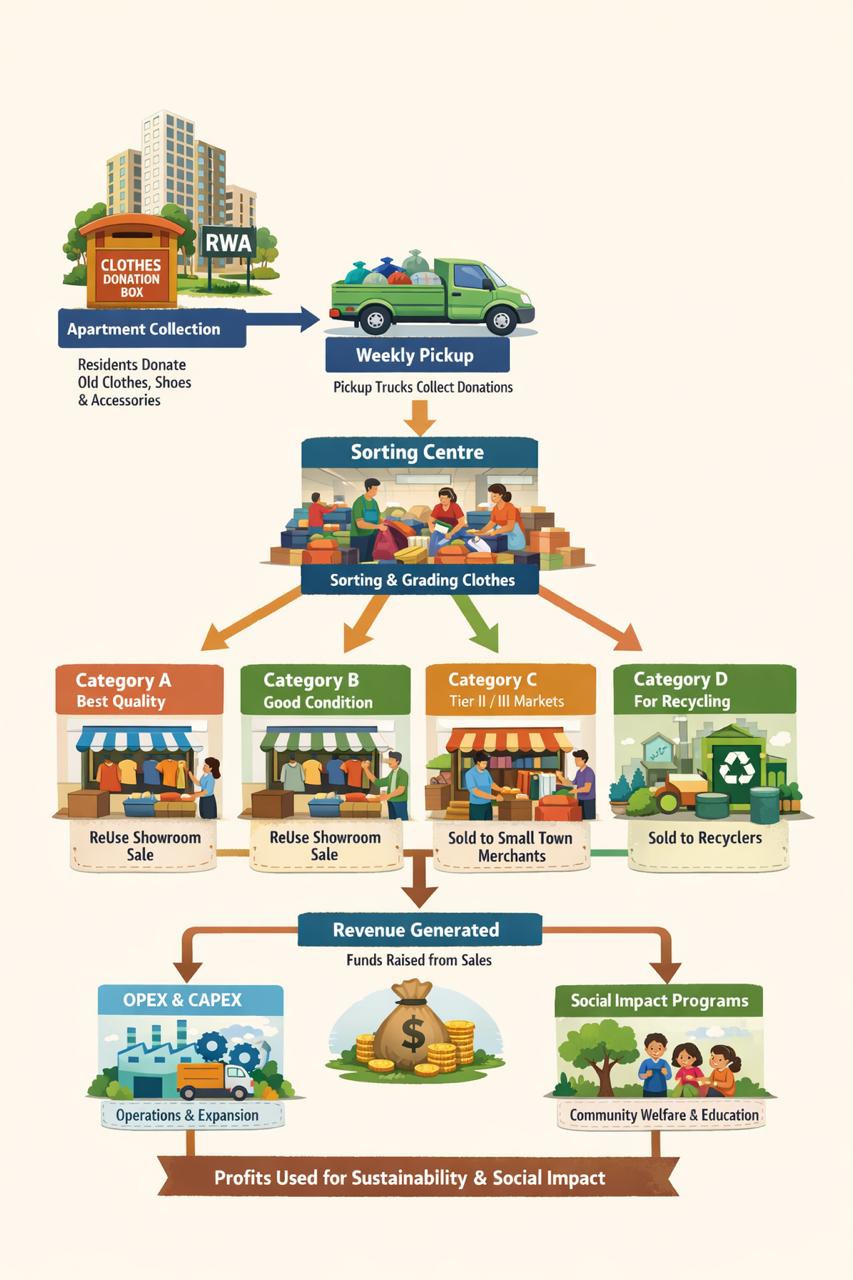
A practical alternative exists, and it is already visible in the reuse models emerging across cities and communities. The ‘collection-sorting-reuse-recycling model’, where clothes donated by households are graded and channelled into resale, regional redistribution, or material recycling, offers a rare triple win. It can save energy and water by avoiding virgin production, reduce landfill pressure and carbon emissions, and create dignified livelihoods across the value chain. In a world searching for climate solutions that also create jobs, textile reuse is a low-hanging fruit hiding in plain sight.
The environmental logic of reuse is powerful. Producing new clothing is energy and water-intensive, especially when fibres are grown, dyed, finished, shipped, and marketed across continents. Cotton alone accounts for massive freshwater use, while polyester is derived from fossil fuels and contributes to microplastic pollution. The fashion sector contributes an estimated 2–8% of global greenhouse gas emissions, making it one of the most carbon-intensive consumer industries.[i] When a garment is reused even once, a large portion of that embedded energy, water, and carbon footprint is avoided. Lifecycle assessments consistently show that resale and reuse pathways can cut emissions per garment by more than half compared to producing a new equivalent, while also sparing thousands of litres of water per kilogram of clothing.[ii] In practical terms, every shirt reused is a shirt not produced, and every kilogram diverted from landfill is methane not emitted during decomposition.

India’s case illustrates both the urgency of the problem and the promise of the solution. The country generates around eight million tonnes of textile waste every year, which is 8.5% of global post-consumer textile discards. India’s textile and apparel sector generates close to four million tonnes of post-consumer textile waste annually, making it one of the country’s largest contributors to landfill, water consumption, and greenhouse gas emissions. While an estimated 57% of used textiles are reused or recycled, these processes take place almost entirely through informal, fragmented, and unregulated channels. The remaining 43% ends up in landfills or is incinerated, reflecting an unsustainable linear ‘buy-use-discard’ consumption pattern that continues to accelerate with the growth of fast fashion[iii].

While India has long traditions of repair and hand-me-downs, rapid urbanisation and fast fashion consumption are overwhelming these cultural buffers. The result is a growing stream of clothing waste in municipal dumps, often mixed with organic waste, making recycling harder and environmental harm more acute. Yet India also hosts some of the world’s most innovative reuse ecosystems. Organisations such as Humana People to People India is demonstrating how urban surplus clothing can be collected and sold through retail channels, and income used for funding social development outcomes[iv], and Goonj collection channelled to rural communities in dignified ways, linking redistribution to community development and livelihoods.[v] Informal networks of sorters, repairers, and traders already keep a significant portion of textiles in circulation, proving that reuse is culturally and economically viable when supported by the right infrastructure. 

Brazil presents a parallel story shaped by urban consumerism and rising awareness. The country generates millions of tonnes of textile waste annually, with a large fraction still going to landfills due to limited formal recycling and reuse systems.[vi] Yet a growing thrift and resale movement, especially among younger Brazilians, is reframing second-hand fashion as both affordable and aspirational.[vii] Community cooperatives and small recyclers are beginning to integrate textile waste into circular micro-economies, creating jobs in sorting, resale, and upcycling. The lesson from Brazil is that cultural acceptance of reuse can shift quickly when affordability, sustainability narratives, and local entrepreneurship align.

The United States, often seen as the epicentre of fast fashion consumption, offers a different scale of lessons. Tens of millions of tonnes of textiles are discarded each year, but the country also has one of the world’s most established second-hand markets, supported by charities, social enterprises, and commercial resale platforms. Organisations collecting used clothing divert billions of pounds from landfills annually, channelling them into domestic resale, international reuse markets, and recycling streams.[viii] Even in a high-consumption society, reuse systems demonstrate that scale is possible when logistics, sorting infrastructure, and consumer awareness are aligned. The American experience shows that reuse is not marginal, but can be commercially viable, and environmentally meaningful at the national scale.

There could be lessons learnt from Brazil and the USA, and good practices replicated in India. Beyond environmental benefits, reuse models unlock employment that matters deeply for India. Every stage of the circular value chain creates work, from collection crews and logistics managers, sorting centre workers trained in grading and repair, retail staff in reuse shops, resellers in Tier II and III towns, and recycling technicians handling end-of-life textiles. Unlike capital-intensive manufacturing, reuse and sorting are labour-intensive, making them ideal for employment generation in peri-urban and rural contexts. India’s textile and apparel ecosystem already employs tens of millions of people, and circular extensions of this value chain can add new layers of income while formalising parts of the informal economy.[ix] For women and youth, especially in low-income communities, reuse enterprises can offer accessible entry points into entrepreneurship and wage work, from operating neighbourhood collection hubs to running small resale outlets.

Such models fit well within India’s national climate adaptation priorities. The National Action Plan on Climate Change[x]emphasises sustainable consumption, waste reduction, and resource efficiency as pillars of climate resilience. Textile reuse contributes to mitigation by cutting emissions embedded in production and avoiding landfill methane, while also supporting adaptation by reducing pressure on water systems and urban waste infrastructure. In water-stressed cities, every litre saved through avoided textile production matters. In flood-prone regions, reducing landfill volume lowers the risk of waste-choked drainage and secondary pollution. Circular textile systems thus become part of urban resilience, not just waste management.

The social enterprise model further adds public value, where profits from resale and recycling can cover operating costs and fund social programs. By reinvesting surpluses into community education, skills training, or local environmental projects, reuse systems can close the loop between consumption and social impact. This can become an excellent example of regenerative economics, where waste becomes a revenue stream that sustains both the enterprise and the communities it serves. When scaled across cities through partnerships with RWAs, municipalities, and CSR programmes, such models can become a distributed infrastructure for circularity, embedded in everyday life rather than confined to pilot projects.

While reuse alone cannot solve fashion’s environmental crisis, overproduction must be addressed, and durable design, extended producer responsibility, and recycling innovation are all necessary. But reuse is the fastest, cheapest, and most socially inclusive solution available today. It requires no new technology breakthroughs, only better organisation of what already exists and conscious consumerism. 

Embracing circular textile reuse at scale in India is not just an environmental choice, but an essential development strategy. It aligns climate action with employment, urban resilience with rural markets, and consumer behaviour with community benefit. Brazil’s cultural shift towards thrift and the USA’s large-scale reuse infrastructure show that such transitions are possible across income levels and cultures. The question is no longer whether reuse works, but whether policy, capital, and civic will can come together to make it the norm rather than the exception. If India gets this right, it will not only reduce its textile footprint but also demonstrate how climate action can be woven into the fabric of everyday economic life.

References 


[i] https://news.un.org/en/story/2025/03/1161636#:~:text=The%20fashion%20industry%20is%20one,of%20global%20greenhouse%20gas%20emissions

[ii] Number Analytics. “The Impact of Recycled Textiles on the Environment.” Lifecycle assessment review, 2024.

[iii] https://reports.fashionforgood.com/report/sorting-for-circularity-india-wealth-in-waste/chapterdetail?reportid=813&chapter=3

[iv] Humana People to People India. “Reuse and Circularity in Textiles”, 2026

[v] Goonj (India). Organisational model and impact summaries, publicly available reports.

[vi] Upcycle4Better. “Textile Recycling in Brazil.” Country brief, 2023.

[vii] Greenbook. “The Thrifting Revolution in Brazil.” Market insight report, 2024.

[viii] Planet Aid

[ix] CSTEP. “India’s Textile and Apparel Sector: Ecosystem and Readiness for EPR.” Policy report, 2024.

[x] National Action Plan on Climate Change (NAPCC), Govt. of India

Why Philanthropy Needs to Evolve

Philanthropy has been a force for good across continents, building hospitals, funding schools and universities, feeding communities in crises, taking action to solve social challenges, and underwriting research. While intending to create positive and lasting change in people’s lives and strengthening communities, often, take the form of that giving is the classic ‘donor → beneficiary’ pipeline, which has serious limits. When well-meaning philanthropic entities simply transfer money or material goods to presumed beneficiaries without sharing power, listening deeply, or tracking outcomes with humility, aid can be inefficient, short-lived, and even harmful. To move from transactional charity to transformative social change, philanthropy must evolve toward participatory, locally led, and evidence-based models that empower communities to define problems, choose solutions, and steward resources. Several philanthropic models need to evolve into a new, pluralistic philanthropy that can deliver better, fairer, and more sustainable impact.

The donor-beneficiary model often centres on donors’ priorities. Funders set agendas, design programs, select implementing partners, and measure success by indicators they choose, often from a distance. This creates several structural problems, like,

  • Power asymmetry occurs when donors decide what counts as a problem and which solutions are legitimate. Communities become recipients rather than partners, and local knowledge is sidelined, reducing relevance and local ownership.
  • Templates developed for ease of scale often ignore social-cultural and political nuances at the local level. Programs that look good in donor reports may fail on the ground due to ‘One-size-fits-all interventions.’
  • Short funding horizons and volatility of donors with grants tied to campaign cycles, leftover funds, or financial year budgets can stop abruptly, leaving services unsustainable and organisations stranded.
  • When philanthropy substitutes for systemic public investment, it can relieve governments of responsibility or create dependency among groups who lack the voice to advocate for longer-term change.
  • Donors are accountable to boards or taxpayers, with limited accountability to the communities they aim to serve; evaluation is often internal and narrowly framed.

These limitations are not theoretical as reviews of philanthropic practice repeatedly find that participation is often performative, i.e., consultation exercises without power transfer. Scholarly and practitioner literature has called out the gap between rhetoric and sustainable commitment to community-led approaches. This is the moment for a pivot to an evolved philanthropic approach that can complement the traditional giving through,

  1. Participatory and community-led decision-making: Communities should help set priorities and co-design programs. Participatory grant-making moves power to those closest to problems, bringing lived experience into funding decisions and increasing the legitimacy and likely effectiveness of interventions.
  • Local leadership and capacity building: Funding should invest in local institutions (community groups, cooperatives, NGOs, social enterprises), and not only project outputs. That means unrestricted core support, leadership development, and multi-year commitments that enable organisations to mature and adapt.
  • Data-driven learning and accountability: Rigorous use of data and learning systems can help tailor solutions, track impact, and course correct. Data must be used ethically, with local ownership and attention to privacy and power dynamics.

When combined, this approach will shift philanthropy from a mere supplier of goods to an enabler of agency. Some good practices from around the world show how participatory and locally led philanthropy can function in practice, and who can act as torchbearers for philanthropic communities in their regions.

Indian philanthropic institutions combine traditional grant-making with newer models. Tata Trusts has invested heavily in the Data-Driven Governance (DELTA: Data, Evaluation, Learning, Technology, and Analysis) framework for strengthening local governance and planning. Their approach works with government entities and communities to build data systems that inform local decision-making rather than impose external solutions. This demonstrates how philanthropy can facilitate evidence-based public systems while engaging local institutions rather than bypassing them.  

Azim Premji University and Foundation have made community engagement in educational work prominent, emphasising long-term partnerships with local schools and communities rather than one-off interventions. Their community engagement model underscores the importance of listening, iterative learning, and strengthening public institutions rather than substituting for them.  

In Southeast Asia, funder collaboratives demonstrate a shift from isolated donors to pooled funds that support locally relevant priorities. The Asia Community Foundation’s 30×30 Southeast Asia Ocean Fund, launched in January 2025, is a recent example. The fund pools resources to protect coastal and marine ecosystems with an emphasis on inclusion and equity, supporting local stewards and communities rather than exporting conservation blueprints. Collaborative funds like this allow donors to align with regional expertise, reduce duplication, and focus on communities affected by interventions.  

The USA has been an incubator for participatory grant-making experiments. Major foundations and movements, spurred by crises such as the COVID-19 pandemic and racial-justice mobilisations, have explored models that transfer decision-making authority to communities. For instance, mainstream philanthropic institutions like Ford Foundation have published reflections on why participatory grant-making mattered during crises and how it can be institutionalised, noting its capacity to surface local priorities and accelerate equitable responses. While the U.S. landscape is mixed (with many foundations still operating traditionally), the growing body of practice shows that community-led funding can be both rapid and rights-respecting when donors cede control.  

The literature and practice of participatory and community-led philanthropy are growing across Africa, rooted in traditional values of solidarity, mutuality, and shared support. Researchers and practitioners have documented participatory grant-making and community governance innovations, arguing that ceding decision rights to local actors helps align funding with local priorities and sustains outcomes. While capacity and infrastructure challenges exist, the momentum toward locally governed funding systems is notable in contexts where external donors historically dominated the agenda. Recent examples of participatory grant-making (such as Harambee in Kenya, Ujamaa in Tanzania, and Ubuntu across the continent) synthesise these trends and highlight both promise and challenges.  

Participation, local leadership, and data are crucial for effective philanthropy because they shift power dynamics, increase relevance and impact, and improve decision-making based on evidence rather than assumption. This approach moves away from traditional, top-down models toward more equitable, efficient, and sustainable processes. Participatory philanthropy and grant-making processes will lead to,

  • Greater relevance when communities help design interventions, uptake and adaptation increase. Local actors understand cultural norms, political constraints, and practical hurdles that external project designers often miss.
  • Sustainability of programs that are owned by communities beyond the grant cycle. Unrestricted support and capacity building enable organisations to respond flexibly to emerging needs.
  • Data systems that include local stakeholders enable rapid feedback loops, like what’s not working can be quickly spotted and fixed, and successes can be scaled responsibly, improving impact through iterative learning.
  • Participatory philanthropy is not neutral, as it intentionally rebalances power by giving those affected by problems a say in solutions.
  • Cost-effectiveness through local knowledge increases returns on investment.

To evolve to the new and effective models of philanthropy, funders should take practical steps such as shifting money and power by moving a significant percentage of grant money into participatory processes and community-governed pools. They should offer multi-year, unrestricted funding and simplify application and reporting requirements. Investing in intermediary infrastructure is crucial, so supporting local philanthropy platforms, community foundations, and capacity builders, incubators, and accelerators who can channel funds and help communities administer grants is essential. Building data partnerships with communities by funding local data systems, such as community scorecards, participatory monitoring, and open data platforms that are owned and governed by communities, while ensuring ethical data practices, is also important. Co-designing evaluation frameworks with community actors to develop success metrics that prioritise outcomes valued by the community, such as economic stability, dignity, and local governance, rather than just donor KPIs, is very much required. Additionally, funders should reward adaptive learning by creating grant mechanisms that allow for iteration of ‘pilot-learn-adapt-scale’ rather than penalising change as ‘failure.’ Lastly, funders should role model humility and plan for their responsible exit by strengthening local institutions so they can sustain without perpetual external support.

However, it’s important to understand that not every ‘participatory’ label signals a real transfer of power. Donors must avoid superficial practices, like convening consultations for optics, creating advisory committees without decision rights, or funding only projects that align with preselected agendas. Genuine participation requires structural changes like in the boards, budgets, and governance processes, that reflect shared authority.

Philanthropy has great potential to speed up solutions to poverty, climate change, governance problems, and social inequality. To shift from charity to meaningful change, funders need to be willing to relax control, invest in local leaders, and support strong, community-led data and learning systems. Examples from India, Southeast Asia, the U.S., and Africa demonstrate various approaches such as data partnerships that improve governance, pooled funds that empower local stewards, and participatory grant making that changes who makes decisions. Effective, equitable, and sustainable change emerges when those affected by problems help define and lead the response. Philanthropy’s evolution from a one-way pipeline of resources to a platform for shared power is not just desirable, it’s necessary if we want charitable funding to do more than temporarily relieve suffering. They must catalyse systems that let communities thrive on their own terms.

Garbology: Our Dirty Love Affair with Trash

by Edward Humes | 325 Pages | Genre: Non-Fiction | Publisher: Avery | Year: 2013 | My Rating: 9/10

“The American Dream is inextricably linked to an endless, accelerating accumulation of trash.”
― Edward Humes, Garbology

I discovered this brilliant book by Pulitzer Prize-winning journalist, Edward Humes, when I was searching for books on plastic waste management after attending the screening of a thought-provoking documentary, A Plastic Ocean, by an award-winning filmmaker and journalist, Craig Leeson.

While the book examines how the USA became addicted to garbage, it is a story all around the world with similar environmental and socioeconomic dilemmas of the modern world. The book makes one think that while recycling the waste is the need of the hour, it is the continuous creation of waste in an endless loop that needs to be addressed. The book brings forth examples of activists and outstanding entrepreneurs who are trying to solve the menace of waste. The book also presents an economic history of garbage in the US along with surprising and even shocking statistics and concludes with a compilation of practical steps that individuals can take to reduce the environmental impacts of their generated waste. However, much more is required than just individual practices to overcome plasticisation. Planet and People need to take precedence over profits and combined efforts by communities and businesses alike along with political will are required to win the war on waste. 

I loved the chapter, ‘Down to the sea in chips’ on marine plastics pollution, and their impacts, which is a global environmental concern, converting our once pristine oceans into plastic soup.

This book is a must-read for all, especially if you are a consumer of modern life.

Men in Black 3

mibGenre: Sci-fi| Year: 2012 | Duration: 103 mins | Director: Barry Sonnenfeld | Medium: Theater (DT Cinemas, Saket) | Trailer: HERE | My rating: 4*/5*

Favorite Dialogue: Agent K: Don’t ask questions you don’t want the answer to”

MIB3 is the sequel to the 2002 film MIB2 starring Tommy Lee Jones as Agent K, and Will Smith as Agent J. Even though its not the best of the three MIBs, its still much better than its predecessor, MIB2, though the gap of ten years between them was equivalent to getting ‘neuralyzed’ had it not been for numerous movie channels on the telly showing repeats of the movies in last ten years. The movie revolves around the escape of a violent alien fugitive, Boris the Animal (Jemaine Clement), who lost his arm in a tangle with Agent K back in 1969. When Boris arrives back on Earth after escaping from special prison on the moon, after 40 years, the Boglodite time travels to 1969 to kill-off K prior to their fateful standoff. When Agent J shows-up at MIB headquarters (with a temporal fracture and a craving for chocolate milk, as discovered by Agent O) and discovers that his partner actually died decades before they ever met, he follows Boris’ trail back to the 1969, a day in advance of the standoff in an effort to not only save K and implement a protective earth cover ArcNet, but prevent a full-on Boglodite invasion that the Men in Black had, in the prior version of reality, managed to thwart.

The Agents meet the alien Griffin (Michael Stuhlbarg), an Arcadian who possesses the ArcNet and is able to see multi-dimensionally in to all possible futures, gives them the ArcNet and instructs them to place it onto the Apollo 11 lunar rocket launch occurring in less than six hours. Boris then snatches Griffin, but the agents, on monocycles (another cool feature of the movie), give chase and recover Griffin. In the end, J & K (Young agent K is played by Josh Brolin) manages to kill both the younger and older versions of Boris, and deploys ArcNet.

This comic sci-fi with funny looking aliens is my Movie of the Day

Larry Crowne

larryGenre: Romance/Comedy| Year: 2011 | Duration: 98 mins | Director: Tom Hanks | Medium: VCD (BIG Home Video) | Trailer: HERE | My rating: 2.5*/5*

Favorite Dialogue: Mercedes: (mixing a strong frozen drink) “Mmmmm…brain freeze!”

Larry Crowne (Tom Hanks), a divorced middle-aged man and navy’s veteran cook, gets fired from his floor keeper job at a store because he lacked a college level education. Upon encouragement from his neighbor, Lamar, he enrolls at a local community college to pursue better opportunities in future, studying economics and communication. Larry befriends a bunch of young, scooter-riding young people, and strikes a special friendship with a free spirited girl Talia.  The saving grace of the movie is the subtle romance between Larry and ever-radiant Julia Roberts as Mercedes Tainot, the public-speaking professor with an alcohol addiction and a disintegrating marriage.

This tepid rom-com, which is neither full of romance nor comic is my Movie of the Day.