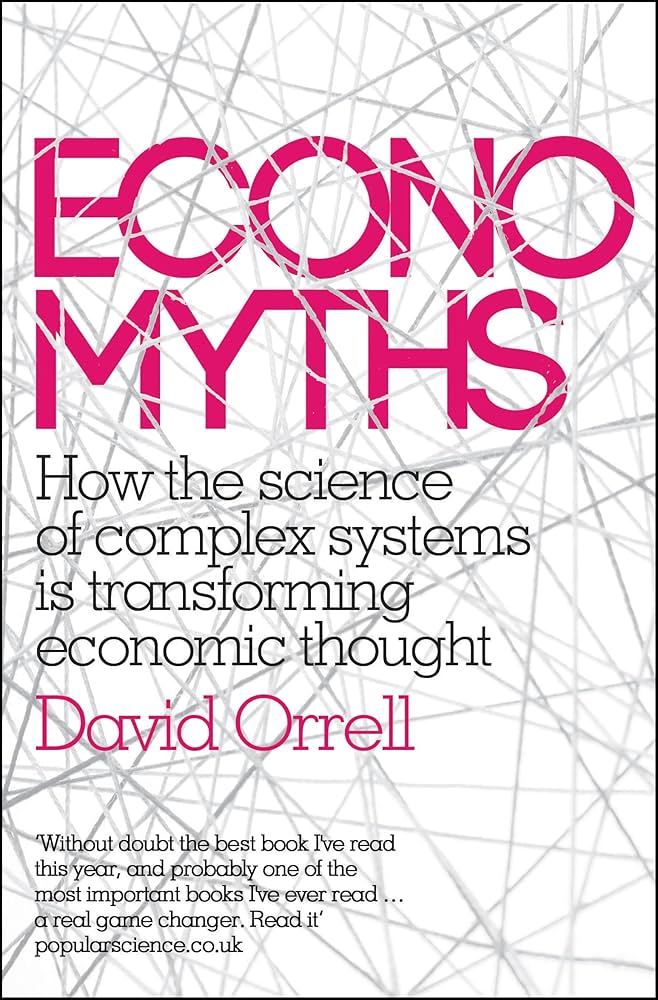
Economyths

Author: David Orrell | 320 Pages | Genre: Non-Fiction | Publisher: Icon Books | Year: 2012 | My Rating: 8/10

Every profession and subject has its myths, like medicine once believed illness was caused by imbalances of bodily humours! Astronomy once believed that Earth sat at the centre of the universe. Economics, despite its mathematical sophistication and Nobel Prizes, is no exception. David Orrell’s Economyths examine some of the stories modern economics tells us and ask whether they still deserve our trust.

What makes this book particularly engaging is that Orrell, a Canadian mathematician, is not writing as an economist defending one school of thought against another. Orrell approaches economics with the curiosity of an outsider and the scepticism of a scientist. He argues that many of the assumptions that underpin mainstream economic thinking are treated as objective truths when they are, in fact, useful stories, simplifications, and sometimes outright myths.

The book systematically dismantles ten such myths. Markets are not always efficient, people are not perfectly rational, money is not neutral, growth is not synonymous with wellbeing, and risk is not always measurable. These ideas may sound obvious after the financial crisis of 2008-09, market bubbles, and widening inequalities of recent decades, but Orrell demonstrates how they are deeply embedded in economic models, policy discussions, and public discussions.

One of the most refreshing aspects of the book is its insistence that economics is not a physics problem. Human societies are messy, emotional, political, and adaptive. Unlike atoms, people change their behaviour when circumstances change. They are influenced by culture, fear, aspiration, power, and relationships. Any attempt to reduce economic life to neat equations inevitably leaves something important out.

As someone working in the social development sector, I found myself reflecting on how often development conversations are shaped by economic assumptions that go unquestioned. We celebrate GDP growth while overlooking ecological degradation. We measure income while ignoring dignity, and optimise for efficiency while neglecting resilience. The book reminded me that the indicators we choose are never neutral, as they shape what we value and what we overlook.

The book encourages intellectual humility and reminds us that economic models are maps, not territories. Useful maps matter, but problems arise when we mistake them for reality itself. Reading Economyths also felt surprisingly relevant beyond economics. In many ways, the book is about the dangers of oversimplification. Whether in public policy, business strategy, or personal life, we often gravitate towards elegant frameworks because complexity is uncomfortable. Reality rarely conforms to tidy narratives, as the world is interconnected, dynamic, and often unpredictable.

The book questions whether economics is ultimately about how societies organise resources to support human development, and then what exactly are we optimising for? Wealth? Growth? Efficiency? Security? Sustainability? Happiness? The answer matters because different goals produce different systems and different outcomes.

More than a critique of economic theory, Economyths is a reminder that every model reflects a set of values. The challenge is not to abandon economics but to recognise its limits, question its assumptions, and remain open to perspectives that better capture the complexity of human life. I finished the book with greater scepticism toward economic certainties but also with greater appreciation for the importance of asking better questions. In a world increasingly driven by metrics, forecasts, and optimisation, that may be one of the most valuable lessons of all. Economyths is a thoughtful and provocative read for anyone interested in economics, public policy, development, business, or simply understanding the assumptions that quietly shape modern society.

The Man Who Knew Infinity

200px-Ramanujan_biography_coverThe Man Who Knew Infinity: A Life of the Genius Ramanujan

by Robert Kanigel | 438 Pages | Genre: Mathematics/Biography | Publisher: Penguin Books| Year: 2000 | My Rating: 10/10

“Dear Sir,

I beg to introduce myself to you as a clerk in the Accounts Department of the Port Trust Office at madras on a salary of only 20 GBP per annum. I am now about 23 years of age. I have had no University education but I have undergone the ordinary school course. After leaving school I have been employing the spare time at my disposal to work at Mathematics. I have not trodden through the conventional regular course which is followed in a University course, but I am striking out a new path for myself. I have made a special investigation of divergent series in general and the results I get are termed by the local mathematicians as ‘startling’. I would request you …………….. Being inexperienced I would very highly value any advice you give me. Requesting to be excused for the trouble I give you.

I remain, 

Dear Sir,

Yours truly,

S. Ramanujan”

– Excerpts from a letter dated “Madras, 16th January 1913” to Cambridge Mathematician, G.H. hardy.

This brilliantly researched and well written book by Kanigel is a biography of an incredibly genius and among the greatest Mathematician of all times in the same league of Jacobi or Euler, Srinivasa Ramanujan Iyengar, commonly known as ‘Ramanujan’. Ramanujan independently compiled nearly 3900 results (mostly equations and identities).  Most of his claims have now been proven correct even after 90 years of his death inspiring a wide range of new research, which is still continuing.

In 1913, while working as a clerk at Madras Port Trust, Ramanujan wrote a letter to the premier English Mathematician of his time, G. H. Hardy, and thus began one of the most productive and unusual scientific collaborations in history, that of an English don and an impoverished and unparalleled genius from India. Hardy arranged a fellowship for Ramanujan to sail for England and come to Cambridge University, leaving behind his wife and family in Madras. Ramanujan’s isolation from his family and the intensity of his work eventually took their toll, and within seven years of leaving India he was dead due to tuberculosis at a young age of 32. Ramanujan was creative and an original thinker, more so than perhaps any other mathematician in history. Hardy had said for his formulas, “They must be true because, if they were not true, no one would have the imagination to invent them.”

This biography with all the drama, the richness with an insatiable love for numbers, and the cultural sweep of a fine historical novel is my Read of the Week.

21

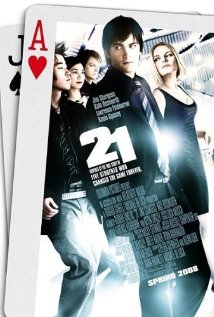
21Genre: Thriller| Year: 2008 | Duration: 123 mins | Director: Robert Luketic | Medium: VCD (BIG Home Video) | Trailer: HERE | My rating: 4*/5*

Fav Dialogue: Ben: “Winner, winner, chicken dinner!”

21 is inspired by the true story of MIT Blackjack Team. The story is of Ben (Jim Sturgess) who’s a senior math major at MIT and is accepted at Harvard Med School and trying to ‘dazzle’ the director in order to win the coveted Robinson scholarship. After dazzling MIT prof Micky Rosa (Kevin Spacey) with his out of the box solution of Monty Hall problem and non-linear math paper, Ben is invited by Rosa to join the balckjack team consisting four other students, where he learns card counting and start making it big at the las vegas casino circuit. He and his team is monitored by security chief Cole Williams (Lawrence Fishburne) for malpractice, and eventually get apprehended and turn in Rosa in lieu of his freedom. The movie ends with Ben recounting the entire tale to a “dazzled” Harvard director.

I liked Ben’s birthday cake in the movie, which read: 0, 1, 1, 2, 3, 5, 8, 13,… These are the first terms in fibonacci series. This is obtained by first writing the numbers ’0,1′, then defining each subsequent number as the sum of the previous two numbers in the series. Thus, the third number in the series is 1 = 1 + 0, the fifth number is 3 = 2 + 1, etc. The next number on the cake would be 21 = 13 + 8, for Ben’s 21st birthday, which goes cleverly with the name of the film or Blackjack!

This mathy gambling  thriller is my ‘Movie of the day’.

The Art of the Infinite

books“We commonly think of ourselves as little and lost in the infinite stretches of time and space, so that it comes as a shock when the French poet Baudelaire speaks of ‘cradling our infinite on the finite seas’. Really? Is it ourself, our mind or spirit, that is infinity’s proper home? Or might the infinite be neither out there nor in here but only in language, a pretty conceit of poetry?”   – Robert Kaplan & Ellen Kaplan, The Art of the Infinite: Our Lost Language of Numbers

The Kaplans have brought out the beauty of math through an engaging mix of history, philosophy, science and lyrical prose, equations, geometric projections, exposition and explanation of a unique range of topics from Alcibiades  to Godel to Gauss.

Being a lover of numbers, this delightful book ‘The art of the infinite’ is my ‘Read of the Week’.