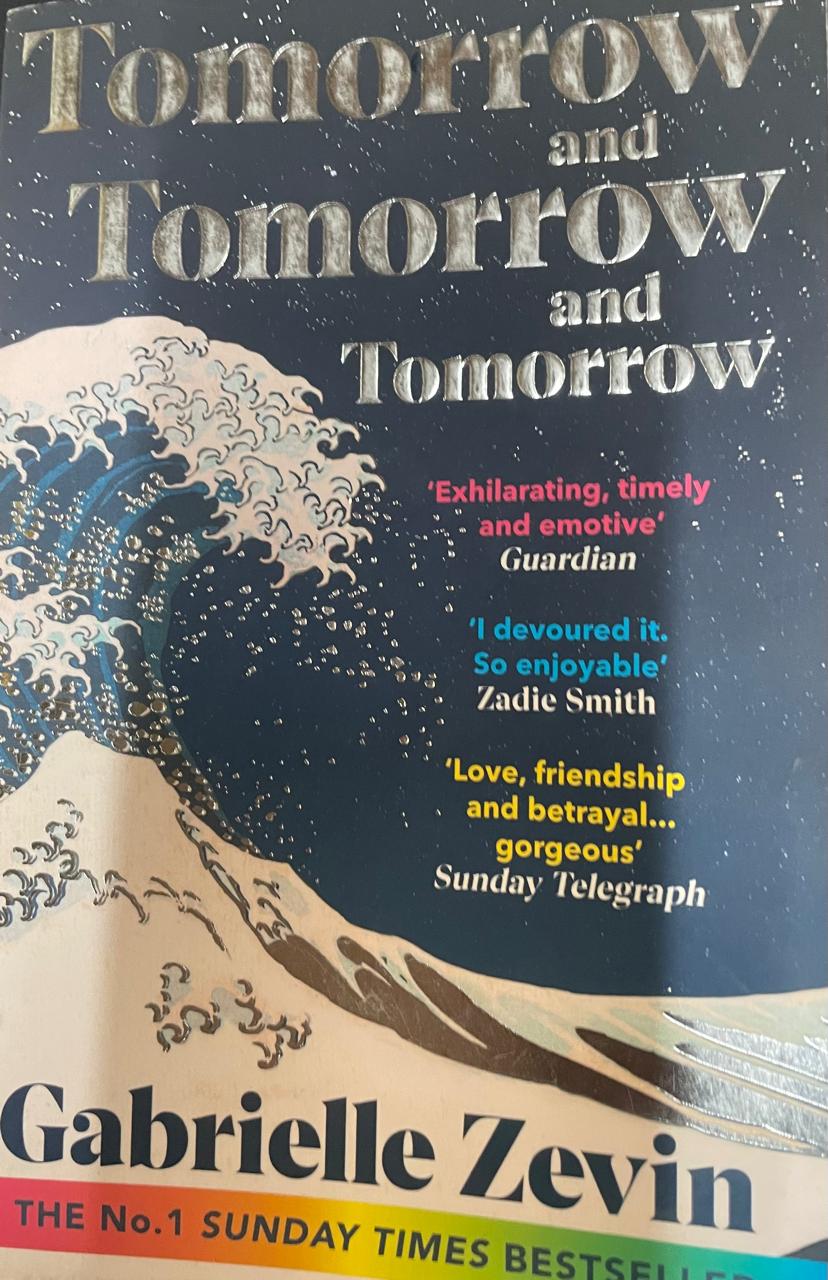
Tomorrow, and Tomorrow, and Tomorrow

Author: Gabrielle Zevin | 476 Pages | Genre: Fiction | Publisher: Knopf Publishing Group | Year: 2022 | My Rating: 9/10

Tomorrow, and tomorrow, and tomorrow,
Creeps in this petty pace from day to day,
To the last syllable of recorded time; 
And all our yesterdays have lighted fools
The way to dusty death. Out, out, brief candle!
Life’s but a walking shadow, a poor player,
That struts and frets his hour upon the stage,
And then is heard no more. It is a tale
Told by an idiot, full of sound and fury, 
Signifying nothing.

Tomorrow, and Tomorrow, and Tomorrow by Gabrielle Zevin is a novel about two friends who make video games together, but to describe it merely as a story about gaming would be as misleading as describing Moby-Dick as a novel about whale hunting. Zevin’s masterpiece is an exploration of creativity, friendship, ambition, grief, identity, and the fragile ways in which human beings love one another without always knowing how to express that love.

When I first picked up the novel, I expected an engaging literary story set against the backdrop of the video game industry. A few chapters later, I realised that the games were merely the canvas. Zevin was painting the extraordinary complexity of human relationships and the strange ways in which we create worlds, both real and imaginary, to survive the one we inhabit. Zevin understands that every act of creation, whether writing a novel, composing music, designing a game, or building a company, is an attempt to answer one of humanity’s oldest questions: how do we leave something meaningful behind? The medium, in this case video games, becomes almost incidental. The real story is about people trying to make worlds because they often struggle to inhabit the one they have been given.

The story follows two childhood friends and extraordinarily gifted individuals, Sam Masur and Sadie Green, whose lives become intertwined through collaboration, separation, misunderstanding, and extraordinary creative success. Their relationship defies easy categorisation, as they are not conventional lovers or just friends. They are collaborators, rivals, emotional anchors, and occasionally strangers to one another. Zevin refuses to reduce their bond into the familiar romantic template that dominates contemporary fiction. Instead, she asks a more difficult question, that can two people become the defining relationship in each other’s lives without ever fitting into society’s conventional definitions of love? That question becomes the emotional centre of the novel.

Reading their story reminded me that the people who influence us most are not always those we fall in love with. Sometimes they are the ones who challenge us intellectually, provoke us creatively, infuriate us endlessly and yet remain impossible to erase from our lives. Some relationships cannot be explained because they are not meant to fit into conventional categories. They simply exist, shaping us in ways we understand only in retrospect.

Having spent much of my own professional life designing programmes, developing products and trying to build ideas into reality, I found these sections deeply familiar. Every creator knows the strange mixture of excitement and insecurity that accompanies making something new. You begin with certainty. Halfway through, you become convinced the entire idea is flawed. Then, somehow, persistence carries you to the finish line. Creation is less an act of inspiration than an act of endurance. That may be why the novel resonated so deeply with me. It understands that building anything worthwhile, whether a business, a social movement, a novel or even a meaningful life, is emotionally expensive. Every achievement extracts a cost that outsiders rarely notice.

Popular culture often celebrates the myth of the solitary genius—the lone inventor, the brilliant artist, the visionary entrepreneur. Tomorrow, and Tomorrow, and Tomorrow dismantles that myth. Great creations emerge not only from talent but from friction where ideas are challenged, egos bruised, compromises negotiated, and failures endured. Sam and Sadie create remarkable games because they disagree passionately. 

The novel treats video games as an art form deserving the same intellectual seriousness traditionally reserved for literature, cinema, or painting. This is perhaps the novel’s most refreshing contribution. Too often, games are dismissed as entertainment or escapism, but Zevin recognises that games are narrative architecture. They are spaces where people rehearse choices, explore identities, confront loss, and imagine alternative futures. The novel argues that games possess a unique emotional power because they require participation. Unlike readers or film audiences, players make decisions. They fail, they try again, they persist, and in that sense, games resemble life more closely than almost any other artistic medium.

Another remarkable strength of the novel is its understanding of friendship. Contemporary fiction often privileges romance as the highest form of intimacy. Friendships frequently exist only to support romantic plots. Zevin reverses that hierarchy and makes friendship the central emotional relationship, possessing every complexity usually reserved for marriage or romance. Sam and Sadie hurt one another in ways that only deeply significant people can. Their conflicts rarely emerge from malice. Instead, they arise from silence, assumptions, pride, and emotional immaturity. Zevin understands that relationships often fail not because people stop caring but because they become incapable of communicating what they most need to say.

The supporting characters deserve equal appreciation, particularly Marx Watanabe, whose warmth and emotional intelligence provide a necessary counterbalance to Sam and Sadie’s intensity. Marx embodies generosity without becoming sentimental. He possesses the rare gift of seeing people as they are rather than as they wish to appear. In many ways, he becomes the novel’s emotional conscience.

What impressed me most was the novel’s refusal to produce heroes or villains. Every major character behaves selfishly at times and generously at others. They make admirable decisions alongside regrettable ones. Zevin understands that adulthood rarely consists of moral certainty. Instead, it is an ongoing negotiation between personal ambition and responsibility toward others. Relationships remain ambiguous because real relationships often are. Love does not always seek possession. Friendship does not always remain stable. Success does not guarantee happiness. Closure, when it arrives, is partial rather than complete.

By the final page, I realised that the book’s most profound insight had very little to do with technology or gaming. It was about the people who make us more creative, more courageous and more ourselves. The greatest masterpieces we produce are rarely individual achievements. They emerge from conversations, collaborations, disagreements and relationships that leave permanent fingerprints on our lives.

Tomorrow, and Tomorrow, and Tomorrow deserves its reputation as one of the finest contemporary literary novels not because it speaks to gamers but because it speaks to anyone who has ever created something, lost someone, pursued an impossible ambition, or struggled to articulate love in all its imperfect forms. Gabrielle Zevin has written a novel that is intellectually stimulating, emotionally devastating, and quietly hopeful. Long after finishing the novel, I found myself thinking that the most important creations in our lives are often not the products we build, but the relationships that make those creations possible. Everything else is temporary. The worlds we imagine together, however, continue to echo, tomorrow, and tomorrow, and tomorrow.

Payback: Debt and the Shadow Side of Wealth

Author: Margaret Atwood | 240 Pages | Genre: Non-Fiction | Publisher: Bloomsbury Publishing PLC | Year: 2008 | My Rating: 8/10

“Without debt, there would be no such thing as credit, and without credit, economies would not exist. But equally, without debt, there would be no such thing as forgiveness.”

-Margaret Atwood, Payback

Payback: Debt and the Shadow Side of Wealth was originally presented as the Massey Lectures in 2008. It is not a book about economics in the traditional sense, as it does not include balance sheets, market trends, or policy prescriptions. Instead, it is a work of literary and moral imagination, a wide-ranging meditation on what debt means, which is not only as a financial construct but as a moral, psychological, and even mythical one. Atwood has shared an idea that governs much of modern life, the idea of owing and being owed. The book’s tone is conversational yet filled with insights, blending history, literature, religion, and personal reflection. It says that debt is an idea that is created by humanity, and that it is closely connected to our concepts of justice, sin, and morality. 

The book is structured into five chapters: Ancient Balances, Debt and Sin, The Shadow Side, Payback, and Payback: The Shadow Side. Each chapter explores debt from a different perspective—cultural, literary, economic, and ecological, slowly building toward a conclusion about the balance between taking and giving, destruction and renewal.

The book traces the origins of debt to ancient times, where it was not only a financial but also a moral and spiritual one. In many cultures, debt has been synonymous with guilt. For example, the language of ‘redemption’ and ‘forgiveness’ in Christianity has deep economic roots. This moral overlap is not accidental. Instead, it reflects a psychological need for balance, for settling accounts not only in terms of money but in life.

Ancient systems of justice were often modelled on an eye for an eye, or a life for a life. The idea of fairness was inherently transactional. Thus, debt becomes a metaphor for all human obligations, between individuals, between human beings and gods, and eventually between humanity and the planet. Therefore, economic debt, moral guilt, and ecological imbalance all stem from the same root: the failure to honour reciprocity.

Atwood moves seamlessly through the Bible, Shakespeare, Dickens, Marlowe, and even pop culture, treating each as a kind of moral ledger. Ebenezer Scrooge, the most famous debtor and creditor in fiction, becomes a recurring figure. She also references Dr. Faustus, who sells his soul to the devil as a literal debt contract. Debt stories are also about identity, who owes whom, and what kind of person it makes you to owe or to be owed. These examples highlight how debt has long served as a narrative to explore human frailty, justice, and redemption.

In the third chapter, ‘The Shadow Side,’ Atwood dives into the psychology of debt and how it can enslave, corrupt, and distort. She talks about Jung’s idea of the hidden moral darkness within every person and society. In this way, debt is like the shadow side of wealth, showing the unseen costs of accumulating riches. Atwood uses historical examples, from debtors’ prisons in Victorian England to the 2008 global financial crisis, to show how societies often ignore moral responsibility. When people or institutions borrow more than they can handle, they’re not just taking financial risks but moral ones too. The book, published just before the 2008 crash, eerily predicts the crisis that was about to happen. Modern capitalism relies on the constant creation of debt, which is both the system’s driving force and its curse. Debt is everywhere, yet we rarely stop to think about its harmful effects.

In the book’s final chapter, a contemporary ‘Scrooge Corporation’ is visited by the Spirit of Earth Day Future. This eco-fable weaves together Atwood’s arguments into a narrative of humanity’s reckoning with the natural world. The spirit unveils to Scrooge the dire consequences of his unbalanced ledger, which comprises a planet drained of resources, tainted by waste, and devoid of moral responsibility. By reinterpreting a well-known moral story through an ecological lens, the book compels the reader to understand that the language of debt is synonymous with the language of survival. When we speak of ‘owing the Earth’ or ‘repaying our debts to future generations,’ these expressions are not merely metaphorical, as they represent literal truths.

Atwood’s writing is witty, elegant, sharp and ironic. Her ability to seamlessly transition from ancient myths to modern finance is truly remarkable, and she always reminds the reader that behind every number, there’s a story. There are moments of satire, especially when she targets corporate greed or political hypocrisy, but also passages of lyrical reflection that showcase her poetic sensibility.

The book is a mix of essay, cultural history, and allegory. Its interdisciplinary approach mirrors the complexity of its subject. Debt isn’t just about economics; it shapes our moral and social worlds. However, Atwood’s digressions and literary references, while enlightening, can sometimes overwhelm readers who aren’t familiar with them. Each chapter feels like a conversation with a brilliant, slightly mischievous teacher who loves turning assumptions upside down. The book is a moral reckoning disguised as a literary essay. It’s a call to remember that every ledger, no matter how abstract, has a human cost. Atwood’s lesson through this book is that living ethically means recognizing one’s debts, not just in money, but in gratitude, care, and responsibility.

Loot

Loot1LOOT and other Stories

by Nadine Gordimer | 237 Pages | Genre: Short Stories| Publisher: bloomsbury | Year: 2004 | Rating: 9/10

Nobel Prize winner Nadine Gordimer explores tragedy and opportunity through the lives of a town’s survivors of an earthquake through the story ‘Loot’, which has the most lyrical narrative among the rest. Loot explores the greed and avarice of people when the ocean bed is bare with treasures, and people are ready to go to extremes to possess others memories. In the end the story takes on a political undertone setting the mood for the entire collection of stories.

My most favorite story in the collection is ‘The Generation Gap’, a sexual allegory of romance and responsibilities, youth and age. It has four grown-up children srambling the lives after their father end the relationship of 42 years and leaves their mother for another woman their age. What follows is an upheaval of the dynamics of their old life; familiar roles and definitions are changed, relationship lines are redrawn. I liked its almost-detached reportage quality of narration, an outsider’s view of a very personal matter, and  that the story never declines into melodrama despite its very nature.

The other stories that I truly enjoyed are ‘Karma’ and ‘Look-Alikes’. This uncomfortably beautiful and wittingly startling book is ‘My Read of the Week’.

The Art of the Infinite

books“We commonly think of ourselves as little and lost in the infinite stretches of time and space, so that it comes as a shock when the French poet Baudelaire speaks of ‘cradling our infinite on the finite seas’. Really? Is it ourself, our mind or spirit, that is infinity’s proper home? Or might the infinite be neither out there nor in here but only in language, a pretty conceit of poetry?”   – Robert Kaplan & Ellen Kaplan, The Art of the Infinite: Our Lost Language of Numbers

The Kaplans have brought out the beauty of math through an engaging mix of history, philosophy, science and lyrical prose, equations, geometric projections, exposition and explanation of a unique range of topics from Alcibiades  to Godel to Gauss.

Being a lover of numbers, this delightful book ‘The art of the infinite’ is my ‘Read of the Week’.

The Sisters Brothers

9781847083180“Come with me into the world and reclaim your independence. You stand to gain so much, and riches are the least of it.”
– Patrick deWitt, The Sisters Brothers
This books made me laugh with its adroit humor and cringe at the same time. Delightful. The story is narrated by Eli Sisters, a hired killer on the American west coast in 1851, around the time of the Gold Rush in the Sierra Nevada mountains. However Eli barely gives the American landscape a glance, and people met along the way are simple figures in his moral drama. Nor does Eli have any larger philosophical or socio-historical insights to offer for the century this story is set in. This hilariously anti-heroic and relentlessly compelling novel is my “Read of the Week”.