Are you time-poor?

Somewhere between the invention of the pressure cooker and the arrival of 5G, we Indians collectively misplaced something really important: Time. Not lost in a dramatic, cinematic way, without violins or slow motion, but more like a wallet lifted from your back pocket in a crowded Metro. One moment it was there, lazy afternoons, unplanned conversations, the comforting stretch of doing nothing, and the next moment, gone. In its place, we now have Google Calendar reminders, WhatsApp notifications, and a persistent feeling that we are always slightly late for something, even when we are sitting still. Welcome to the era of time poverty, where your bank balance may look respectable, your Zomato order history may be thriving, and your LinkedIn profile may be aggressively inspirational, but your time account is permanently overdrawn.

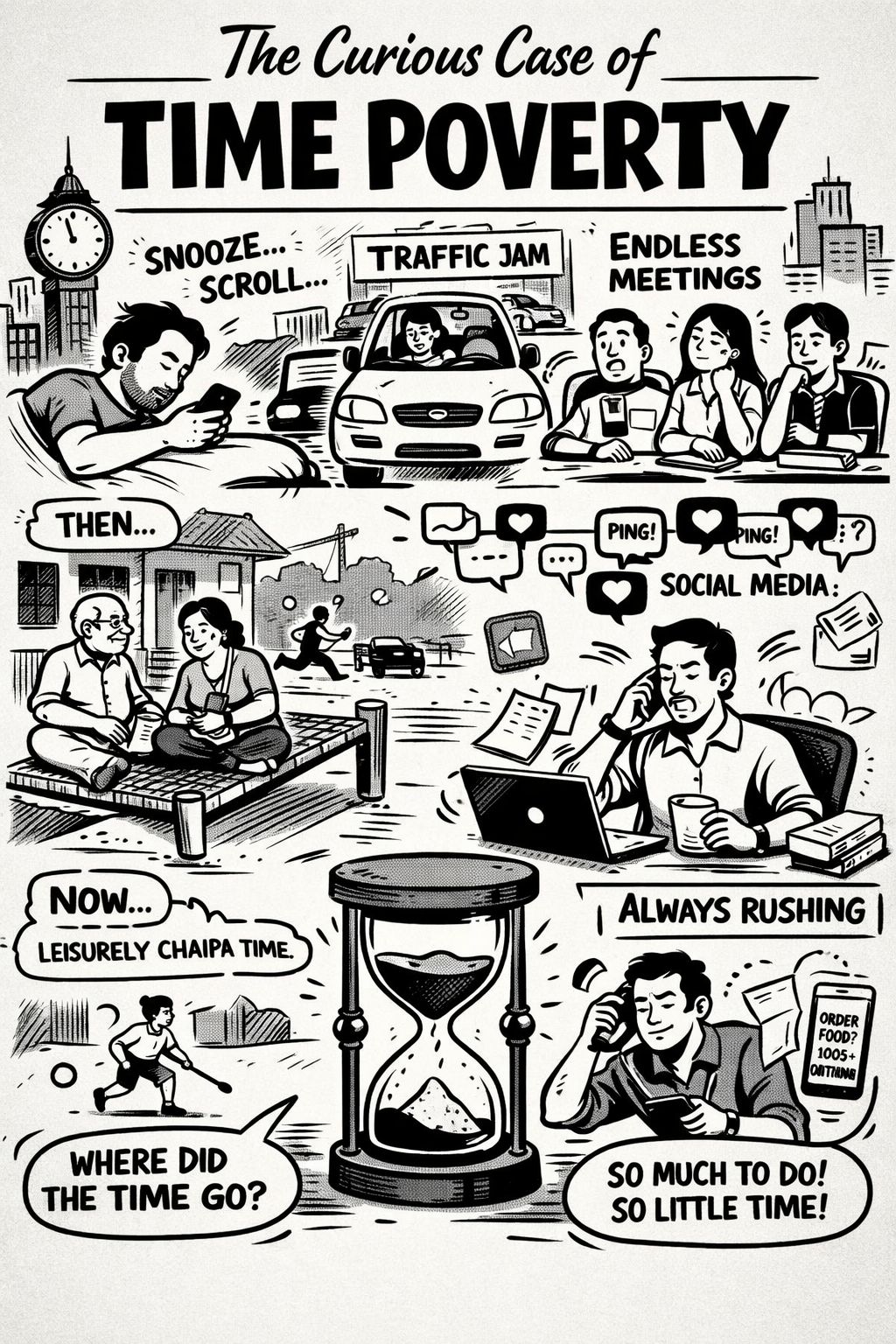
Let’s rewind a bit, not to some sepia-toned village fantasy, but just a generation ago, in the same cities we inhabit today, where life had a different rhythm. Time was not abundant in a literal sense, as people still worked hard, commuted, raised families, but it felt less fractured. Evenings were events in themselves, when people sat outside their homes discussing politics and cricket over multiple cups of tea, and that one neighbour who always seemed to have too many visitors. Children played gully cricket until the ball inevitably landed in someone’s kitchen, leading to heated negotiations that doubled as character-building exercises. Mothers called out from balconies and verandahs with a mix of authority and affection, summoning children home before darkness turned into parental anxiety. There were fewer choices, yes, but also fewer decisions to make. Dinner was whatever was cooked, and nobody spent fifteen minutes comparing paneer butter masala across twelve delivery apps while reading 237 reviews written by people who clearly have too much time.

The great unifier, television, had one channel, Doordarshan, maybe two if you were fancy. If you missed your favourite show, you missed it, as there was no replay, no binge-watching, no existential spiral at 2 AM where you question your life choices while watching the fourth episode of something you don’t even like. And waiting, ah, waiting was a legitimate activity. We waited for letters, for phone calls on the clunky telephone sets, for exam results. Waiting was not seen as wasted time; it was just part of time itself, like monsoons or power cuts. Our minds wandered, conversations happened, and occasionally, we even ‘thought’ our own thoughts without an algorithm suggesting what to think next!

Now fast forward to urban India today, where time is not just scarce but seems to be actively hunted. A typical weekday begins with negotiation between you and your alarm clock, which has now evolved into a relentless life coach with a snooze button. Before your feet even touch the ground, your thumb has already scrolled through emails, news updates, Instagram reels, and three subtle reminders that everyone else seems to be doing better than you at 7:17 am in the morning. We often eat breakfast alongside a call that begins with ‘Can you hear me?’ and ends with ‘Let’s take this offline,’ a phrase that has single-handedly consumed more human hours than traffic jams.

If time poverty had a national symbol, it would undoubtedly be the urban traffic. Whether you are inching along the Delhi-Gurgaon expressway, contemplating your life choices at Bengaluru’s Central Silk Board junction, or performing advanced geometry in Mumbai’s local trains, your commute is not just a journey, but a full emotional experience. You begin with hope, perhaps even optimism, maybe today will be different, maybe traffic will be lighter, signals more cooperative, humanity kinder. Ten minutes later, you are recalibrating your expectations, bargaining with Google Maps, and listening to podcasts or FM radio not out of curiosity but as a coping mechanism. By the time you reach your destination, you have experienced a full spectrum of human emotion and possibly learned a new cuss word, none of which you will remember by lunchtime.

And then come the meetings, those sacred rituals of modern work culture where time doesn’t exactly die, it dissolves. Meetings to prepare for meetings, meetings to debrief previous meetings, and meetings that exist solely because someone somewhere feared the silence of not having a meeting. Entire hours are spent discussing action items that could have been bullet points in an email, that could have been a message, that could have been… nothing. Ironically, in our relentless pursuit of productivity, we have created systems so elaborate that they ensure we have no time left to actually produce anything. Efficiency has become a performance, and everyone is performing.

Of course, technology was supposed to save us, and in many ways, it has. Tasks that once took hours now take minutes, information is accessible instantly, and communication is effortless. But somewhere along the way, technology stopped being a tool and started behaving like a very needy companion. Your phone, that sleek little rectangle of promise, is now a workplace, an entertainment centre, a social hub, and an anxiety generator rolled into one. You pick it up to check the time and resurface twenty-seven minutes later, having watched three reels, replied to two messages, ignored five, read half an article, and completely forgotten why you picked it up in the first place. Time isn’t just being spent; it is being nibbled away in tiny, invisible bites.

Urban India today offers an abundance of choices in the form of food, experiences, careers, and content. But abundance comes with a hidden tax in the form of decision fatigue. Earlier, dinner was simple, and now it is an exercise in research, comparison, and occasional soul-searching. Even leisure has become labour, as watching a movie involves navigating multiple platforms, genres, languages, and algorithmic suggestions, each insisting it knows you better than you know yourself. By the time you decide what to watch, you are too tired to watch anything. The freedom to choose has quietly transformed into the burden of choosing.

Friendships, once spontaneous and effortless, are now managed with the precision of project timelines. ‘Let’s catch up’ translates into checking calendars, blocking slots, rescheduling due to unforeseen commitments, and finally meeting for exactly sixty minutes before someone inevitably says, ‘I have an early morning tomorrow.’ Even weddings, those grand celebrations of chaos and joy, have been optimised for efficiency. Destination weddings over long weekends, carefully curated guest lists, and itineraries that resemble conference agendas. Nothing says romance like a well-managed Google Sheet.

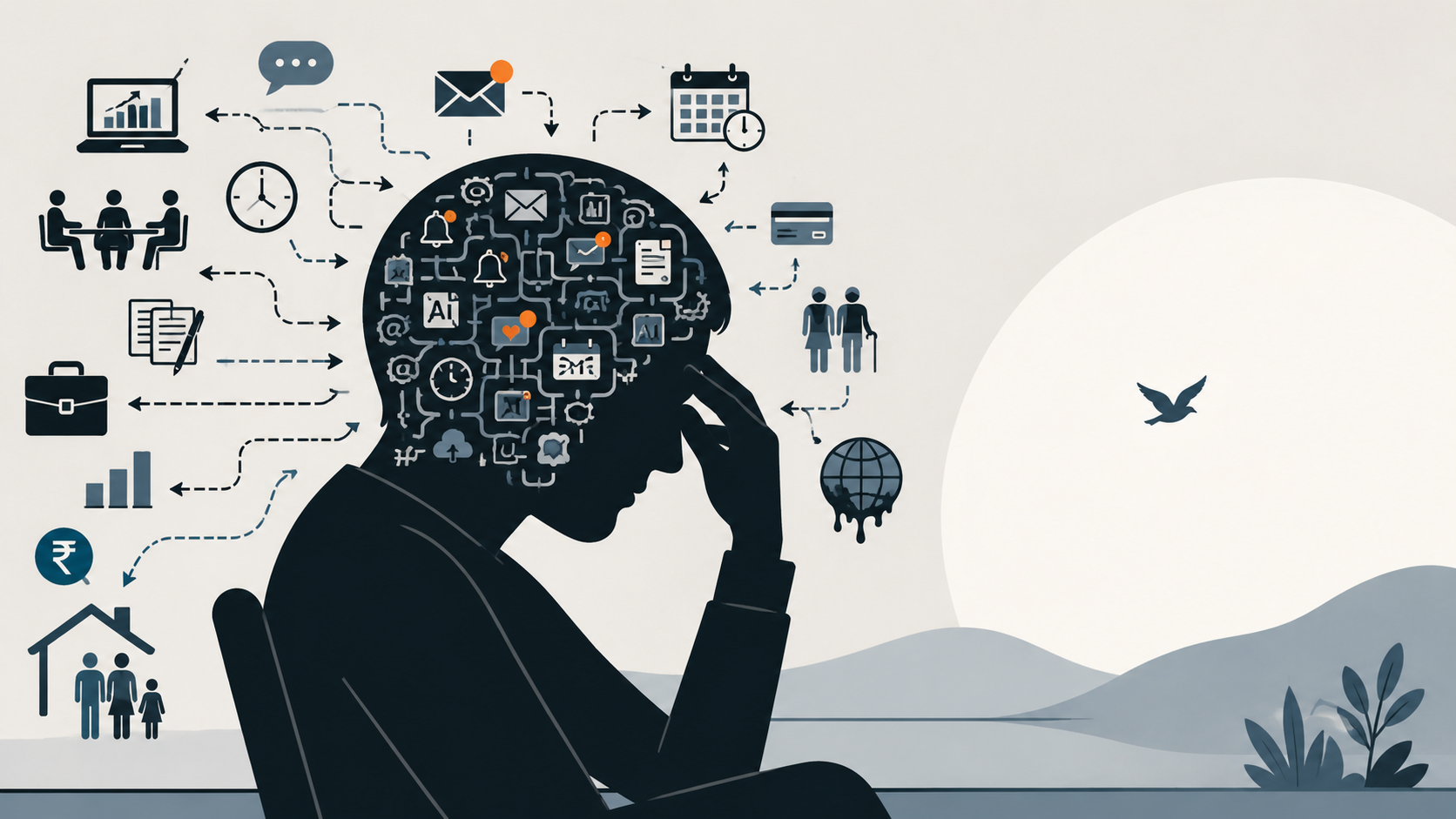
But perhaps the most insidious aspect of time poverty is lack of attention rather than the lack of hours. You may technically have free time, but your mind is rarely free. You are at dinner, but thinking about work. You are on vacation, but checking emails. You are resting but feeling guilty about it. The boundary between work and life hasn’t just blurred; it has politely excused itself and left the building. What remains is a constant hum of ‘I should be doing something,’ a background noise that turns even moments of rest into opportunities for anxiety.

In India, this phenomenon feels particularly intense because of the unique cocktail of factors at play. Rapid urbanisation has stretched infrastructure beyond its limits, turning simple commutes into endurance tests. Aspirational pressure ensures that everyone is constantly striving for better jobs, better salaries, better lifestyles. Digital adoption has been fast and enthusiastic, compressing decades of technological evolution into a few short years. And social expectations are layered on top of all this that rarely reduce, even as professional demands increase. The result is a society trying to operate at first-world speed with third-world infrastructure and fourth-world patience.

So are we truly poor in time? Or have we simply allowed time to be colonised and constantly interrupted? The uncomfortable truth is that it is a bit of both. We are busier, yes, but we are also more distracted. We have more tools, but less control. We are connected, but not always present. Time poverty, then, is not just about scarcity, but more about how we experience the time that we have. It is the difference between a long, uninterrupted conversation and a series of half-hearted replies. Between a meal savoured and a meal consumed while scrolling. Between living time and merely passing through it.

The solution, if there is one, is unlikely to be dramatic. Most of us are not about to quit our jobs and retreat to the Himalayas like some of our friends have, and even if we did, we would probably post about it online. But small shifts are possible, like protecting pockets of uninterrupted time, reducing unnecessary decisions, and occasionally allowing ourselves the radical act of doing nothing. These are not grand gestures, but they are meaningful ones. They remind us that time is not just something to be managed but something to be experienced.

We often say, ‘I don’t have time,’ when what we really mean is, ‘Something else has taken priority.’ Time poverty is not just a condition but a consequence of choices, both ours and the systems we inhabit. In a country that has mastered the art of jugaad, perhaps it is high time we apply that ingenuity to time itself. Because somewhere between the past we romanticise and the present we rush through lies a simple, almost rebellious idea that what if we stopped trying to save time and started trying to live it?

The cost of ‘free’ in India

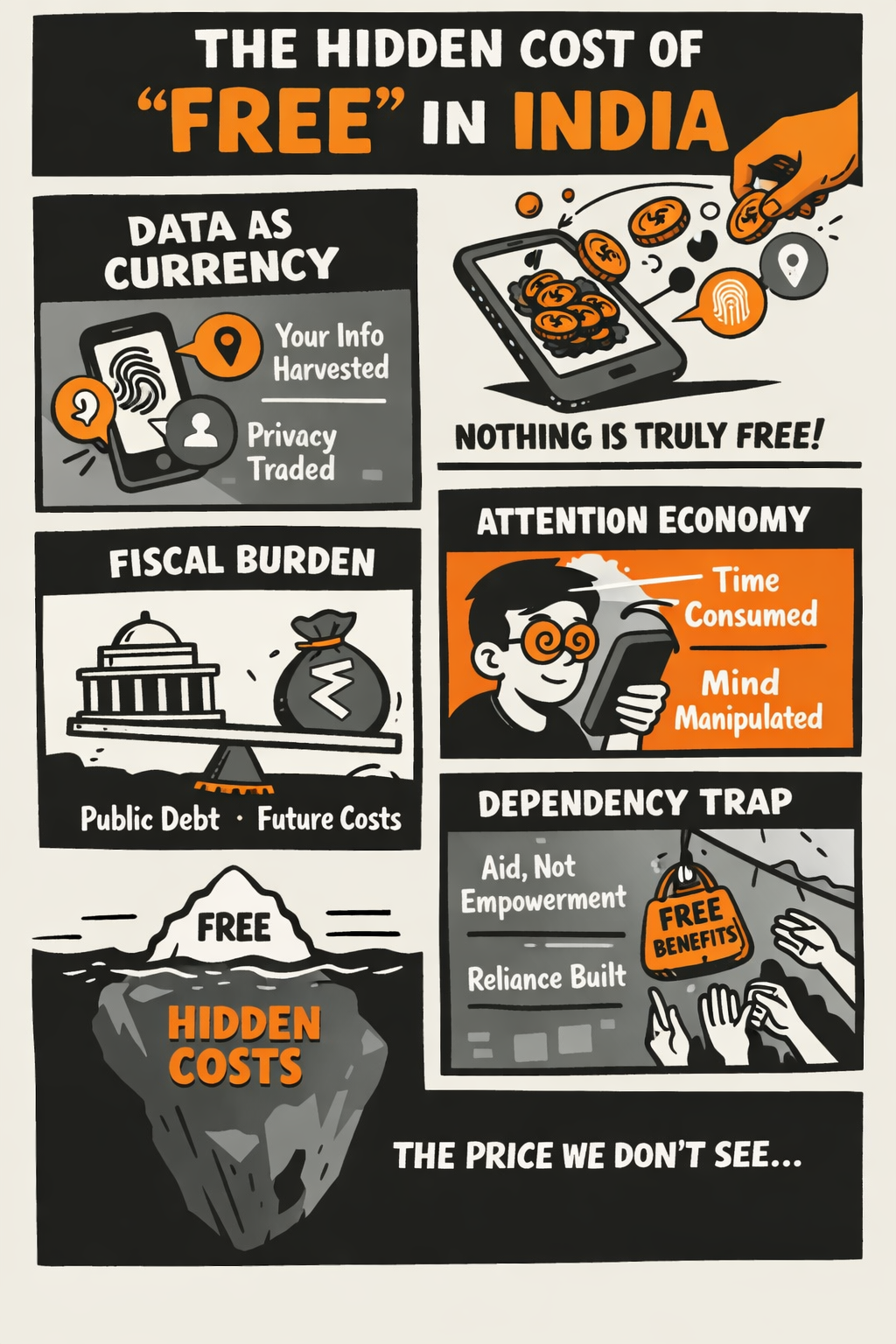
The word ‘free’ carries a unique emotional and political charge in India. It signals relief, generosity, access, and sometimes even justice. In a country marked by deep inequality and historical deprivation, the idea of receiving something without having to pay for it feels not just attractive but morally right. Free school meals, free healthcare camps, free ration, free mobile data, free apps, free advice—these are not fringe phenomena but central features of everyday life. Yet as ‘free’ becomes more pervasive, it becomes more urgent to interrogate what it actually costs in reality. Because nothing in this world is truly free. Even when money is not exchanged, value is still transferred, quietly, unevenly, and often invisibly.

The digital revolution has made ‘free’ feel natural, even inevitable. India’s smartphone explosion, driven by affordable devices and some of the world’s cheapest mobile data, has brought hundreds of millions online in a short span of time. For first-time internet users, free apps are often the internet itself. Messaging platforms, video-sharing apps, digital wallets, navigation tools, shopping platforms, and learning apps promise unlimited access at zero cost. Downloading them requires no financial transaction, only a tap on a screen. This apparent absence of cost masks a different economy altogether, one where data, attention, and behaviour are the currencies being traded.

Every free app extracts value as it collects personal information, tracks usage patterns, studies preferences, and monitors behaviour across platforms. In return for convenience and access, we surrender fragments of our digital selves, often without fully understanding the implications. In India, where digital literacy has not kept pace with digital adoption, this exchange is especially asymmetrical. We routinely accept terms and conditions that we cannot realistically read or comprehend, granting permissions that would be alarming if framed in simpler language. Location data, contact lists, browsing habits, voice samples, and even biometric identifiers become assets in a vast data economy. We do not pay in rupees, but we pay in terms of our privacy, autonomy, and long-term exposure.

This is not a small concern, as data is power, and not merely information. When aggregated at scale, it allows companies to predict behaviour, shape consumption, influence opinion, and nudge decision-making. In India, where hundreds of millions engage daily with free digital platforms, this concentration of behavioural data in private hands has far-reaching consequences. It affects what we see, what we buy, how we think, and even how we vote. The cost of free apps is not just about individual privacy but collective vulnerability to influence and manipulation. What appears to be a harmless trade in terms of free services for data becomes a structural imbalance when we lack meaningful choice or awareness.

Free apps are designed to maximise engagement because engagement drives advertising revenue. Endless scrolling, autoplay videos, push notifications, algorithmic recommendations, and gamified feedback loops are not accidental features; instead, they are engineered mechanisms to capture and hold attention. Time spent on these platforms is monetised elsewhere, converted into impressions, clicks, and behavioural insights. For us, this translates into hours lost daily to digital consumption. The opportunity cost is immense in terms of time not spent on learning, work, rest, relationships, or reflection. In a country where time poverty is already acute for large sections of the population, the extraction of attention is a high but rarely acknowledged cost of ‘free.’

Alongside free apps, free government schemes occupy a central place in India’s public imagination. Welfare programs offering free food, free electricity, free healthcare, free education, and direct cash transfers are often framed as moral imperatives in a society with widespread poverty. And indeed, many such schemes have had transformative impacts. Free school meals have improved nutrition and attendance. Subsidised healthcare has saved lives. Social security schemes have provided safety nets in times of crisis. To dismiss free schemes outright would be both inaccurate and unjust.

However, the scale and politics of ‘free’ in governance demand scrutiny. Government schemes are funded by public money, either through taxation or borrowing. When services are offered for free, the cost is distributed across society, including future generations. Fiscal resources are finite, and every rupee allocated to a subsidy is a rupee not spent elsewhere. The real question is not whether the state should provide support, but how that support is designed, targeted, and sustained. Poorly designed free schemes can strain public finances, crowd out long-term investments, and create distortions that are difficult to reverse.

One of the most persistent risks associated with free government schemes is the shift from empowerment to dependency. When benefits are delivered without clear pathways to capability-building, translating into skills, livelihoods, ownership, or agency, they can trap beneficiaries in cycles of reliance. This is not a failure of intent but of design. Welfare that does not evolve into opportunity risks becoming permanent relief rather than temporary support. Over time, political incentives can encourage the expansion of free entitlements without corresponding investments in productivity, institutional capacity, or economic growth. The cost, then, is borne in slower development, rising debt, and reduced fiscal flexibility.

There is also a less visible social cost when citizens begin to relate to the state primarily as a provider of free goods rather than as a facilitator of opportunity, and expectations shift. Accountability becomes transactional, and long-term policy thinking gives way to short-term appeasement. This dynamic can erode democratic deliberation, reducing complex governance challenges to simplistic promises of free distribution. In such an environment, the language of rights is often mixed with the politics of giveaways, weakening the deeper idea of citizenship rooted in participation, contribution, and shared responsibility.

In India, ‘free’ advice is abundant and rarely priced. Friends, relatives, colleagues, social media influencers, and anonymous online forums dispense guidance on everything from investments and careers to health, parenting, and mental well-being. At one level, this reflects strong social bonds and collective problem-solving. Knowledge-sharing has always been part of Indian society. But in the contemporary context, the proliferation of free advice, especially online, has begun to undermine the value of expertise itself. Professional knowledge is produced through years of education, training, practice, and ethical accountability. When expert advice is expected to be free, its perceived value diminishes. Professionals are pressured to give away labour without compensation, while advice-seekers are encouraged to treat complex problems as easily solvable through quick opinions. The result is often superficial guidance applied to situations that demand nuance. In fields like finance, law, and health, the consequences can be serious, resulting in misdiagnoses, financial losses, legal complications, and long-term harm.

Digital platforms have amplified this problem dramatically. Social media rewards confidence, not competence. Algorithms favour content that is engaging, simplified, and emotionally charged. As a result, the loudest voices often drown out the most qualified ones. Free advice becomes entertainment, stripped of context and accountability. Influencers monetise indirectly through advertising, brand deals, or lead generation, while audiences consume advice under the illusion that it is altruistic. The hidden cost here is the ability to distinguish reliable knowledge from persuasive noise.

Behavioural economics shows that people disproportionately favour free options, even when they are inferior to low-cost alternatives. The absence of price triggers a sense of gain that overrides rational evaluation. In India, this bias plays out repeatedly when users choose free digital services with weak privacy protections over modestly priced, safer alternatives,  beneficiaries prefer immediate free benefits over long-term investments in capability, or individuals trust free advice over paid expertise because payment itself is mistaken for bias. These patterns are not signs of ignorance but of how human psychology interacts with scarcity and aspiration.

Free social media platforms, while enabling connection, intensify comparison. Carefully curated images of success, beauty, and happiness circulate endlessly, shaping aspirations and insecurities. The cost is stress, anxiety, and diminished self-worth, especially among young users. These effects are not accidental side-effects but structural outcomes of platforms designed to maximise engagement rather than well-being.

When platforms subsidise services to gain scale, smaller players struggle to compete. Local businesses, creators, and service providers are often forced into ecosystems where they generate value but capture little of it. Revenue flows upward and outward, concentrating power in a few large entities. Price signals weaken, making it difficult for sustainable, high-quality alternatives to emerge. Over time, consumers accustomed to free access become resistant to paying for quality, undermining the viability of independent work and innovation.

Yet it would be a mistake to conclude that free is inherently harmful. Free education, free public healthcare, free libraries, and free public infrastructure have historically been among the most powerful tools for social progress. The issue is not free versus paid, but opaque free versus conscious free. When free services are transparent about costs, respectful of users, and oriented toward empowerment rather than extraction, they create genuine public value. When free becomes a strategy to harvest data, attention, votes, or dependency, its costs far outweigh its benefits.

The challenge for India is to develop a more mature relationship with ‘free.’ This requires stronger regulation of digital platforms, particularly around data protection, transparency, and competition. It requires better design and evaluation of welfare schemes, ensuring they build capabilities and not just deliver consumption. It requires cultural shifts that restore respect for expertise and recognise that paying for knowledge is not exploitation but investment. And most importantly, it requires citizens to ask harder questions when something is offered at no cost.

Who is paying for this? What am I giving up? Who benefits in the long run? Is this making me more capable or more dependent? These questions are not cynical, but are of utmost importance. In a complex society, the absence of price does not mean the absence of cost. It only means the cost has been displaced onto privacy, time, dignity, judgment, or the future. India’s relationship with ‘free’ will shape its developmental trajectory in profound ways. If used wisely, then free access can level the playing field and unlock human potential; else it can deepen inequalities, hollow out institutions, and quietly extract value from those least equipped to see it. Free is never just an economic choice; instead, it is a moral, political, and social one. And in a country as large and consequential as India, the true cost of free is something we can no longer afford to ignore.

Algorithmic Self

In today’s digital landscape, our identities are increasingly shaped by algorithms. These complex sets of rules and calculations determine the content we see on social media, the advertisements we encounter, and even the news we consume. This phenomenon, often referred to as the ‘algorithmic self,’ highlights the interplay between technology and personal identity. Algorithmic mechanisms on digital media are powered by social drivers, creating a feedback loop complicating the role of algorithms and existing social structures. 

At the core of the algorithmic self is the idea that our online behaviours and interactions feed into algorithms that, in turn, influence our future actions. Are we becoming the people our feeds want us to be? Scroll long enough on social media platforms like Insta, Tube, or FB and you’ll notice that the content feels uncannily tailored to you. Your feed seems to know what you crave before you do, an oddly perfect mix of travel destinations, recipes, memes, news, workouts, and political takes. This can lead to a more personalised online experience, but it also raises questions about the extent to which our choices are truly our own. What began as a convenience has evolved into something far more consequential. We are not merely using algorithms anymore; we are slowly becoming the selves they design for us.

Algorithms are built to predict and keep us engaged. Every click, pause, like, or scroll is recorded and analysed. In return, the system feeds us more of what we have already consumed. This sounds harmless. After all, who wouldn’t want relevant recommendations? But personalization is never neutral. When a platform rewards the content that hooks us, it amplifies our biases and shrinks our curiosity. Over time, the feedback loop begins to define our worldview, narrowing the range of opinions, art, music, or even relationships we encounter.

The unsettling part is that the algorithm’s goal is not truth, diversity, or personal growth. It is engagement. If desire makes you scroll, it will serve you love. If envy fuels your clicks, it will curate envy-inducing lifestyles. What feels like a reflection of your taste is often a reflection of what keeps you online.

Human behaviour is always shaped by culture, but algorithmic influence is different in speed and precision. Traditional media might set trends, but it never recalibrated itself in real time for every individual. Today, AI systems track micro-reactions—how long your eyes linger on a video frame, how quickly you swipe away, and adjust instantly.

This raises a disturbing question. When you decide to buy a product, support a social cause, or adopt a new hobby, how much of that decision is you, and how much is a carefully engineered nudge? We still feel autonomous because the algorithm rarely forces choices. Instead, it quietly limits what enters the realm of possibility. You can’t choose what you don’t see. Is this the erosion of free will?

Living in an algorithmic world also reshapes identity. Our “digital selves” are rewarded for consistency. The more we like certain posts, the more similar content we receive, and the more we feel pressure to maintain that version of ourselves, whether it’s the fitness enthusiast, the foodie, the activist, or the minimalist. The feed trains us to be predictable because unpredictability breaks the machine’s efficiency.

The rise of the algorithmic self also brings about ethical considerations. There are concerns about privacy, as the data collected to fuel these algorithms often includes personal and sensitive information. Additionally, there is the issue of transparency. Many algorithms operate as ‘black boxes,’ with their inner workings hidden from users. This lack of transparency can make it difficult to understand how decisions are being made and to hold platforms accountable for their actions.

Many people feel a subtle dissonance, their offline preferences drift, but their online persona stays fixed. We perform for the algorithm, optimizing captions, hashtags, even our emotions, to remain visible. Our feeds don’t just reflect who we are, they encourage us to stay who we were yesterday.

But then how do we break the loop?  The answer is not to reject technology altogether. Algorithms are not inherently evil; they can help us discover music, connect with communities, find a job we want, or learn skills we might never find on our own. The challenge is to reclaim agency within the system.

Practical acts of resistance can be quite simple, like, disrupting the feed by clicking on unfamiliar topics or following people outside your cultural bubble; time-box social media use or schedule ‘algorithm-free’ days; read newsletters or listen podcasts where engagement isn’t the primary metric. There could be several other ways to disrupt and reintroduce randomness. However, the most important step, is awareness. Algorithms will always evolve faster than regulations or ethical guidelines. The only lasting defence is a conscious user, someone who understands that every scroll is a form of training data.

The algorithmic self represents a significant shift in how we navigate our identities in the digital age. The question is not whether technology shapes us. It always has. As we continue to integrate technology into our daily lives, it is essential to remain mindful of the ways in which algorithms shape our identities and to advocate for greater transparency and ethical considerations in their design and implementation. The real question is whether we allow a handful of opaque systems to quietly define what we desire, believe, and become. If we don’t actively resist, our algorithmic selves may thrive while our authentic selves quietly disappear into the feed.

5 key bootstrapping strategies

I have been a bootstrapper from day one since I got bitten by the entrepreneurial bug. I learnt important key lessons from my first Startup that I applied in the next to optimize the chances of its success. Based on my learning, am sharing the following strategies for bootstrapped startups,

  1. Network hard and get connected, but work the ways on your own. Look for business mentors, hire experts, and the rest ‘Do It Yourself’. Remember that all other kinds of help and support costs money that you don’t have. It’s fine that you are a rocket scientist, a specialist, but you can train yourself to do marketing, sales pitch, finance, websites, and other work that will help your Startup grow.
  2. Rent for office space is one of the biggest expenses for any Startup. Till you start making money from your business, try to work from a home office. Rent that garage the Bill Gates way. Work virtually. Spend the rock bottom minimum money to keep your Startup running. Look for innovative ways through which you can cut down your costs, be it setting up fees or the operational costs.
  3. You don’t need to start taking huge CXO salaries the moment your Startup starts making money. Take out survival money and re-invest the rest of profits back in your Startup. Before you get into the bootstrapping mode, plan your survival finances for 12 months, instead of the mythical 6 months break even period. Believe me, in most of the cases you are not going to see any real money coming to your Startup in its first year.
  4. You will have to constantly find ways to market your Startup creatively. Use social media to its fullest. Don’t go for the glittering marketing expenses, which are huge and will eat up your initial money that may not bring results to keep you and your confidence afloat for a long time. Either find interns from graduate schools around who can do marketing for you through twitter, Facebook, e-mail, LinkedIn etc. or just do it yourself.
  5. They key to any bootstrapped Startup is perseverance. If you don’t have patience and want to strike the jackpot from the word go then either you have to be the luckiest person around or you are living in a utopian world. For the real people, steady persistence with focused course of action leads to desirable results and success.

So keep a tight lid on your costs, trust your gut feeling, and march forward with all the passion in your dream. The growth may be slower with bootstrapping, but it’s all yours. All the very best in your endeavors!