Why change cannot be delivered

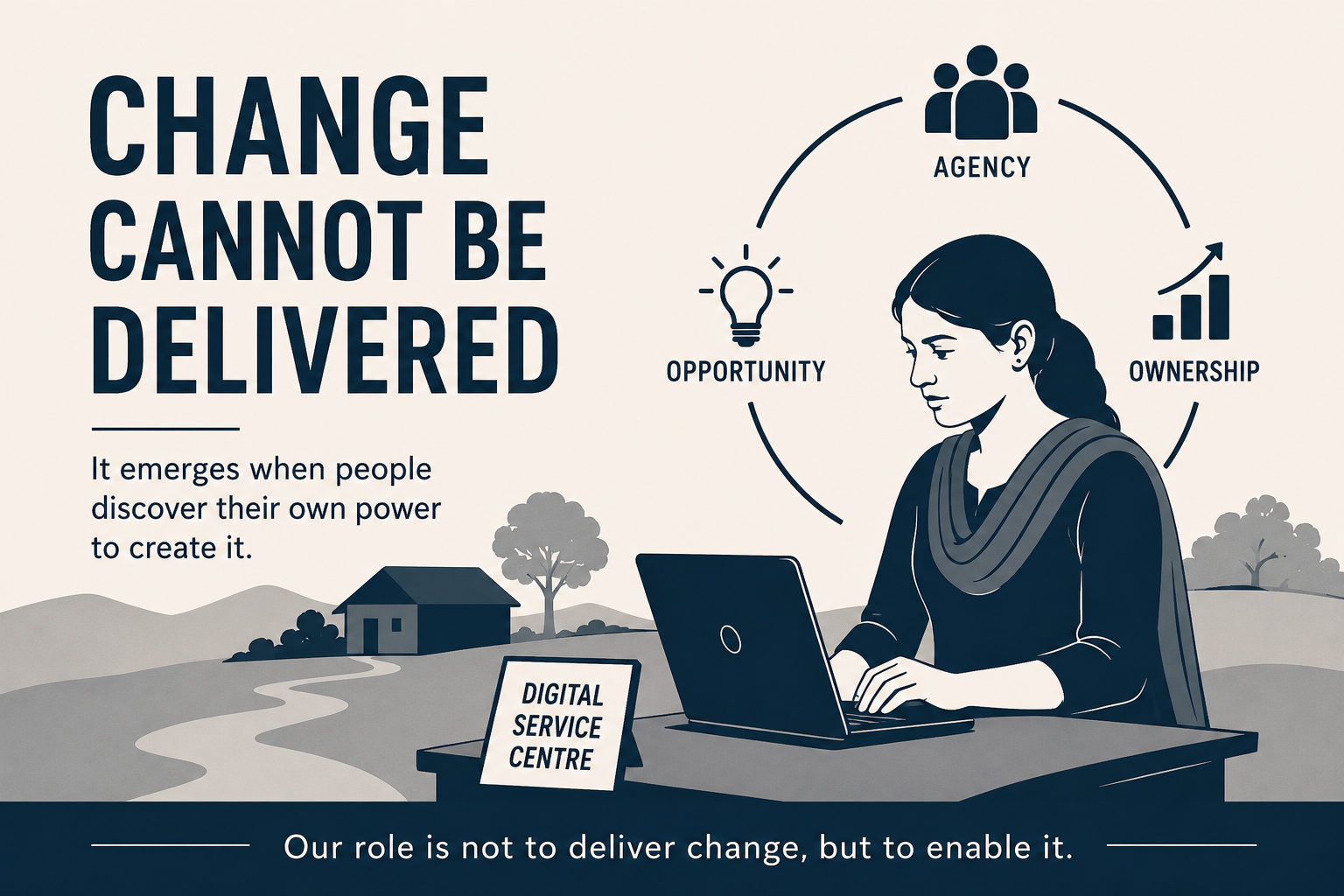
After 20+ years in development sector, this is the lesson I carry with the greatest conviction that change cannot be delivered to people. It emerges when people discover their own power to create it. We often treat it as something that can be designed, funded, managed, monitored, and delivered. We create theories of change, strategic plans, annual targets, dashboards, and impact indicators. We write proposals describing how communities will evolve over the next three or five years and convince ourselves that social transformation can be engineered with enough resources, expertise, and discipline. Yet the longer I have worked in this sector, the more I have realised that change is far more organic, unpredictable, and human than our project documents suggest.

When I began my career, I believed what many young professionals entering the development sector believe, that poverty could be reduced through good Programs alone, that social problems could be solved through smart interventions, and that institutions with the right intent could create pathways for people to improve their lives. I still believe in all of those things. What has changed is my understanding of where transformation actually comes from. After working across livelihoods, entrepreneurship, environmental sustainability, women’s empowerment, public health, education, and digital inclusion, I have come to a simple conclusion that development succeeds when people gain the agency to shape their own futures.

One of the first assumptions I had to unlearn was the idea that communities are primarily defined by what they lack. Development discussion is filled with the language of deficits. We identify needs, vulnerabilities, gaps, and constraints, and catalogue problems and design interventions to address them. While these exercises are important, they can also blind us to a more powerful reality. Communities possess knowledge, resilience, social capital, aspirations, and capabilities that outsiders frequently underestimate. Over the years, I have met women who built successful enterprises despite social barriers, farmers who adapted to environmental challenges long before climate resilience became a policy priority, and young people who created opportunities where experts saw only limitations. What distinguished these individuals was not the assistance they received but the agency they exercised. The most successful development programs I have witnessed were those that helped people discover their own capacity to act.

This may sound obvious, yet much of the development sector still operates as though change originates from institutions rather than individuals. We often speak of empowering communities as if empowerment is something that can be handed over like a grant or a training manual. Experience has taught me that empowerment is not delivered, but is unlocked. People change their lives when they begin to see themselves not as beneficiaries of someone else’s program but as active participants in shaping their own future.

Another lesson that I took years to fully appreciate is that projects produce outputs, while ecosystems create change. Development organisations have become increasingly sophisticated in measuring activities and outputs. We know how many people attended training programs, how many households received services, how many entrepreneurs were supported, and how many villages were covered. These numbers and accountability matter as funders and stakeholders deserve evidence that resources are being used effectively. Yet some of the most transformative changes I have witnessed had little to do with what was captured in a monitoring framework.

I have seen projects with impressive numbers disappear almost entirely once funding ended. I have also seen relatively modest initiatives continue creating value years after external support had ceased. The difference was rarely the size of the budget or the quality of the project design. More often, it was whether the intervention had strengthened the local ecosystem or not. Sustainable change emerges from relationships, institutions, markets, networks, and leadership. It emerges when communities develop the capacity to solve problems collectively, and when local actors begin driving progress themselves. 

This is particularly true in the field of livelihoods and entrepreneurship, where I have spent much of my professional life. For decades, development programs have focused on training individuals, providing assets, or facilitating access to finance. These interventions are valuable, but they are rarely sufficient. Entrepreneurship does not flourish simply because someone acquires a skill. It flourishes when an entire ecosystem supports risk-taking, innovation, market access, mentorship, and growth. The future of development, especially in rural economies, lies in building environments where success becomes possible for many.

One of the more surprising lessons from my career concerns money. Having spent years raising resources for social programs, I have a deep appreciation for the role of funding in creating impact. Without resources, good ideas often remain aspirations. Yet after helping mobilise hundreds of crores for development initiatives, I have come to believe that development is rarely constrained primarily by money. That may sound like an unusual statement coming from someone whose responsibilities have included fundraising and partnership development, but experience repeatedly points in that direction.

Many social challenges that appear to be funding problems are, in reality, leadership problems, institutional problems, capability problems, or trust problems. Additional funding can accelerate progress when strong systems exist. It can also magnify inefficiencies when those systems are weak. Some of the most effective organisations I have come across were not the wealthiest. They were the ones who built credibility, nurtured talent, fostered partnerships, learned continuously, and remained deeply connected to the communities they served. Development ultimately depends on institutions, as strong institutions outlive projects, preserve knowledge, adapt to changing circumstances, and create platforms through which future generations can continue the work. Sustainable change requires institutions capable of sustaining momentum long after a grant agreement expires.

Another belief I have gradually become sceptical of is the sector’s fascination with innovation. Few words are used more frequently in development conversations today. Every conference, funding call, and strategy document seems to emphasise innovation as the pathway to impact. New technologies, new models, and new approaches are often celebrated as solutions to deeply entrenched social challenges. Innovation undoubtedly has value, and many important advances have emerged from creative thinking. Yet the longer I work in development, the more I believe that adaptation is often more important than innovation.

Communities do not need solutions that look impressive in presentations; rather, they need solutions that work within their realities. The most successful initiatives I have known were not necessarily the most innovative. They were the most adaptive and respected local contexts rather than attempting to impose external models. The development sector is full of examples where brilliant ideas failed because they ignored the realities of the people they were intended to serve. It is also full of examples where relatively simple approaches succeeded because they were grounded in local ownership and practical wisdom.

Perhaps the most important lesson of all is that ownership is the ultimate measure of impact. For many years, I believed that scale alone represented the highest aspiration in development. Reach more people, expand into more geographies, and increase the numbers. Scale is important, and the magnitude of global challenges demands ambition. Yet scale without ownership is fragile. Programs that depend indefinitely on external actors are vulnerable by design. Lasting change occurs when communities begin to see an initiative as their own, when local leaders emerge, when institutions take root, and when progress continues without constant external direction.

This requires a profound shift in how we think about our role as development practitioners. Too often, organisations position themselves as providers of solutions. A more useful role may be that of a catalyst, connector, facilitator, and investor in human potential. The objective is not to become indispensable, but to create the conditions under which communities can thrive independently. Success is not measured by how long people depend on us, but by how effectively people progress without us.

As I reflect on my 20+ years in this sector, I remain optimistic despite the scale of the challenges before us. Climate change, inequality, unemployment, public health crises, and social exclusion remain formidable problems. Yet I have seen enough examples of human ingenuity, resilience, and determination to believe that meaningful progress is possible. I have seen individuals transform their circumstances, communities build collective solutions, and institutions evolve into powerful vehicles for social change. These experiences have reinforced my conviction, which has only grown stronger with time.The future of development will not be determined solely by larger budgets, more sophisticated frameworks, or more ambitious programs. It will be determined by our ability to strengthen local institutions, nurture entrepreneurship, build resilient economic ecosystems, and trust communities to shape their own destinies. If twenty years have taught me anything, it is that change is not something we deliver to people. Change is something people create when they have the opportunity, confidence, and freedom to act. Our responsibility is not to direct that process. It is to help create the conditions that make it possible and then have the humility to step aside.

Disclaimer: The opinions expressed are those of the author and do not purport to reflect the views or opinions of any organisation, foundation, CSR, non-profit or others.

Why everyone says, I am fine 

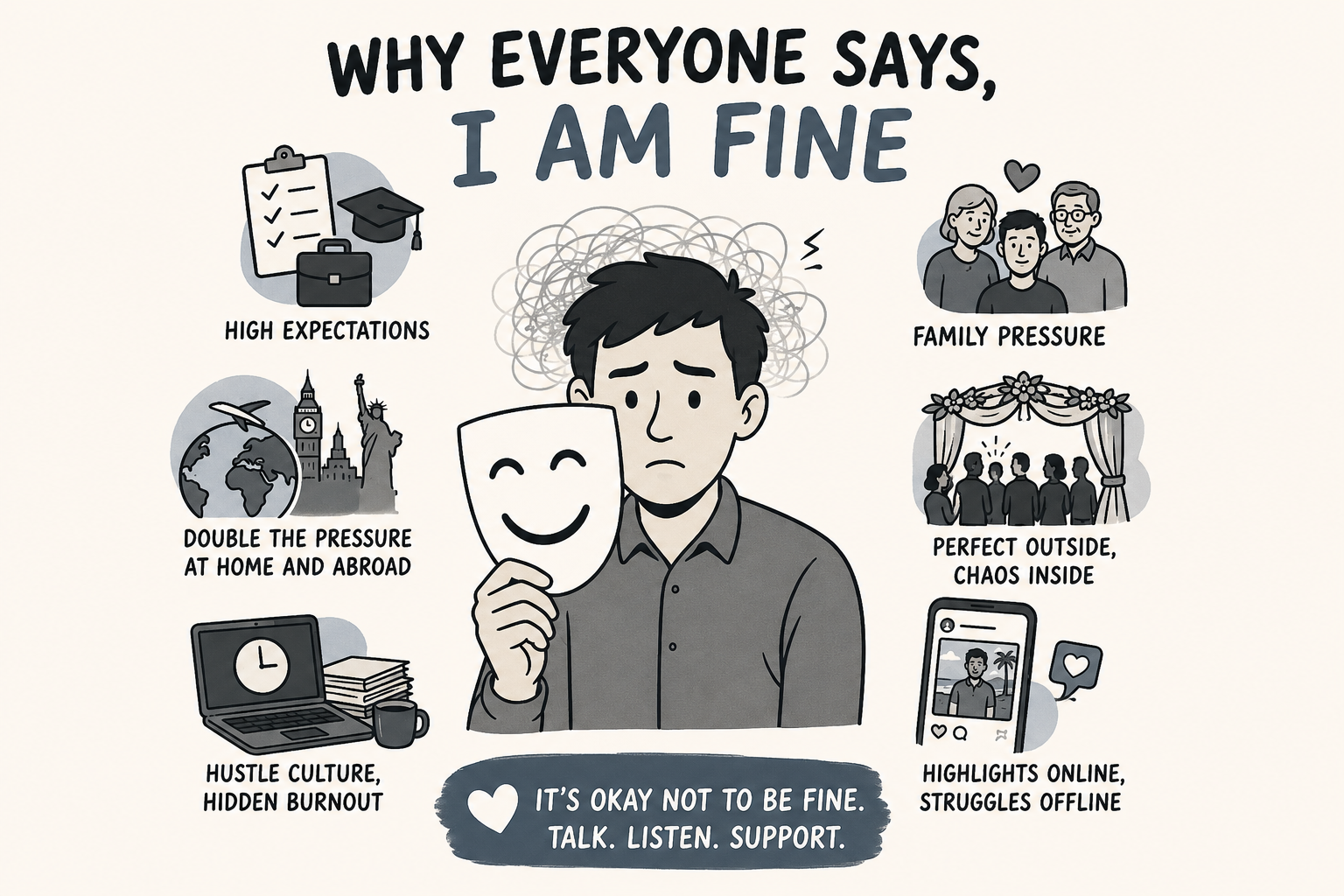
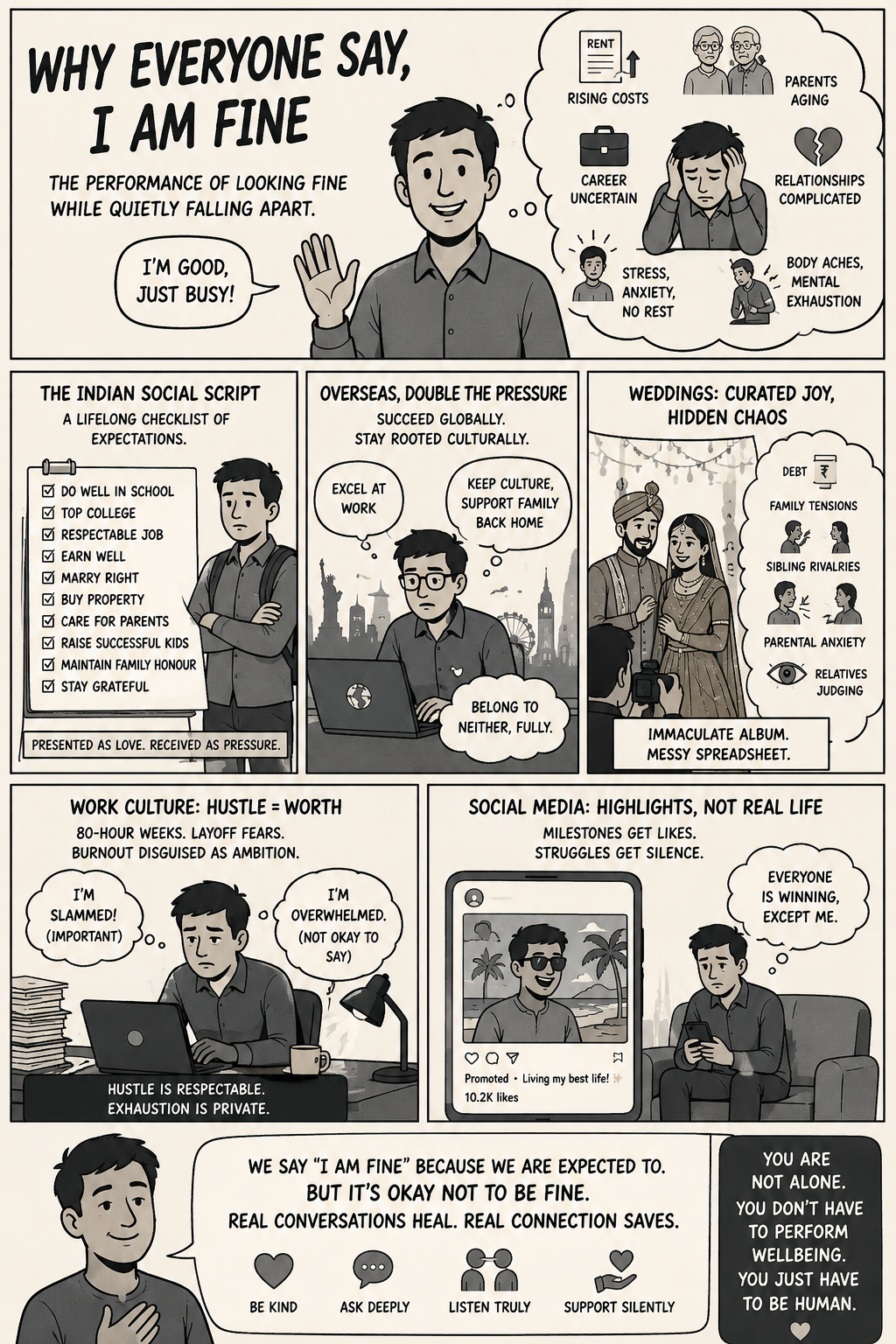
There is a performance that many people have mastered in modern life, of looking completely fine while quietly falling apart. It has become one of the most refined social skills of our time. You show up to work on time, reply to emails with professional warmth, attend weddings with coordinated outfits, post cheerful holiday photos, laugh at dinner parties, and reassure everyone that ‘all is well’ while your internal monologue resembles an emergency board meeting. Rent is rising, parents are ageing, careers feel uncertain, relationships are complicated, your back hurts for reasons your doctor politely describes as stress related, and you have not felt truly rested since sometime before the pandemic. Yet when someone asks how you are doing, the answer remains remarkably consistent, ‘Good, good. Just busy.’

Across the world, people are becoming increasingly fluent in this language of polished distress. Social media has trained us to curate competence, while professional culture rewards composure, and families often value stability over vulnerability. Entire societies function because millions of people continue showing up despite private exhaustion. But this performance feels particularly pronounced among Indians who are living both within India and across the global diaspora, where social expectations are often complex, relentless, and efficient at producing outward success alongside inward strain.

The Indian social script remains deeply achievement-oriented. From childhood, most of us are introduced to a familiar sequence of expectations that feels both culturally specific and globally recognisable, which includes performing well in school, attending a branded university/college, entering a respectable profession, earning well, marrying appropriately, buying property, caring for parents, raising successful children, and maintaining family honour while appearing effortlessly grateful for the opportunity. There are, of course, regional, class, and generational variations, but the broad architecture remains remarkably durable. Even among progressive urban families, conventional expectations often survive in modern packaging. Instead of explicit pressure to become a doctor or engineer, there may be subtle comparisons with cousins working at Google, Amazon, or investment firms in London. Marriage pressure may sound softer, but family Whatsapp groups can still function as passive-aggressive reminder systems.

The emotional burden becomes even more complicated because these expectations are rarely framed as pressure, as they are often presented as love, sacrifice, duty, and practical wisdom. Parents who invested heavily in their children’s education may genuinely believe they are guiding them toward security. Extended families may see their involvement as care. Communities may celebrate conformity because it appears stable. But good intentions do not eliminate psychological consequences. Many young professionals in Mumbai, Bengaluru, Delhi NCR, and Hyderabad are managing demanding careers while quietly navigating family expectations around marriage, caregiving responsibilities, home ownership, and financial support. They are often simultaneously trying to be globally competitive professionals and culturally responsible children. It is a difficult balancing act, made harder by the fact that neither side fully acknowledges the strain.

For Indians living overseas, the pressures often become even more complex. The immigrant success story remains one of the most celebrated narratives in many diaspora communities. The child of immigrants in the United States, Canada, the United Kingdom, or Australia may be expected to succeed professionally in highly competitive societies while also preserving cultural identity, supporting family back home, and remaining deeply connected to traditions that often become more rigid in migration. This produces a strange phenomenon where individuals feel pressure to excel in two worlds while fully belonging to neither. You are expected to understand tax laws in Seattle, maintain emotional fluency in Bihari family politics, and explain to relatives why you are still unmarried at 32 despite having what appears, on paper, to be an excellent and successful life!

Weddings deserve special mention as global showcases of curated wellbeing. Few events demonstrate collective emotional theatre quite like the fat Indian weddings. Families spend enormous amounts of money celebrating joy while quietly navigating interpersonal tensions, financial stress, unresolved conflicts, and logistical chaos. Guests arrive dressed magnificently, smiling for photographs that suggest a flawless communal celebration. Beneath the choreography, there may be sibling rivalries, debt, parental anxieties, and relatives evaluating everything from the food menu to life decisions. And though the wedding album looks immaculate, the emotional spreadsheet rarely does.

Professionally, employees are expected to remain productive through layoffs, economic uncertainty, technological disruption, and burnout. In India’s startup hubs and global financial centres alike, people casually describe 80-hour workweeks as ambition while quietly experiencing anxiety, insomnia, and emotional depletion. The language of hustle culture has simply provided respectable branding for exhaustion. Saying ‘I am slammed’ has become shorthand for importance. Saying ‘I am overwhelmed’ remains harder.

Social media has amplified all of this by turning life into a continuous public relations exercise. Platforms reward milestones like promotions, vacations, engagements, anniversaries, fitness transformations, children’s achievements, and entrepreneurial announcements. They are less enthusiastic about ambiguity, grief, stagnation, infertility struggles, career confusion, loneliness, or ordinary dissatisfaction. The result is a digital ecosystem where everyone appears to be thriving. You scroll through photographs of destination weddings in Udaipur, startup exits in San Francisco, babies in matching outfits, and beachfront holidays in Bali while sitting with your own uncertainty and wondering whether everyone else has somehow figured out adulthood.

Many people who appear successful are privately negotiating debt, loneliness, marital strain, workplace anxiety, fertility struggles, caregiving responsibilities, mental health challenges, or the exhausting task of meeting expectations they never consciously chose. The colleague who seems composed may be supporting parents through medical crises. The cousin posting anniversary photos may be managing deep relationship problems. The entrepreneur celebrating funding rounds may be unable to sleep. The family friend who constantly asks why you are not married may have spent years trapped in an unhappy marriage themselves. Human beings are remarkably skilled at editing their visible narratives.

Indian society’s combination of collectivist expectations, rapid economic change, intergenerational obligations, and intense social comparison creates a particularly sophisticated ecosystem of invisible pressure. What makes this dynamic especially difficult is that many people feel guilty for acknowledging it. After all, they may have stable jobs, supportive families, educational privilege, or material comfort relative to previous generations. Gratitude becomes weaponised against honest emotional reflection. ‘What do you have to complain about?’ remains one of the most efficient ways to shut down vulnerability in many households. 

The irony is that a genuine connection often begins the moment someone drops the performance. When one friend admits they are burnt out, another confesses they are anxious. When someone speaks honestly about marriage pressure, career confusion, depression, caregiving exhaustion, or loneliness, others often respond with relief rather than judgment. The collective illusion begins to weaken. Perhaps the challenge of modern adulthood is not learning how to appear fine. Most people have already mastered that skill. The real challenge is building lives, friendships, workplaces, and families where ‘I’m not okay right now’ does not feel like a social failure.Behind many polished LinkedIn profiles, family portraits, wedding photographs, and cheerful Whatsapp updates lies the same truth that everyone looks fine because that is what society often rewards. But many are carrying far more than they show, and sometimes the most radical act of honesty is answering ‘How are you?’ with something closer to the truth.

The cost of ‘free’ in India

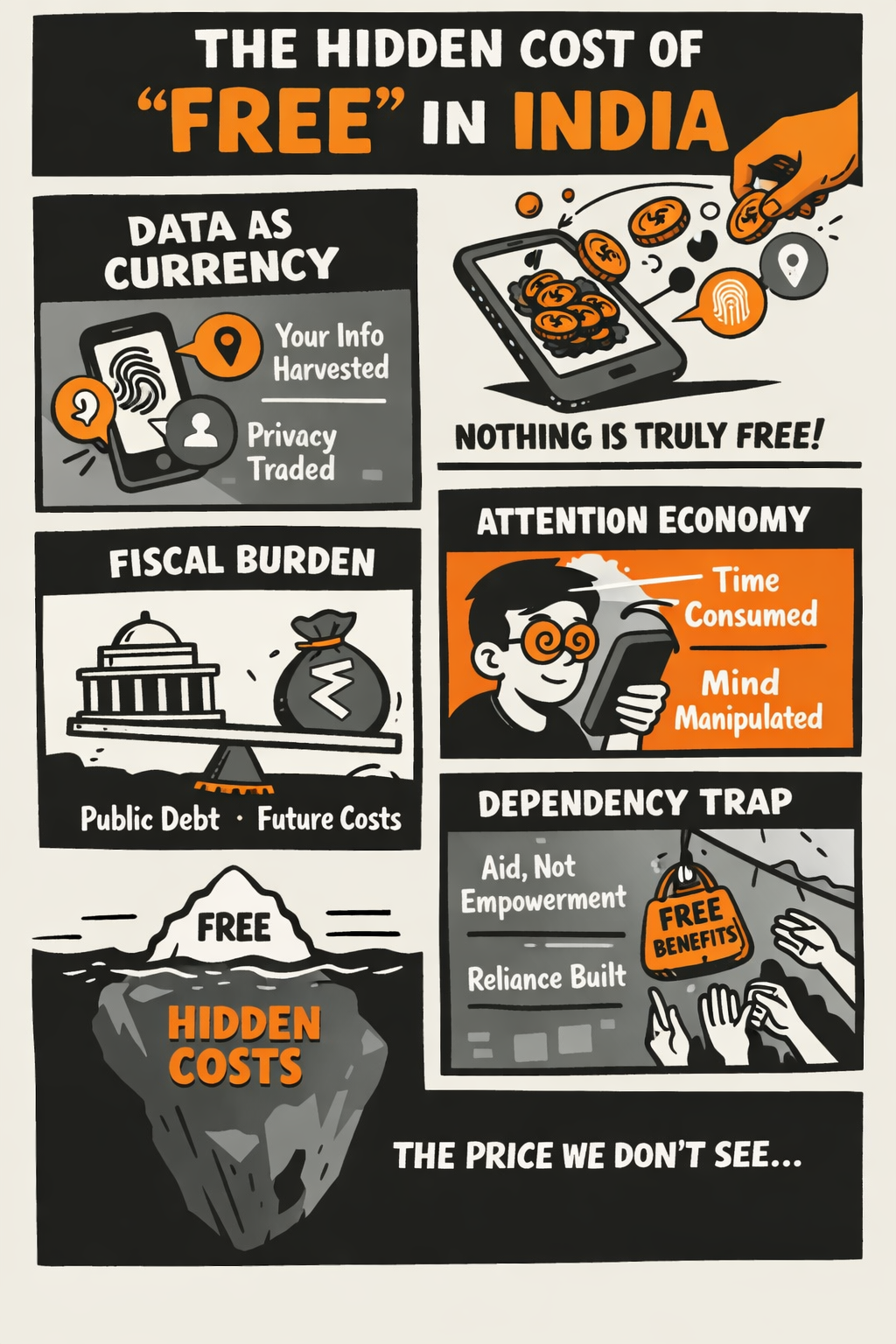
The word ‘free’ carries a unique emotional and political charge in India. It signals relief, generosity, access, and sometimes even justice. In a country marked by deep inequality and historical deprivation, the idea of receiving something without having to pay for it feels not just attractive but morally right. Free school meals, free healthcare camps, free ration, free mobile data, free apps, free advice—these are not fringe phenomena but central features of everyday life. Yet as ‘free’ becomes more pervasive, it becomes more urgent to interrogate what it actually costs in reality. Because nothing in this world is truly free. Even when money is not exchanged, value is still transferred, quietly, unevenly, and often invisibly.

The digital revolution has made ‘free’ feel natural, even inevitable. India’s smartphone explosion, driven by affordable devices and some of the world’s cheapest mobile data, has brought hundreds of millions online in a short span of time. For first-time internet users, free apps are often the internet itself. Messaging platforms, video-sharing apps, digital wallets, navigation tools, shopping platforms, and learning apps promise unlimited access at zero cost. Downloading them requires no financial transaction, only a tap on a screen. This apparent absence of cost masks a different economy altogether, one where data, attention, and behaviour are the currencies being traded.

Every free app extracts value as it collects personal information, tracks usage patterns, studies preferences, and monitors behaviour across platforms. In return for convenience and access, we surrender fragments of our digital selves, often without fully understanding the implications. In India, where digital literacy has not kept pace with digital adoption, this exchange is especially asymmetrical. We routinely accept terms and conditions that we cannot realistically read or comprehend, granting permissions that would be alarming if framed in simpler language. Location data, contact lists, browsing habits, voice samples, and even biometric identifiers become assets in a vast data economy. We do not pay in rupees, but we pay in terms of our privacy, autonomy, and long-term exposure.

This is not a small concern, as data is power, and not merely information. When aggregated at scale, it allows companies to predict behaviour, shape consumption, influence opinion, and nudge decision-making. In India, where hundreds of millions engage daily with free digital platforms, this concentration of behavioural data in private hands has far-reaching consequences. It affects what we see, what we buy, how we think, and even how we vote. The cost of free apps is not just about individual privacy but collective vulnerability to influence and manipulation. What appears to be a harmless trade in terms of free services for data becomes a structural imbalance when we lack meaningful choice or awareness.

Free apps are designed to maximise engagement because engagement drives advertising revenue. Endless scrolling, autoplay videos, push notifications, algorithmic recommendations, and gamified feedback loops are not accidental features; instead, they are engineered mechanisms to capture and hold attention. Time spent on these platforms is monetised elsewhere, converted into impressions, clicks, and behavioural insights. For us, this translates into hours lost daily to digital consumption. The opportunity cost is immense in terms of time not spent on learning, work, rest, relationships, or reflection. In a country where time poverty is already acute for large sections of the population, the extraction of attention is a high but rarely acknowledged cost of ‘free.’

Alongside free apps, free government schemes occupy a central place in India’s public imagination. Welfare programs offering free food, free electricity, free healthcare, free education, and direct cash transfers are often framed as moral imperatives in a society with widespread poverty. And indeed, many such schemes have had transformative impacts. Free school meals have improved nutrition and attendance. Subsidised healthcare has saved lives. Social security schemes have provided safety nets in times of crisis. To dismiss free schemes outright would be both inaccurate and unjust.

However, the scale and politics of ‘free’ in governance demand scrutiny. Government schemes are funded by public money, either through taxation or borrowing. When services are offered for free, the cost is distributed across society, including future generations. Fiscal resources are finite, and every rupee allocated to a subsidy is a rupee not spent elsewhere. The real question is not whether the state should provide support, but how that support is designed, targeted, and sustained. Poorly designed free schemes can strain public finances, crowd out long-term investments, and create distortions that are difficult to reverse.

One of the most persistent risks associated with free government schemes is the shift from empowerment to dependency. When benefits are delivered without clear pathways to capability-building, translating into skills, livelihoods, ownership, or agency, they can trap beneficiaries in cycles of reliance. This is not a failure of intent but of design. Welfare that does not evolve into opportunity risks becoming permanent relief rather than temporary support. Over time, political incentives can encourage the expansion of free entitlements without corresponding investments in productivity, institutional capacity, or economic growth. The cost, then, is borne in slower development, rising debt, and reduced fiscal flexibility.

There is also a less visible social cost when citizens begin to relate to the state primarily as a provider of free goods rather than as a facilitator of opportunity, and expectations shift. Accountability becomes transactional, and long-term policy thinking gives way to short-term appeasement. This dynamic can erode democratic deliberation, reducing complex governance challenges to simplistic promises of free distribution. In such an environment, the language of rights is often mixed with the politics of giveaways, weakening the deeper idea of citizenship rooted in participation, contribution, and shared responsibility.

In India, ‘free’ advice is abundant and rarely priced. Friends, relatives, colleagues, social media influencers, and anonymous online forums dispense guidance on everything from investments and careers to health, parenting, and mental well-being. At one level, this reflects strong social bonds and collective problem-solving. Knowledge-sharing has always been part of Indian society. But in the contemporary context, the proliferation of free advice, especially online, has begun to undermine the value of expertise itself. Professional knowledge is produced through years of education, training, practice, and ethical accountability. When expert advice is expected to be free, its perceived value diminishes. Professionals are pressured to give away labour without compensation, while advice-seekers are encouraged to treat complex problems as easily solvable through quick opinions. The result is often superficial guidance applied to situations that demand nuance. In fields like finance, law, and health, the consequences can be serious, resulting in misdiagnoses, financial losses, legal complications, and long-term harm.

Digital platforms have amplified this problem dramatically. Social media rewards confidence, not competence. Algorithms favour content that is engaging, simplified, and emotionally charged. As a result, the loudest voices often drown out the most qualified ones. Free advice becomes entertainment, stripped of context and accountability. Influencers monetise indirectly through advertising, brand deals, or lead generation, while audiences consume advice under the illusion that it is altruistic. The hidden cost here is the ability to distinguish reliable knowledge from persuasive noise.

Behavioural economics shows that people disproportionately favour free options, even when they are inferior to low-cost alternatives. The absence of price triggers a sense of gain that overrides rational evaluation. In India, this bias plays out repeatedly when users choose free digital services with weak privacy protections over modestly priced, safer alternatives,  beneficiaries prefer immediate free benefits over long-term investments in capability, or individuals trust free advice over paid expertise because payment itself is mistaken for bias. These patterns are not signs of ignorance but of how human psychology interacts with scarcity and aspiration.

Free social media platforms, while enabling connection, intensify comparison. Carefully curated images of success, beauty, and happiness circulate endlessly, shaping aspirations and insecurities. The cost is stress, anxiety, and diminished self-worth, especially among young users. These effects are not accidental side-effects but structural outcomes of platforms designed to maximise engagement rather than well-being.

When platforms subsidise services to gain scale, smaller players struggle to compete. Local businesses, creators, and service providers are often forced into ecosystems where they generate value but capture little of it. Revenue flows upward and outward, concentrating power in a few large entities. Price signals weaken, making it difficult for sustainable, high-quality alternatives to emerge. Over time, consumers accustomed to free access become resistant to paying for quality, undermining the viability of independent work and innovation.

Yet it would be a mistake to conclude that free is inherently harmful. Free education, free public healthcare, free libraries, and free public infrastructure have historically been among the most powerful tools for social progress. The issue is not free versus paid, but opaque free versus conscious free. When free services are transparent about costs, respectful of users, and oriented toward empowerment rather than extraction, they create genuine public value. When free becomes a strategy to harvest data, attention, votes, or dependency, its costs far outweigh its benefits.

The challenge for India is to develop a more mature relationship with ‘free.’ This requires stronger regulation of digital platforms, particularly around data protection, transparency, and competition. It requires better design and evaluation of welfare schemes, ensuring they build capabilities and not just deliver consumption. It requires cultural shifts that restore respect for expertise and recognise that paying for knowledge is not exploitation but investment. And most importantly, it requires citizens to ask harder questions when something is offered at no cost.

Who is paying for this? What am I giving up? Who benefits in the long run? Is this making me more capable or more dependent? These questions are not cynical, but are of utmost importance. In a complex society, the absence of price does not mean the absence of cost. It only means the cost has been displaced onto privacy, time, dignity, judgment, or the future. India’s relationship with ‘free’ will shape its developmental trajectory in profound ways. If used wisely, then free access can level the playing field and unlock human potential; else it can deepen inequalities, hollow out institutions, and quietly extract value from those least equipped to see it. Free is never just an economic choice; instead, it is a moral, political, and social one. And in a country as large and consequential as India, the true cost of free is something we can no longer afford to ignore.

Economics of Diwali

As we celebrate the sparkle of Diwali festivities with lights, the Indian economy, too, is glowing with festive energy. Diwali is not only a cultural and spiritual event but also an economic phenomenon that mobilizes consumption, trade, and emotion on a scale unmatched by any other festival in India. It is a festival where faith, finance, and family come together to illuminate not just homes but entire markets.

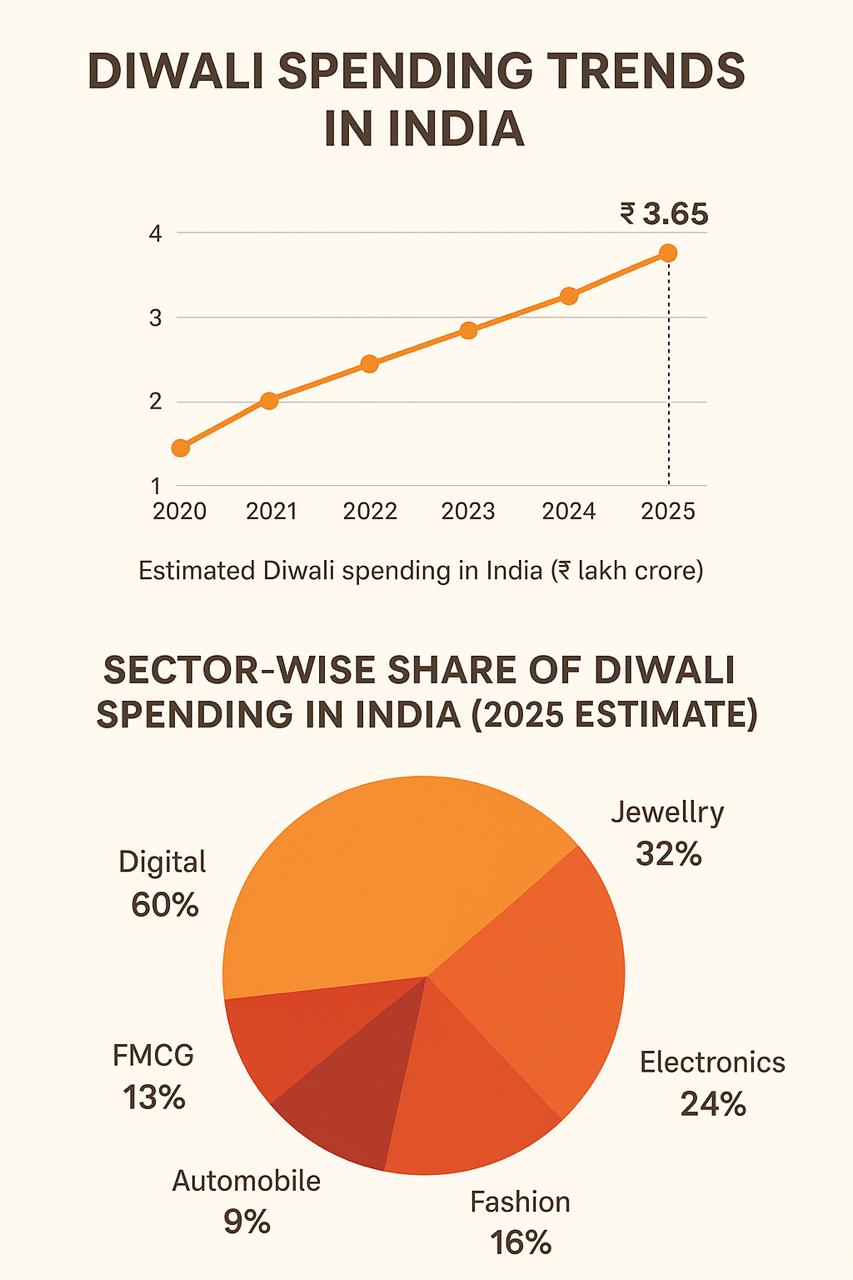
Diwali blends culture and commerce. Traditionally marking the return of Lord Ram to Ayodhya after 14 years of vanavasa (exile), the festival has evolved into India’s largest consumption cycle. According to industry estimates, Diwali season alone accounts for 30–40% of annual sales in sectors like jewellery, automobiles, electronics, apparel, and consumer goods.

In 2024, India’s festive spending during Diwali week was estimated at INR 3.2 lakh crore, reflecting a 17% rise over 2023, driven by rising disposable incomes, pent-up post-pandemic demand, and digital retail penetration. Retail chains, e-commerce platforms, and even microenterprises depend on this period to recover annual profits. For small traders, Diwali is often the difference between a good year and a bad one. The festival also synchronizes the Indian economy’s emotional rhythm—consumer sentiment peaks as the festival approaches, heightened by work bonuses, gifts, and an almost cultural belief that new purchases bring prosperity.

Two days before Diwali, Indians celebrate Dhanteras, considered the most auspicious day to buy gold, silver, or anything of value. Historically, this practice was rooted in agrarian prosperity cycles during which, farmers who had completed the harvest season invested their earnings in tangible assets like metals. Today, the sentiment remains, but the scale has exploded. The symbolism has migrated from the vault to the marketplace, aligning tradition with modern consumption.

Diwali’s economic landscape has been radically redrawn by digital commerce. In 2024, online festive sales crossed INR 90,000 crore, driven by e-commerce platforms like Amazon, Flipkart, and Meesho. Tier-II and Tier-III cities accounted for more than 60% of new shoppers, an indication that India’s digital inclusion is now deeply linked with its festive economy.

Algorithms have replaced astrologers in predicting purchasing patterns. AI-driven recommendations, influencer marketing, and digital payment ecosystems like UPI have made the act of buying faster and impulsive. While urban consumers enjoy massive discounts, small offline retailers struggle to match online prices. Many traditional businesses like sweet shops, garment stores, and gift outlets are now adapting with hybrid models, selling on WhatsApp or through community platforms. The local bazaar is not dying; it is simply going online.

Behind the glitter of malls and advertisements lies a quieter but equally powerful story of the informal and rural economy that powers Diwali. Across India, millions of artisans, potters, weavers, and small manufacturers depend on the season for a significant portion of their income. From handmade diyas in Bihar to terracotta idols from Bankura, paper lanterns in Maharashtra, and bamboo crafts from Northeastern states, Diwali sustains local creative economies that embody both tradition and entrepreneurship. In recent years, several NGOs and social enterprises have helped rural producers connect directly with urban buyers through digital platforms. For instance, self-help groups (SHGs) supported by government programs like NRLM (National Rural Livelihoods Mission) and private CSR initiatives now sell festive handicrafts on e-commerce sites and social media. The “Make in Village” movement during Diwali is becoming a quiet counter-narrative to imported mass-produced goods. Every diya sold is not just a source of light but a livelihood.

Gifting is central to Diwali’s economic ecosystem. From corporate gift hampers to sweets exchanged among families, the ritual symbolizes goodwill, reciprocity, and status. In 2024, India’s corporate gifting industry was valued at ₹12,000 crore, with strong growth projected for 2025. Beyond sweets and dry fruits, companies now gift experiences like wellness vouchers, eco-friendly hampers, and handmade products to reflect social consciousness and sustainability. The gifting economy also reveals deeper social psychology. Gifts during Diwali are not just commodities; they are currencies of relationship. In economic terms, they create “social capital”, the trust and goodwill that sustain business and personal networks alike.

In last decade or so, Diwali’s environmental impact has come under scrutiny. Delhi is the best (or worst) example of this intense air pollution from firecrackers making the environment unbreathable, plastic waste from packaging, and excessive electricity consumption have led to rising calls for a Green Diwali. The market is responding with conscious choices. In 2025, the sale of eco-friendly crackers and biodegradable decorations is expected to grow by 30%. Solar-powered lighting, organic sweets, and recycled packaging are becoming mainstream. Conscious consumers, especially younger urban Indians, are now demanding sustainable alternatives that align celebration with responsibility. The shift from conspicuous consumption to conscious consumption marks a new chapter in the economics of Diwali, one where prosperity is measured not just by spending, but by sustainability.

However, Diwali’s prosperity is not evenly distributed. Inflation affects the purchasing power of lower-income families who often face higher food and fuel prices during the season despite the recent GST reforms, which has significantly brought down the prices of most of the consumer goods. While the urban affluent splurge on gadgets and gold, many households cut back on essentials.

This divergence reflects the broader K-shaped recovery post-pandemic of the Indian economy, where upper segments surge ahead while those on the lower segments struggle. The festive glow, though radiant, hides shadows of inequality. For small retailers, rising input costs and competition from online giants have squeezed margins. For daily wage earners, the festival may mean temporary income spikes but little long-term security. Diwali illuminates both the promise and paradox of India’s growth story.

At its core, Diwali celebrates renewal of hope, homes, and human spirit. Economically too, it acts as a reset button for the nation’s consumer sentiment. The act of cleaning homes, buying new things, and lighting lamps mirrors the cyclical nature of economic optimism. For policymakers and economists, the festive season is a real-time barometer of demand. For families, it’s a reminder that prosperity is not just about wealth, but about togetherness and gratitude. In many ways, Diwali teaches an enduring lesson in economics that growth is sustainable only when it is inclusive, joyful, and mindful.

The economics of Diwali is not just about expenditure, but it is also about the exchange of energy, emotion, and enterprise. It reflects India’s evolving story of modernization rooted in tradition, digital transformation anchored in ritual, and capitalism softened by culture. The future of India’s festive economy will shine brightest when it balances profit with purpose, growth with gratitude, and consumption with conscience.

Algorithmic Self

In today’s digital landscape, our identities are increasingly shaped by algorithms. These complex sets of rules and calculations determine the content we see on social media, the advertisements we encounter, and even the news we consume. This phenomenon, often referred to as the ‘algorithmic self,’ highlights the interplay between technology and personal identity. Algorithmic mechanisms on digital media are powered by social drivers, creating a feedback loop complicating the role of algorithms and existing social structures. 

At the core of the algorithmic self is the idea that our online behaviours and interactions feed into algorithms that, in turn, influence our future actions. Are we becoming the people our feeds want us to be? Scroll long enough on social media platforms like Insta, Tube, or FB and you’ll notice that the content feels uncannily tailored to you. Your feed seems to know what you crave before you do, an oddly perfect mix of travel destinations, recipes, memes, news, workouts, and political takes. This can lead to a more personalised online experience, but it also raises questions about the extent to which our choices are truly our own. What began as a convenience has evolved into something far more consequential. We are not merely using algorithms anymore; we are slowly becoming the selves they design for us.

Algorithms are built to predict and keep us engaged. Every click, pause, like, or scroll is recorded and analysed. In return, the system feeds us more of what we have already consumed. This sounds harmless. After all, who wouldn’t want relevant recommendations? But personalization is never neutral. When a platform rewards the content that hooks us, it amplifies our biases and shrinks our curiosity. Over time, the feedback loop begins to define our worldview, narrowing the range of opinions, art, music, or even relationships we encounter.

The unsettling part is that the algorithm’s goal is not truth, diversity, or personal growth. It is engagement. If desire makes you scroll, it will serve you love. If envy fuels your clicks, it will curate envy-inducing lifestyles. What feels like a reflection of your taste is often a reflection of what keeps you online.

Human behaviour is always shaped by culture, but algorithmic influence is different in speed and precision. Traditional media might set trends, but it never recalibrated itself in real time for every individual. Today, AI systems track micro-reactions—how long your eyes linger on a video frame, how quickly you swipe away, and adjust instantly.

This raises a disturbing question. When you decide to buy a product, support a social cause, or adopt a new hobby, how much of that decision is you, and how much is a carefully engineered nudge? We still feel autonomous because the algorithm rarely forces choices. Instead, it quietly limits what enters the realm of possibility. You can’t choose what you don’t see. Is this the erosion of free will?

Living in an algorithmic world also reshapes identity. Our “digital selves” are rewarded for consistency. The more we like certain posts, the more similar content we receive, and the more we feel pressure to maintain that version of ourselves, whether it’s the fitness enthusiast, the foodie, the activist, or the minimalist. The feed trains us to be predictable because unpredictability breaks the machine’s efficiency.

The rise of the algorithmic self also brings about ethical considerations. There are concerns about privacy, as the data collected to fuel these algorithms often includes personal and sensitive information. Additionally, there is the issue of transparency. Many algorithms operate as ‘black boxes,’ with their inner workings hidden from users. This lack of transparency can make it difficult to understand how decisions are being made and to hold platforms accountable for their actions.

Many people feel a subtle dissonance, their offline preferences drift, but their online persona stays fixed. We perform for the algorithm, optimizing captions, hashtags, even our emotions, to remain visible. Our feeds don’t just reflect who we are, they encourage us to stay who we were yesterday.

But then how do we break the loop?  The answer is not to reject technology altogether. Algorithms are not inherently evil; they can help us discover music, connect with communities, find a job we want, or learn skills we might never find on our own. The challenge is to reclaim agency within the system.

Practical acts of resistance can be quite simple, like, disrupting the feed by clicking on unfamiliar topics or following people outside your cultural bubble; time-box social media use or schedule ‘algorithm-free’ days; read newsletters or listen podcasts where engagement isn’t the primary metric. There could be several other ways to disrupt and reintroduce randomness. However, the most important step, is awareness. Algorithms will always evolve faster than regulations or ethical guidelines. The only lasting defence is a conscious user, someone who understands that every scroll is a form of training data.

The algorithmic self represents a significant shift in how we navigate our identities in the digital age. The question is not whether technology shapes us. It always has. As we continue to integrate technology into our daily lives, it is essential to remain mindful of the ways in which algorithms shape our identities and to advocate for greater transparency and ethical considerations in their design and implementation. The real question is whether we allow a handful of opaque systems to quietly define what we desire, believe, and become. If we don’t actively resist, our algorithmic selves may thrive while our authentic selves quietly disappear into the feed.