Are you time-poor?

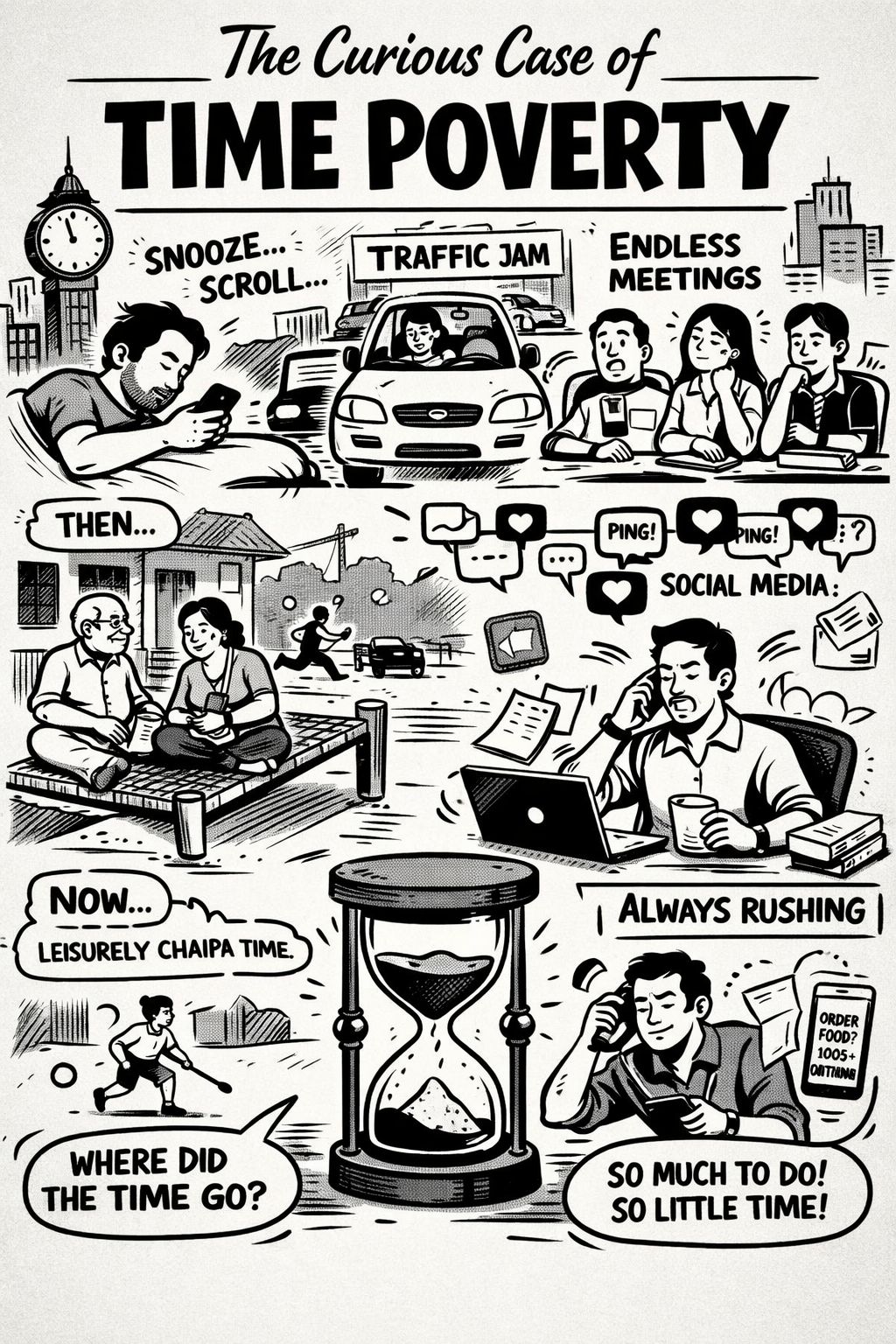
Somewhere between the invention of the pressure cooker and the arrival of 5G, we Indians collectively misplaced something really important: Time. Not lost in a dramatic, cinematic way, without violins or slow motion, but more like a wallet lifted from your back pocket in a crowded Metro. One moment it was there, lazy afternoons, unplanned conversations, the comforting stretch of doing nothing, and the next moment, gone. In its place, we now have Google Calendar reminders, WhatsApp notifications, and a persistent feeling that we are always slightly late for something, even when we are sitting still. Welcome to the era of time poverty, where your bank balance may look respectable, your Zomato order history may be thriving, and your LinkedIn profile may be aggressively inspirational, but your time account is permanently overdrawn.

Let’s rewind a bit, not to some sepia-toned village fantasy, but just a generation ago, in the same cities we inhabit today, where life had a different rhythm. Time was not abundant in a literal sense, as people still worked hard, commuted, raised families, but it felt less fractured. Evenings were events in themselves, when people sat outside their homes discussing politics and cricket over multiple cups of tea, and that one neighbour who always seemed to have too many visitors. Children played gully cricket until the ball inevitably landed in someone’s kitchen, leading to heated negotiations that doubled as character-building exercises. Mothers called out from balconies and verandahs with a mix of authority and affection, summoning children home before darkness turned into parental anxiety. There were fewer choices, yes, but also fewer decisions to make. Dinner was whatever was cooked, and nobody spent fifteen minutes comparing paneer butter masala across twelve delivery apps while reading 237 reviews written by people who clearly have too much time.

The great unifier, television, had one channel, Doordarshan, maybe two if you were fancy. If you missed your favourite show, you missed it, as there was no replay, no binge-watching, no existential spiral at 2 AM where you question your life choices while watching the fourth episode of something you don’t even like. And waiting, ah, waiting was a legitimate activity. We waited for letters, for phone calls on the clunky telephone sets, for exam results. Waiting was not seen as wasted time; it was just part of time itself, like monsoons or power cuts. Our minds wandered, conversations happened, and occasionally, we even ‘thought’ our own thoughts without an algorithm suggesting what to think next!

Now fast forward to urban India today, where time is not just scarce but seems to be actively hunted. A typical weekday begins with negotiation between you and your alarm clock, which has now evolved into a relentless life coach with a snooze button. Before your feet even touch the ground, your thumb has already scrolled through emails, news updates, Instagram reels, and three subtle reminders that everyone else seems to be doing better than you at 7:17 am in the morning. We often eat breakfast alongside a call that begins with ‘Can you hear me?’ and ends with ‘Let’s take this offline,’ a phrase that has single-handedly consumed more human hours than traffic jams.

If time poverty had a national symbol, it would undoubtedly be the urban traffic. Whether you are inching along the Delhi-Gurgaon expressway, contemplating your life choices at Bengaluru’s Central Silk Board junction, or performing advanced geometry in Mumbai’s local trains, your commute is not just a journey, but a full emotional experience. You begin with hope, perhaps even optimism, maybe today will be different, maybe traffic will be lighter, signals more cooperative, humanity kinder. Ten minutes later, you are recalibrating your expectations, bargaining with Google Maps, and listening to podcasts or FM radio not out of curiosity but as a coping mechanism. By the time you reach your destination, you have experienced a full spectrum of human emotion and possibly learned a new cuss word, none of which you will remember by lunchtime.

And then come the meetings, those sacred rituals of modern work culture where time doesn’t exactly die, it dissolves. Meetings to prepare for meetings, meetings to debrief previous meetings, and meetings that exist solely because someone somewhere feared the silence of not having a meeting. Entire hours are spent discussing action items that could have been bullet points in an email, that could have been a message, that could have been… nothing. Ironically, in our relentless pursuit of productivity, we have created systems so elaborate that they ensure we have no time left to actually produce anything. Efficiency has become a performance, and everyone is performing.

Of course, technology was supposed to save us, and in many ways, it has. Tasks that once took hours now take minutes, information is accessible instantly, and communication is effortless. But somewhere along the way, technology stopped being a tool and started behaving like a very needy companion. Your phone, that sleek little rectangle of promise, is now a workplace, an entertainment centre, a social hub, and an anxiety generator rolled into one. You pick it up to check the time and resurface twenty-seven minutes later, having watched three reels, replied to two messages, ignored five, read half an article, and completely forgotten why you picked it up in the first place. Time isn’t just being spent; it is being nibbled away in tiny, invisible bites.

Urban India today offers an abundance of choices in the form of food, experiences, careers, and content. But abundance comes with a hidden tax in the form of decision fatigue. Earlier, dinner was simple, and now it is an exercise in research, comparison, and occasional soul-searching. Even leisure has become labour, as watching a movie involves navigating multiple platforms, genres, languages, and algorithmic suggestions, each insisting it knows you better than you know yourself. By the time you decide what to watch, you are too tired to watch anything. The freedom to choose has quietly transformed into the burden of choosing.

Friendships, once spontaneous and effortless, are now managed with the precision of project timelines. ‘Let’s catch up’ translates into checking calendars, blocking slots, rescheduling due to unforeseen commitments, and finally meeting for exactly sixty minutes before someone inevitably says, ‘I have an early morning tomorrow.’ Even weddings, those grand celebrations of chaos and joy, have been optimised for efficiency. Destination weddings over long weekends, carefully curated guest lists, and itineraries that resemble conference agendas. Nothing says romance like a well-managed Google Sheet.

But perhaps the most insidious aspect of time poverty is lack of attention rather than the lack of hours. You may technically have free time, but your mind is rarely free. You are at dinner, but thinking about work. You are on vacation, but checking emails. You are resting but feeling guilty about it. The boundary between work and life hasn’t just blurred; it has politely excused itself and left the building. What remains is a constant hum of ‘I should be doing something,’ a background noise that turns even moments of rest into opportunities for anxiety.

In India, this phenomenon feels particularly intense because of the unique cocktail of factors at play. Rapid urbanisation has stretched infrastructure beyond its limits, turning simple commutes into endurance tests. Aspirational pressure ensures that everyone is constantly striving for better jobs, better salaries, better lifestyles. Digital adoption has been fast and enthusiastic, compressing decades of technological evolution into a few short years. And social expectations are layered on top of all this that rarely reduce, even as professional demands increase. The result is a society trying to operate at first-world speed with third-world infrastructure and fourth-world patience.

So are we truly poor in time? Or have we simply allowed time to be colonised and constantly interrupted? The uncomfortable truth is that it is a bit of both. We are busier, yes, but we are also more distracted. We have more tools, but less control. We are connected, but not always present. Time poverty, then, is not just about scarcity, but more about how we experience the time that we have. It is the difference between a long, uninterrupted conversation and a series of half-hearted replies. Between a meal savoured and a meal consumed while scrolling. Between living time and merely passing through it.

The solution, if there is one, is unlikely to be dramatic. Most of us are not about to quit our jobs and retreat to the Himalayas like some of our friends have, and even if we did, we would probably post about it online. But small shifts are possible, like protecting pockets of uninterrupted time, reducing unnecessary decisions, and occasionally allowing ourselves the radical act of doing nothing. These are not grand gestures, but they are meaningful ones. They remind us that time is not just something to be managed but something to be experienced.

We often say, ‘I don’t have time,’ when what we really mean is, ‘Something else has taken priority.’ Time poverty is not just a condition but a consequence of choices, both ours and the systems we inhabit. In a country that has mastered the art of jugaad, perhaps it is high time we apply that ingenuity to time itself. Because somewhere between the past we romanticise and the present we rush through lies a simple, almost rebellious idea that what if we stopped trying to save time and started trying to live it?

Coffee and Concept Notes

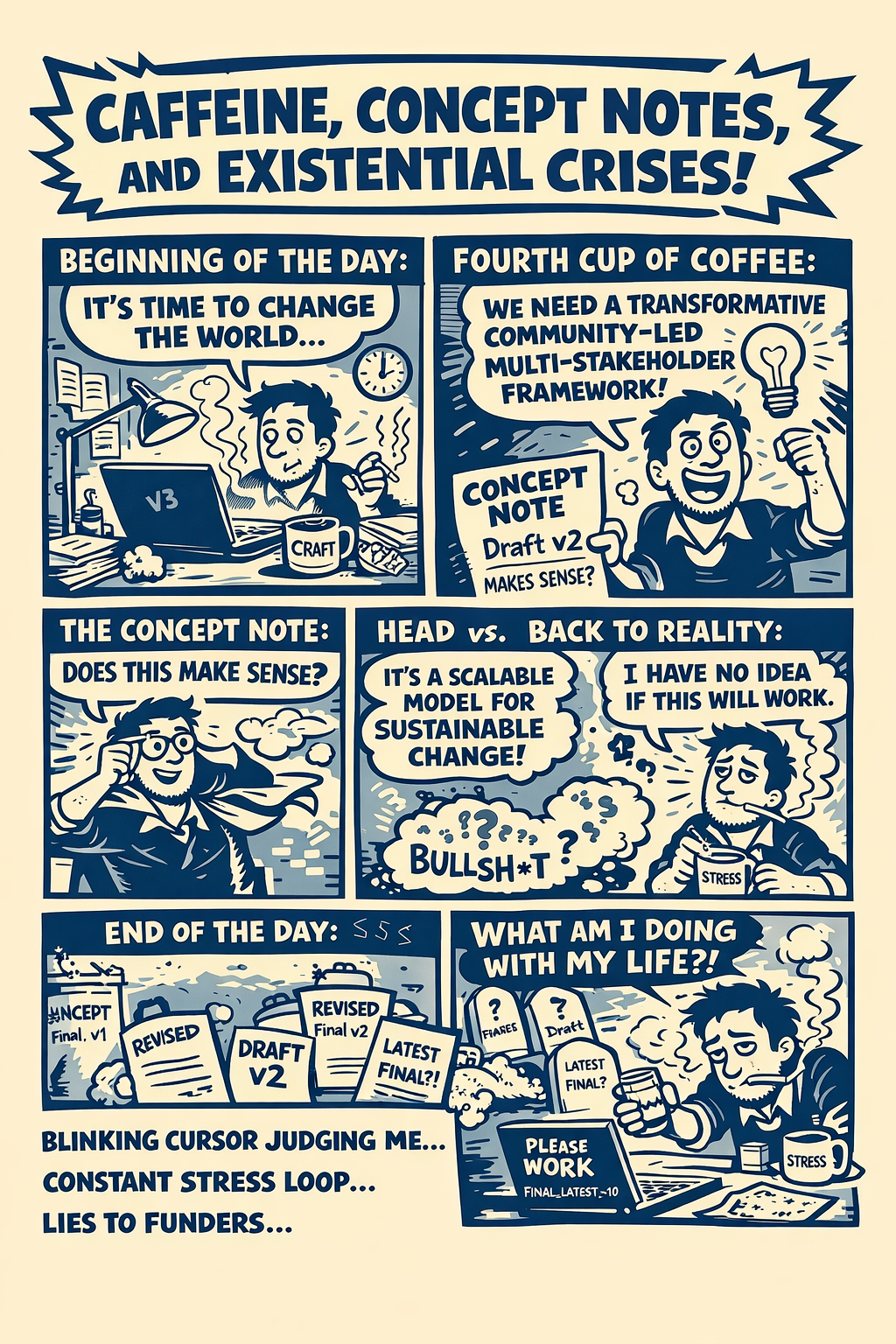
There is a very specific kind of person who measures time through cups of tea/coffee consumed, number of smokes, and versions of concept notes. I am that person. My day does not begin at 9 AM like everybody else. It begins when the first sip of tea and a puff of grey poetry hits my bloodstream and convinces my brain that solving structural poverty through a two-page document is a reasonable life goal. By the third sip/puff, I am ready to change the world. By the fourth, I am opening last year’s concept note and renaming it “Final_Updated_Latest_UseThisOne_v3.0.”

There is something deeply optimistic, almost delusional, about writing a concept note. It always starts innocently: ‘Let’s improve livelihoods in rural communities.’ Twenty minutes later, I find myself writing sentences like, ‘This integrated, community-led, multi-stakeholder convergence model seeks to catalyse sustainable socio-economic transformation…’ At this point, I pause and admire my own ability to say absolutely nothing in 21 words. Concept notes exist in a strange parallel universe where every problem is solvable, every intervention is scalable, every outcome is measurable, and every budget is ‘indicative.’ Of course, the reality is sitting quietly in the corner, waiting for implementation to begin so it can laugh.

Starting a concept note is a ritual that starts with my caffeine fix, opening a blank document, and staring at it as if it owes me money. The blinking cursor is not neutral as it blinks with judgment. ‘Go on,’ it seems to say, ‘design systemic change.’ So I begin with writing a suitable title, then change it, make it sound more ‘strategic,’ add the word ‘transformative,’ remove it because it feels too ambitious, and then add it back because the funder likes ambition. Thirty minutes later, the only thing I have finalised is the font.

At some point in my career as a fundraising professional, I have accepted that coffee/tea is a programmatic input and not just a beverage. Without caffeine/nictone fix, there is no Theory of Change, no LFA, no pathway to impact. With the ‘fix’, there are frameworks, diagrams, and a dangerous amount of confidence. This fix makes me believe things like, ‘Yes, we can align community aspirations with institutional frameworks through participatory convergence.’ Without the fix, I would simply say, ‘We will try our best and see what happens,’ but that is not a fundable language.

Every concept note reaches an uncomfortable moment, usually around page two. I have written the problem statement, objectives, and proposed intervention, and now I am staring at the section titled ‘Expected Outcomes.’ This is where things get philosophical. Will this actually work? Are we solving the problem, or just describing it better? Is this impact, or just well-structured optimism? I leave my desk, go for a quick fix, and look at the skies as if answers are stored there, but they are not.

If you have written enough concept notes, you develop ‘the donor voice’ in your head as your second personality. It appears uninvited and asks uncomfortable questions like, ‘Can you make this more scalable?’ ‘What is the innovation here?’ ’How will you measure impact?’ ‘Can you reduce overheads?’ The last one hurts the most. So I return to the document and start adjusting reality. I make things more efficient on paper, outcomes more certain, risks more ‘mitigated.’ At some point, I realise that I am not just writing a concept note, instead I am negotiating between truth and fundability.

Have you heard about a fine art in fundraising called strategic vagueness? You must say enough to sound intelligent, but not so much that you become accountable. Instead of writing, ‘We will train 1000 farmers,’ you write, ‘We will build the capacity of local stakeholders through targeted interventions.’ Who are these stakeholders? What interventions? That is a journey for another day.

One of my favourite moments is when a concept note meets the field. In the document, community participation is enthusiastic, systems respond efficiently, and timelines are respected. In reality, the meeting starts late, half the participants are confused, and the system is ‘on leave today.’ And yet, the report will still say, ‘The intervention was successfully initiated with active community engagement.’ Because technically, there was engagement, and someone did show up!

Concept notes also have a strange relationship with time, as they do not end, but they evolve. There is Draft, Final Draft, Final_Final, Final_Reviewed, Final_Reviewed_Updated, and the legendary ‘Final_Reviewed_Updated_Latest with version 1.0 to versions n.n. And just when you think you are done, someone sends an email saying, ‘Can we make a few small changes?’ This is how legends are born.

What concept notes really offer is the illusion of control. You design inputs, outputs, outcomes, and impact, and everything flows neatly in arrows and boxes. But development work is not a flowchart; it is more like a messy, unpredictable, human conversation. And yet, we keep drawing boxes, because boxes are fundable.

Every now and then, after multiple cups of coffee, endless sticks of ‘(un)holy smoke’ and several minor existential crises, something magical happens, which is clarity. I suddenly see the program for what it is, what matters, what is unnecessary, what is real. I delete half the document, simplify, and write something honest. For a brief moment, the concept note feels true, and then, almost instinctively, I complicate it again. My colleagues say that I write in Russian! (No offence to Russians here). Because honesty is risky, I add a framework, a diagram, and a few strategic words, and just like that, I am back in the safe zone.

Despite everything, including the caffeine and nicotine dependency, the document gymnastics, and the existential crises, we keep writing concept notes. Somewhere in between the jargon and the formatting, there is a real intention. A belief that things can improve, systems can shift, and people can live better. The concept note is simply the translation of that belief into a language that institutions understand. At the end of the day, I close my laptop. The concept note is sent, the cup is finished, and the existential questions remain unresolved. And still there’s satisfaction, not because the document is perfect, but because I tried to make sense of something complex. Tomorrow, there will be another concept note, another fix, and another moment of staring at a blinking cursor. And I will begin again because this is what we do. We drink coffee and smoke cigarettes, we write concept notes, and occasionally, we question the meaning of it all, preferably before the next deadline.

Confessions of a Fundraiser

By a Head of Development, who has been there, done that. 

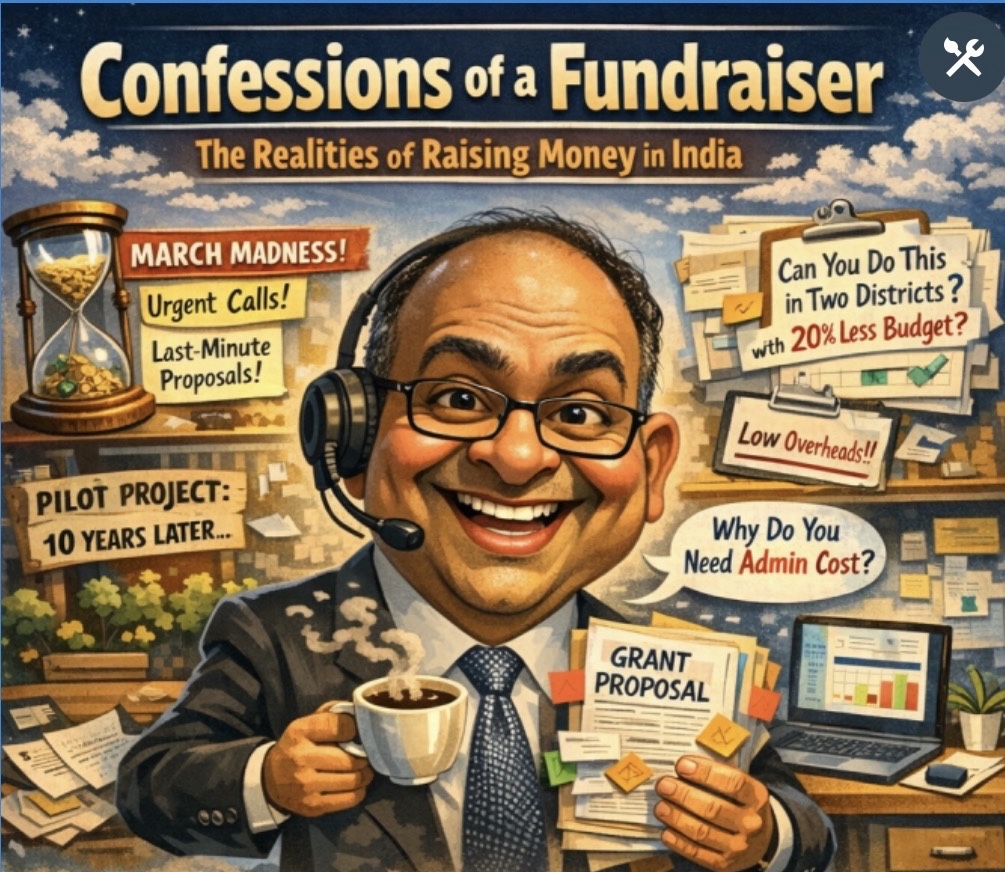
I have spent a good part of my career raising funds for livelihoods and entrepreneurship, environmental sustainability, and digital inclusion. These are kinds of work that everyone agrees are deeply important, and expects to be delivered at miraculous speed, near-zero overheads, and with measurable transformation visible by the next board meeting! Over the years, I have learned that in India’s funding universe, March is not just a month but a mood, where phone calls are returned with unprecedented urgency, proposals are rediscovered with fresh enthusiasm, and sustainability plans are requested even before the first grant tranche has cleared. I have learnt to speak fluently about empowerment while explaining, with equal conviction, why empowerment requires trainers, coordinators, field activities, local transport, and a field office. I have learnt that pilots can run for a decade and still be called pilots, that social impact is expected to be both transformative and inexpensive, and that the most common expression of donor admiration is, ‘This is excellent work. Can you replicate in two districts with 20% less budget?’ And yet, I have also learnt that when trust is built patiently, and partnerships are approached as shared responsibility rather than transactional funding, the system does work, unevenly, imperfectly, but often just in time.

If you ever want to test your emotional resilience, professional patience, and metaphysical belief in destiny, try becoming a fundraiser for social impact in India. Not as a hobby or a phase in life, but as a full-time, salaried, KPI-driven profession where your success is measured in crores raised, relationships sustained, and hopes renewed, often all before lunch. Fundraising in India is not a job; it is a personality type. It is a slow-burning spiritual practice. It is also, on some days, a contact sport.

Most fundraisers do not grow up dreaming of this life. No child has ever said, ‘When I grow up, I want to write concept notes, follow up politely seven times, and still be told the CSR budget has already been exhausted for this year.’ Fundraisers are usually people who joined the development sector with good intentions and then stayed because they discovered a rare combination of optimism, masochism, and an above-average tolerance for ambiguity. In India, fundraising also requires fluency in multiple dialects, not linguistic ones, but donor dialects. You must speak CSR, philanthropy, family office, multilateral, HNI, trust, and the particularly tricky language known as ‘let’s take this offline.’

Every fundraising journey begins with a proposal that is equal parts strategy and speculative fiction. A document that must be simultaneously visionary and realistic, innovative yet ‘scalable,’ rooted in community voice and at the same time aligned to the donor’s thematic priorities for the current financial year. The proposal must do many things at once: ‘Solve poverty + empower women + be sustainable by the third year + align with SDGs (preferably all of them) + cost exactly the amount the funder has available + have low overheads but world-class MEL.’ You will spend weeks refining language, perfecting logframes, and polishing budgets, only to be asked in the first meeting, ‘Can you explain this in two lines?’ You will smile, compress your knowledge of years of community work into a sentence, and remind yourself that clarity is a virtue, even when it hurts.

Sooner or later, every fundraiser in India faces the great philosophical question of our time: Why do you need staff to run a project? Recently, another question got added to my great list when a funder asked me, ‘Why do you need field offices to implement a community-based high-touch project?’ Mind you, I managed a straight-faced answer, without any smirk or sarcasm, even though I cursed the day I decided to be a fundraiser.

Admin costs are a suspicious category in the minds of Indian donors. They include dangerous items like salaries, rent, electricity, and internet, none of which, apparently, contribute to impact. As a fundraiser, you become adept at explaining that projects do not run on goodwill and sunlight alone. That field teams do not teleport. That data does not collect itself. You learn to say ‘lean but adequate,’ ‘efficient yet ethical,’ and ‘value for money’ with full sincerity. I have even attempted some humour at times on the negotiation tables, saying, ‘Without admin costs, the project will still exist, but just as an idea.’ Results vary post such statements.

What I have understood is that fundraising in India is less about money and more about relationships. Money is merely the by-product of trust built over years, conversations, coffees, conferences, and carefully worded WhatsApp messages. I have learnt that a ‘quick call’ can last an hour or more, a ‘small grant’ can require six levels of approvals and may take two years; silence doesn’t mean rejection (or acceptance); words from leadership are golden, but if you don’t have that in writing, you are screwed. The fundraiser’s greatest skill is not writing; it is patience. You patiently wait for responses, for board meetings, for the next quarter, for the funder who loved your work but is noncommittal. You wait with optimism, and dignified reminders, gentle ones every couple of weeks.

Then comes the project visit by the funder, usually by some of their board members and senior leadership. Often, they bring moments of high drama along with it. For the donor, it is a glimpse into our community-connect and implementation efficiency. For a fundraiser, it often turns into a logistical marathon involving vehicles, weather, community leaders, beneficiaries, translators, photographers, and a strong hope that nothing goes wrong. In all such visits, we fundraisers pray to some invisible power that the roads are navigable, community meetings start on time, funder’s visibility is primed, and no one asks an unplanned question about funding gaps. If all goes well, the funder says, ‘This is so impactful.’ You nod, beaming. You make a mental note to follow up in three days. At the beginning of my fundraising career in India two decades ago, I often ended up being shocked by the variety of demands by donor representatives visiting project sites. Thanks to the information age, the visiting representatives nowadays are well informed and often invested in social change.

Fundraisers also live at the intersection of data and dignity, translating lived experience into metrics without stripping it of meaning.Indian donors want data and stories, and at times, even at the cost of losing the bigger picture. You learn to convert human change into numbers without losing the soul of the work. You say things like, ‘4025 women trained’, and then you add, ‘Meet Sunita, who now earns independently and negotiates at home.’ You know that neither is sufficient alone, and the narrative together, they might just unlock the next tranche.

How can I forget the ultimate sword of big NO! Rejection is a constant companion of us fundraisers, like a dark shadow. Sometimes polite, sometimes vague, and sometimes dressed up as ‘great work, but not this year.’ You learn not to take it personally, mostly. You also learn that today’s rejection can be tomorrow’s opportunity, because India’s funding ecosystem is small, relational, and cyclical. The donor who said no last year may say yes next year, after changing jobs, priorities, or perspectives. So you keep the door open, always.

Fundraising is emotional labour. You hold hope for communities, for organisations, for teams whose salaries depend on your ability to convince someone that change is worth investing in. You are optimistic on behalf of others, even on days you feel tired. You absorb anxiety, translate urgency, and project confidence. You celebrate quietly when funds come through, and cushion disappointment when they don’t. You are expected to be resilient, persuasive, strategic, and endlessly positive. No one tells you this in job descriptions.

And yet, despite the follow-ups, the spreadsheets, the rejections, the ‘please reduce your budget by 15-20%,’ and often ending up becoming a football between the funder and the grantee management, we choose to stay. Because once in a while, a funder truly listens. Once in a while, a partnership feels equal. Once in a while, funding aligns perfectly with need, timing, and trust. And in those moments, you remember why fundraising matters. Because social impact does not scale on passion alone. It scales on resources, relationships, and people willing to ask again and again for something better.

So here’s to the fundraisers in India: The translators. The bridge-builders. The professional optimists. May your proposals be read, your follow-ups answered, and your impact always exceed your budgets. And may you never lose your sense of humour. Wishing you strong coffee, timely approvals, and generous funders, today and always.

May the force be with you! 

The bark side of friendship

You know how people say imitation is the sincerest form of flattery? I used to believe that until my friend named his dog after me. I’m still not sure whether to feel honoured or insulted.

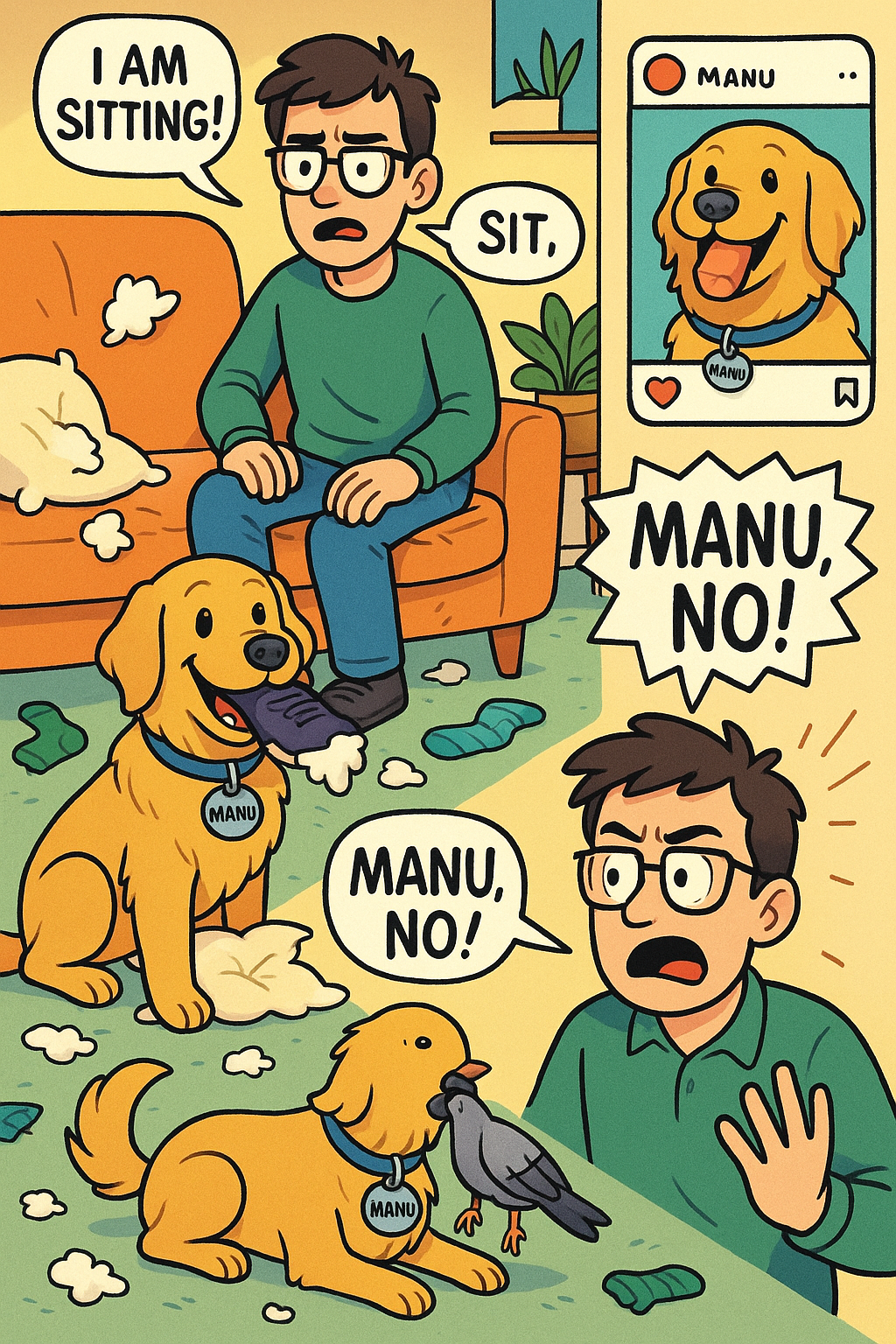
This isn’t just any dog. This is a fluffy, drooling tornado that eats sofa cushions and socks for breakfast. It once proudly presented a dead pigeon as a “gift”. And now, thanks to my dear lifelong friend, this creature shares my name.

Meet Manu.

Or rather, meet Dog-Manu.

I, the human Manu, now live in a world where people often mistake me for a top dog with boundary issues. It started innocently enough. One day, my friend called me and said, “Hey, I got a dog!” Sweet. Dogs are great. Then he added, “And I named him Manu!”

“After me?” I asked, thinking I might have misheard.  

“Yes! Because you’re loyal, funny, and always hungry. It just felt right.”

Right. Because who doesn’t want to be compared to a creature that thinks toilet water is a delicacy?

Even though my friend tried to placate me by saying that dog-manu has been named after his favourite football team, Manchester United (Man-U), it was just too fake for me to digest. 

To make things worse, every time I visit his house, it turns into a comedy of mistaken identity.

“Sit, Manu!”  

“I am sitting.”  

“No, not you. The one licking his nether regions.”

Oh. Good to know I’m the one who isn’t licking anything. Progress.

The other day, our mutual friend called me and exclaimed, “I saw a video of Manu on Instagram with a cube in his mouth!”  

I panicked. “What? When was this? Was I sleepwalking?”  

“No! The dog. Your namesake.”  

Of course. Because nothing screams “legacy” like being remembered as a four-legged menace with a vendetta against all household items.

I’ve also been getting some strange compliments.  

“Wow, Manu, you have such soft ears!”  

“Thanks, since childhood?”  

“Oh no, I meant the dog.”

Sure. Because I definitely needed another blow to my self-esteem.

There are some benefits, though. For example, now I know what it feels like to be loved unconditionally, vicariously, through a golden retriever. People light up when they hear my name, until they realize I don’t respond to belly rubs with tail wags.

But maybe the best part? Every time Dog-Manu gets in trouble for chewing a shoe or peeing on a rug, my friend yells, “MANU, NO!” and then looks at me apologetically, as if he just scolded me personally, which in a way, he has.

So if you’re wondering what it’s like to have your friend name a dog after you, I must say that it’s confusing, mildly humiliating, and an ultimate compliment in a weird way! 

After all, in dog years, I’ll be legendary for at least 87 more.

And let’s be honest, if someone had to be named after a stubborn, loyal, treat-obsessed creature who occasionally pees on rugs during thunderstorms, it might as well be me.

Long live Manu—the dog. And also me, I guess.

How Social Media Reels are Redefining Relationships

Social media has evolved over the last decade and more so during and post COVID-19 from a casual means of communication to a complex social ecosystem where relationships are not only maintained but also publicly measured, performed, and often misunderstood. The act of tagging someone in a post or sending a reel now frequently carries more weight than the content itself and appears to be a new language of intimacy, loyalty, and belonging.

Human relationships were always forged and maintained through physical presence, shared experiences, and mutual conversation. While those elements still hold value, social media platforms like Instagram, WhatsApp, and Facebook have changed social interaction. Friendship seems to have become ‘performative’ and is now getting increasingly defined by our digital gestures, who we tag, send content to, and frequently react to on social media. The exchange of DMs, reels, memes, and story replies may seem petty, but they have become the new currency of connection. In this new digital age, being remembered in someone’s “share” list is a modern affirmation of your place in their emotional world where time is divided and attention is commodified. It’s no longer the maturity of the friendship built over years defining the strength of the connection, this new phenomenon has been affecting and afflicting across all age groups from teens to people in their 70s!

What used to be simple rules for friendship, like coffee, conversations, and sharing silly jokes over text, has now changed. Friendship is now measured in direct messages, tags, and who receives the meme first. It’s no longer just about being included; it’s about being the first and only one included. Because nothing says “you matter to me” like a cat video at 3 AM. Social media platforms promote visibility and engagement. As a result, users develop interaction patterns that reflect this trend. Relationships are increasingly maintained through small interactions: likes, reactions, emojis, replies, and short content exchanges. These replace deeper communication, creating the illusion of closeness without needing much time or vulnerability.

Algorithmic affection is growing. If you engage often with someone’s content, they will show up more in your feed, and vice versa. This strengthens some relationships while quietly undermining others. Sometimes, a drop in communication doesn’t stem from emotional distance but rather because an algorithm has quietly removed someone from your digital view. Social media has turned even the smallest actions into emotional signals that are often unintentional. Reels are like modern-day carrier pigeons of affection, flying through algorithmic skies and delivering 60 seconds of inside jokes, shared interests, or passive-aggressive messages.

A subtle but clear hierarchy has formed in social groups based on digital content. Who sees the funny video first? Who is tagged in the inside joke? Who gets included in close friends’ stories? These digital hierarchies provide new social cues about belonging, preference, and even exclusion. This change creates anxiety and social tension, particularly for those who often read omissions or changes in online behaviour as signs of personal problems. We’ve all experienced this. You’re casually scrolling through the group chat, dodging memes and unwanted life updates, when you notice that your friend has been sending reels, but not to you. Instead, they are sending them to someone else in your friend circle. Betrayal has never looked so clear.

With constant connectivity and “always on” friendships comes an unintended consequence: relational burnout. There was a time when friendships were tested by forgotten birthdays. Now, deep emotional hurt comes from not being tagged in a reel or story about something entirely unrelated. The pressure to respond quickly, stay updated, and keep up with every friend’s online persona can drain the joy of connection. Friendship, once based on depth, now often depends on speed and consistency, two measures that reflect platforms more than people. This urgency leads to miscommunication. A late reply, a missed tag, or a seen-but-not-responded reel can be seen as disinterest or rejection, even if the reason is trivial. As a result, friendships suffer not from real conflict but from imagined slights born from the overly sensitive nature of digital interaction.

Soon, new measures of connection and relationships will emerge, and platforms will introduce new tools to assess your FQ (Friendship Quotient). Measure these three indicators, and you’ll have your FQ. Like quarterly or annual performance reviews at school, these FQ levels will shape the future of friendship.

Quality of friendship = (number of reels received × frequency of tags) / number of mutual story reacts. 

Closeness coefficient = number of times you get the reel before it appears on your public feed/total reels posted. 

Emotional intimacy level = number of times and frequency they send you the reel with “this reminded me of you” instead of a lifeless emoji.

Despite the challenges, social media offers new ways to show care and share thoughts. A well-timed meme or relevant reel can bring laughter, validation, and a shared moment of joy across distances. In an increasingly busy and scattered world, these exchanges can be lifelines.

But, like all technologies, mindful use is essential. As we adjust to this new relational landscape, we should consider, 

– Are we truly connecting, or just maintaining a facade of connection?

– Are we sharing to include others, or to show how close we are? 

– Are we interpreting digital silence too severely, or using it too carelessly?

In the end, while the medium has changed, the need for empathy, intention, and presence remains the same. Whether through reels, texts, or face-to-face conversations, what we all want is simple: to be seen, to be valued, and to know we matter.