What if you have already achieved enough
November 16, 2026 Leave a comment
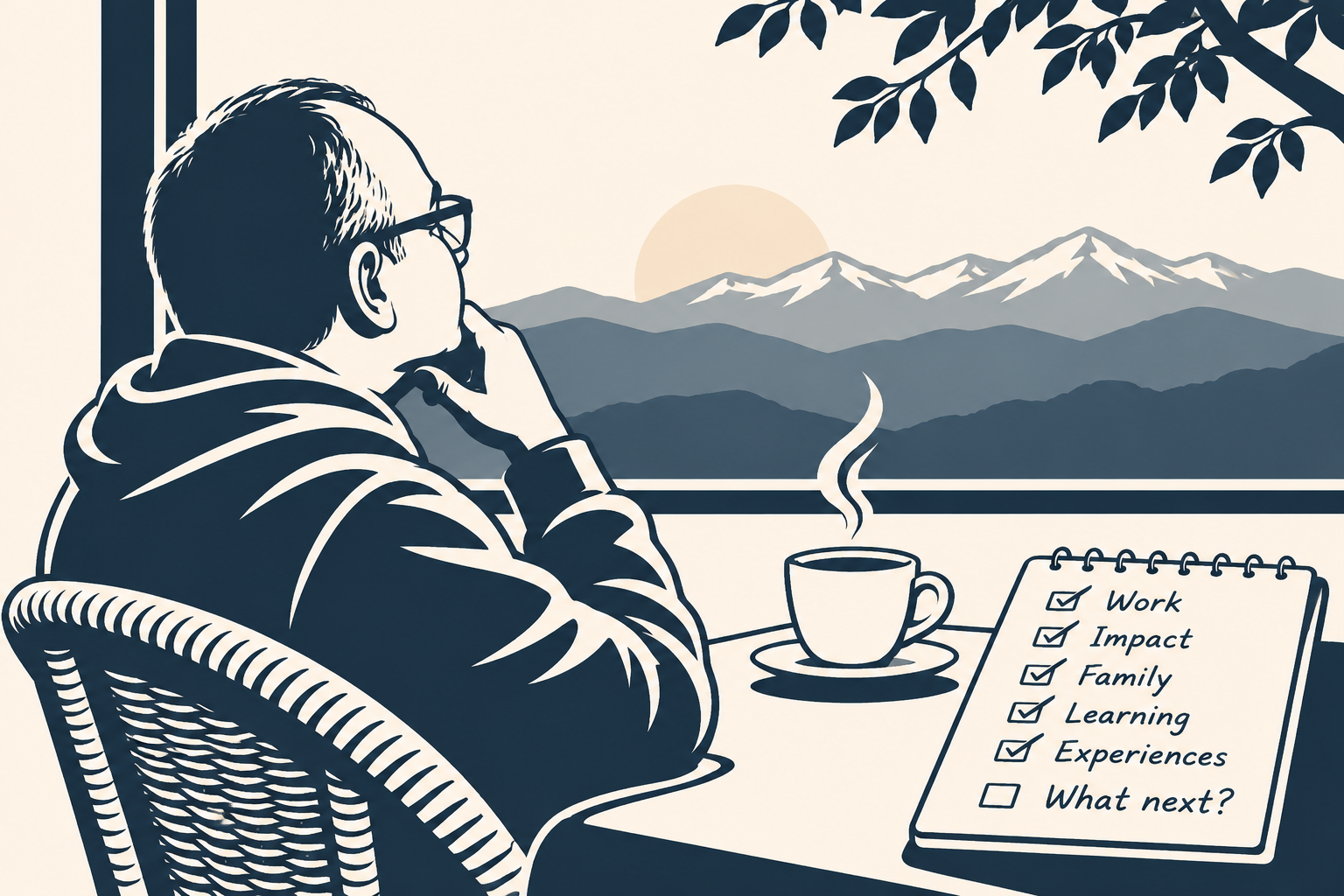
A few months ago, I was sitting alone on a Sunday morning, drinking coffee and thinking about everything I still needed to accomplish. There was no reason to be anxious, as the work was reasonably good, life was comfortable, the family was doing well, and most of the things I had worried about years earlier had somehow fallen into place. There were responsibilities, certainly, and a few unfinished ambitions, but nothing that could honestly be described as a crisis. Somehow, still my mind was busy making a list. There is a professional milestone I still want to reach, a few financial goals that need attention, skills that I want to learn, books I have been meaning to read, places I want to visit, and ideas I want to explore. I found myself thinking about the next five years, then the next ten. What should I achieve? What should I build? How could I make better use of the time ahead?
Suddenly, an uncomfortable thought interrupted this familiar exercise. What if I have already achieved enough? Not enough to stop growing or dreaming, but enough to acknowledge that the person I once desperately wanted to become is, in many ways, the person I have already become. Why was I finding it so difficult to enjoy that? I thought about the younger version of myself who had entered the development sector with a sense of purpose and an uncomplicated belief that meaningful work could make a difference. Over more than twenty years, that belief has taken me through different roles, institutions and professional challenges. I have worked with organisations, donors, foundations, businesses and government partners, trying to bring different interests and resources together around problems that are rarely simple. It has been a career shaped as much by persistence as by conviction.
Looking back, I can see how much of my professional life has been spent trying to become more capable, more experienced and more effective. Each role brought a new set of expectations, and each responsibility required a little more confidence and a little more knowledge. There was always another organisation to work with, another partnership to build, another program to design or another challenge to solve. I rarely stopped to ask whether I had reached a point at which I could simply acknowledge what I had learned and what I had contributed.
Perhaps this is one of the greatest contradictions of middle age. We are living parts of the life we once worked hard to create, and yet behaving as though we are still struggling to get there. We spend the first half of our lives preparing to enjoy the second. We study for good jobs, work to build careers, build careers to earn money, and earn money to acquire security. But when some of that security arrives, our minds have already moved on to the next ambition.
Ambition, of course, is not the enemy. For many of us, it begins with something deeply personal, such as the desire to escape difficult circumstances, prove ourselves, make our parents proud, establish independence, or create a life different from the one we inherited. In our 20s, ambition gives direction to uncertainty. It makes us work through difficult periods, take risks and accept responsibilities that may initially feel beyond our abilities. The world seems enormous, time appears unlimited, and every achievement feels like a stepping stone towards something greater. We make sacrifices because we believe they will eventually make sense. The difficulty is that ambition rarely retires voluntarily. The first promotion becomes a stepping stone to the next. The salary we once considered remarkable becomes the new baseline. Recognition, once received, quickly becomes an expectation. What once seemed extraordinary becomes ordinary. Psychologists call this hedonic adaptation, which is our tendency to adjust to improvements in our circumstances until they become part of our everyday expectations. We get what we wanted, enjoy it briefly, and then begin wanting something else. We seem to have trained ourselves to appreciate the pursuit more than the achievement.
I recognise this pattern in my own professional life. There was a time when gaining experience, being trusted with larger responsibilities and working on increasingly complex programs felt like significant milestones. Later, those things became the normal expectations of a career. The satisfaction of completing one chapter was often short-lived because another question had already appeared: What next? What would it take to move into a more strategic role? Could I work at a broader level? Could I contribute to shaping institutions and policy rather than primarily supporting programs and their implementation?
These are legitimate questions, but I have begun to wonder how much of this restlessness comes from genuine curiosity and how much comes from the belief that a career must keep moving upwards to remain worthwhile. This restlessness is reinforced by the invisible scoreboard against which we measure ourselves. We compare salaries, professional designations, houses, holidays, investments and the apparent success of people around us. Social media makes this particularly relentless. Someone becomes a CEO at forty, another completes a doctorate at fifty, someone else builds a successful business or retires early to travel the world. We see the announcements and photographs, rarely the compromises behind them. Somehow, their achievements become an indictment of our own lives.
There is always another benchmark, another person doing better, another definition of success to pursue. An externally defined idea of achievement has no natural endpoint. There will always be someone wealthier, more influential, more accomplished or better travelled. If our happiness depends on outperforming others, we have signed up for a race without a finish line. Perhaps maturity begins when we stop asking whether we are doing better than everyone else and start asking whether we are living a life that genuinely makes sense to us.
Middle age makes this question harder to ignore because our relationship with time begins to change. At 25, fifty seemed impossibly far away. Approaching fifty, the years ahead feel more tangible. We notice our parents ageing, children growing up, friends confronting health problems and familiar faces gradually disappearing from our lives. Time is no longer an abstract resource. We become aware that some opportunities have expiry dates. The body, too, begins negotiating with ambition. A sleepless night has consequences as recovery takes longer. Health becomes something we cannot indefinitely postpone in exchange for professional productivity. We become less interested in being everywhere and more interested in being somewhere that feels right.
I have found that this stage of life can produce a new kind of professional anxiety. After more than two decades in one sector, there is a natural desire to ask what else might be possible. I still have considerable energy and, I hope, many productive years ahead. I do not necessarily want to repeat the same professional chapter simply because it is familiar. I find myself drawn towards new areas of learning and work, like the intersection of technology and development, AI, research, social enterprise and the role of philanthropy and institutions in shaping change.
I have even considered returning to a full-time residential academic environment, studying again and putting myself in a setting where I would have to learn alongside people with different experiences and perspectives. The idea is exciting, but it also raises practical questions. Is this the right investment at this stage of life? Will it open new doors? Can I translate the experience I have accumulated into a different kind of professional contribution? Am I seeking knowledge, a new network and a wider horizon, or am I trying to reassure myself that I have not missed my chance to do something different? Perhaps the honest answer is that it is a little of all these things, and that is not necessarily a problem. Not every new ambition is a midlife crisis; sometimes it is simply a neglected part of us asking for attention. The challenge is to recognise whether we are moving towards something meaningful or merely running away from the discomfort of standing still.
Consider how many years we spend looking forward to milestones. We imagine how wonderful life will feel when we earn a particular salary, occupy a particular position or achieve financial independence. We construct elaborate pictures of the happiness waiting on the other side of success. And then we arrive as we get the job, receive the promotion, make the investment and reach the milestone. There is genuine satisfaction, perhaps for a few days or weeks. Then the mind begins its familiar negotiation of what next?
This is particularly true of people who have spent decades in demanding professional environments. Their identities become inseparable from being useful, productive, responsible and needed. Even leisure starts feeling like an unproductive activity. A holiday needs an itinerary, reading needs to produce knowledge, exercise needs measurable results, and a hobby must eventually become a skill. We have become so accustomed to optimising our lives that we have forgotten how to simply inhabit them.
We spend so much time trying to become someone that we rarely stop to consider whether we like the person we have become. We build professional, financial and social identities. We become dependable colleagues, experienced professionals, responsible parents and problem solvers. These identities give our lives structure, but they can also become prisons. At some point, we begin confusing our usefulness with our worth. We feel important when someone needs us, validated when someone appreciates our work, and relevant when someone seeks our opinion.
This is why retirement, career transitions and professional setbacks can be so unsettling, even for people who have achieved considerable success. They are not necessarily losing their abilities but are losing the familiar structures through which they have learned to recognise themselves. Perhaps the next stage of life requires a different question. Instead of asking, ‘What more can I become?’, we might occasionally ask, ‘Who am I when I am not trying to become anything?’
This does not mean abandoning ambition or settling for an unfulfilled existence. It means changing the reason for which we pursue things. There is a difference between studying because we fear becoming irrelevant and studying because we are genuinely curious. There is a difference between seeking a new role to prove that we are still capable of succeeding and seeking one because it offers a worthwhile challenge. There is a difference between travelling to demonstrate that we have lived an interesting life and travelling because the world continues to fascinate us.
The external activity may look identical, but the internal motivation is entirely different. Perhaps the healthiest ambition comes from curiosity rather than inadequacy. We work because we find meaning in contributing, learn because knowledge enriches us, and create because something inside us deserves expression. Ambition can remain an important part of our lives without becoming the measure of our worth.
I sometimes think about the Program I pursued at the University of Queensland, and what it meant to return to a formal learning environment after years of professional experience. There is a particular humility in being a student again. You are reminded that experience, however valuable, does not mean you have finished learning. You encounter unfamiliar ideas, discover gaps in your understanding and find yourself looking at familiar problems through a different lens. It can be invigorating. That experience has reinforced something I want to carry into the next stage of my life, the desire to remain intellectually curious. I do not want to keep learning simply to add another credential to my professional profile. I want to understand how the world is changing, how technology is reshaping development, how capital and institutions influence social outcomes, and where the experience I have accumulated might be useful in new contexts. There is still a great deal I want to explore. But I am beginning to understand that exploration does not have to become another race.
Imagine meeting your twenty five year old self. You might tell her/him about the work s/he would do, the people s/he would meet, the programs s/he would help shape and the challenges s/he would encounter. You might tell her/him that some dreams would come true, others would change, and a few would turn out to be less important than s/he imagined. You might tell her/him that s/he would acquire knowledge, make mistakes, build relationships and develop a professional identity that s/he could not yet picture.
And then you might tell her/him something s/he would find difficult to believe that one day, s/he would have a life that was, in many ways, quite good. Not perfect, not without regrets, and certainly not without unfinished business, but good. Would s/he be impressed? Would s/he feel relieved that so much of what worried her/him had eventually worked out? Would s/he ask why, despite everything, you still seem to be in such a hurry? Perhaps that is the conversation worth having. We have spent so much time becoming the person our younger selves wanted us to be that we have forgotten to appreciate the person we actually are!
I am increasingly drawn to the idea that the second half of life should not necessarily be about achieving more, but about experiencing more deliberately. I do not want to lose the appetite for difficult work, new ideas or professional reinvention. I still want to meet people who challenge my thinking, enter unfamiliar spaces and contribute to things larger than myself. But I also want to recognise that the years already lived have not merely been preparation for some more impressive future. They are the substance of my life.
There is dignity in the work we have done, the responsibilities we have carried, the people we have worked alongside and the problems we have tried to solve. There is also value in the things that will never appear on a CV, like the relationships sustained, the difficult periods navigated, the conversations remembered and the ordinary days that make up most of a life. Some books will remain unread, some countries will remain unvisited, some opportunities will pass, and some versions of us will remain possibilities rather than realities. This is not necessarily failure but the natural consequence of having one life and an infinite number of ways in which it could have been lived.
I think the real challenge of middle age is learning to live without constantly negotiating with the future. For so long, we have treated the present as a temporary arrangement, something to endure until life becomes more complete, more secure or more successful. We have been excellent at preparing for life, but perhaps less accomplished at actually living it. I sometimes wonder what would happen if, for a change, we stopped adding things to our ambitions and examined the lives those ambitions have already given us. Not through the lens of what is missing, but through the accumulated evidence of a life lived, the people who stayed, the difficulties we survived, the work we did, the mistakes we made, the knowledge we acquired, the causes we cared about and the ordinary mornings that somehow became years. There may be more substance there than our restless minds are willing to acknowledge.
I don’t think this means we should stop wanting things. I hope we never lose the curiosity to begin again or the courage to attempt something difficult. But perhaps we should become more selective about what deserves our remaining time. Not every opportunity is worth pursuing, not every ambition needs fulfilling, and not every unexplored possibility represents a missed life.
That Sunday morning, I never quite arrived at an answer. The lists, after all, are still there. There will always be something to improve, somewhere to go and something to accomplish. There may yet be another qualification, another professional transition, another idea worth pursuing. But I find myself occasionally looking at those lists differently. Instead of immediately asking what needs to be added, I wonder whether some things can simply be left as they are. Perhaps that is an important distinction between youth and middle age. When we are young, we measure life by what we hope to acquire. Later, we might learn to measure it by what we are willing to stop chasing. And perhaps, one of these Sunday mornings, I will finish my coffee without making another list. Not because I have run out of ambitions, or because I have decided that my story is complete, but because, for once, the life outside the window will seem interesting enough to hold my attention.
The cover image is generated using AI