What are we optimising for

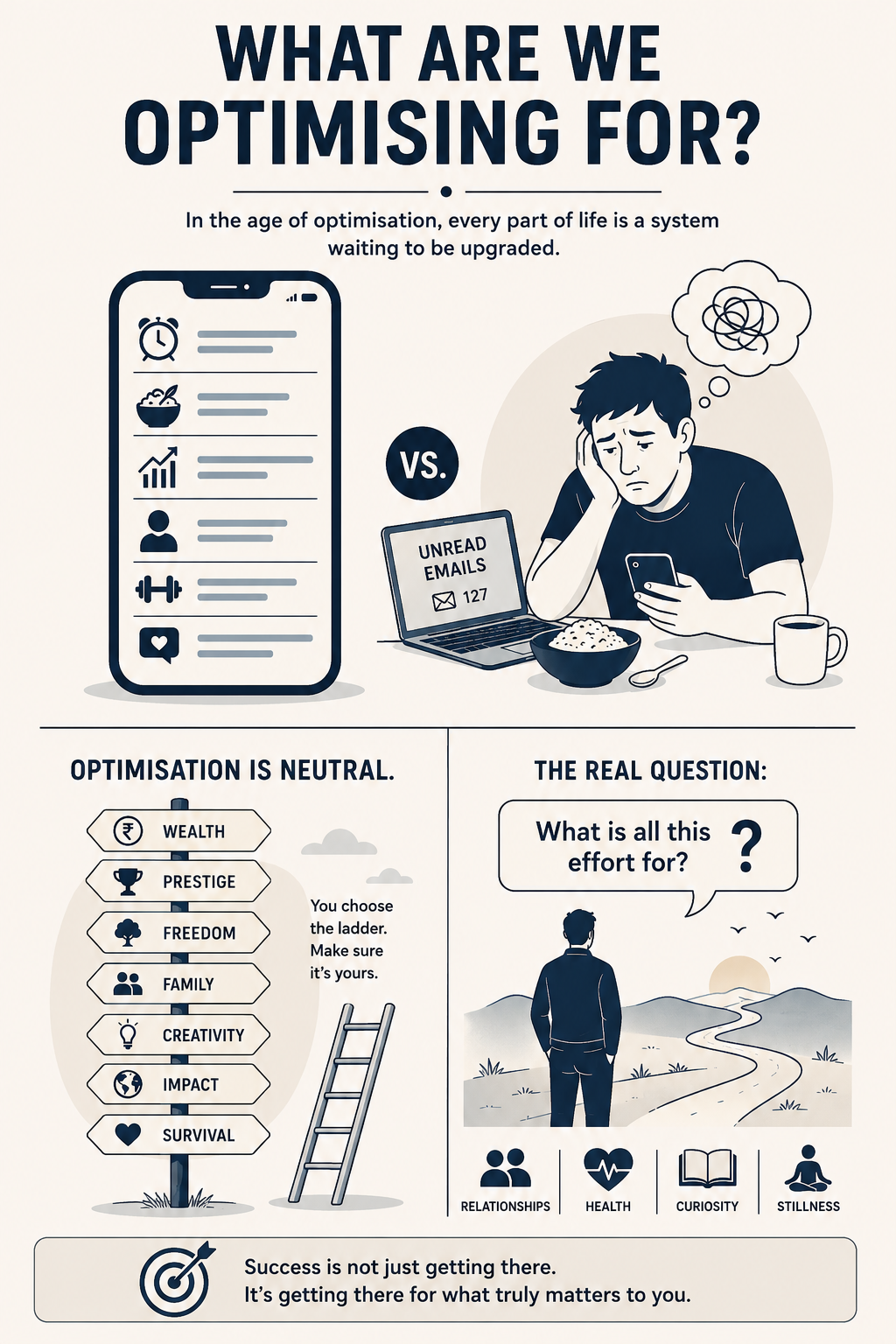
There is a peculiar anxiety that defines modern adulthood, which is the fear that somewhere, someone your age is living life better than you. They wake up at 5 AM to journal, meditate, go for a run or walk, consume protein-heavy breakfasts with ingredients you cannot even pronounce, maintain diversified investment portfolios, post thoughtful LinkedIn reflections about leadership, practice intermittent fasting, listen to podcasts at double speed, and somehow still find time to post photos captioned ‘grateful for the journey.’ Meanwhile, you are eating leftover biryani at 11 PM, ignoring unread emails, and wondering whether watching three back-to-back episodes of a series on OTT counts as self-care or surrender. Welcome to the age of optimisation, where every aspect of human life is treated as a system waiting to be upgraded.

Every time I am on my Instagram, it is showing me posts and reels on how to work harder, sleep better, network smarter, manage my relationships more efficiently, eat cleaner, learn faster, age slower, retire earlier and build passive income streams. I keep receiving spam on how to track my calories, my mood, my steps, my productivity, and my screen time (usually through apps that require even more screen time!). Human beings have never had more tools to improve their lives, yet many seem increasingly unsure about what all this relentless optimisation is actually meant to achieve. That question matters because optimisation itself is morally neutral. One can optimise for wealth, prestige, freedom, family, creativity, impact, or simply survival. The real danger begins when people optimise by default, without consciously deciding what destination they are trying to reach.

For much of human history, life paths were shaped by geography, class, castes, family structures, religion, and social expectations. A farmer’s son often became a farmer, and family businesses were inherited. Communities dictated rhythms of marriage, work, and social responsibility. These systems could be deeply restrictive, but they also answered major life questions before individuals had to confront them. Modern life replaced those rigid structures with unprecedented freedom, but that freedom has created its own exhaustion. Today, individuals can theoretically become anything, from a founder, consultant, artist, social development specialist, creator, digital nomad, climate entrepreneur, venture capitalist, to a wellness coach, or any number of job titles that appear to have been invented inside a coworking space brainstorming session. But when every path appears open, every decision begins to feel like closing off another possibility.

This conundrum is particularly visible in India, where rapid economic transformation has dramatically expanded aspiration. In cities such as Bengaluru, Mumbai, and Gurugram, millions of first-generation professionals are participating in one of the largest upward mobility experiments in modern history. Many are children of doctors, teachers, farmers, small business owners, or government employees whose sacrifices created opportunities their children could only dream of. Their children now work in multinational firms, startups, for-purpose organisations, consulting companies, and global technology firms. The opportunities are real, but so is the pressure. Success often carries responsibilities beyond personal fulfilment, as it repays family debt, funds siblings’ education, supports parents, and becomes a symbol of collective social mobility. Ambition, therefore, becomes deeply emotional because it often carries the weight of inherited dreams.

This phenomenon is hardly unique to the geographic boundaries of India. Similar pressures shape immigrant families in the United States, first-generation professionals in Kenya, and upwardly mobile households across Southeast Asia and Latin America. However, India’s sheer population scale makes this phenomenon particularly visible. At the same time, global workplace culture has become remarkably effective at turning ambition into identity. Work is no longer simply something people do, but it is increasingly defining who they are. At networking events (and even social ones, as I am experiencing), the first question is almost always ‘What do you do?’ Rarely does anyone ask what brings someone joy, what relationships they value most, or whether they feel at peace with their lives.

Modern workplaces reward speed, availability, and measurable outcomes. There is always another promotion cycle, another certification, another startup opportunity, another productivity framework, and another way to feel perpetually behind. Entire industries now thrive by convincing people they are one habit away from becoming better versions of themselves. Even leisure has been absorbed into ambition, as travel becomes networking with other travellers you meet at the airports, next seat, at breakfast tables, sunset viewing, and in the swimming pools, reading becomes content consumption, exercise becomes data analytics on your smartphone, hobbies become monetisable side hustles, and rest becomes recovery for more work. Recently, a friend joked that he can no longer enjoy a morning run unless his smartwatch confirms he enjoyed it efficiently, which may be one of the most accurate summaries of modern life.

Technology has intensified this culture by expanding the scale of comparison. Earlier generations compared themselves to neighbours, relatives, or colleagues. Today, individuals compare themselves with startup founders in San Francisco, creators in Seoul, bankers in London, and influencers in Dubai before breakfast. Social media ensures that there is always someone younger, wealthier, fitter, more accomplished, and apparently more fulfilled. What social media rarely reveals are burnout, loneliness, failed ventures, strained marriages, anxiety medication, or the existential doubts that often accompany visible success.

One of the strangest contradictions of elite ambition is that many people spend decades optimising for lifestyles they barely have time to enjoy. Prestigious jobs leave little room for family, and dream vacations are interrupted by work calls. This is not an argument against ambition itself, as ambition can be deeply meaningful. It can lift families out of poverty, create institutions, solve major problems, produce art, and expand human progress. The problem is unconscious ambition. If someone wants to optimise for income, there is nothing inherently wrong with that. If someone prioritises freedom, impact, family, or creativity, those are equally valid choices. The important thing is understanding which game one is playing. Too many people are climbing ladders handed to them by parents, peers, employers, or algorithms without ever asking whether they wanted to climb those ladders in the first place.

The absurdities of optimisation culture become visible in everyday life. People optimise their routines while neglecting friendships, chase promotions while postponing health, expand professional networks while losing touch with siblings, or save aggressively for retirement while forgetting how to enjoy their lives in the present. Many work relentlessly for future freedom as though the future is guaranteed, but it is not, as layoffs and illness happen,  political systems become unstable, and entire industries disappear. The future remains far less controllable than optimisation culture would like people to believe.

That uncertainty can feel frightening, but it can also be liberating. If life is fundamentally unpredictable, perhaps the goal should not be maximum efficiency. Perhaps the goal should be building a life that feels coherent, a life where work matters but does not consume identity, where ambition exists without becoming an addiction, and where success includes relationships, health, curiosity, and moments of stillness. It may mean creating a calendar that reflects actual values rather than external expectations.Ultimately, every individual must confront the most important question for themselves: ‘What is all this effort for?’ Not what impresses employers, relatives, social media followers, or algorithms, but what genuinely matters on a personal level. For some, the answer may be financial security. For others, it may be family, entrepreneurship, public service, writing, travel, or a quieter life built around enough rather than endless accumulation. The greatest tragedy of modern life may not be failure, but may be becoming extraordinarily efficient at pursuing goals that were never truly your own.

Confessions of a Fundraiser

By a Head of Development, who has been there, done that. 

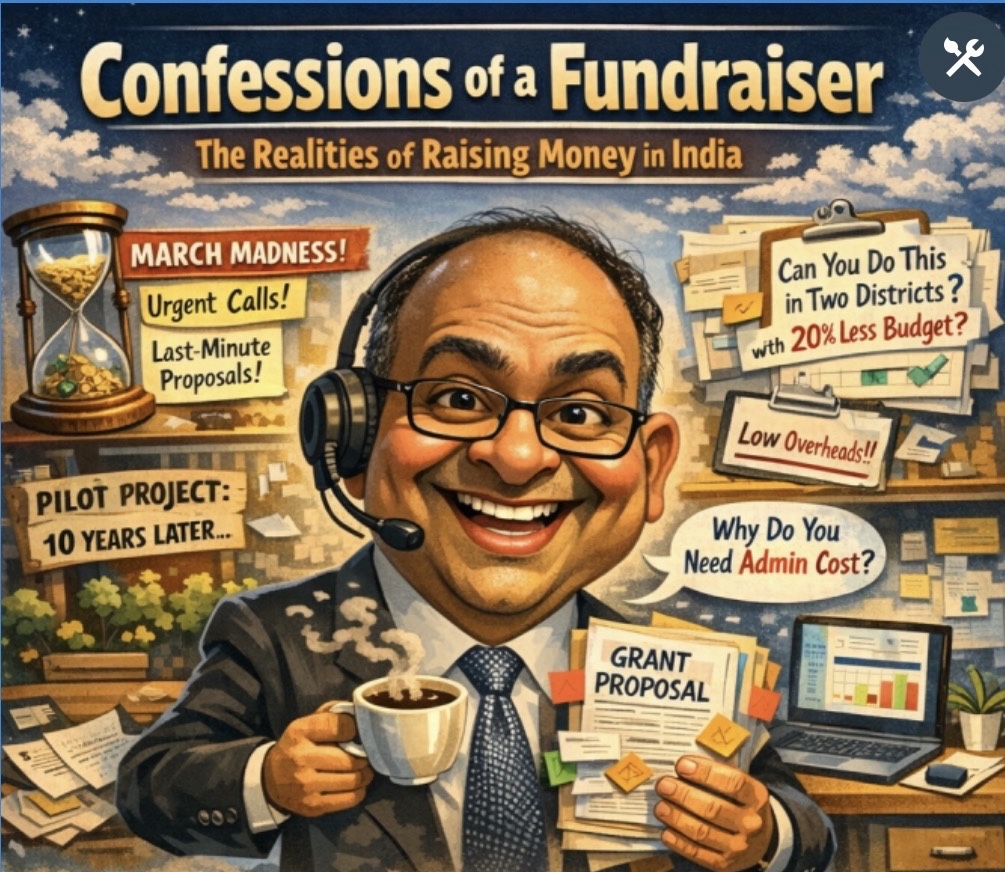
I have spent a good part of my career raising funds for livelihoods and entrepreneurship, environmental sustainability, and digital inclusion. These are kinds of work that everyone agrees are deeply important, and expects to be delivered at miraculous speed, near-zero overheads, and with measurable transformation visible by the next board meeting! Over the years, I have learned that in India’s funding universe, March is not just a month but a mood, where phone calls are returned with unprecedented urgency, proposals are rediscovered with fresh enthusiasm, and sustainability plans are requested even before the first grant tranche has cleared. I have learnt to speak fluently about empowerment while explaining, with equal conviction, why empowerment requires trainers, coordinators, field activities, local transport, and a field office. I have learnt that pilots can run for a decade and still be called pilots, that social impact is expected to be both transformative and inexpensive, and that the most common expression of donor admiration is, ‘This is excellent work. Can you replicate in two districts with 20% less budget?’ And yet, I have also learnt that when trust is built patiently, and partnerships are approached as shared responsibility rather than transactional funding, the system does work, unevenly, imperfectly, but often just in time.

If you ever want to test your emotional resilience, professional patience, and metaphysical belief in destiny, try becoming a fundraiser for social impact in India. Not as a hobby or a phase in life, but as a full-time, salaried, KPI-driven profession where your success is measured in crores raised, relationships sustained, and hopes renewed, often all before lunch. Fundraising in India is not a job; it is a personality type. It is a slow-burning spiritual practice. It is also, on some days, a contact sport.

Most fundraisers do not grow up dreaming of this life. No child has ever said, ‘When I grow up, I want to write concept notes, follow up politely seven times, and still be told the CSR budget has already been exhausted for this year.’ Fundraisers are usually people who joined the development sector with good intentions and then stayed because they discovered a rare combination of optimism, masochism, and an above-average tolerance for ambiguity. In India, fundraising also requires fluency in multiple dialects, not linguistic ones, but donor dialects. You must speak CSR, philanthropy, family office, multilateral, HNI, trust, and the particularly tricky language known as ‘let’s take this offline.’

Every fundraising journey begins with a proposal that is equal parts strategy and speculative fiction. A document that must be simultaneously visionary and realistic, innovative yet ‘scalable,’ rooted in community voice and at the same time aligned to the donor’s thematic priorities for the current financial year. The proposal must do many things at once: ‘Solve poverty + empower women + be sustainable by the third year + align with SDGs (preferably all of them) + cost exactly the amount the funder has available + have low overheads but world-class MEL.’ You will spend weeks refining language, perfecting logframes, and polishing budgets, only to be asked in the first meeting, ‘Can you explain this in two lines?’ You will smile, compress your knowledge of years of community work into a sentence, and remind yourself that clarity is a virtue, even when it hurts.

Sooner or later, every fundraiser in India faces the great philosophical question of our time: Why do you need staff to run a project? Recently, another question got added to my great list when a funder asked me, ‘Why do you need field offices to implement a community-based high-touch project?’ Mind you, I managed a straight-faced answer, without any smirk or sarcasm, even though I cursed the day I decided to be a fundraiser.

Admin costs are a suspicious category in the minds of Indian donors. They include dangerous items like salaries, rent, electricity, and internet, none of which, apparently, contribute to impact. As a fundraiser, you become adept at explaining that projects do not run on goodwill and sunlight alone. That field teams do not teleport. That data does not collect itself. You learn to say ‘lean but adequate,’ ‘efficient yet ethical,’ and ‘value for money’ with full sincerity. I have even attempted some humour at times on the negotiation tables, saying, ‘Without admin costs, the project will still exist, but just as an idea.’ Results vary post such statements.

What I have understood is that fundraising in India is less about money and more about relationships. Money is merely the by-product of trust built over years, conversations, coffees, conferences, and carefully worded WhatsApp messages. I have learnt that a ‘quick call’ can last an hour or more, a ‘small grant’ can require six levels of approvals and may take two years; silence doesn’t mean rejection (or acceptance); words from leadership are golden, but if you don’t have that in writing, you are screwed. The fundraiser’s greatest skill is not writing; it is patience. You patiently wait for responses, for board meetings, for the next quarter, for the funder who loved your work but is noncommittal. You wait with optimism, and dignified reminders, gentle ones every couple of weeks.

Then comes the project visit by the funder, usually by some of their board members and senior leadership. Often, they bring moments of high drama along with it. For the donor, it is a glimpse into our community-connect and implementation efficiency. For a fundraiser, it often turns into a logistical marathon involving vehicles, weather, community leaders, beneficiaries, translators, photographers, and a strong hope that nothing goes wrong. In all such visits, we fundraisers pray to some invisible power that the roads are navigable, community meetings start on time, funder’s visibility is primed, and no one asks an unplanned question about funding gaps. If all goes well, the funder says, ‘This is so impactful.’ You nod, beaming. You make a mental note to follow up in three days. At the beginning of my fundraising career in India two decades ago, I often ended up being shocked by the variety of demands by donor representatives visiting project sites. Thanks to the information age, the visiting representatives nowadays are well informed and often invested in social change.

Fundraisers also live at the intersection of data and dignity, translating lived experience into metrics without stripping it of meaning.Indian donors want data and stories, and at times, even at the cost of losing the bigger picture. You learn to convert human change into numbers without losing the soul of the work. You say things like, ‘4025 women trained’, and then you add, ‘Meet Sunita, who now earns independently and negotiates at home.’ You know that neither is sufficient alone, and the narrative together, they might just unlock the next tranche.

How can I forget the ultimate sword of big NO! Rejection is a constant companion of us fundraisers, like a dark shadow. Sometimes polite, sometimes vague, and sometimes dressed up as ‘great work, but not this year.’ You learn not to take it personally, mostly. You also learn that today’s rejection can be tomorrow’s opportunity, because India’s funding ecosystem is small, relational, and cyclical. The donor who said no last year may say yes next year, after changing jobs, priorities, or perspectives. So you keep the door open, always.

Fundraising is emotional labour. You hold hope for communities, for organisations, for teams whose salaries depend on your ability to convince someone that change is worth investing in. You are optimistic on behalf of others, even on days you feel tired. You absorb anxiety, translate urgency, and project confidence. You celebrate quietly when funds come through, and cushion disappointment when they don’t. You are expected to be resilient, persuasive, strategic, and endlessly positive. No one tells you this in job descriptions.

And yet, despite the follow-ups, the spreadsheets, the rejections, the ‘please reduce your budget by 15-20%,’ and often ending up becoming a football between the funder and the grantee management, we choose to stay. Because once in a while, a funder truly listens. Once in a while, a partnership feels equal. Once in a while, funding aligns perfectly with need, timing, and trust. And in those moments, you remember why fundraising matters. Because social impact does not scale on passion alone. It scales on resources, relationships, and people willing to ask again and again for something better.

So here’s to the fundraisers in India: The translators. The bridge-builders. The professional optimists. May your proposals be read, your follow-ups answered, and your impact always exceed your budgets. And may you never lose your sense of humour. Wishing you strong coffee, timely approvals, and generous funders, today and always.

May the force be with you!