Behavioural Systems Approach to Rural Entrepreneurship Development

The popular approach to rural entrepreneurship in India often includes providing poor households with access to credit, skills training, subsidies, or market linkages, which will naturally lead to entrepreneurship development. This assumption has shaped countless development programs led by governments, NGOs, microfinance institutions, and multilateral agencies. Two individuals living in the same village, receiving identical training and similar financial support, often experience vastly different entrepreneurial trajectories. One may build a sustainable enterprise, expand into new markets, and improve household income, while another may abandon the effort entirely despite possessing comparable resources. Conventional development frameworks struggle to explain this divergence because they remain overwhelmingly focused on material inputs rather than behavioural systems.

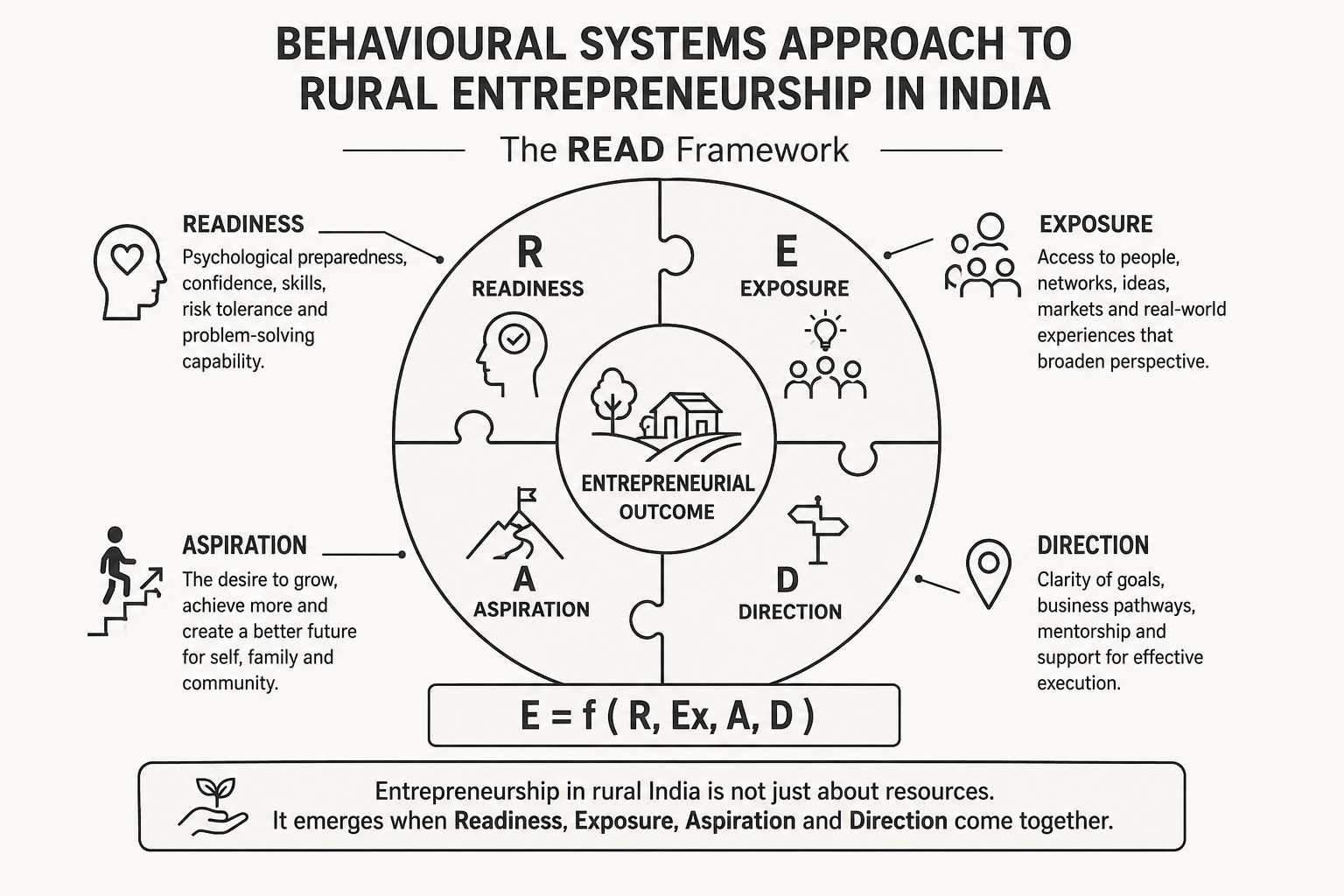
I am proposing the READ Framework (Readiness, Exposure, Aspiration, and Direction), which can shift the analytical lens from resource scarcity to behavioural conditions that shape economic action. Rather than treating entrepreneurship as a linear outcome of financial or technical support, the model suggests that enterprise creation depends on a dynamic interaction between psychological preparedness, social exposure, aspirations for mobility, and clarity of execution pathways. This perspective is particularly important in contemporary India, where entrepreneurship has become central to the national development narrative, and yet rural livelihoods remain constrained by social inequality, institutional gaps, and behavioural barriers that are often invisible within conventional policy frameworks.

India’s economic transformation over the past three decades has generated significant growth, but it has also exposed structural contradictions. Although India aspires to become a major global economic power, a large proportion of its population continues to live in rural areas dependent on fragile agriculture-based livelihoods. According to the World Bank, nearly two-thirds of India’s population still resides in rural areas, while agriculture contributes a relatively small share of GDP. This imbalance has intensified pressure on rural households to diversify income sources beyond farming. Rural entrepreneurship is therefore increasingly viewed as a pathway for employment generation, women’s empowerment, local economic resilience, and reduction of distress migration. Government initiatives such as Startup India, Mudra Yojana, and the National Rural Livelihoods Mission reflect this policy emphasis. However, despite substantial investments in microcredit, self-help groups, and skill development programs, many interventions continue to produce limited or unsustainable outcomes. The limitations of conventional entrepreneurship models arise partly from their assumption that individuals act rationally once economic barriers are removed. The prevailing logic can be summarised as a straightforward sequence of inputs leading to skills, enterprise, income (Inputs -> Skills -> Enterprise -> Income).

Development economists such as Abhijit Banerjee and Esther Duflo have demonstrated that poverty fundamentally shapes cognition and decision-making. Scarcity creates what behavioural economists describe as a ‘bandwidth tax,’ reducing people’s ability to plan long-term, tolerate risk, or experiment economically. Poverty is therefore not merely a shortage of money, but a condition that influences imagination, confidence, emotional resilience, and perceptions of possibility. The READ framework is developed upon this intellectual foundation but advances it further by conceptualising entrepreneurship as an interconnected behavioural ecosystem rather than a collection of isolated economic variables.

The framework proposes that entrepreneurial outcomes are a function of four interacting dimensions: Readiness, Exposure, Aspiration, and Direction.

E = f(R,Ex,A,D)

The formulation is simple and treats entrepreneurship as emergent behaviour rather than a direct consequence of inputs. This framework rejects the assumption that entrepreneurship automatically emerges when capital or skills are introduced. Instead, it recognises that deficiencies in any one behavioural dimension can undermine the entire entrepreneurial process. An individual may possess technical capability but lack confidence, another may have ambition but no understanding of viable business pathways, making entrepreneurship an emergent behaviour shaped by multiple interacting conditions rather than a predictable economic reaction to incentives.

The first dimension, Readiness, refers to the psychological and situational preparedness required to undertake entrepreneurial activity. This includes emotional resilience, confidence, time availability, family support, and willingness to tolerate and adapt to uncertainty. In rural India, readiness is deeply shaped by social structures such as gender norms, caste hierarchies, and family expectations. A rural woman may receive training in tailoring, computer operations, or food processing yet still hesitate to establish a business because domestic responsibilities, mobility restrictions, or patriarchal control limit her ability to act independently. Similarly, entrepreneurs belonging to marginalised communities may face exclusion from traditional market networks or social resistance when attempting to enter certain occupations. Readiness, therefore, is not simply an individual psychological trait but a socially conditioned state shaped by power relations and everyday realities.

Readiness also resonates strongly with the capability approach developed by Amartya Sen, who argued that development should be understood not just in terms of resources but in terms of people’s actual freedoms to pursue lives they value. Sen distinguishes between capabilities and functioning. Individuals may possess capabilities in theory, yet structural and social constraints may prevent them from converting those capabilities into real economic action. The READ framework extends this insight into the domain of entrepreneurship by recognising that the existence of opportunity alone does not guarantee participation.

The second dimension, Exposure, is about the importance of social learning, networks, role models, and market visibility. Entrepreneurship is rarely an isolated individual act, and is deeply influenced by social environments. Individuals often become entrepreneurs because they observe others navigating similar pathways successfully. In many rural communities, however, exposure to growth-oriented enterprises remains extremely limited. People may encounter only subsistence-level economic activity and therefore struggle to imagine entrepreneurship beyond survival-oriented self employment. A young person in a remote village who has never interacted with digital commerce, branding strategies, or scalable enterprises may lack exposure to viable economic possibilities, and not necessarily ambition or intelligence.

Economic sociology has consistently demonstrated the importance of networks in shaping entrepreneurial success. Urban startup ecosystems thrive partly because of dense social environments that provide mentorship, peer learning, investment access, and visible examples of success. Rural entrepreneurship programs often fail to replicate such ecosystems because they focus narrowly on asset distribution or technical training. The READ framework’s emphasis on exposure therefore addresses a major gap in existing development practice. Exposure is not simply informational, as it also creates legitimacy. Seeing people from similar social or economic backgrounds succeed changes what individuals believe is socially and economically possible for themselves.

The third dimension, Aspiration, is socially conditioned and unevenly distributed. Development programs frequently assume that poor households naturally aspire toward upward mobility. Sociologist Pierre Bourdieu argued that social structures shape individuals’ ‘horizons of possibility,’ influencing what they perceive as achievable for people like themselves. Similarly, economist Debraj Ray has written extensively about the ‘aspirations window,’ suggesting that exposure to successful peers influences economic ambition and long-term planning.

In many rural contexts, especially among historically marginalised communities, entrepreneurship may not appear imaginable as a pathway to transformation. Young people may aspire primarily toward government employment or urban migration because these trajectories are socially visible and culturally validated. In contrast, business ownership may appear risky, uncertain, or inaccessible. The READ framework recognises that aspiration is not simply a motivational issue but a socially produced cognitive condition. This insight has profound policy implications because it suggests that entrepreneurship promotion requires more than financial support, and often also requires interventions that expand people’s imagination of possible futures.

The fourth dimension, Direction, refers to clarity regarding viable pathways, execution strategies, and market navigation. Many rural entrepreneurs possess determination and ambition but lack strategic guidance. They may not know how to identify profitable sectors, understand customer demand, access supply chains, navigate regulations, price products competitively, or scale operations sustainably. Traditional entrepreneurship programs frequently provide generic training but fail to offer long-term mentoring or strategic support. Participants may learn technical skills without understanding how to build viable enterprises in dynamic market environments.

Direction has become increasingly important in India’s digital economy, where market participation requires familiarity with e-commerce platforms, logistics systems, digital payments, and branding practices. Without adequate guidance, rural entrepreneurs often remain trapped in highly localised, low-margin markets vulnerable to competition and economic shocks. The READ framework’s emphasis on direction therefore highlights the need for sustained mentoring ecosystems rather than one-time training interventions.

The proposed READ framework uses a systems orientation, with an understanding that human behaviour does not operate through isolated causal pathways. Entrepreneurial action emerges from interactions between psychological, social, economic, and institutional conditions. A person may possess high aspiration but lack direction, leading to frustration rather than enterprise creation. Another may have exposure to successful entrepreneurs but insufficient readiness due to household resistance or emotional insecurity. By recognising these interactions, the framework aligns with broader systems-thinking approaches increasingly influential in public policy and development studies.

The framework can prove to be useful when examining women’s entrepreneurship in rural India. Many livelihood programs targeting women measure success primarily through participation rates or loan disbursement numbers. However, women’s formal inclusion in enterprise programs does not necessarily translate into genuine entrepreneurial autonomy. Women may technically own businesses while male family members control decision-making and finances. The READ framework suggests a more nuanced understanding of these realities by examining the behavioural and social conditions surrounding enterprise participation. A woman may receive training and capital yet still lack readiness because of household opposition, exposure because of mobility restrictions, aspiration because of internalised gender norms, or direction because she lacks mentorship networks. This multidimensional perspective provides a richer understanding of why many women-led enterprises remain small-scale and economically vulnerable despite extensive policy attention.

At the same time, the framework raises important conceptual and methodological questions. Behavioural dimensions such as aspiration or readiness are difficult to quantify reliably. Self-reported surveys may suffer from social desirability bias, contextual inconsistencies, or cultural variation. Constructing a robust ‘READ Index’ would therefore require careful psychometric validation and adaptation across diverse social contexts (I am working on defining and designing the Index, and will publish once I am ready). Rural India is not a uniform behavioural landscape, as aspirations, gender norms, and economic expectations vary significantly across regions, castes, religions, and linguistic communities.

Another concern is that behavioural frameworks can unintentionally shift responsibility onto individuals while underemphasizing structural inequalities. Entrepreneurial failure is not always the result of behavioural deficiencies. Infrastructure gaps, poor logistics, corruption, climate shocks, monopolistic market structures, and digital exclusion remain major constraints. A highly motivated entrepreneur with strong exposure and clear direction may still fail because of unreliable electricity, exploitative intermediaries, or lack of transportation infrastructure. Behavioural systems approaches should therefore complement rather than replace structural analysis. Otherwise, there is a risk that development discourse becomes overly individualised, framing poverty as a problem of mindset rather than political economy.

The framework also raises broader questions about the increasing romanticisation of entrepreneurship within contemporary development policy. Entrepreneurship is often presented as a universal solution to unemployment and rural distress. However, not every individual seeks or benefits from entrepreneurial risk. Many rural households prioritise stability and security over growth-oriented enterprise. Excessive emphasis on entrepreneurship can obscure the state’s responsibility to generate decent employment, strengthen public services, and reduce structural inequality. The READ framework has the potential to become most valuable when used as an analytical and program-design tool rather than as an ideological justification for reducing state responsibility.

Despite these concerns, the framework can offer substantial practical relevance for policymakers, NGOs, and development practitioners. If empirically validated, it could reshape the design of rural livelihood programs across India. Interventions could move beyond transactional models toward more relational and behaviourally informed approaches. Programs might assess behavioural readiness before enrollment, create peer-learning ecosystems, facilitate exposure visits, incorporate aspiration-building modules, involve families in sensitisation processes, and provide long-term mentoring rather than short-term training alone. Such approaches would recognise entrepreneurship as a socially embedded process rather than merely an economic activity.

The broader significance of the READ framework is in its attempt to bridge economics, sociology, behavioural science, and development practice. It recognises that poverty is not solely material deprivation but also a condition that shapes agency, imagination, and action. By integrating behavioural insights with systems thinking and capability theory, the framework challenges simplistic assumptions about how development occurs. It asks a deeper question than most entrepreneurship programs currently address, that why do some individuals act on opportunity while others facing similar conditions do not? The answer to that question may be central not only to rural entrepreneurship policy but to the future of inclusive development in India itself.

References

  1. Abhijit Banerjee and Esther Duflo, Poor Economics, PublicAffairs, 2011.
  2. Amartya Sen, Development as Freedom, Oxford University Press, 1999.
  3. Debraj Ray, Aspirations, Poverty, and Economic Change, Oxford University Press, 2006.
  4. Pierre Bourdieu, Outline of a Theory of Practice, Cambridge University Press, 1977.
  5. World Bank rural population and development indicators.
  6. International Labour Organization reports on informal economies and entrepreneurship.
  7. NITI Aayog policy papers on women entrepreneurship and rural livelihoods.
  8. National Rural Livelihoods Mission (Government of India) operational and policy documents.

Invisible Entrepreneurs

Across rural India and much of the developing world, millions of women wake up before dawn, manage households, tend to livestock, cultivate small plots of land, process food, stitch garments, rear poultry, trade locally, and keep families economically afloat through a variety of income generating activities. Despite their relentless productivity, most of this work does not count as ‘business’ in policy frameworks, financial systems, or even social imagination. These women are workers, contributors, and risk takers, but are rarely recognised as entrepreneurs. Their labour remains invisible, undervalued, and structurally excluded from the very systems meant to promote enterprise and growth.

The invisibility of rural women entrepreneurs is not accidental. It is the outcome of deeply entrenched economic definitions, gender norms, institutional biases, and measurement failures that collectively erase women’s work from formal recognition. To understand why rural women’s enterprises remain unseen, one must look beyond individual capability or ambition and examine how ‘business’ itself is defined, counted, and legitimised.

Entrepreneurship has a narrow and exclusionary definition. In mainstream economics, a business is typically imagined as a registered entity, operating from a distinct workspace, producing for markets beyond the household, employing labour, and generating measurable profits. This definition immediately excludes most rural women, whose enterprises are often home-based, seasonal, informal, and interwoven with domestic responsibilities. When a woman processes grains, sells homemade snacks, stitches clothes for neighbours, weaves handloom products, or rears goats for periodic sale, her work is seen as an extension of household duty rather than economic activity. The fact that it generates income is treated as incidental, not central.

This conceptual blindness is further reinforced by national accounting systems. Gross Domestic Product calculations and labour force surveys systematically undervalue or exclude unpaid and semi-paid work. Women’s labour in family farms, household enterprises, and informal trade is often categorised as ‘assisting’rather than ‘ownership’ work. Even when women contribute substantial labour and decision-making, land titles, business ownership, and enterprise registration are typically in men’s names. As a result, women disappear statistically, even when they are economically indispensable.

Social norms further deepen this invisibility, as in many rural societies, men are perceived as breadwinners and women as caregivers, regardless of actual income contribution in the households. When a man sells produce in the market, he is seen as doing business. When a woman does the same, it is often framed as ‘helping’ the family. Earnings generated by women are frequently pooled into household income, while men’s earnings are recognised as individual contribution. This asymmetry strips women of entrepreneurial identity and reinforces the idea that their work lacks independent economic value.

The location of women’s work also plays a critical role in its invisibility. Because women’s enterprises are commonly home-based, they blur the line between productive and reproductive labour. The home, traditionally associated with unpaid care work, becomes a site where economic activity is rendered invisible simply because it does not conform to spatial norms of business. While a shop has legitimacy, a kitchen does not; a workshop is considered productive, but a courtyard is not. This spatial bias penalises women whose mobility is restricted by safety concerns, social norms, accessibility, or caregiving responsibilities.

Most rural women operate outside formal regulatory frameworks, not as their choice but by necessity. Registration processes are complex, documentation-heavy, and poorly aligned with women’s realities. Limited literacy, lack of identity documents, absence of land titles, and dependence on male family members make formalisation difficult. Formal financial institutions, in turn, rely on formal registration to extend business credit, insurance, and market linkages. This creates a vicious cycle, where women remain informal because systems exclude them, and systems exclude them because they remain informal.

Despite extensive evidence that women are reliable borrowers and effective managers of small enterprises, rural women face disproportionate barriers to credit and access to formal business financing. Collateral requirements favour land and property ownership, which women rarely possess. Credit histories are tied to formal transactions that women are excluded from. Even microfinance, often celebrated as a solution, has limits. Loans are frequently used for household consumption rather than enterprise expansion, and women bear repayment responsibility without gaining corresponding control over assets or profits. Financial inclusion without entrepreneurial recognition risks turning women into financial intermediaries rather than empowered business owners.

Rural women tend to operate at the lowest end of value chains, engaged in production rather than aggregation, branding, or marketing. They sell in local haats (markets), through informal networks, or to middlemen who capture most of the value. Because their scale is small and operations fragmented, their economic contribution is dismissed as marginal. Yet, collectively, these micro-enterprises form the backbone of rural economies, sustaining food systems, crafts, services, and local trade.

The development sector itself has played an ambivalent role in reinforcing invisibility. Programs targeting rural women often frame entrepreneurship as a social development or empowerment intervention rather than a serious economic strategy. Women are encouraged to ‘supplement’ household income, and not to build scalable enterprises. Training focuses on skills rather than markets, confidence rather than capital, participation rather than profit. While these interventions have value, they inadvertently reinforce the idea that women’s enterprises are secondary and subsistence-oriented and not engines of growth.

Most measurement surveys and impact assessments rely on indicators that fail to capture women’s economic realities. Metrics such as revenue, employment generation, or formal registration overlook non-monetary contributions, seasonal income, risk mitigation, and household-level decision making. Women’s enterprises are often judged against male norms of entrepreneurship, setting them up to appear less productive or ambitious, when in fact they operate under entirely different constraints. When women’s work is not recognised as business, they are excluded from policy support, denied access to finance, overlooked in market development initiatives, and marginalised in economic planning. This exclusion perpetuates gender gaps in income, assets, and agency. It also represents a massive loss to economies that fail to harness the full potential of half their population.

There is growing evidence that recognising and supporting rural women entrepreneurs yields significant economic and social returns. Studies show that women are more likely to reinvest earnings in nutrition, education, and health, creating intergenerational benefits. Women-led enterprises contribute to local resilience, especially in contexts of climate stress, migration, and economic shocks. Yet, without recognition, these benefits remain undervalued and underleveraged. Changing this reality requires a fundamental shift in how entrepreneurship is conceptualised and operationalised. Definitions of business must expand to include informal, home-based, and collective enterprises. Economic contribution should be measured not only by scale and formality, but by sustainability, resilience, and impact. Data systems must be redesigned to capture women’s work accurately, including unpaid and semi-paid labour, joint ownership, and household enterprises.

Institutional reforms are needed to lower barriers to formalisation without penalising informality. Simplified registration, group-based enterprises, and recognition of alternative forms of collateral can help bring women into formal systems on their own terms. Financial products must be tailored to women’s enterprise cycles, risk profiles, and asset constraints. Credit should be linked to capacity building, market access, and asset ownership, not just repayment discipline. Market interventions must move beyond production to address value chains holistically. Supporting aggregation, branding, digital access, and collective bargaining can help women capture greater value. Technology, if designed with women’s realities in mind, can play a transformative role by reducing mobility constraints and expanding market reach. However, as experience shows, access alone is insufficient without confidence, trust, and institutional support.

Finally, social norms must be confronted directly, as recognition is not only a technical issue but a cultural one. When communities, families, and institutions begin to see women as entrepreneurs rather than helpers, power dynamics shift. Legal recognition, public visibility, and role models matter, and so does language. Calling women ‘business owners’ instead of beneficiaries is a political act, and not just semantics. Invisibility is not a natural state, and is produced through choices about what counts, who counts, and whose work is valued. Rural women have always been entrepreneurs in practice, even if not in name. Making their work visible is not about charity or inclusion alone, but it is about economic realism. Until rural women’s enterprises are recognised, measured, and supported as legitimate businesses, development efforts will continue to underestimate both the problem and the potential.

The cover image is generated using AI

Building Demand for Development

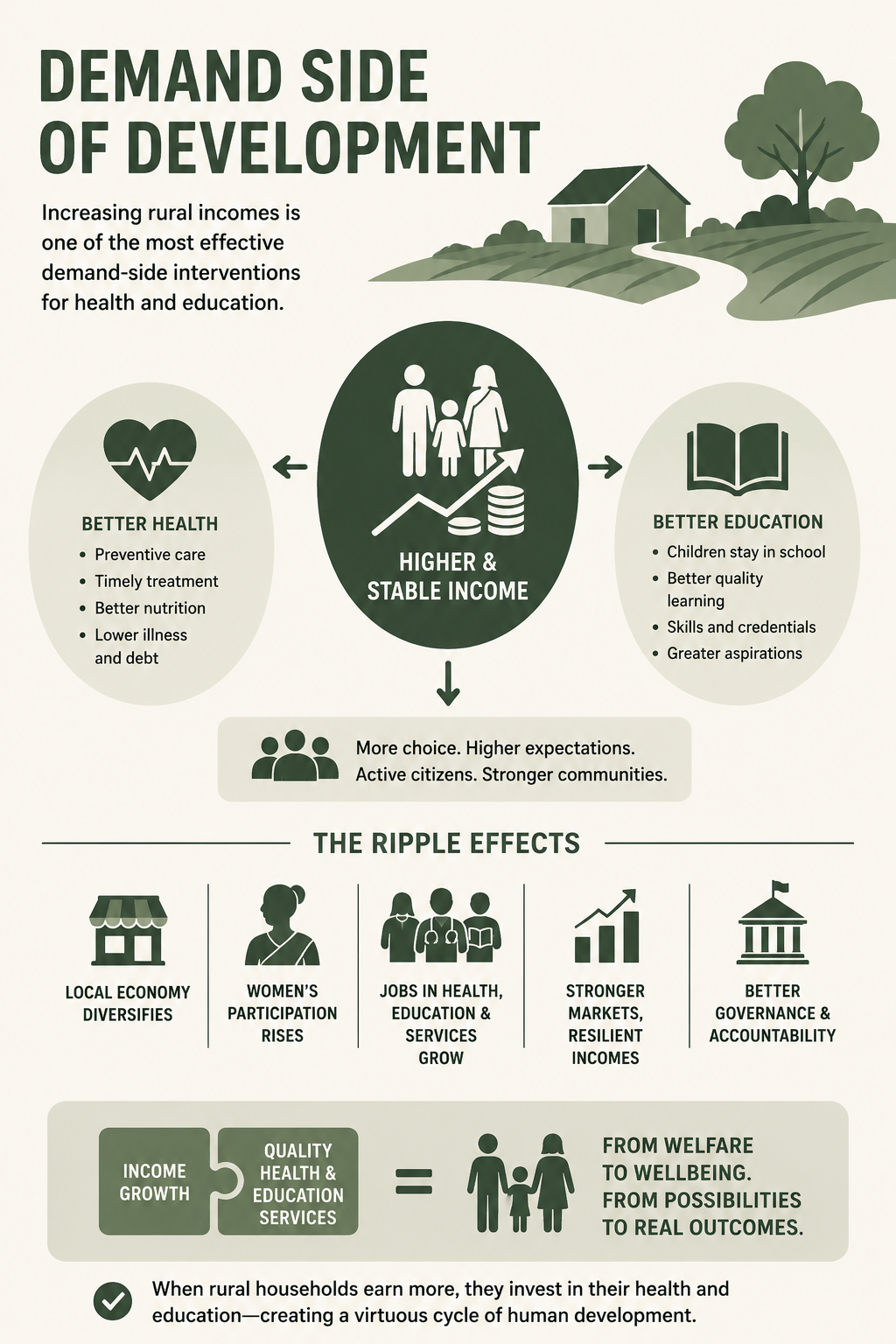
India’s rural development dialogues have treated health, education, and income as parallel priorities often pursued through separate policy silos. Budgets are allocated, schemes are launched, infrastructure is built, and targets are set, all with good intent. However, one foundational truth remains insufficiently acknowledged, that increasing rural incomes is not merely an economic goal but one of the most effective demand-side interventions for health and education. Without income security, even the best school education systems and local health facilities struggle to translate access into outcomes. With income growth, aspirations gain purchasing power, the choice basket expands, and human development accelerates in ways no standalone welfare program can achieve.

The constraint on health and education in rural India is rarely a lack of awareness alone. Most families understand the value of a healthy body and an educated child, but they cannot act on that understanding consistently. Irregular incomes, seasonal employment, debt cycles, and exposure to shocks force households into a constant state of prioritising needs and what is immediately affordable. In such conditions, preventive healthcare is postponed until illness becomes unavoidable, and education becomes negotiable once opportunity costs rise. When incomes increase, particularly when they become predictable rather than sporadic, this calculus begins to shift fundamentally. I have witnessed this change countless times among the families from rural livelihood and entrepreneurship development programs across multiple states of India, from the north to the northeast.

The first visible change that accompanies rising rural income is in health-seeking behaviour. As disposable income grows, households move from reactive to preventive care. They begin to spend on nutritious food intake, diagnostics, maternal health, and timely treatment rather than relying solely on home remedies or last-resort interventions. This is observable across rural belts where livelihoods have stabilised through dairy cooperatives, non-farm employment, or entrepreneurship opportunities. Increased income reduces the psychological cost of seeking care. A doctor’s visit no longer feels like a financial gamble, and medicine is no longer a choice between recovery and indebtedness. Over time, this shift translates into lower morbidity, higher productivity, and a virtuous cycle of income and wellbeing.

Education follows a similar but slightly delayed trajectory. At very low-income levels, schooling competes with survival. Children’s labour, whether on farms, in family enterprises, or in caregiving roles, has immediate economic value. As incomes rise, the opportunity cost of schooling declines. Families are more willing to keep children in school, invest in better quality institutions, often private schools in their own villages or neighbouring towns, and support supplementary learning such as tuition or digital tools. Crucially, income growth often changes learning outcomes and ambition, and not just enrolment. Education stops being about literacy alone and starts being about mobility, including English proficiency, technical skills, credentials, and pathways beyond the village economy.

This transition from survival to investment is critical as human capital investments respond strongly to income thresholds. Below a certain level of income, households simply cannot afford to plan long-term, and above that critical level, behaviour changes rapidly. Rural India today stands at precisely this inflection point. Decades of infrastructure expansion, electrification, and digital penetration have laid the groundwork. What remains uneven is sustainable income enhancement pathways at scale. Where it happens, demand for health and education services rises organically, often faster than supply systems can respond.

However, increased income alters expectations and does not merely increase consumption. Rural households with higher incomes begin to demand quality, accountability, and outcomes. They compare schools, question teaching standards, seek second medical opinions, and are willing to pay for reliability with profound implications. It challenges the assumption that rural citizens will accept poor service quality indefinitely. It also creates space for private, social, and hybrid service models like low-cost clinics, diagnostic centres, skill academies, and ed-tech platforms that were previously unviable due to weak demand. Income growth can enable choice for households, who would increasingly adopt mixed strategies of using public facilities for some services and private providers for others. This duality can, if managed well, improve overall system performance. 

The ripple effects of income-driven demand can extend beyond individual households. As spending on health and education will increase, local economies will diversify. Teachers, health workers, lab technicians, transport providers, and service support staff will find employment closer to home. Women’s participation in the workforce will rise as care responsibilities will reduce and aspirations will expand. These multiplier effects will strengthen rural markets, making income growth more resilient and less dependent on a single sector like agriculture.

However, income growth alone is not sufficient, as demand without supply will lead to frustration, not development. In many rural areas, rising incomes have resulted in out-migration for services, with families travelling long distances or relocating temporarily to access quality healthcare and education. This is not a failure of income-led development, but a failure to anticipate and respond to it. Both public and private supply systems must be designed to scale alongside income growth. Physical access, skilled personnel, digital connectivity, and trust are essential if local ecosystems are to capture the benefits of rising demand.

Livelihood programmes and social sector investments are often conceived independently. Income-generation schemes focus on outputs like jobs created and enterprises supported, while health and education programmes focus on inputs like schools built, staff hired, and beneficiaries enrolled. What is missing is an integrated demand-supply lens. Rural income enhancement should be explicitly recognised as a human development strategy, with parallel investments planned in service delivery capacity. When livelihoods improve in a region, health and education infrastructure should be strengthened proactively, not reactively.

For corporate social responsibility (CSR) and philanthropy, this insight could be particularly valuable. Rather than choosing between livelihoods and social services, funders should see them as sequential and reinforcing investments. Supporting rural entrepreneurship, value chains, or digital livelihoods creates the conditions for sustained demand for health and education. Complementing this with investments in service quality of teacher training, primary healthcare strengthening, telemedicine, or skill education will maximise impact. Fragmented interventions will yield fragmented outcomes, while integrated strategies can create lasting change.

When rural citizens earn more, they become more vocal stakeholders in the local political economy. They demand better governance, transparency, and responsiveness. Health and education, being highly visible services, often become focal points of this demand. Income growth thus strengthens democratic accountability. It shifts the relationship between the state and citizens from charity to entitlement, from gratitude to expectation. 

India’s development journey offers ample evidence of this dynamic. States like Gujarat, Tamil Nadu, and Maharashtra that have successfully diversified rural incomes through improved irrigation, manufacturing clusters, or services consistently outperform others on health and education indicators. The lesson is that the effectiveness of social spending is amplified when households have the means to engage with it meaningfully. Supply creates possibility, and income creates participation.

As India looks ahead to the next phase of rural transformation, the question is no longer whether to invest in health, education, or livelihoods, but how to sequence and integrate them. Treating income growth as the foundation of demand generation reframes the debate. It reminds us that people are not passive recipients of services, but active decision-makers whose choices shape outcomes. Empowering those choices through income security may be the most humane and pragmatic development strategy to have. This has the potential of unlocking a chain reaction that will turn latent needs into effective demand, services into systems, and welfare into wellbeing. Healthier bodies and educated minds do not emerge in isolation, but they grow where households have the freedom to choose them. And that freedom, in rural India, begins with income.

Microenterprises, Macro Impact: The transformative social impact by rural women entrepreneurs

Across India’s villages, a quieter and powerful transformation is unfolding, led by women entrepreneurs building microenterprises that are changing not just their lives but also contributing towards local prosperity.

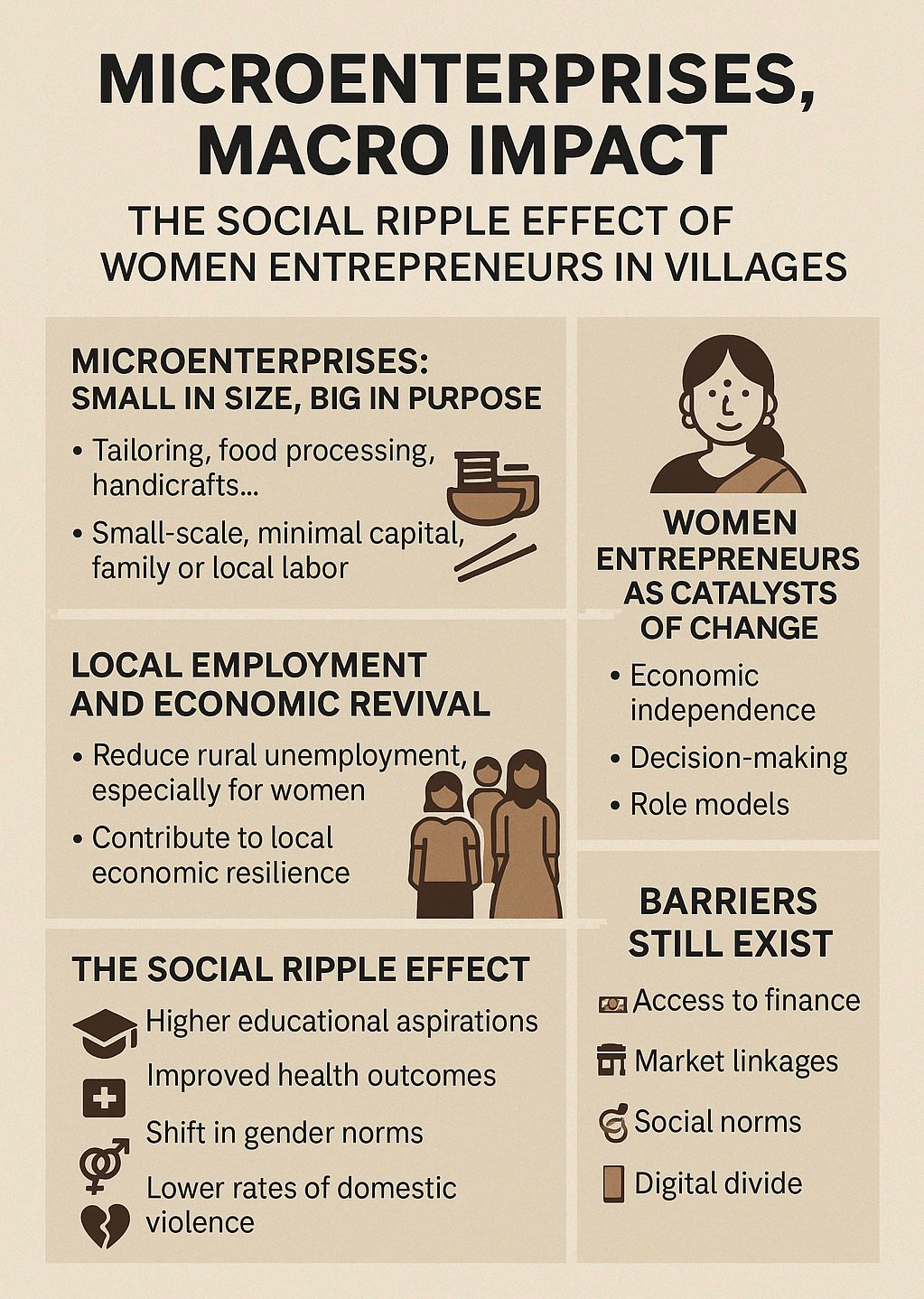
In rural India, microenterprises (and many a time, even termed as nanoenterprises) are typically small-scale and often home-based ventures. These include tailoring shops, grocery stores, food processing units, poultry farms, handloom or handicraft businesses, among many others. They usually operate with minimal capital, often under INR 1 lakh, and rely on family support systems. While these businesses may appear modest on the surface, they’re laying the foundation for grassroots economic resilience and social transformation.

When a woman in a village starts a business, she’s not just earning an income, she’s stepping into a position of agency. She becomes a decision-maker, a provider, and importantly, a role model.

In Jharkhand, Shashi, a determined and resilient woman, has become a role model of empowerment in her village of Kura. With knowledge, financial and device support, she started her Digital Business, which became a hub of convenience and accessibility for people in her village and neighbouring villages. Her journey as a digital entrepreneur empowered her and gave her the agency to make a meaningful contribution to her community. Today, she’s also a Mukhiya (village head) and fondly known as “Digital Mukhiya”, continuing to be the voice of women’s empowerment.

Microenterprises help address the rural employment gap, especially for women who often can’t migrate or work outside the home due to social norms and family responsibilities. These businesses absorb local labour, retain economic value in the village, and reduce dependence on urban employment.

In Assam, Mintai’s Jacquard Handloom Weaving business now employs 3-4 local women who were previously unemployed. They earn and save, and for the first time, imagine futures that include good education for their children or owning a business.

This kind of bottom-up economic activity contributes to local economic resilience, the ability of communities to survive and thrive even during external shocks. The social impact generated by women entrepreneurs is profound. This often translates into higher educational aspirations for children, especially girls staying and completing their school education; increased income leading to better nutrition, access to healthcare and sanitation leading to improved health outcomes; acceptance and shift in gender norms; and financial independence gives women negotiating power within households leading to lower rates of domestic violence.

Despite their success, rural women entrepreneurs continue to face systemic challenges like, (a) collateral requirements and credit histories disqualify many from accessing formal loans, (b) getting products to larger and fairer markets remains a logistical challenge, (c) stifling social norms due to resistance from family or community, (d) accessing business education to develop ‘aptitude’ matching their entrepreneurial ‘attitude’, and ( e) digital divide due to limited access to smartphones and digital tools. While schemes like Stand-Up India and MUDRA loans have made progress, implementation gaps persist.

Rural women’s microenterprises are not side projects. They are economic engines, social change-makers, and community stabilizers. When one woman is empowered to start a business, a ripple begins, touching families, uplifting communities, and reshaping rural India from the ground up.

If you’re a policymaker, social investor, donor, or even just a storyteller, your support can help expand that ripple into a wave and finally a movement of economic security and resilience.

(All views are personal)

(Cover image generated using AI)

#Stand-upIndia #LetsDoMore

Bamboo: The Green Gold for Poverty Reduction and Rural Growth

India has huge natural bamboo stocks that have been an integral part of Indian culture for many millennia. Bamboo in many ways is the mainstay of the rural Indian economy, sparking considerable social and ecological spin-offs. In the early part of the century, large tracts of bamboo occurred in many parts of the country but were treated by the forestry sector (which was then cast in a production forestry mode) as a weed of little economic value and was used mostly by the rural communities for crafts, making implements and as housing material. It was the discovery of bamboo as a source of long-fiber by the Forest Research Institute in Dehradun that started the process of using bamboo in a variety of industrial applications, so far unexplored, with several paper mills and rayon mills being set up. But in the absence of a clear policy there was rapid degradation and decimation of the resource in much of the country. Bamboo resources plummeted so alarmingly that at present the resource is limited to few pockets in the country. Two-thirds of the bamboo in the country is restricted to the North-Eastern Region (NER) while the remaining one-third is spread across the country.

But there is hope for the resurgence of bamboo, and this is based on evidence of significant new and contemporary economic opportunities that have emerged over the past decades. A bamboo revolution that holds the potential of reversing economic downturns and ensuring profitability, is very much possible.  Bamboo is an untapped avenue of economic growth, and a burgeoning bamboo sector can rope in prosperity, profits, and sustainable livelihoods.

Despite the severe degradation of the resource in the past, India still has a considerable growing stock of bamboo, and comparative annual harvest figures[1] still place India at the top of the global league. It is important to realize the considerable latent potential that bamboo has to contribute to economic growth, poverty alleviation, generating employment, rehabilitating vast tracts of degraded land generated due to past agricultural and industrial practices and policies, and revitalizing the social, economic and ecological well-being of rural economies.

In line with this, goals should be aimed at focusing on recovering the resources lost to the rural poor as it has been a natural capital that has helped them to keep their economies afloat even in times of significant cash crunches. Attempts should be made to replenish bamboo stocks, make it economically beneficial to rural communities in a way that it provides them opportunities to earn a sustainable income and improve their standard of living. Efforts should also be made to increase the economic opportunity from the use of bamboo as an industrial raw material, to raise employment opportunities (especially for the educated and unemployed rural youth), and to rehabilitate the degraded lands across the country (making available and productive a natural resource which is increasingly becoming scarce and expensive).

Over the years a variety of strategies have been developed to reduce the poverty of rural and rurban population through small enterprise development, based on various forest produce. In rural areas, the poor are overwhelmingly dependent on natural resources and in most cases, it is the only capital they possess. They have little power or ability to climb out of poverty. They are not only financially poor, but also opportunity-and knowledge-poor. In this respect, bamboo is one of the few natural resources that could provide a lifeline to sagging rural economies and help integrate them into the market economy. As bamboo is not one commodity but the fountainhead of many products, it could open up a number of markets simultaneously for the rural poor with the added advantage of being a low-risk option.

The bamboo sector also forges personal links with the rural community, allowing them to participate closely in production processes and directly access profits through value addition as compared to other industrialized processes. As the sector is dependent to a large extent on manual labour, it demands many hands to contribute to the cultivation, harvesting, preservation and value-added manufacturing processes. The upshot is that it provides livelihood options in varying activities to a large number of rural workers. This is the main reason why developing countries find it more viable to be involved with the sector whereas developed countries prefer becoming consumptive markets for these very products. Women in particular stand to gain from this sector as they secure means of livelihood due to their dexterity with the material and their ability to shape it into products and more important, they gain from the flexible work hours this sector affords. Bamboo can thus break marginalization through empowerment and also bridge gender divides.

Employment generation and livelihood creation are enabled through strong backward integration of bamboo production and processing. Though tree-like in stature, bamboo is best grown and managed like an agricultural crop or managed as such within the forest. This needs labour input, which calls for significant people involvement. Again, volume production in bamboo is achieved through a large number of unit poles, unlike timber where one large log provides a substantial quantity of wood. But on the other hand, the lightweight poles enable people participation in its transport. Furthermore, the easy linear splitting ability of bamboo, quite unlike that of wood, enables primary processing for a final industrial product to be undertaken by the rural community. The above properties lay the economic basis for definite win-win community-industry partnerships in bamboo, with the bamboo being managed or grown, and primary processing undertaken by communities in rural areas.

Experience has shown natural resources can be harvested sustainably if people stand to benefit from it. The development of bamboo as a cash crop will result in the conservation and protection of the existing resource, and the scaling up of cultivation, which would be a natural outcome of the increased cash value of the resource, as against its present low cash to mere-subsistence value. The environmental benefits from the economic development of bamboo can be very significant.

As a resource that can be harvested annually, it could provide a regular supply of construction material to the communities. If the use of wood could be replaced with that of bamboo, it could reverse the process of severe and rapid degradation of forests and forest cover. Bamboo also helps protect soil from erosion, especially in the upland areas. Bamboo should also be strategically grown to reduce or prevent soil cutting from riverbanks, which is perhaps the major cause of siltation of riverbanks, resulting in reduced carrying capacity of rivers and flooding during the peak rainy season.

In last 3-4 decades, intensifying patterns of land and resource utilization, primarily due to pressure from the rapidly increasing population, have caused land and natural resource degradation in many parts of India. Bamboo is an ideal resource for rehabilitation, even in extremely degraded situations such as land used for brick making.

India with its rich potential of bamboo resources has only just started to develop bamboo marketing and trade.  However, the significant bamboo resources in India make it ideally placed to benefit from the experience of China and other countries around the globe. Bamboo holds within it the promise of bailing people out from below poverty line levels.

Bamboo finds many uses today in addition to its conventional uses for handicrafts, scaffolding and the paper industry.  It can be used as construction material, as a wood substitute and as food, fuel and a filtration medium. Its real contribution to housing lies in the dual role it can play – of providing a cheap and affordable wood alternative to the homeless while at the same time generating livelihood options for those involved with it.

Bamboo can propel economic growth through increased local production and the sale of high-value wood-substitute products, especially in bamboo-rich states. Robust local production of a local natural resource capital like bamboo will lead to the retention and circulation of cash within the state economies itself, rather than the cash flowing out for purchase of goods from outside the state. Export of cash value-added bamboo products to markets outside the bamboo states could enable incremental cash earnings that will add to the economic growth of the state. Asset creation and local consumption can get a fillip from the increased circulation of money within the state economy from local consumption of locally manufactured products. This consumption will be enabled not only by government purchases, but also as a result of the higher disposable incomes that will be generated.

In India, as elsewhere in other developing countries, strong correlative linkages exist between economic growth, rural poverty and the environment. Firstly, the poor are more vulnerable to the health effects of pollution because of their inadequate nutrition, poor access to health care and their unhealthy living environment. Secondly, the poor are affected faster by degradation of natural resources because of their greater reliance on them to meet basic needs. Environmental degradation, in turn, adversely affects the economy’s capacity to grow, because growth relies on the sustainable productivity of natural resources and the health of the population.

It is a vicious circle, which can be broken through a growth solution that is not only income generating for rural communities but also environmentally sound. Bamboo, a natural resource and one that protects the environment, enables the development of industries, which function through a symbiotic linkage between small and large enterprise that significantly benefits the community. 

Bamboo is available throughout the country barring the states of Jammu and Kashmir and Rajasthan (except for some areas). Existing traditional bamboo and cane handicraft products, though not many, could be improved, diversified, produced along industrial assembly lines and converted into value-added products that are already a part of mainstream industry. Value additions could be made to its use in the paper industry and its use in the unorganized scaffolding industry can be doubled.  Simultaneously, other mainstream micro and small enterprise products such as matchsticks, pencils, toothpicks, skewer sticks, and blinds, as well as medium-scale industrial panel products that rival wood products, with strong backward community linkages and benefits can be explored. An increase in bamboo products and market opportunities will also result in increases in demand for raw bamboo, besides the production of fresh bamboo shoots and their processed products. There is considerable potential to set up medium and large-scale industries for generating value-added food and wood-substitute products for export markets.

The value-added bamboo industry is ideally placed to adopt that model. Given the right policy atmosphere and thrust, the value-added bamboo industry in India has the potential of reaching a size of USD 2.3 billion (USD 131.5 billion globally) in the next 10 years with a CAGR of 10.3%, employing 11-15 million people in the primary, secondary and tertiary sectors[2].

The bamboo industry also fulfils the criteria needed by sectors that aim to achieve double-digit economic growth. Bamboo has a very strong and direct with rural communities, which would allow them to partake directly and in a more significant way to value addition as compared to other industrialized processes. The value-added bamboo industry thus provides an integrated solution that uses an abundant natural resource that protects the environment and can be processed and generated through community-owned enterprises, both small and large.


[1] INBAR 2002, Market Opportunities Report

[2] https://www.futuremarketinsights.com/reports/bamboo-products-market

Photo Credit: NMBA

Disclaimer: The opinions expressed are those of the author and do not purport to reflect the views or opinions of any organization, foundation, CSR, non-profit or others