Behavioural Systems Approach to Rural Entrepreneurship Development
October 12, 2026 Leave a comment
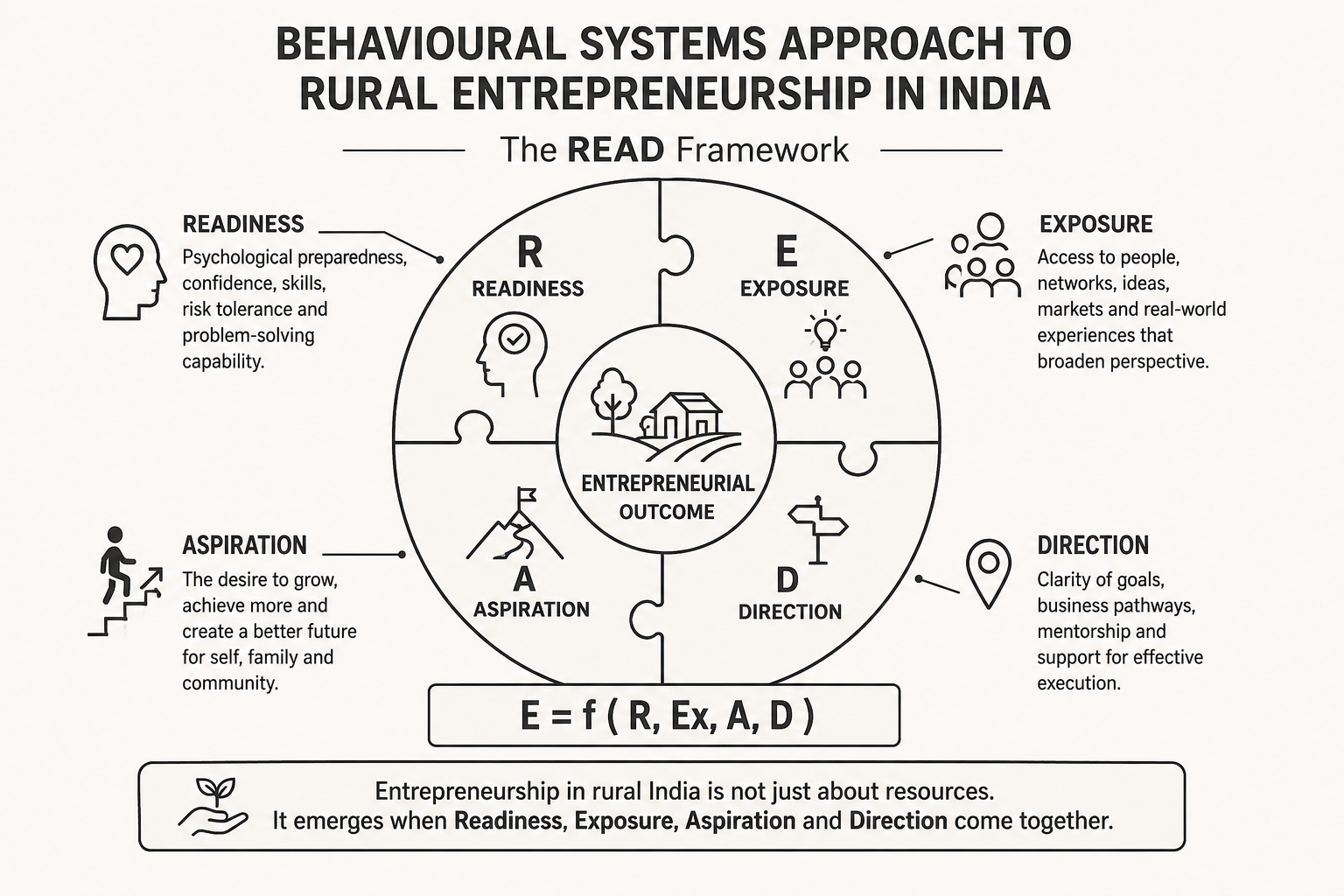
The popular approach to rural entrepreneurship in India often includes providing poor households with access to credit, skills training, subsidies, or market linkages, which will naturally lead to entrepreneurship development. This assumption has shaped countless development programs led by governments, NGOs, microfinance institutions, and multilateral agencies. Two individuals living in the same village, receiving identical training and similar financial support, often experience vastly different entrepreneurial trajectories. One may build a sustainable enterprise, expand into new markets, and improve household income, while another may abandon the effort entirely despite possessing comparable resources. Conventional development frameworks struggle to explain this divergence because they remain overwhelmingly focused on material inputs rather than behavioural systems.
I am proposing the READ Framework (Readiness, Exposure, Aspiration, and Direction), which can shift the analytical lens from resource scarcity to behavioural conditions that shape economic action. Rather than treating entrepreneurship as a linear outcome of financial or technical support, the model suggests that enterprise creation depends on a dynamic interaction between psychological preparedness, social exposure, aspirations for mobility, and clarity of execution pathways. This perspective is particularly important in contemporary India, where entrepreneurship has become central to the national development narrative, and yet rural livelihoods remain constrained by social inequality, institutional gaps, and behavioural barriers that are often invisible within conventional policy frameworks.
India’s economic transformation over the past three decades has generated significant growth, but it has also exposed structural contradictions. Although India aspires to become a major global economic power, a large proportion of its population continues to live in rural areas dependent on fragile agriculture-based livelihoods. According to the World Bank, nearly two-thirds of India’s population still resides in rural areas, while agriculture contributes a relatively small share of GDP. This imbalance has intensified pressure on rural households to diversify income sources beyond farming. Rural entrepreneurship is therefore increasingly viewed as a pathway for employment generation, women’s empowerment, local economic resilience, and reduction of distress migration. Government initiatives such as Startup India, Mudra Yojana, and the National Rural Livelihoods Mission reflect this policy emphasis. However, despite substantial investments in microcredit, self-help groups, and skill development programs, many interventions continue to produce limited or unsustainable outcomes. The limitations of conventional entrepreneurship models arise partly from their assumption that individuals act rationally once economic barriers are removed. The prevailing logic can be summarised as a straightforward sequence of inputs leading to skills, enterprise, income (Inputs -> Skills -> Enterprise -> Income).
Development economists such as Abhijit Banerjee and Esther Duflo have demonstrated that poverty fundamentally shapes cognition and decision-making. Scarcity creates what behavioural economists describe as a ‘bandwidth tax,’ reducing people’s ability to plan long-term, tolerate risk, or experiment economically. Poverty is therefore not merely a shortage of money, but a condition that influences imagination, confidence, emotional resilience, and perceptions of possibility. The READ framework is developed upon this intellectual foundation but advances it further by conceptualising entrepreneurship as an interconnected behavioural ecosystem rather than a collection of isolated economic variables.
The framework proposes that entrepreneurial outcomes are a function of four interacting dimensions: Readiness, Exposure, Aspiration, and Direction.
E = f(R,Ex,A,D)
The formulation is simple and treats entrepreneurship as emergent behaviour rather than a direct consequence of inputs. This framework rejects the assumption that entrepreneurship automatically emerges when capital or skills are introduced. Instead, it recognises that deficiencies in any one behavioural dimension can undermine the entire entrepreneurial process. An individual may possess technical capability but lack confidence, another may have ambition but no understanding of viable business pathways, making entrepreneurship an emergent behaviour shaped by multiple interacting conditions rather than a predictable economic reaction to incentives.
The first dimension, Readiness, refers to the psychological and situational preparedness required to undertake entrepreneurial activity. This includes emotional resilience, confidence, time availability, family support, and willingness to tolerate and adapt to uncertainty. In rural India, readiness is deeply shaped by social structures such as gender norms, caste hierarchies, and family expectations. A rural woman may receive training in tailoring, computer operations, or food processing yet still hesitate to establish a business because domestic responsibilities, mobility restrictions, or patriarchal control limit her ability to act independently. Similarly, entrepreneurs belonging to marginalised communities may face exclusion from traditional market networks or social resistance when attempting to enter certain occupations. Readiness, therefore, is not simply an individual psychological trait but a socially conditioned state shaped by power relations and everyday realities.
Readiness also resonates strongly with the capability approach developed by Amartya Sen, who argued that development should be understood not just in terms of resources but in terms of people’s actual freedoms to pursue lives they value. Sen distinguishes between capabilities and functioning. Individuals may possess capabilities in theory, yet structural and social constraints may prevent them from converting those capabilities into real economic action. The READ framework extends this insight into the domain of entrepreneurship by recognising that the existence of opportunity alone does not guarantee participation.
The second dimension, Exposure, is about the importance of social learning, networks, role models, and market visibility. Entrepreneurship is rarely an isolated individual act, and is deeply influenced by social environments. Individuals often become entrepreneurs because they observe others navigating similar pathways successfully. In many rural communities, however, exposure to growth-oriented enterprises remains extremely limited. People may encounter only subsistence-level economic activity and therefore struggle to imagine entrepreneurship beyond survival-oriented self employment. A young person in a remote village who has never interacted with digital commerce, branding strategies, or scalable enterprises may lack exposure to viable economic possibilities, and not necessarily ambition or intelligence.
Economic sociology has consistently demonstrated the importance of networks in shaping entrepreneurial success. Urban startup ecosystems thrive partly because of dense social environments that provide mentorship, peer learning, investment access, and visible examples of success. Rural entrepreneurship programs often fail to replicate such ecosystems because they focus narrowly on asset distribution or technical training. The READ framework’s emphasis on exposure therefore addresses a major gap in existing development practice. Exposure is not simply informational, as it also creates legitimacy. Seeing people from similar social or economic backgrounds succeed changes what individuals believe is socially and economically possible for themselves.
The third dimension, Aspiration, is socially conditioned and unevenly distributed. Development programs frequently assume that poor households naturally aspire toward upward mobility. Sociologist Pierre Bourdieu argued that social structures shape individuals’ ‘horizons of possibility,’ influencing what they perceive as achievable for people like themselves. Similarly, economist Debraj Ray has written extensively about the ‘aspirations window,’ suggesting that exposure to successful peers influences economic ambition and long-term planning.
In many rural contexts, especially among historically marginalised communities, entrepreneurship may not appear imaginable as a pathway to transformation. Young people may aspire primarily toward government employment or urban migration because these trajectories are socially visible and culturally validated. In contrast, business ownership may appear risky, uncertain, or inaccessible. The READ framework recognises that aspiration is not simply a motivational issue but a socially produced cognitive condition. This insight has profound policy implications because it suggests that entrepreneurship promotion requires more than financial support, and often also requires interventions that expand people’s imagination of possible futures.
The fourth dimension, Direction, refers to clarity regarding viable pathways, execution strategies, and market navigation. Many rural entrepreneurs possess determination and ambition but lack strategic guidance. They may not know how to identify profitable sectors, understand customer demand, access supply chains, navigate regulations, price products competitively, or scale operations sustainably. Traditional entrepreneurship programs frequently provide generic training but fail to offer long-term mentoring or strategic support. Participants may learn technical skills without understanding how to build viable enterprises in dynamic market environments.
Direction has become increasingly important in India’s digital economy, where market participation requires familiarity with e-commerce platforms, logistics systems, digital payments, and branding practices. Without adequate guidance, rural entrepreneurs often remain trapped in highly localised, low-margin markets vulnerable to competition and economic shocks. The READ framework’s emphasis on direction therefore highlights the need for sustained mentoring ecosystems rather than one-time training interventions.
The proposed READ framework uses a systems orientation, with an understanding that human behaviour does not operate through isolated causal pathways. Entrepreneurial action emerges from interactions between psychological, social, economic, and institutional conditions. A person may possess high aspiration but lack direction, leading to frustration rather than enterprise creation. Another may have exposure to successful entrepreneurs but insufficient readiness due to household resistance or emotional insecurity. By recognising these interactions, the framework aligns with broader systems-thinking approaches increasingly influential in public policy and development studies.
The framework can prove to be useful when examining women’s entrepreneurship in rural India. Many livelihood programs targeting women measure success primarily through participation rates or loan disbursement numbers. However, women’s formal inclusion in enterprise programs does not necessarily translate into genuine entrepreneurial autonomy. Women may technically own businesses while male family members control decision-making and finances. The READ framework suggests a more nuanced understanding of these realities by examining the behavioural and social conditions surrounding enterprise participation. A woman may receive training and capital yet still lack readiness because of household opposition, exposure because of mobility restrictions, aspiration because of internalised gender norms, or direction because she lacks mentorship networks. This multidimensional perspective provides a richer understanding of why many women-led enterprises remain small-scale and economically vulnerable despite extensive policy attention.
At the same time, the framework raises important conceptual and methodological questions. Behavioural dimensions such as aspiration or readiness are difficult to quantify reliably. Self-reported surveys may suffer from social desirability bias, contextual inconsistencies, or cultural variation. Constructing a robust ‘READ Index’ would therefore require careful psychometric validation and adaptation across diverse social contexts (I am working on defining and designing the Index, and will publish once I am ready). Rural India is not a uniform behavioural landscape, as aspirations, gender norms, and economic expectations vary significantly across regions, castes, religions, and linguistic communities.
Another concern is that behavioural frameworks can unintentionally shift responsibility onto individuals while underemphasizing structural inequalities. Entrepreneurial failure is not always the result of behavioural deficiencies. Infrastructure gaps, poor logistics, corruption, climate shocks, monopolistic market structures, and digital exclusion remain major constraints. A highly motivated entrepreneur with strong exposure and clear direction may still fail because of unreliable electricity, exploitative intermediaries, or lack of transportation infrastructure. Behavioural systems approaches should therefore complement rather than replace structural analysis. Otherwise, there is a risk that development discourse becomes overly individualised, framing poverty as a problem of mindset rather than political economy.
The framework also raises broader questions about the increasing romanticisation of entrepreneurship within contemporary development policy. Entrepreneurship is often presented as a universal solution to unemployment and rural distress. However, not every individual seeks or benefits from entrepreneurial risk. Many rural households prioritise stability and security over growth-oriented enterprise. Excessive emphasis on entrepreneurship can obscure the state’s responsibility to generate decent employment, strengthen public services, and reduce structural inequality. The READ framework has the potential to become most valuable when used as an analytical and program-design tool rather than as an ideological justification for reducing state responsibility.
Despite these concerns, the framework can offer substantial practical relevance for policymakers, NGOs, and development practitioners. If empirically validated, it could reshape the design of rural livelihood programs across India. Interventions could move beyond transactional models toward more relational and behaviourally informed approaches. Programs might assess behavioural readiness before enrollment, create peer-learning ecosystems, facilitate exposure visits, incorporate aspiration-building modules, involve families in sensitisation processes, and provide long-term mentoring rather than short-term training alone. Such approaches would recognise entrepreneurship as a socially embedded process rather than merely an economic activity.
The broader significance of the READ framework is in its attempt to bridge economics, sociology, behavioural science, and development practice. It recognises that poverty is not solely material deprivation but also a condition that shapes agency, imagination, and action. By integrating behavioural insights with systems thinking and capability theory, the framework challenges simplistic assumptions about how development occurs. It asks a deeper question than most entrepreneurship programs currently address, that why do some individuals act on opportunity while others facing similar conditions do not? The answer to that question may be central not only to rural entrepreneurship policy but to the future of inclusive development in India itself.
References
- Abhijit Banerjee and Esther Duflo, Poor Economics, PublicAffairs, 2011.
- Amartya Sen, Development as Freedom, Oxford University Press, 1999.
- Debraj Ray, Aspirations, Poverty, and Economic Change, Oxford University Press, 2006.
- Pierre Bourdieu, Outline of a Theory of Practice, Cambridge University Press, 1977.
- World Bank rural population and development indicators.
- International Labour Organization reports on informal economies and entrepreneurship.
- NITI Aayog policy papers on women entrepreneurship and rural livelihoods.
- National Rural Livelihoods Mission (Government of India) operational and policy documents.
Disclaimer: The opinions expressed are those of the author and do not purport to reflect the views or opinions of any organization, foundation, CSR, non-profit or others.
The cover image is generated using AI.