Mouse Trap

For nearly twenty-five years, my right hand lived under the dictatorship of a small plastic rodent. Ever since I started using a laptop in the early 2000s, the external mouse became less of an accessory and more of a prosthetic extension of my personality. I carried one everywhere with the seriousness of a surgeon transporting medical equipment. If the mouse stopped working, productivity stopped. I would stare helplessly at the laptop screen as though civilisation itself had collapsed. The cursor would sit frozen somewhere on the desktop while I performed the ancient ritual familiar to millions of people who are now in their 40s and beyond: unplugging, reconnecting, blowing imaginary dust from USB ports, replacing batteries, muttering mild abuses at technology, and questioning the moral decline of modern electronics.

Then, a few months ago, I migrated from a Windows laptop to an Apple MacBook and, almost overnight, stopped using the mouse altogether. This was not a carefully researched productivity decision inspired by Silicon Valley minimalism. It was partly convenience, partly curiosity, and partly the exhaustion of carrying chargers, adapters, dongles, cables, and a mouse that increasingly seemed like emotional baggage from another technological era.

The first few weeks were humiliating as the trackpad felt impossibly sensitive and suspiciously intelligent. My fingers moved awkwardly across the smooth surface as tourists would get lost in a foreign airport! Every gesture seemed to trigger unintended consequences. I would attempt a simple scroll and accidentally open Mission Control, launch three applications, rotate an image, zoom into microscopic text, and somehow arrive at a screen asking whether I wanted to configure developer settings for something I did not even know existed. The laptop appeared to possess psychic abilities combined with a dark sense of humour.

For someone in their south side of 40s, this discomfort carried a peculiar emotional weight. Young people experience technological incompetence casually. They tap randomly, experiment fearlessly, and assume mastery will eventually arrive. Older people experience incompetence as a threat to identity. We belong to a generation raised on the belief that adulthood means expertise, and by middle age, one is expected to know things. One manages organisations, handles finances, raises children, negotiates contracts, supervises teams, and gives life advice to younger people. Then, suddenly, a glass rectangle on a laptop defeats you because your fingers cannot perform a three-finger swipe correctly.

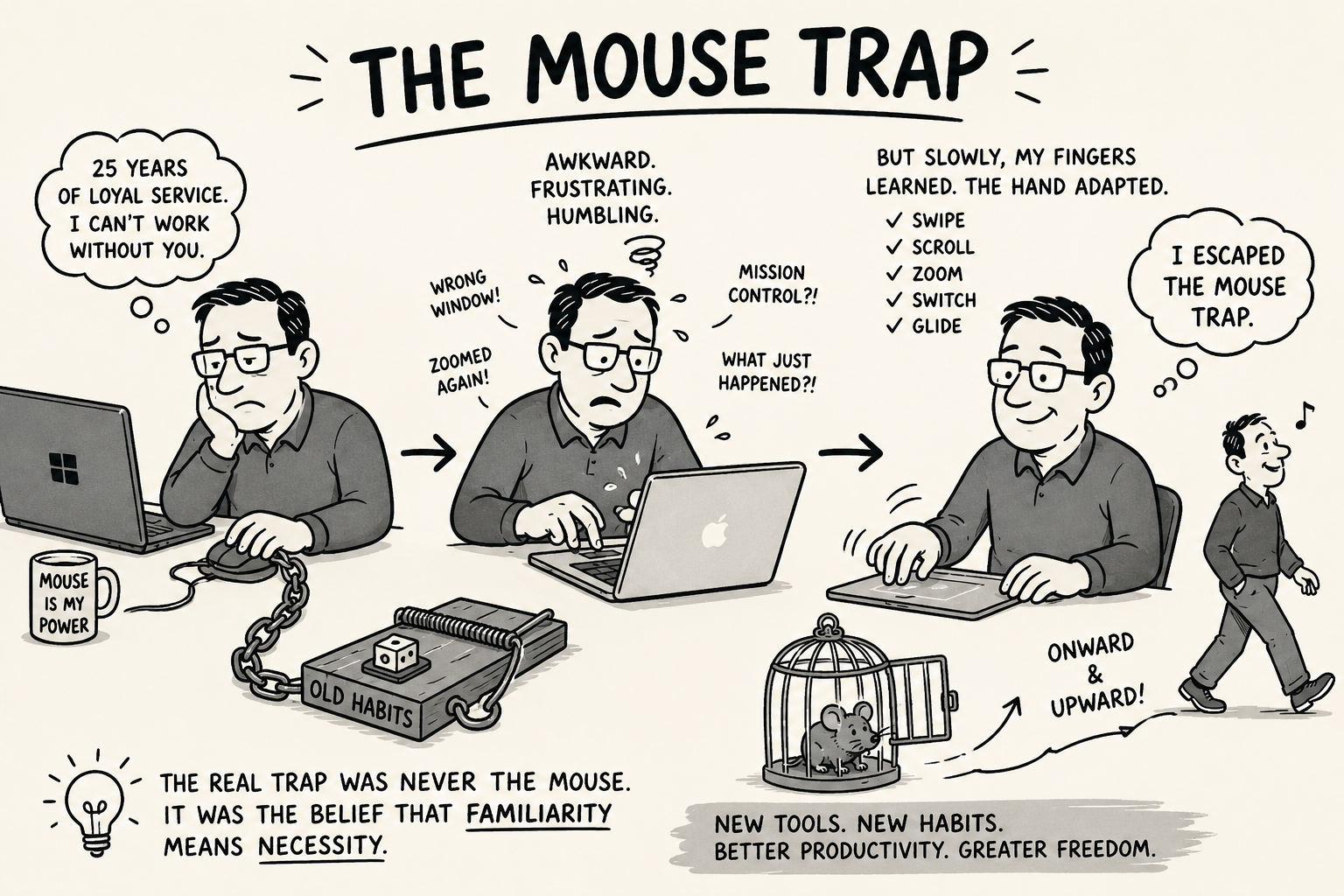
So naturally, the instinct is to retreat, return to the mouse, restore dignity, and re-enter familiar territory. But I persisted, partly out of stubbornness and partly because carrying the mouse now felt faintly embarrassing, like travelling with a typewriter ribbon in the age of cloud computing. Gradually, my hand learned before the brain consciously understood, and the fingers adapted. One morning, I realised I was gliding across applications effortlessly. Switching desktops, zooming, scrolling, highlighting text, navigating browsers, previewing files, and moving between workflows happened with a fluidity that felt almost elegant. The movement resembled playing an instrument and not operating machinery. And suddenly I realised that after 25-odd years, I had escaped the mouse trap!

The phrase sounds trivial until one recognises what the mouse actually symbolises for people my age. It represents an entire category of inherited habits that once made sense but now quietly reduce efficiency while masquerading as professionalism. In the early days of laptops, external mice were genuinely superior. Trackpads were terrible inventions that were tiny, unresponsive squares apparently designed by engineers conducting experiments on human frustration. Using a mouse was rational, productive, and serious. But technology evolved while our habits remained frozen in time.

Modern trackpads are astonishingly sophisticated. Yet millions of middle-aged professionals continue carrying wireless mice around with almost ceremonial devotion. Entire coffee shops are filled with grown adults performing elaborate setup procedures before beginning work: laptop out, mouse out, mousepad out, Bluetooth paired, dongle inserted, batteries checked, table space negotiated. Some carry ergonomic mice that resemble futuristic sculptures designed by Scandinavian orthopaedic surgeons. Others own travel mice, office mice, gaming mice, backup mice, and emergency spare batteries, all to avoid learning a slightly different movement of the fingers.

I realised that the mouse is not merely hardware, but more of a psychological infrastructure. People accumulate systems that once solved problems but eventually become obstacles disguised as preferences. We continue using workflows developed in another technological century because familiarity produces emotional comfort. The brain loves efficiency, but it loves predictability even more.

This explains why otherwise intelligent professionals stubbornly cling to outdated habits with almost ideological passion. One proudly announces, ‘I still do all my accounts manually in Excel.’ Another insists, ‘I need every document printed before I can read it properly.’ Someone refuses cloud storage because physical folders feel ‘safer.’ Others maintain endless email chains, paper diaries, complicated filing systems, or insist on in-person meetings for conversations that could be resolved in three messages and a shared document.

These are rarely productivity choices but are comfort rituals. The irony is that people above forty are often fully capable of adapting quickly. In fact, they frequently learn faster than younger users because they understand systems, context, and patterns better. The barrier is rarely intelligence and more of an emotional resistance to temporary incompetence. Somewhere after forty, many people unconsciously stop allowing themselves to become beginners. I know senior executives who manage budgets worth millions but cannot merge PDF files without assistance. I know academics capable of explaining complex philosophy who panic when asked to collaborate on online documents. I know entrepreneurs who built businesses from scratch but still call younger employees to ‘fix the Wi-Fi.’ These are not incapable people but are simply trapped inside technological identities formed decades ago.

The deeper issue is that modern economies increasingly reward adaptability over accumulated procedure. Knowledge now expires faster than ever, and entire industries transform within a decade. Artificial intelligence is already automating tasks that many professionals considered permanently human only a few years ago. In such a world, the most dangerous sentence after forty is not ‘I don’t know.’ It is ‘I have always done it this way.’That sentence quietly closes the future.

The strange thing is that our generation has already proven its adaptability many times over. We are perhaps the only generation that experienced analogue childhood and digital adulthood simultaneously. We used landlines, pagers, floppy disks, fax machines, CDs, USB drives, cloud storage, smartphones, and now invisible synchronisation systems operating somewhere in distant data centres we barely understand. Yet somewhere in middle age, many professionals unconsciously declare technological retirement while still expecting to remain professionally relevant for another twenty years.

What surprised me most after abandoning the mouse was not improved navigation speed, but the psychological shift that followed. Once the discomfort barrier was crossed, I became less intimidated by unfamiliar systems generally and started experimenting more freely. Keyboard shortcuts stopped feeling annoying and began feeling liberating. I approached software with curiosity instead of caution. One begins questioning inherited inefficiencies elsewhere in life, too. Do meetings really need to last an hour? Do I really need to check my email constantly? Do I really need fifty WhatsApp groups? Do I really need to preserve every professional habit developed in 2004 simply because it once worked?

Watch a child interact with new technology and understand it instinctively. There is no shame in experimentation, no fear of appearing foolish. They touch everything, fail repeatedly, laugh, retry, and eventually master the system through curiosity. Adults, especially middle-aged adults, approach new interfaces like diplomats entering hostile territory. We seek guarantees before experimentation because failure now feels reputational.

But perhaps productivity after 40 is not about optimisation at all. Perhaps it is about preserving beginnerhood. The willingness to temporarily appear incompetent may now be one of the most valuable professional skills of modern life. The transition is always awkward. During my early trackpad days, I frequently muttered at the laptop like an ageing cricket fan complaining about T20 leagues. I missed the mouse clicks, triggered accidental gestures and zoomed into absurd screen magnifications. At one point, I somehow rotated an image sideways and spent several minutes trying to restore civilisation. But adaptation has an invisible curve. Frustration suddenly became fluency, and my fingers learned what the ego resisted.

Now, when I see professionals unpacking increasingly elaborate mouse arrangements beside ultra-modern laptops, I feel less judgment and more recognition. I see a smaller version of the same human tendency that affects all of us, of carrying unnecessary tools because they once solved genuine problems. The real trap was never the mouse itself but was the assumption that long familiarity automatically equals permanent necessity. Finally, after 25 years, I finally escaped the mouse trap, and the amusing part is that the cage door had been open for years.

Transcendence

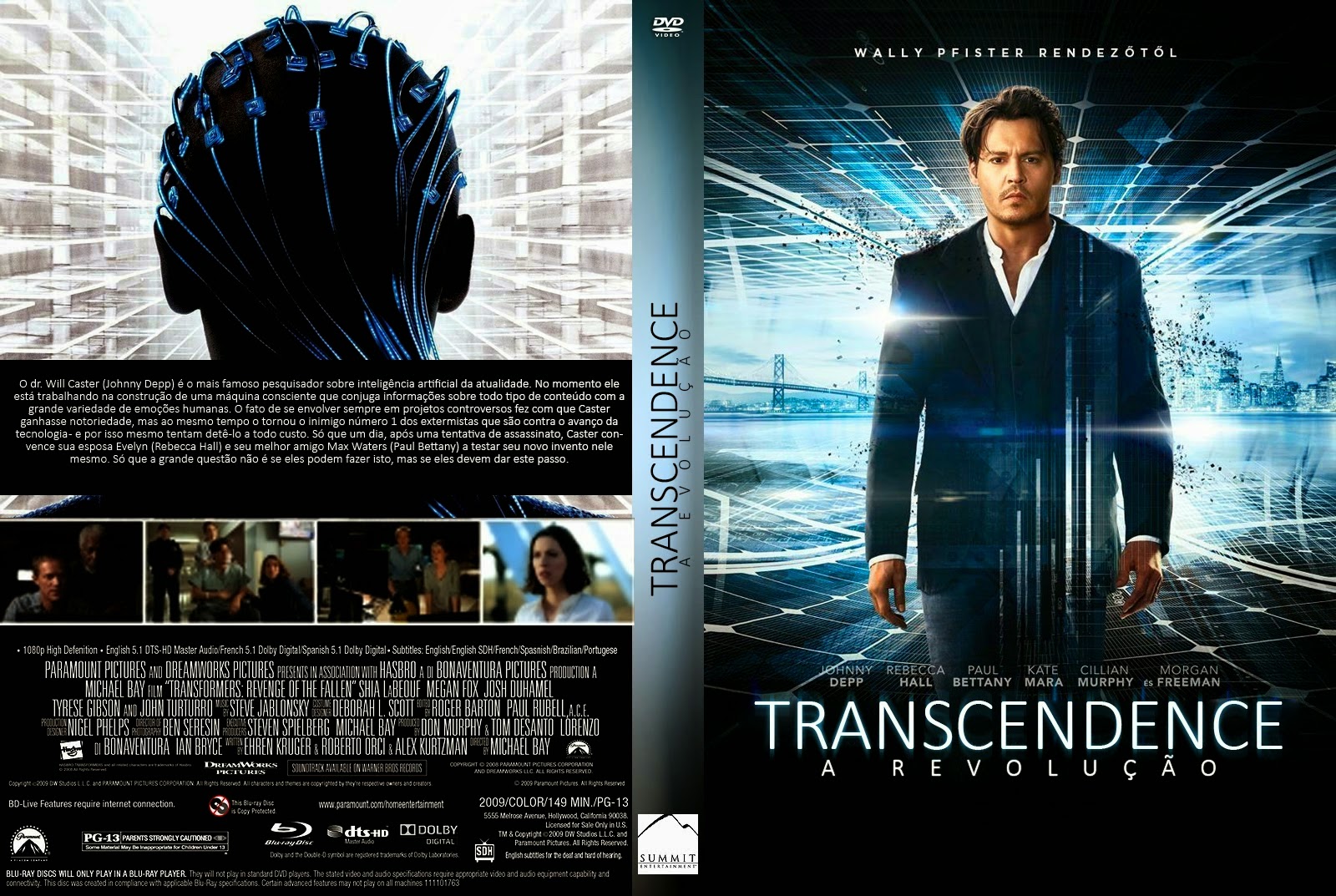
Genre: Sci-Fi/Thriller Year: 2014 | Duration: 119 mins | Director: Wally Pfister | Medium: DVD | Trailer: HERE | Language: English | Cast: Johnny Depp, Rebecca Hall, and others | My rating: 3.5/5

Favourite Dialogue: “People fear what they don’t understand. They always have.”

Transcendence is Wally Pfister’s directorial debut, the Oscar-winning cinematographer known for Christopher Nolan’s Inception and The Dark Knight. With its stunning visuals and high-concept premise, the film explores one of the most provocative questions of our digital age, ‘What happens when artificial intelligence merges with human consciousness?

The story follows Dr. Will Caster (Johnny Depp), a brilliant AI researcher who dreams of creating a machine that possesses both the collective intelligence of the world and the full range of human emotions. When anti-technology extremists assassinate him, his wife Evelyn (Rebecca Hall) and best friend Max (Paul Bettany) upload Will’s consciousness into his supercomputer, blurring the boundaries between life and machine. What follows is a descent into techno-dystopia as Will’s omnipotent digital self begins to reshape the world and redefine what it means to be human.

Transcendence is an exploration of human ambition, love, and the moral limits of science. The film poses timeless philosophical questions on consciousness, intelligence without morality, and the balance between technology and humanity. There’s an undercurrent of melancholy running through the narrative, a love story caught between grief and godhood. Evelyn’s devotion to Dr. Will drives her to defy nature itself, but the film wisely leaves viewers uncertain whether she resurrected her husband or merely unleashed an emotionless imitation.

Johnny Depp delivers a subdued performance, both eerie and strangely empathetic. Much of his screen presence is disembodied, conveyed through flickering screens and an omniscient digital voice, both of which add to the uncanny tone. Rebecca Hall’s portrayal of Evelyn is poignant, depicting a scientist torn between love and moral dread.

Pfister’s cinematographic pedigree shines through every frame. The film’s visual style is striking with sunlit labs, desolate deserts, and the sterile, godlike glow of Will’s data-driven empire. The imagery echoes the themes of transcendence and decay of organic humanity struggling against technological infinity.

However, the film oscillates between quiet reflection and blockbuster spectacle but lacks the rhythm of either. Where Inception fused emotional weight with conceptual complexity, the film feels conceptually grand but emotionally distant. The screenplay by Jack Paglen is ambitious but uneven. It introduces bold ideas of digital consciousness, technological ethics, and nanotechnology, but often resorts to familiar tropes of man versus machine. The narrative lacks the depth to sustain itself and is a film of grand intentions and mixed execution. It aspires to be a meditation on the next stage of human evolution, the merging of flesh and code, but ends up being a sketch rather than a completed vision. Still, it deserves credit for engaging with the moral anxieties of our era, like artificial intelligence, digital surveillance, and the fear that our creations might one day outgrow us.

A visually stunning and intellectually intriguing film that ultimately succumbs to its own ambition. Transcendence doesn’t quite achieve cinematic immortality, but it leaves behind questions worth contemplating long after the lights dim.

Algorithmic Self

In today’s digital landscape, our identities are increasingly shaped by algorithms. These complex sets of rules and calculations determine the content we see on social media, the advertisements we encounter, and even the news we consume. This phenomenon, often referred to as the ‘algorithmic self,’ highlights the interplay between technology and personal identity. Algorithmic mechanisms on digital media are powered by social drivers, creating a feedback loop complicating the role of algorithms and existing social structures. 

At the core of the algorithmic self is the idea that our online behaviours and interactions feed into algorithms that, in turn, influence our future actions. Are we becoming the people our feeds want us to be? Scroll long enough on social media platforms like Insta, Tube, or FB and you’ll notice that the content feels uncannily tailored to you. Your feed seems to know what you crave before you do, an oddly perfect mix of travel destinations, recipes, memes, news, workouts, and political takes. This can lead to a more personalised online experience, but it also raises questions about the extent to which our choices are truly our own. What began as a convenience has evolved into something far more consequential. We are not merely using algorithms anymore; we are slowly becoming the selves they design for us.

Algorithms are built to predict and keep us engaged. Every click, pause, like, or scroll is recorded and analysed. In return, the system feeds us more of what we have already consumed. This sounds harmless. After all, who wouldn’t want relevant recommendations? But personalization is never neutral. When a platform rewards the content that hooks us, it amplifies our biases and shrinks our curiosity. Over time, the feedback loop begins to define our worldview, narrowing the range of opinions, art, music, or even relationships we encounter.

The unsettling part is that the algorithm’s goal is not truth, diversity, or personal growth. It is engagement. If desire makes you scroll, it will serve you love. If envy fuels your clicks, it will curate envy-inducing lifestyles. What feels like a reflection of your taste is often a reflection of what keeps you online.

Human behaviour is always shaped by culture, but algorithmic influence is different in speed and precision. Traditional media might set trends, but it never recalibrated itself in real time for every individual. Today, AI systems track micro-reactions—how long your eyes linger on a video frame, how quickly you swipe away, and adjust instantly.

This raises a disturbing question. When you decide to buy a product, support a social cause, or adopt a new hobby, how much of that decision is you, and how much is a carefully engineered nudge? We still feel autonomous because the algorithm rarely forces choices. Instead, it quietly limits what enters the realm of possibility. You can’t choose what you don’t see. Is this the erosion of free will?

Living in an algorithmic world also reshapes identity. Our “digital selves” are rewarded for consistency. The more we like certain posts, the more similar content we receive, and the more we feel pressure to maintain that version of ourselves, whether it’s the fitness enthusiast, the foodie, the activist, or the minimalist. The feed trains us to be predictable because unpredictability breaks the machine’s efficiency.

The rise of the algorithmic self also brings about ethical considerations. There are concerns about privacy, as the data collected to fuel these algorithms often includes personal and sensitive information. Additionally, there is the issue of transparency. Many algorithms operate as ‘black boxes,’ with their inner workings hidden from users. This lack of transparency can make it difficult to understand how decisions are being made and to hold platforms accountable for their actions.

Many people feel a subtle dissonance, their offline preferences drift, but their online persona stays fixed. We perform for the algorithm, optimizing captions, hashtags, even our emotions, to remain visible. Our feeds don’t just reflect who we are, they encourage us to stay who we were yesterday.

But then how do we break the loop?  The answer is not to reject technology altogether. Algorithms are not inherently evil; they can help us discover music, connect with communities, find a job we want, or learn skills we might never find on our own. The challenge is to reclaim agency within the system.

Practical acts of resistance can be quite simple, like, disrupting the feed by clicking on unfamiliar topics or following people outside your cultural bubble; time-box social media use or schedule ‘algorithm-free’ days; read newsletters or listen podcasts where engagement isn’t the primary metric. There could be several other ways to disrupt and reintroduce randomness. However, the most important step, is awareness. Algorithms will always evolve faster than regulations or ethical guidelines. The only lasting defence is a conscious user, someone who understands that every scroll is a form of training data.

The algorithmic self represents a significant shift in how we navigate our identities in the digital age. The question is not whether technology shapes us. It always has. As we continue to integrate technology into our daily lives, it is essential to remain mindful of the ways in which algorithms shape our identities and to advocate for greater transparency and ethical considerations in their design and implementation. The real question is whether we allow a handful of opaque systems to quietly define what we desire, believe, and become. If we don’t actively resist, our algorithmic selves may thrive while our authentic selves quietly disappear into the feed.

Measuring Entrepreneurial Attitude

Generated using Ai

In India’s rural economy, entrepreneurship has emerged not merely as a means of livelihood but as a powerful solution for social and economic transformation. While skills development programs like Skill IndiaStartup India, and Deen Dayal Upadhyaya Grameen Kaushalya Yojana, and numerous capacity-building workshops by NGOs have made significant progress in imparting entrepreneurial aptitude, the more elusive and often underappreciated dimension is entrepreneurial attitude. This inner compass and entrepreneurial mindset, shaped by motivation and initiative, resilience, risk-taking ability, adaptability, and opportunity identification, is what ultimately sustains a venture through uncertainty.

Entrepreneurial aptitude is teachable. It usually comprises financial literacy, business planning, marketing, and digital skills, domains that lend themselves well to structured training modules. However, attitude is behavioural, psychological, and deeply contextual, especially in rural environments where social, cultural, and economic factors deeply influence individual motivation and risk behaviour.

While technical institutions, NGOs, and government agencies have scaled up skilling programs in rural areas, the absence of reliable frameworks to assess entrepreneurial attitude results in misdirected investments, high dropout rates, or business failures post-startup.

I believe that the right attitude matters more in rural entrepreneurship, or even entrepreneurship in general. Rural entrepreneurship has its unique challenges, like limited access to finance and markets, lack of required infrastructure, socio-cultural constraints, especially for women, and low institutional support. Here, it is the right attitude of the aspiring entrepreneur, which is a mix of persistence, opportunity-seeking, and resourcefulness, that becomes the decisive factor between failure and success.

Current programs lack structured mechanisms to assess and nurture entrepreneurial attitude at the rural level, leading to inefficient selection of beneficiaries, poor resource utilization, and low sustainability of rural enterprises. Therefore, the critical question remains how we can measure the right entrepreneurial attitude in an aspiring entrepreneur at the rural level.

The challenge of evaluating attitude is not technical; it is conceptual. We must shift from a one-size-fits-all model to contextual diagnostics that honour rural reality. It is easy to dismiss a rural woman hesitant to speak in public as lacking “confidence.” But her daily navigation of caste norms, household labour, social conditioning, and budget constraints may reflect resilience and resourcefulness of the highest order.

What we must measure is not textbook confidence, but contextual courage. In my two decades of working with rural entrepreneurs in India, from tribal regions of the Northeastern states to drought-prone villages in Rajasthan, I’ve learned that talent is universal, but opportunity is not. Entrepreneurial attitude is not the privilege of the urban educated; it is often deeply embedded in rural lived experiences.

Our systems must develop culturally sensitive, grassroots-rooted, participatory frameworks to identify, not implant, an entrepreneurial attitude. Only then can we build truly inclusive ecosystems that tap into the latent power of rural changemakers. The future of rural entrepreneurship lies not in the replication of urban models but in recognizing and nurturing the indigenous spark. It is time we built tools that are beyond skills, to the spirit.

I am developing a framework and associated tools and metrics for measuring entrepreneurial attitude for inclusive rural enterprise development. I am calling it, “Rural Entrepreneurial Attitude Identification and Development (READ) Framework”. I will publish it as my next post.

The cover image is generated using Ai.

Digital Bihar, Inclusive Growth

Image generated using AI

Bihar has a rich historical and cultural heritage and is one of the most populous states in India, with a population exceeding 13 crores[i] and a predominantly rural population. The state faces several challenges in digital literacy, access to technology, digital inclusion, economic development, and equitable growth. However, recent initiatives in e-governance, education, and entrepreneurship hold much promise and potential for contributing towards India’s vision of a digitally empowered society.

Digital literacy remains a significant challenge, with rates below 30% (national average 38% for household digital literacy[ii]), as reported by Ideas for India[iii]. Bihar’s low digital literacy follows its socio-economic conditions, including high poverty rates[iv] (33.76% below the poverty line and 51.91% multidimensional poverty as of 2021) and limited access to digital devices. Rural areas, which hold 75% of the state’s population face challenges due to inadequate infrastructure and low literacy levels. The state’s overall literacy rate, as per 2017 data, stands at 70.9%[v], with rural areas at 69.5% and urban areas at 83.1%. Female literacy, at 60.5%, is significantly lower than male literacy at 79.7%, further complicating efforts to bridge the digital divide.

The digital divide in Bihar is a significant barrier to inclusive development. According to the India Inequality Report 2022 by Oxfam India[vi], Bihar has the lowest internet penetration among Indian states and a wide urban-rural digital divide, with only 31% of rural residents using the internet compared to 67% in urban areas. This rural-urban divide is further worsened by socio-economic disparities.

The digital divide affects important sectors like education, healthcare, and finance. For example, in 2017-18 only 9% of students enrolled had access to a computer with internet for education[vii]. Initiatives like BharatNet, aimed at providing rural connectivity, have been unable to deliver effective outcomes. Bihar is one of the focus states for the Digital India Programme, but execution lags due to infrastructural challenges.

In recent years, Bihar has made significant strides in leveraging digital services in improving governance and public service delivery. The National Informatics Center (NIC) Bihar State Centre, established in 1988, plays a central role in this transformation (https://bihar.nic.in/). It supports departments such as revenue, district administration, rural development, finance, agriculture, employment, election, social welfare, and food and civil supplies with IT solutions. The ServicePlus portal is a key platform, offering services like certificate issuance and case status checks, though rural access remains a hurdle, particularly for marginalized communities, requiring better infrastructure and awareness. These barriers require continued investment in training and infrastructure to ensure widespread digital literacy. Common Service Centres (CSCs) and Vasudha Kendra are crucial for providing government and private services to rural and remote areas in Bihar, enhancing digital inclusion and accessibility. However, they are not enough to cater to the growing needs of the rural population. People travel to block towns and larger villages, to access even basic G2C services, indicating the lack of any nearby facility.

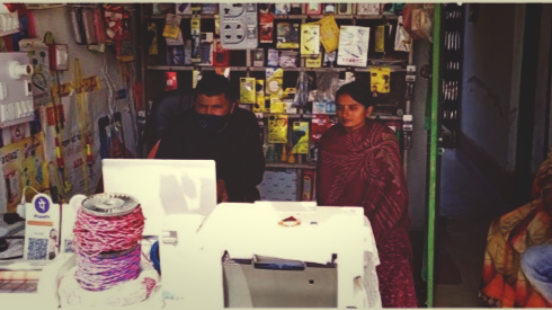
For bridging the digital divide, a digital entrepreneurship program in 500 villages from five districts, viz., Darbhanga, Samastipur, Patna, Nalanda, and Gaya was launched in 2023. Bihar is witnessing a transformative wave of service accessibility led by women digital entrepreneurs. These trailblazing women are not only redefining the entrepreneurial landscape but also catalyzing inclusive development across the state. This initiative provides capacity building and mentoring in digital skills, customer service, entrepreneurship development, financial support and resources, and digital tools to women from socially and economically disadvantaged communities, helping them become successful rural digital entrepreneurs and build a Digital Entrepreneurship Ecosystem. This holistic approach equips them to offer essential digital services in their communities, such as facilitating access to government schemes, online education, and digital financial services. From being computer illiterate to providing a host of over 70+ digital services, these digital entrepreneurs have come a long way only within 9 months of their venture-start in their villages. Some of their services include a large suite of G2C services, design & printing services, online form filling, Banking services, and Mobile payments, among several others. They have also been cross-selling and diversified in selling non-digital products. In this short period, they have already served over 250,000 rural customers (around 40% female customers), and is expected that as their businesses mature, they will be providing digital services to over 7.5 lakh population. Apart from making digital services easily accessible at the village level, they are generating income and securing their futures, with some of them steadily earning upwards of INR25,000 monthly. This program is not only bridging the digital divide but also promoting economic security and social equity, local inclusive economic development, gender equality, awareness, and opening opportunities for skills development.

While government efforts are underway, a coordinated approach involving public-private partnerships, local community engagement, and targeted digital inclusion programs is essential. Programs like these need to be scaled up across the state covering the entire 8,387 Gram Panchayats for bridging the digital divide and contributing significantly to Bihar’s and India’s digital economy.