Mouse Trap
June 29, 2026 Leave a comment
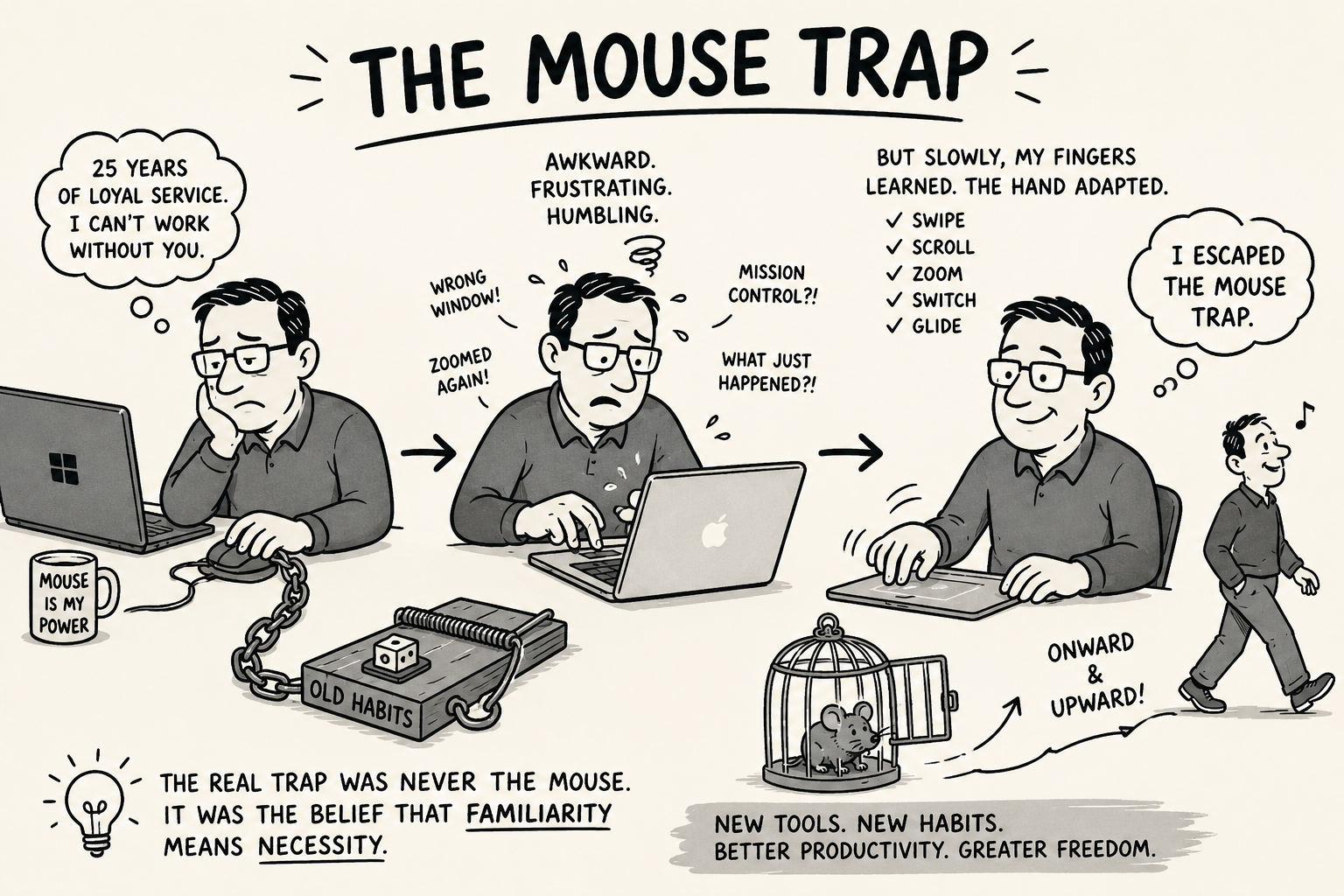
For nearly twenty-five years, my right hand lived under the dictatorship of a small plastic rodent. Ever since I started using a laptop in the early 2000s, the external mouse became less of an accessory and more of a prosthetic extension of my personality. I carried one everywhere with the seriousness of a surgeon transporting medical equipment. If the mouse stopped working, productivity stopped. I would stare helplessly at the laptop screen as though civilisation itself had collapsed. The cursor would sit frozen somewhere on the desktop while I performed the ancient ritual familiar to millions of people who are now in their 40s and beyond: unplugging, reconnecting, blowing imaginary dust from USB ports, replacing batteries, muttering mild abuses at technology, and questioning the moral decline of modern electronics.
Then, a few months ago, I migrated from a Windows laptop to an Apple MacBook and, almost overnight, stopped using the mouse altogether. This was not a carefully researched productivity decision inspired by Silicon Valley minimalism. It was partly convenience, partly curiosity, and partly the exhaustion of carrying chargers, adapters, dongles, cables, and a mouse that increasingly seemed like emotional baggage from another technological era.
The first few weeks were humiliating as the trackpad felt impossibly sensitive and suspiciously intelligent. My fingers moved awkwardly across the smooth surface as tourists would get lost in a foreign airport! Every gesture seemed to trigger unintended consequences. I would attempt a simple scroll and accidentally open Mission Control, launch three applications, rotate an image, zoom into microscopic text, and somehow arrive at a screen asking whether I wanted to configure developer settings for something I did not even know existed. The laptop appeared to possess psychic abilities combined with a dark sense of humour.
For someone in their south side of 40s, this discomfort carried a peculiar emotional weight. Young people experience technological incompetence casually. They tap randomly, experiment fearlessly, and assume mastery will eventually arrive. Older people experience incompetence as a threat to identity. We belong to a generation raised on the belief that adulthood means expertise, and by middle age, one is expected to know things. One manages organisations, handles finances, raises children, negotiates contracts, supervises teams, and gives life advice to younger people. Then, suddenly, a glass rectangle on a laptop defeats you because your fingers cannot perform a three-finger swipe correctly.
So naturally, the instinct is to retreat, return to the mouse, restore dignity, and re-enter familiar territory. But I persisted, partly out of stubbornness and partly because carrying the mouse now felt faintly embarrassing, like travelling with a typewriter ribbon in the age of cloud computing. Gradually, my hand learned before the brain consciously understood, and the fingers adapted. One morning, I realised I was gliding across applications effortlessly. Switching desktops, zooming, scrolling, highlighting text, navigating browsers, previewing files, and moving between workflows happened with a fluidity that felt almost elegant. The movement resembled playing an instrument and not operating machinery. And suddenly I realised that after 25-odd years, I had escaped the mouse trap!
The phrase sounds trivial until one recognises what the mouse actually symbolises for people my age. It represents an entire category of inherited habits that once made sense but now quietly reduce efficiency while masquerading as professionalism. In the early days of laptops, external mice were genuinely superior. Trackpads were terrible inventions that were tiny, unresponsive squares apparently designed by engineers conducting experiments on human frustration. Using a mouse was rational, productive, and serious. But technology evolved while our habits remained frozen in time.
Modern trackpads are astonishingly sophisticated. Yet millions of middle-aged professionals continue carrying wireless mice around with almost ceremonial devotion. Entire coffee shops are filled with grown adults performing elaborate setup procedures before beginning work: laptop out, mouse out, mousepad out, Bluetooth paired, dongle inserted, batteries checked, table space negotiated. Some carry ergonomic mice that resemble futuristic sculptures designed by Scandinavian orthopaedic surgeons. Others own travel mice, office mice, gaming mice, backup mice, and emergency spare batteries, all to avoid learning a slightly different movement of the fingers.
I realised that the mouse is not merely hardware, but more of a psychological infrastructure. People accumulate systems that once solved problems but eventually become obstacles disguised as preferences. We continue using workflows developed in another technological century because familiarity produces emotional comfort. The brain loves efficiency, but it loves predictability even more.
This explains why otherwise intelligent professionals stubbornly cling to outdated habits with almost ideological passion. One proudly announces, ‘I still do all my accounts manually in Excel.’ Another insists, ‘I need every document printed before I can read it properly.’ Someone refuses cloud storage because physical folders feel ‘safer.’ Others maintain endless email chains, paper diaries, complicated filing systems, or insist on in-person meetings for conversations that could be resolved in three messages and a shared document.
These are rarely productivity choices but are comfort rituals. The irony is that people above forty are often fully capable of adapting quickly. In fact, they frequently learn faster than younger users because they understand systems, context, and patterns better. The barrier is rarely intelligence and more of an emotional resistance to temporary incompetence. Somewhere after forty, many people unconsciously stop allowing themselves to become beginners. I know senior executives who manage budgets worth millions but cannot merge PDF files without assistance. I know academics capable of explaining complex philosophy who panic when asked to collaborate on online documents. I know entrepreneurs who built businesses from scratch but still call younger employees to ‘fix the Wi-Fi.’ These are not incapable people but are simply trapped inside technological identities formed decades ago.
The deeper issue is that modern economies increasingly reward adaptability over accumulated procedure. Knowledge now expires faster than ever, and entire industries transform within a decade. Artificial intelligence is already automating tasks that many professionals considered permanently human only a few years ago. In such a world, the most dangerous sentence after forty is not ‘I don’t know.’ It is ‘I have always done it this way.’That sentence quietly closes the future.
The strange thing is that our generation has already proven its adaptability many times over. We are perhaps the only generation that experienced analogue childhood and digital adulthood simultaneously. We used landlines, pagers, floppy disks, fax machines, CDs, USB drives, cloud storage, smartphones, and now invisible synchronisation systems operating somewhere in distant data centres we barely understand. Yet somewhere in middle age, many professionals unconsciously declare technological retirement while still expecting to remain professionally relevant for another twenty years.
What surprised me most after abandoning the mouse was not improved navigation speed, but the psychological shift that followed. Once the discomfort barrier was crossed, I became less intimidated by unfamiliar systems generally and started experimenting more freely. Keyboard shortcuts stopped feeling annoying and began feeling liberating. I approached software with curiosity instead of caution. One begins questioning inherited inefficiencies elsewhere in life, too. Do meetings really need to last an hour? Do I really need to check my email constantly? Do I really need fifty WhatsApp groups? Do I really need to preserve every professional habit developed in 2004 simply because it once worked?
Watch a child interact with new technology and understand it instinctively. There is no shame in experimentation, no fear of appearing foolish. They touch everything, fail repeatedly, laugh, retry, and eventually master the system through curiosity. Adults, especially middle-aged adults, approach new interfaces like diplomats entering hostile territory. We seek guarantees before experimentation because failure now feels reputational.
But perhaps productivity after 40 is not about optimisation at all. Perhaps it is about preserving beginnerhood. The willingness to temporarily appear incompetent may now be one of the most valuable professional skills of modern life. The transition is always awkward. During my early trackpad days, I frequently muttered at the laptop like an ageing cricket fan complaining about T20 leagues. I missed the mouse clicks, triggered accidental gestures and zoomed into absurd screen magnifications. At one point, I somehow rotated an image sideways and spent several minutes trying to restore civilisation. But adaptation has an invisible curve. Frustration suddenly became fluency, and my fingers learned what the ego resisted.
Now, when I see professionals unpacking increasingly elaborate mouse arrangements beside ultra-modern laptops, I feel less judgment and more recognition. I see a smaller version of the same human tendency that affects all of us, of carrying unnecessary tools because they once solved genuine problems. The real trap was never the mouse itself but was the assumption that long familiarity automatically equals permanent necessity. Finally, after 25 years, I finally escaped the mouse trap, and the amusing part is that the cage door had been open for years.
If this article made you think differently about productivity, work, or life choices, subscribe to my blog for one article every week in your mailbox.
(Cover image is generated using AI)


