Why good projects struggle for funding

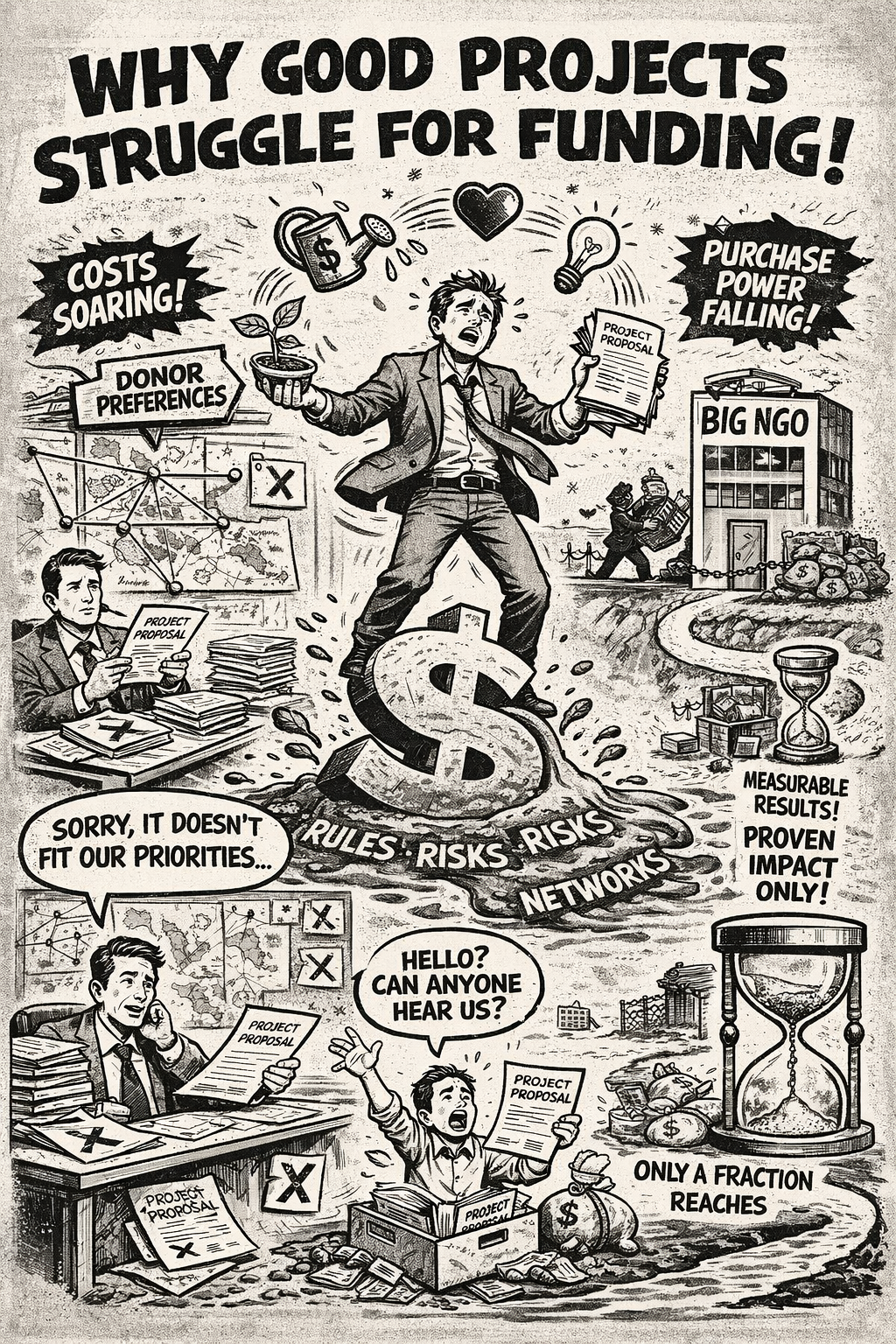
The social impact sector’s irony is that some of the most thoughtful, community-centred, transformative projects struggle to secure funding, while others that are not so well designed, and sometimes even superficial, find their way into donor portfolios. This contradiction is often explained as a failure of proposal writing or organisational capacity, but such explanations only scratch the surface. The deeper truth lies in understanding donor behaviour, including the incentives, constraints, and biases that shape funding decisions. Good projects are overlooked not because they lack merit, as ‘merit’ is not the primary currency in the funding ecosystem, but because of factors like alignment, risk perception, measurability, and institutional incentives.

At the core of the problem is the simple fact that donors do not fund the ‘best’ projects; instead, they support those that align with their priorities. Every donor operates within a specific thematic, geographic, and strategic framework, often influenced by board directives, political factors, or institutional legacy. A project that is highly relevant to a particular community may still be rejected if it does not fit neatly into a donor’s current focus areas. This creates a subtle but significant distortion in the sector, as organisations begin to design projects around donors’ language and preferences rather than the lived realities of communities. In this process, genuinely valuable ideas can become invisible, not because they lack worth, but because they are misaligned with funding narratives.

This is further compounded by the deeply risk-averse nature of development funding. Donors are not neutral actors, and they are accountable upward to their boards, governments, shareholders, or trustees. This shapes a cautious approach to funding, where the emphasis is on minimising risk rather than maximising impact. Established nonprofits with proven track records are preferred over emerging grassroots organisations, even when the latter may have deeper contextual understanding. Similarly, tried-and-tested models are favoured over experimental or innovative approaches. The consequence is a filtering mechanism that systematically excludes many high-potential projects simply because they appear uncertain or difficult to manage. Ironically, the very qualities like innovation, localisation, and adaptability that make a project transformative are often the ones that make it seem risky.

Now there’s a growing emphasis on measurability in funding decisions. Donors desire clear metrics, defined outputs, and quantifiable results for results-based management and data-driven accountability of projects. While this has enhanced transparency, it has also created a bias toward interventions that can demonstrate immediate, tangible results. Projects focused on infrastructure, service delivery, or training programmes tend to perform better because their outputs are easily measurable. Conversely, initiatives aimed at changing social norms, empowering communities, or strengthening institutions struggle to articulate their impact within the same frameworks. The most complex and deeply rooted development challenges are often the least measurable within the funding cycle, and therefore the least fundable. Good projects operating in these areas are disadvantaged not because they are ineffective, but because their effectiveness cannot be readily quantified.

The nature of donor engagement further complicates the picture, despite frequent references to ‘partnership,’ much of development funding remains transactional. Organisations submit proposals in competitive, opaque processes with limited opportunity for dialogue or feedback. In such an environment, relationships matter enormously. Organisations with prior visibility, networks, or access to donor ecosystems often have a significant advantage, even if their projects are not fundamentally stronger. Trust, built over time, can outweigh the intrinsic quality of a proposal. Conversely, new or lesser-known organisations, particularly those operating at the grassroots level, find it difficult to break into these networks. As a result, good projects often fail not on their own terms, but because they are evaluated in isolation, without the benefit of relational context.

This dynamic is closely tied to a broader structural bias within the global development ecosystem. Local organisations, despite being closest to the communities they serve, receive only a small fraction of direct funding. Donors frequently cite concerns around compliance, financial risk, and administrative capacity, which leads them to channel funds through larger intermediaries. While this may simplify management from the donor’s perspective, it creates a distance between resources and realities. Local initiatives, which may be highly effective and deeply embedded, often remain underfunded or entirely excluded. This is not merely an operational issue, but reflects an implicit hierarchy of trust, where proximity to power and familiarity with donor systems are valued over contextual knowledge and lived experience.

Equally important is what might be called the ‘proposal illusion’, with the tendency to compare the quality of a project with the quality of its documentation. In practice, donors assess proposals, not projects. This places a premium on articulation, structure, and the ability to translate complex realities into donor-friendly language. Organisations with access to skilled writers, consultants, or international exposure are better positioned to succeed, even if their fieldwork is not exceptional. On the other hand, grassroots organisations that may be doing outstanding work often struggle to present it in ways that resonate with donor expectations. The result is a system where storytelling can overshadow reality, and where good projects are overlooked because they are not packaged effectively.

Time horizons further skew funding decisions as donors tend to operate within short funding cycles, typically ranging from one to three years, with success evaluated within this limited timeframe. This creates a preference for projects that can demonstrate quick wins, rather than those that require sustained engagement over longer periods. Yet most of the development challenges, like education reform, livelihood transformation, and social cohesion, are inherently long-term and demand patience, continuity, and iterative learning. When funding is short-term, even well-designed projects can struggle to show meaningful results, making them less attractive to donors. This leads to what is often described as the ‘pilot trap,’ where innovative ideas receive initial funding but fail to scale or sustain due to a lack of long-term commitment.

Another big challenge is the persistent reluctance to fund organisational overheads. Donors often prefer to allocate resources directly to programmatic activities, placing limits on administrative costs such as salaries, systems, and governance. This undermines the very foundations that enable effective implementation. Strong organisations require robust systems, skilled personnel, and institutional stability. When these are underfunded, the quality of implementation suffers, reinforcing donor perceptions of risk and inefficiency. This creates a vicious cycle in which organisations are unable to build capacity, and good projects become difficult to execute at scale.

Underlying all of these factors are the incentives that shape donor behaviour. Funding decisions are rarely neutral as they are often influenced by a range of external and internal considerations. Corporate donors are often guided by brand alignment and visibility, favouring projects that can be showcased or communicated easily. Philanthropic foundations may be influenced by leadership vision, legacy goals, or thematic interests. In each case, the logic of funding extends beyond impact alone. Good projects that do not align with these broader incentives may struggle to gain traction, regardless of their potential.

Bilateral and multilateral donors operate within geopolitical frameworks, where aid allocation may reflect strategic interests as much as development priorities. In the wake of global economic slowdowns, traditional sources of Official Development Assistance (ODA) are shrinking. The U.S., U.K., and several European governments have all announced significant cuts to their ODA budgets. These reductions should have sparked debates about the failures of the aid system, but they largely passed with little reflection. The outcome is a development finance environment that’s simultaneously more selective and more risk-averse. Funders now prioritise large-scale, measurable, and politically ‘safe’ projects that can boast short-term, quantifiable results. Small-scale social initiatives, particularly those addressing systemic or cultural issues like inequality or governance, find themselves outside the funding radar. Even when progressive funding streams exist, for example, climate justice or inclusive innovation programs, they come wrapped in new conditionalities of alignment with national development strategies, ESG benchmarks, or private-sector co-financing. These conditions further alienate grassroots actors who can’t meet such formal requirements.

It is also important to acknowledge a more fundamental constraint of scarcity, as the pool of available funding is limited, while the number of worthy projects is vast. Even in a perfectly functioning system, not all good ideas can be supported. This introduces an element of competition that is not purely based on merit. Projects must not only be good, but must also be timely, visible, and strategically positioned. In such an environment, marginal differences in presentation, alignment, or relationships can determine outcomes, leaving many strong proposals unfunded.

Projects that are technically sound but insufficiently rooted in community realities often struggle to convince donors of their sustainability. Funders have been increasingly looking for evidence of participation, co-creation, and local ownership. However, these elements are difficult to demonstrate within conventional proposal formats, leading to a gap between genuine engagement and its representation. Good projects that are deeply participatory may still fall short if they cannot adequately convey this dimension to donors.

These dynamics suggest that the funding ecosystem does not necessarily reward the intrinsic quality of projects. Instead, it rewards alignment, clarity, measurability, and perceived reliability. This does not mean that donors are acting in bad faith; rather, they are responding to their own constraints and accountability structures. The system, in many ways, is functioning as designed. However, the consequences are significant, as innovative, context-specific, and potentially transformative projects often remain unfunded, while safer, more conventional interventions dominate.If we are serious about tackling poverty, inequality, and climate injustice, we must start by rethinking how funding itself operates. It is not enough to design good projects, but one must also learn to translate them into the language of donors without diluting their essence. This requires strategic proposal architecture, effective communication, and relationship-building. For donors, the challenge is more profound as it involves rethinking risk, expanding definitions of impact, and creating funding mechanisms that are flexible, inclusive, and long-term. Without such shifts, the sector will continue to produce good ideas that never see the light of day, not because they are unworthy, but because they do not fit the system that is meant to support them.

Confessions of a Fundraiser

By a Head of Development, who has been there, done that. 

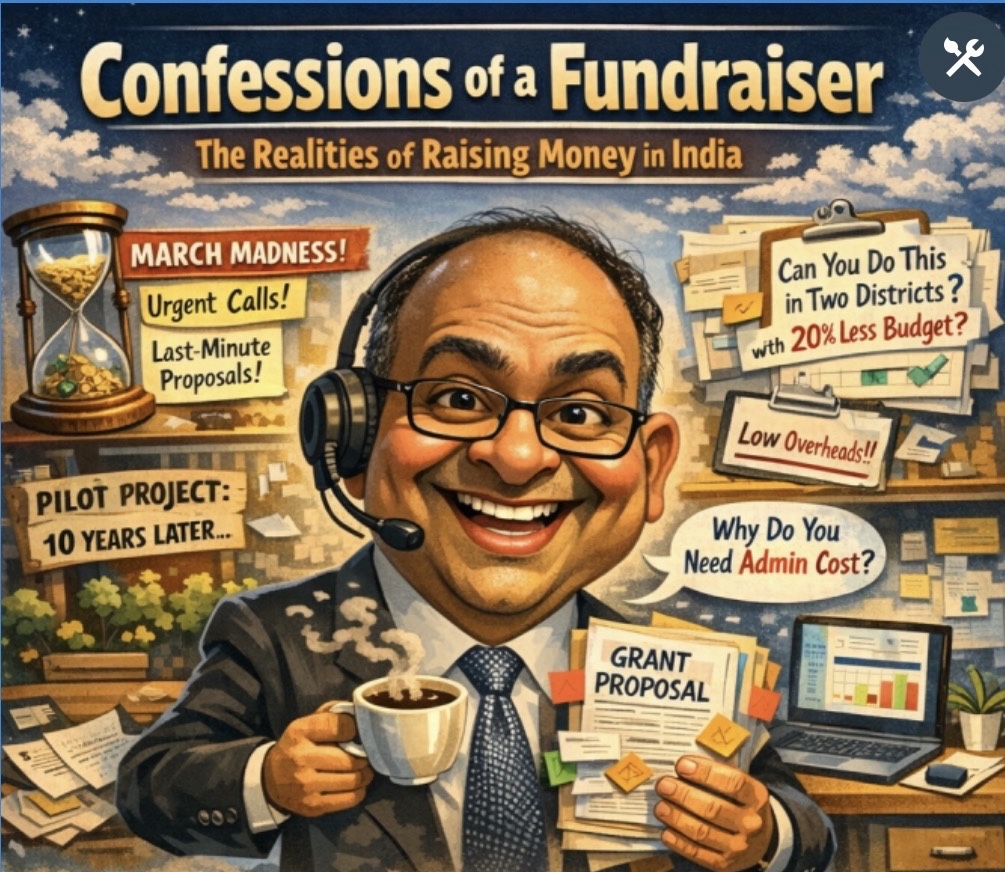
I have spent a good part of my career raising funds for livelihoods and entrepreneurship, environmental sustainability, and digital inclusion. These are kinds of work that everyone agrees are deeply important, and expects to be delivered at miraculous speed, near-zero overheads, and with measurable transformation visible by the next board meeting! Over the years, I have learned that in India’s funding universe, March is not just a month but a mood, where phone calls are returned with unprecedented urgency, proposals are rediscovered with fresh enthusiasm, and sustainability plans are requested even before the first grant tranche has cleared. I have learnt to speak fluently about empowerment while explaining, with equal conviction, why empowerment requires trainers, coordinators, field activities, local transport, and a field office. I have learnt that pilots can run for a decade and still be called pilots, that social impact is expected to be both transformative and inexpensive, and that the most common expression of donor admiration is, ‘This is excellent work. Can you replicate in two districts with 20% less budget?’ And yet, I have also learnt that when trust is built patiently, and partnerships are approached as shared responsibility rather than transactional funding, the system does work, unevenly, imperfectly, but often just in time.

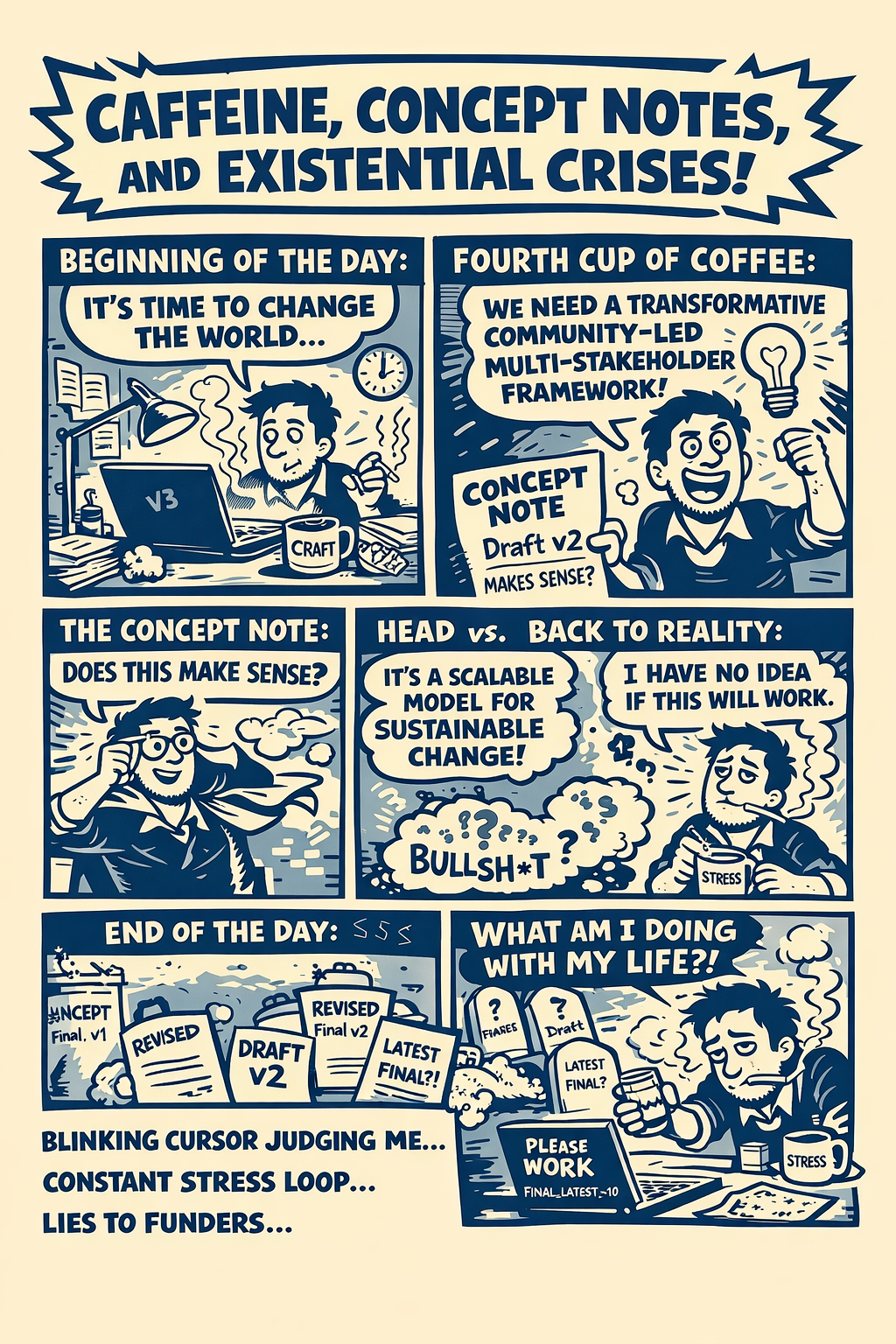
If you ever want to test your emotional resilience, professional patience, and metaphysical belief in destiny, try becoming a fundraiser for social impact in India. Not as a hobby or a phase in life, but as a full-time, salaried, KPI-driven profession where your success is measured in crores raised, relationships sustained, and hopes renewed, often all before lunch. Fundraising in India is not a job; it is a personality type. It is a slow-burning spiritual practice. It is also, on some days, a contact sport.

Most fundraisers do not grow up dreaming of this life. No child has ever said, ‘When I grow up, I want to write concept notes, follow up politely seven times, and still be told the CSR budget has already been exhausted for this year.’ Fundraisers are usually people who joined the development sector with good intentions and then stayed because they discovered a rare combination of optimism, masochism, and an above-average tolerance for ambiguity. In India, fundraising also requires fluency in multiple dialects, not linguistic ones, but donor dialects. You must speak CSR, philanthropy, family office, multilateral, HNI, trust, and the particularly tricky language known as ‘let’s take this offline.’

Every fundraising journey begins with a proposal that is equal parts strategy and speculative fiction. A document that must be simultaneously visionary and realistic, innovative yet ‘scalable,’ rooted in community voice and at the same time aligned to the donor’s thematic priorities for the current financial year. The proposal must do many things at once: ‘Solve poverty + empower women + be sustainable by the third year + align with SDGs (preferably all of them) + cost exactly the amount the funder has available + have low overheads but world-class MEL.’ You will spend weeks refining language, perfecting logframes, and polishing budgets, only to be asked in the first meeting, ‘Can you explain this in two lines?’ You will smile, compress your knowledge of years of community work into a sentence, and remind yourself that clarity is a virtue, even when it hurts.

Sooner or later, every fundraiser in India faces the great philosophical question of our time: Why do you need staff to run a project? Recently, another question got added to my great list when a funder asked me, ‘Why do you need field offices to implement a community-based high-touch project?’ Mind you, I managed a straight-faced answer, without any smirk or sarcasm, even though I cursed the day I decided to be a fundraiser.

Admin costs are a suspicious category in the minds of Indian donors. They include dangerous items like salaries, rent, electricity, and internet, none of which, apparently, contribute to impact. As a fundraiser, you become adept at explaining that projects do not run on goodwill and sunlight alone. That field teams do not teleport. That data does not collect itself. You learn to say ‘lean but adequate,’ ‘efficient yet ethical,’ and ‘value for money’ with full sincerity. I have even attempted some humour at times on the negotiation tables, saying, ‘Without admin costs, the project will still exist, but just as an idea.’ Results vary post such statements.

What I have understood is that fundraising in India is less about money and more about relationships. Money is merely the by-product of trust built over years, conversations, coffees, conferences, and carefully worded WhatsApp messages. I have learnt that a ‘quick call’ can last an hour or more, a ‘small grant’ can require six levels of approvals and may take two years; silence doesn’t mean rejection (or acceptance); words from leadership are golden, but if you don’t have that in writing, you are screwed. The fundraiser’s greatest skill is not writing; it is patience. You patiently wait for responses, for board meetings, for the next quarter, for the funder who loved your work but is noncommittal. You wait with optimism, and dignified reminders, gentle ones every couple of weeks.

Then comes the project visit by the funder, usually by some of their board members and senior leadership. Often, they bring moments of high drama along with it. For the donor, it is a glimpse into our community-connect and implementation efficiency. For a fundraiser, it often turns into a logistical marathon involving vehicles, weather, community leaders, beneficiaries, translators, photographers, and a strong hope that nothing goes wrong. In all such visits, we fundraisers pray to some invisible power that the roads are navigable, community meetings start on time, funder’s visibility is primed, and no one asks an unplanned question about funding gaps. If all goes well, the funder says, ‘This is so impactful.’ You nod, beaming. You make a mental note to follow up in three days. At the beginning of my fundraising career in India two decades ago, I often ended up being shocked by the variety of demands by donor representatives visiting project sites. Thanks to the information age, the visiting representatives nowadays are well informed and often invested in social change.

Fundraisers also live at the intersection of data and dignity, translating lived experience into metrics without stripping it of meaning.Indian donors want data and stories, and at times, even at the cost of losing the bigger picture. You learn to convert human change into numbers without losing the soul of the work. You say things like, ‘4025 women trained’, and then you add, ‘Meet Sunita, who now earns independently and negotiates at home.’ You know that neither is sufficient alone, and the narrative together, they might just unlock the next tranche.

How can I forget the ultimate sword of big NO! Rejection is a constant companion of us fundraisers, like a dark shadow. Sometimes polite, sometimes vague, and sometimes dressed up as ‘great work, but not this year.’ You learn not to take it personally, mostly. You also learn that today’s rejection can be tomorrow’s opportunity, because India’s funding ecosystem is small, relational, and cyclical. The donor who said no last year may say yes next year, after changing jobs, priorities, or perspectives. So you keep the door open, always.

Fundraising is emotional labour. You hold hope for communities, for organisations, for teams whose salaries depend on your ability to convince someone that change is worth investing in. You are optimistic on behalf of others, even on days you feel tired. You absorb anxiety, translate urgency, and project confidence. You celebrate quietly when funds come through, and cushion disappointment when they don’t. You are expected to be resilient, persuasive, strategic, and endlessly positive. No one tells you this in job descriptions.

And yet, despite the follow-ups, the spreadsheets, the rejections, the ‘please reduce your budget by 15-20%,’ and often ending up becoming a football between the funder and the grantee management, we choose to stay. Because once in a while, a funder truly listens. Once in a while, a partnership feels equal. Once in a while, funding aligns perfectly with need, timing, and trust. And in those moments, you remember why fundraising matters. Because social impact does not scale on passion alone. It scales on resources, relationships, and people willing to ask again and again for something better.

So here’s to the fundraisers in India: The translators. The bridge-builders. The professional optimists. May your proposals be read, your follow-ups answered, and your impact always exceed your budgets. And may you never lose your sense of humour. Wishing you strong coffee, timely approvals, and generous funders, today and always.

May the force be with you! 

Why Philanthropy Needs to Evolve

Philanthropy has been a force for good across continents, building hospitals, funding schools and universities, feeding communities in crises, taking action to solve social challenges, and underwriting research. While intending to create positive and lasting change in people’s lives and strengthening communities, often, take the form of that giving is the classic ‘donor → beneficiary’ pipeline, which has serious limits. When well-meaning philanthropic entities simply transfer money or material goods to presumed beneficiaries without sharing power, listening deeply, or tracking outcomes with humility, aid can be inefficient, short-lived, and even harmful. To move from transactional charity to transformative social change, philanthropy must evolve toward participatory, locally led, and evidence-based models that empower communities to define problems, choose solutions, and steward resources. Several philanthropic models need to evolve into a new, pluralistic philanthropy that can deliver better, fairer, and more sustainable impact.

The donor-beneficiary model often centres on donors’ priorities. Funders set agendas, design programs, select implementing partners, and measure success by indicators they choose, often from a distance. This creates several structural problems, like,

  • Power asymmetry occurs when donors decide what counts as a problem and which solutions are legitimate. Communities become recipients rather than partners, and local knowledge is sidelined, reducing relevance and local ownership.
  • Templates developed for ease of scale often ignore social-cultural and political nuances at the local level. Programs that look good in donor reports may fail on the ground due to ‘One-size-fits-all interventions.’
  • Short funding horizons and volatility of donors with grants tied to campaign cycles, leftover funds, or financial year budgets can stop abruptly, leaving services unsustainable and organisations stranded.
  • When philanthropy substitutes for systemic public investment, it can relieve governments of responsibility or create dependency among groups who lack the voice to advocate for longer-term change.
  • Donors are accountable to boards or taxpayers, with limited accountability to the communities they aim to serve; evaluation is often internal and narrowly framed.

These limitations are not theoretical as reviews of philanthropic practice repeatedly find that participation is often performative, i.e., consultation exercises without power transfer. Scholarly and practitioner literature has called out the gap between rhetoric and sustainable commitment to community-led approaches. This is the moment for a pivot to an evolved philanthropic approach that can complement the traditional giving through,

  1. Participatory and community-led decision-making: Communities should help set priorities and co-design programs. Participatory grant-making moves power to those closest to problems, bringing lived experience into funding decisions and increasing the legitimacy and likely effectiveness of interventions.
  • Local leadership and capacity building: Funding should invest in local institutions (community groups, cooperatives, NGOs, social enterprises), and not only project outputs. That means unrestricted core support, leadership development, and multi-year commitments that enable organisations to mature and adapt.
  • Data-driven learning and accountability: Rigorous use of data and learning systems can help tailor solutions, track impact, and course correct. Data must be used ethically, with local ownership and attention to privacy and power dynamics.

When combined, this approach will shift philanthropy from a mere supplier of goods to an enabler of agency. Some good practices from around the world show how participatory and locally led philanthropy can function in practice, and who can act as torchbearers for philanthropic communities in their regions.

Indian philanthropic institutions combine traditional grant-making with newer models. Tata Trusts has invested heavily in the Data-Driven Governance (DELTA: Data, Evaluation, Learning, Technology, and Analysis) framework for strengthening local governance and planning. Their approach works with government entities and communities to build data systems that inform local decision-making rather than impose external solutions. This demonstrates how philanthropy can facilitate evidence-based public systems while engaging local institutions rather than bypassing them.  

Azim Premji University and Foundation have made community engagement in educational work prominent, emphasising long-term partnerships with local schools and communities rather than one-off interventions. Their community engagement model underscores the importance of listening, iterative learning, and strengthening public institutions rather than substituting for them.  

In Southeast Asia, funder collaboratives demonstrate a shift from isolated donors to pooled funds that support locally relevant priorities. The Asia Community Foundation’s 30×30 Southeast Asia Ocean Fund, launched in January 2025, is a recent example. The fund pools resources to protect coastal and marine ecosystems with an emphasis on inclusion and equity, supporting local stewards and communities rather than exporting conservation blueprints. Collaborative funds like this allow donors to align with regional expertise, reduce duplication, and focus on communities affected by interventions.  

The USA has been an incubator for participatory grant-making experiments. Major foundations and movements, spurred by crises such as the COVID-19 pandemic and racial-justice mobilisations, have explored models that transfer decision-making authority to communities. For instance, mainstream philanthropic institutions like Ford Foundation have published reflections on why participatory grant-making mattered during crises and how it can be institutionalised, noting its capacity to surface local priorities and accelerate equitable responses. While the U.S. landscape is mixed (with many foundations still operating traditionally), the growing body of practice shows that community-led funding can be both rapid and rights-respecting when donors cede control.  

The literature and practice of participatory and community-led philanthropy are growing across Africa, rooted in traditional values of solidarity, mutuality, and shared support. Researchers and practitioners have documented participatory grant-making and community governance innovations, arguing that ceding decision rights to local actors helps align funding with local priorities and sustains outcomes. While capacity and infrastructure challenges exist, the momentum toward locally governed funding systems is notable in contexts where external donors historically dominated the agenda. Recent examples of participatory grant-making (such as Harambee in Kenya, Ujamaa in Tanzania, and Ubuntu across the continent) synthesise these trends and highlight both promise and challenges.  

Participation, local leadership, and data are crucial for effective philanthropy because they shift power dynamics, increase relevance and impact, and improve decision-making based on evidence rather than assumption. This approach moves away from traditional, top-down models toward more equitable, efficient, and sustainable processes. Participatory philanthropy and grant-making processes will lead to,

  • Greater relevance when communities help design interventions, uptake and adaptation increase. Local actors understand cultural norms, political constraints, and practical hurdles that external project designers often miss.
  • Sustainability of programs that are owned by communities beyond the grant cycle. Unrestricted support and capacity building enable organisations to respond flexibly to emerging needs.
  • Data systems that include local stakeholders enable rapid feedback loops, like what’s not working can be quickly spotted and fixed, and successes can be scaled responsibly, improving impact through iterative learning.
  • Participatory philanthropy is not neutral, as it intentionally rebalances power by giving those affected by problems a say in solutions.
  • Cost-effectiveness through local knowledge increases returns on investment.

To evolve to the new and effective models of philanthropy, funders should take practical steps such as shifting money and power by moving a significant percentage of grant money into participatory processes and community-governed pools. They should offer multi-year, unrestricted funding and simplify application and reporting requirements. Investing in intermediary infrastructure is crucial, so supporting local philanthropy platforms, community foundations, and capacity builders, incubators, and accelerators who can channel funds and help communities administer grants is essential. Building data partnerships with communities by funding local data systems, such as community scorecards, participatory monitoring, and open data platforms that are owned and governed by communities, while ensuring ethical data practices, is also important. Co-designing evaluation frameworks with community actors to develop success metrics that prioritise outcomes valued by the community, such as economic stability, dignity, and local governance, rather than just donor KPIs, is very much required. Additionally, funders should reward adaptive learning by creating grant mechanisms that allow for iteration of ‘pilot-learn-adapt-scale’ rather than penalising change as ‘failure.’ Lastly, funders should role model humility and plan for their responsible exit by strengthening local institutions so they can sustain without perpetual external support.

However, it’s important to understand that not every ‘participatory’ label signals a real transfer of power. Donors must avoid superficial practices, like convening consultations for optics, creating advisory committees without decision rights, or funding only projects that align with preselected agendas. Genuine participation requires structural changes like in the boards, budgets, and governance processes, that reflect shared authority.

Philanthropy has great potential to speed up solutions to poverty, climate change, governance problems, and social inequality. To shift from charity to meaningful change, funders need to be willing to relax control, invest in local leaders, and support strong, community-led data and learning systems. Examples from India, Southeast Asia, the U.S., and Africa demonstrate various approaches such as data partnerships that improve governance, pooled funds that empower local stewards, and participatory grant making that changes who makes decisions. Effective, equitable, and sustainable change emerges when those affected by problems help define and lead the response. Philanthropy’s evolution from a one-way pipeline of resources to a platform for shared power is not just desirable, it’s necessary if we want charitable funding to do more than temporarily relieve suffering. They must catalyse systems that let communities thrive on their own terms.

Cracking the fundraising code

Fundraising is the art and science of turning good intentions into actual impact! Throughout my career I have been raising funds for social impact, for causes of basic necessities like food, water, shelter, livelihood to a green economy, bridges over rivers to even a roller coaster in a developed country. I have been actively involved in raising funds for these causes from as small as $10 up to $50 million from a variety of sources and instruments. As the Head of Development at a nonprofit organization for social impact projects in India, I’ve navigated the corridors of CSR leaderships and foundation offices, and let me tell you, it’s not always smooth sailing. Often, it feels like trying to surf a tsunami with a paper boat!

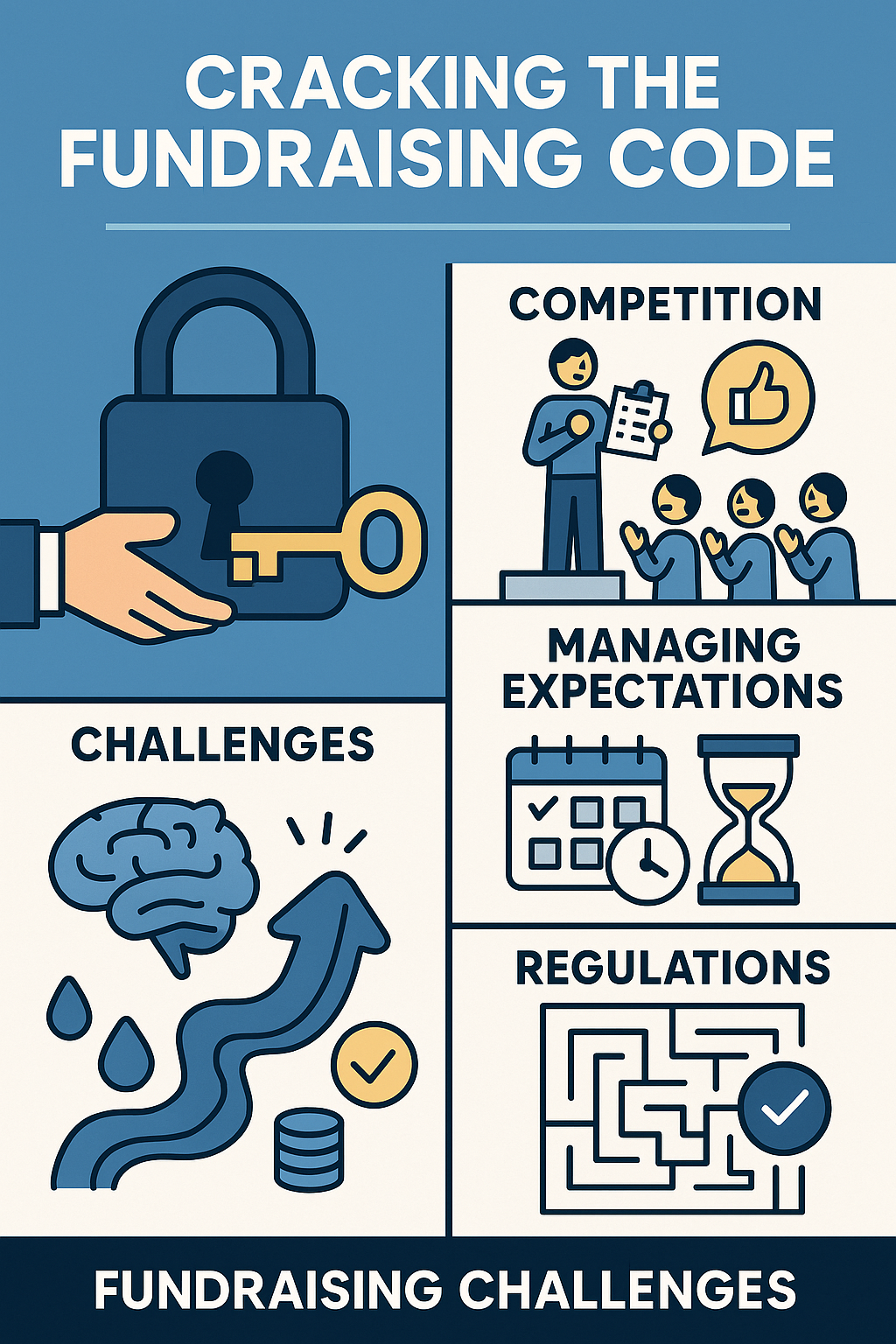
Corporate Social Responsibility isn’t just a box to tick. It’s a strategic dance between business goals, stakeholder expectations, and social impact. With so many initiatives competing for attention, securing a dedicated slice of the CSR pie often feels like requesting a moment on a crowded stage, and convincing the audience that your act is worth their applause.

Foundations receive hundreds of pitches, each expecting to win the golden ticket. Getting noticed requires more than a well-crafted proposal; it demands storytelling that resonates and relationships that endure. Sometimes, it’s less about what you say and more about how you say it, and how quickly you can make a compelling case before the next shiny pitch distracts them.

Donors want results, but impact is often a marathon, not a sprint. Managing expectations without being over promising is an art. We’ve all faced the uncomfortable moment of explaining why a project’s full fruits may take years to ripen, a diplomatic tightrope walk that can test even the most seasoned fundraiser.

India’s complex regulatory landscape can feel like a labyrinth where one wrong turn can lead to delays or disapprovals. Keeping up with FCRA regulations, tax exemptions, and reporting requirements is a full-time job, and sometimes, it’s like speaking a different language altogether. Ironically, securing funds for a project often means fundraising itself. Resource constraints can limit outreach and follow-up, turning what should be a strategic focus into a haphazard firefight.

A mix of storytelling, patience, relationship-building, and a dash of humour helps. When engaging with CSR and foundations, understanding their priorities, aligning your mission with their vision, and communicating impact clearly can turn challenges into opportunities.

To my fellow fundraisers who are navigating this maze: keep your spirits high, your pitches sharper, and remember, every “no” is just a “yes” in disguise waiting to happen!

Let’s keep the conversation going. Share your stories or tips below, because in the game of social impact, we’re all in this together.

Download a brutally honest fundraising checklist!

Impact Funding in the time of COVID-19

Photo source: The New Humanitarian

The global pandemic COVID-19 has triggered the most severe economic recession in nearly a century and is causing enormous damage to people’s health, jobs, and well-being. It has changed the social sector landscape and will continue to impact the sector for the next few years. In the short term, since March 2020, change in the funding trends is already being witnessed by non-profits, especially of the CSR in India, with majority of them contributing to the PM Cares, CM Relief Funds and contributions towards local relief work like food and PPE distribution. The unexpected crisis created due to migrant labour returning to their home states, we are witnessing some of the bigger CSRs channeling their funds towards ‘Rehabilitation during and post COVID-19’ phase with a focus on re-skilling, sustainable livelihoods and job creation, BCC, and food & nutrition security.

Until the next 12-18 months, there will be opportunities for partnerships under the ‘rehabilitation lens’ across geographies, but more focused on states like Bihar, Uttar Pradesh, Madhya Pradesh, Chhattisgarh, Odisha, Assam, and Jharkhand. Apart from relief & rehabilitation, Health (preventive health, strengthening local health systems at block and village levels, and co-morbidity diseases like TB, HIV/AIDS, Diabetes, etc.) and Education (especially working with a sudden increase in out-of-school-children due to in-migration, and skilling School teachers in rural and sub-urban India in virtual classrooms, course development and delivery, and digital communication) are other areas, where donor funds are potentially going to be invested. In other areas, especially environment and climate change (unless CSRs & foundation’s core focus is environment), it is bound to be severe funding cuts (40%-60% from pre-COVID times) over short to mid-term.

Non-profits need to continue building strong partnership with their existing CSR Partners, to continue getting support to even those projects that are not COVID aligned, and build new partnerships using COVID aligned models. It is expected that Government funding will increase and so will partnership opportunities in most of the areas like livelihoods, education and health using innovative implementation mechanisms and digital communication. The World Bank has announced large assistance programs for India, which will be implemented through state governments and may bring non-profits with the opportunities of large partnerships between now and 2025. The current changed funding trend will more or less continue in 2021. However bigger CSR and foundations will see a potential downside of 30-50% in their funding allocations.

As restrictions are being eased world-wide, the path to global economic recovery remains highly uncertain with 6-7.5% negative growth in 2020, it is expected to climb back to around 2.8-3% in 2021 and move slowly towards recovery. In the long run, 2022-25, when both national and international economies are strongly on the recovery path, it is expected that several international aid agencies, which had stopped direct funding in Indian development sector, once again will open a window for 3-5 years of funding, and number of funding opportunities for India and other developing countries will increase. Historically, post mega disaster comes the golden period of funding for impact sector. It is a phase, and it too shall pass. Together, we will continue to drive change and together we will prevail.

Disclaimer: The opinions expressed are those of the author and do not purport to reflect the views or opinions of any organization, foundation, CSR, non-profit or others.