Why good projects struggle for funding

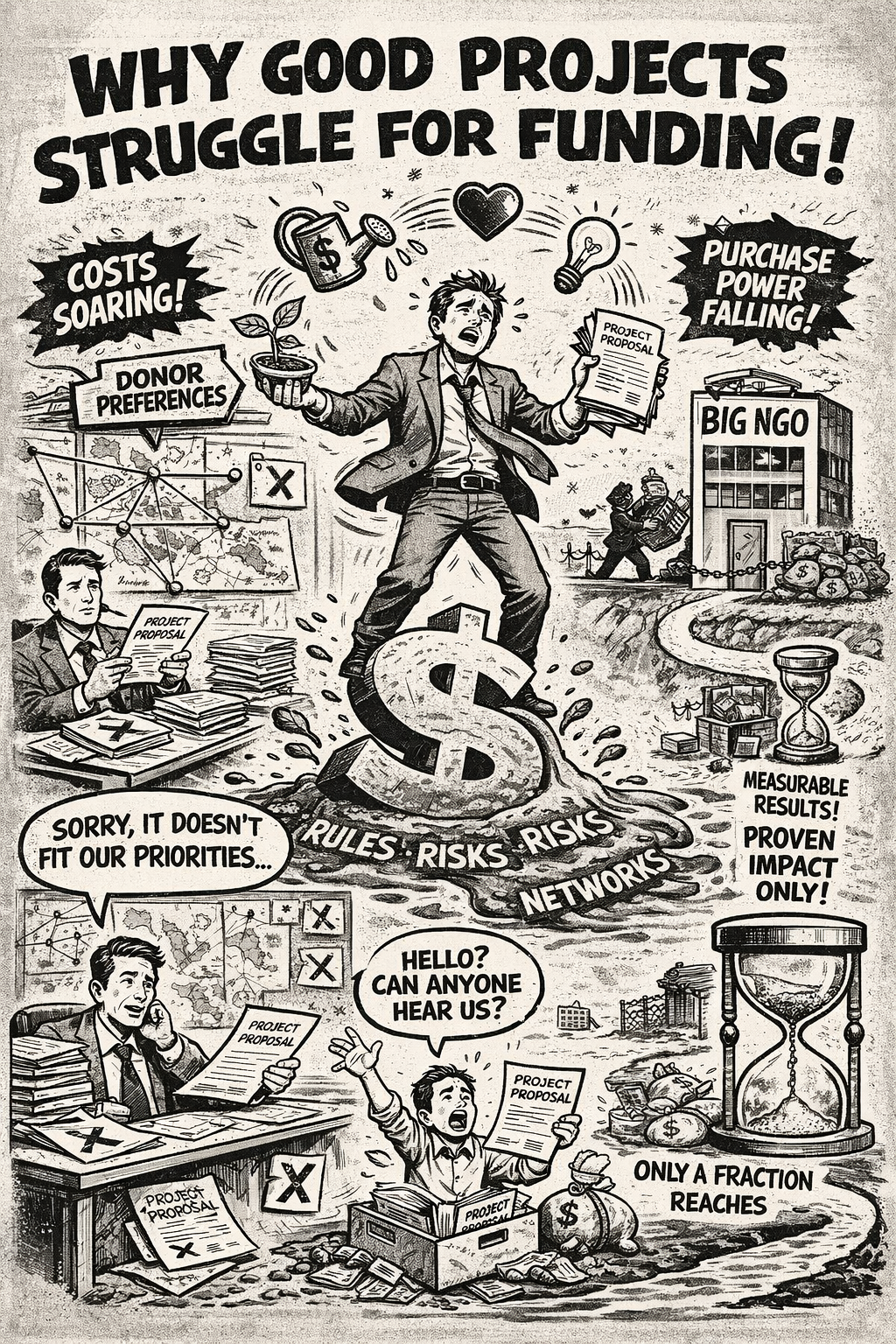
The social impact sector’s irony is that some of the most thoughtful, community-centred, transformative projects struggle to secure funding, while others that are not so well designed, and sometimes even superficial, find their way into donor portfolios. This contradiction is often explained as a failure of proposal writing or organisational capacity, but such explanations only scratch the surface. The deeper truth lies in understanding donor behaviour, including the incentives, constraints, and biases that shape funding decisions. Good projects are overlooked not because they lack merit, as ‘merit’ is not the primary currency in the funding ecosystem, but because of factors like alignment, risk perception, measurability, and institutional incentives.

At the core of the problem is the simple fact that donors do not fund the ‘best’ projects; instead, they support those that align with their priorities. Every donor operates within a specific thematic, geographic, and strategic framework, often influenced by board directives, political factors, or institutional legacy. A project that is highly relevant to a particular community may still be rejected if it does not fit neatly into a donor’s current focus areas. This creates a subtle but significant distortion in the sector, as organisations begin to design projects around donors’ language and preferences rather than the lived realities of communities. In this process, genuinely valuable ideas can become invisible, not because they lack worth, but because they are misaligned with funding narratives.

This is further compounded by the deeply risk-averse nature of development funding. Donors are not neutral actors, and they are accountable upward to their boards, governments, shareholders, or trustees. This shapes a cautious approach to funding, where the emphasis is on minimising risk rather than maximising impact. Established nonprofits with proven track records are preferred over emerging grassroots organisations, even when the latter may have deeper contextual understanding. Similarly, tried-and-tested models are favoured over experimental or innovative approaches. The consequence is a filtering mechanism that systematically excludes many high-potential projects simply because they appear uncertain or difficult to manage. Ironically, the very qualities like innovation, localisation, and adaptability that make a project transformative are often the ones that make it seem risky.

Now there’s a growing emphasis on measurability in funding decisions. Donors desire clear metrics, defined outputs, and quantifiable results for results-based management and data-driven accountability of projects. While this has enhanced transparency, it has also created a bias toward interventions that can demonstrate immediate, tangible results. Projects focused on infrastructure, service delivery, or training programmes tend to perform better because their outputs are easily measurable. Conversely, initiatives aimed at changing social norms, empowering communities, or strengthening institutions struggle to articulate their impact within the same frameworks. The most complex and deeply rooted development challenges are often the least measurable within the funding cycle, and therefore the least fundable. Good projects operating in these areas are disadvantaged not because they are ineffective, but because their effectiveness cannot be readily quantified.

The nature of donor engagement further complicates the picture, despite frequent references to ‘partnership,’ much of development funding remains transactional. Organisations submit proposals in competitive, opaque processes with limited opportunity for dialogue or feedback. In such an environment, relationships matter enormously. Organisations with prior visibility, networks, or access to donor ecosystems often have a significant advantage, even if their projects are not fundamentally stronger. Trust, built over time, can outweigh the intrinsic quality of a proposal. Conversely, new or lesser-known organisations, particularly those operating at the grassroots level, find it difficult to break into these networks. As a result, good projects often fail not on their own terms, but because they are evaluated in isolation, without the benefit of relational context.

This dynamic is closely tied to a broader structural bias within the global development ecosystem. Local organisations, despite being closest to the communities they serve, receive only a small fraction of direct funding. Donors frequently cite concerns around compliance, financial risk, and administrative capacity, which leads them to channel funds through larger intermediaries. While this may simplify management from the donor’s perspective, it creates a distance between resources and realities. Local initiatives, which may be highly effective and deeply embedded, often remain underfunded or entirely excluded. This is not merely an operational issue, but reflects an implicit hierarchy of trust, where proximity to power and familiarity with donor systems are valued over contextual knowledge and lived experience.

Equally important is what might be called the ‘proposal illusion’, with the tendency to compare the quality of a project with the quality of its documentation. In practice, donors assess proposals, not projects. This places a premium on articulation, structure, and the ability to translate complex realities into donor-friendly language. Organisations with access to skilled writers, consultants, or international exposure are better positioned to succeed, even if their fieldwork is not exceptional. On the other hand, grassroots organisations that may be doing outstanding work often struggle to present it in ways that resonate with donor expectations. The result is a system where storytelling can overshadow reality, and where good projects are overlooked because they are not packaged effectively.

Time horizons further skew funding decisions as donors tend to operate within short funding cycles, typically ranging from one to three years, with success evaluated within this limited timeframe. This creates a preference for projects that can demonstrate quick wins, rather than those that require sustained engagement over longer periods. Yet most of the development challenges, like education reform, livelihood transformation, and social cohesion, are inherently long-term and demand patience, continuity, and iterative learning. When funding is short-term, even well-designed projects can struggle to show meaningful results, making them less attractive to donors. This leads to what is often described as the ‘pilot trap,’ where innovative ideas receive initial funding but fail to scale or sustain due to a lack of long-term commitment.

Another big challenge is the persistent reluctance to fund organisational overheads. Donors often prefer to allocate resources directly to programmatic activities, placing limits on administrative costs such as salaries, systems, and governance. This undermines the very foundations that enable effective implementation. Strong organisations require robust systems, skilled personnel, and institutional stability. When these are underfunded, the quality of implementation suffers, reinforcing donor perceptions of risk and inefficiency. This creates a vicious cycle in which organisations are unable to build capacity, and good projects become difficult to execute at scale.

Underlying all of these factors are the incentives that shape donor behaviour. Funding decisions are rarely neutral as they are often influenced by a range of external and internal considerations. Corporate donors are often guided by brand alignment and visibility, favouring projects that can be showcased or communicated easily. Philanthropic foundations may be influenced by leadership vision, legacy goals, or thematic interests. In each case, the logic of funding extends beyond impact alone. Good projects that do not align with these broader incentives may struggle to gain traction, regardless of their potential.

Bilateral and multilateral donors operate within geopolitical frameworks, where aid allocation may reflect strategic interests as much as development priorities. In the wake of global economic slowdowns, traditional sources of Official Development Assistance (ODA) are shrinking. The U.S., U.K., and several European governments have all announced significant cuts to their ODA budgets. These reductions should have sparked debates about the failures of the aid system, but they largely passed with little reflection. The outcome is a development finance environment that’s simultaneously more selective and more risk-averse. Funders now prioritise large-scale, measurable, and politically ‘safe’ projects that can boast short-term, quantifiable results. Small-scale social initiatives, particularly those addressing systemic or cultural issues like inequality or governance, find themselves outside the funding radar. Even when progressive funding streams exist, for example, climate justice or inclusive innovation programs, they come wrapped in new conditionalities of alignment with national development strategies, ESG benchmarks, or private-sector co-financing. These conditions further alienate grassroots actors who can’t meet such formal requirements.

It is also important to acknowledge a more fundamental constraint of scarcity, as the pool of available funding is limited, while the number of worthy projects is vast. Even in a perfectly functioning system, not all good ideas can be supported. This introduces an element of competition that is not purely based on merit. Projects must not only be good, but must also be timely, visible, and strategically positioned. In such an environment, marginal differences in presentation, alignment, or relationships can determine outcomes, leaving many strong proposals unfunded.

Projects that are technically sound but insufficiently rooted in community realities often struggle to convince donors of their sustainability. Funders have been increasingly looking for evidence of participation, co-creation, and local ownership. However, these elements are difficult to demonstrate within conventional proposal formats, leading to a gap between genuine engagement and its representation. Good projects that are deeply participatory may still fall short if they cannot adequately convey this dimension to donors.

These dynamics suggest that the funding ecosystem does not necessarily reward the intrinsic quality of projects. Instead, it rewards alignment, clarity, measurability, and perceived reliability. This does not mean that donors are acting in bad faith; rather, they are responding to their own constraints and accountability structures. The system, in many ways, is functioning as designed. However, the consequences are significant, as innovative, context-specific, and potentially transformative projects often remain unfunded, while safer, more conventional interventions dominate.If we are serious about tackling poverty, inequality, and climate injustice, we must start by rethinking how funding itself operates. It is not enough to design good projects, but one must also learn to translate them into the language of donors without diluting their essence. This requires strategic proposal architecture, effective communication, and relationship-building. For donors, the challenge is more profound as it involves rethinking risk, expanding definitions of impact, and creating funding mechanisms that are flexible, inclusive, and long-term. Without such shifts, the sector will continue to produce good ideas that never see the light of day, not because they are unworthy, but because they do not fit the system that is meant to support them.

Digital Bihar, Inclusive Growth

Image generated using AI

Bihar has a rich historical and cultural heritage and is one of the most populous states in India, with a population exceeding 13 crores[i] and a predominantly rural population. The state faces several challenges in digital literacy, access to technology, digital inclusion, economic development, and equitable growth. However, recent initiatives in e-governance, education, and entrepreneurship hold much promise and potential for contributing towards India’s vision of a digitally empowered society.

Digital literacy remains a significant challenge, with rates below 30% (national average 38% for household digital literacy[ii]), as reported by Ideas for India[iii]. Bihar’s low digital literacy follows its socio-economic conditions, including high poverty rates[iv] (33.76% below the poverty line and 51.91% multidimensional poverty as of 2021) and limited access to digital devices. Rural areas, which hold 75% of the state’s population face challenges due to inadequate infrastructure and low literacy levels. The state’s overall literacy rate, as per 2017 data, stands at 70.9%[v], with rural areas at 69.5% and urban areas at 83.1%. Female literacy, at 60.5%, is significantly lower than male literacy at 79.7%, further complicating efforts to bridge the digital divide.

The digital divide in Bihar is a significant barrier to inclusive development. According to the India Inequality Report 2022 by Oxfam India[vi], Bihar has the lowest internet penetration among Indian states and a wide urban-rural digital divide, with only 31% of rural residents using the internet compared to 67% in urban areas. This rural-urban divide is further worsened by socio-economic disparities.

The digital divide affects important sectors like education, healthcare, and finance. For example, in 2017-18 only 9% of students enrolled had access to a computer with internet for education[vii]. Initiatives like BharatNet, aimed at providing rural connectivity, have been unable to deliver effective outcomes. Bihar is one of the focus states for the Digital India Programme, but execution lags due to infrastructural challenges.

In recent years, Bihar has made significant strides in leveraging digital services in improving governance and public service delivery. The National Informatics Center (NIC) Bihar State Centre, established in 1988, plays a central role in this transformation (https://bihar.nic.in/). It supports departments such as revenue, district administration, rural development, finance, agriculture, employment, election, social welfare, and food and civil supplies with IT solutions. The ServicePlus portal is a key platform, offering services like certificate issuance and case status checks, though rural access remains a hurdle, particularly for marginalized communities, requiring better infrastructure and awareness. These barriers require continued investment in training and infrastructure to ensure widespread digital literacy. Common Service Centres (CSCs) and Vasudha Kendra are crucial for providing government and private services to rural and remote areas in Bihar, enhancing digital inclusion and accessibility. However, they are not enough to cater to the growing needs of the rural population. People travel to block towns and larger villages, to access even basic G2C services, indicating the lack of any nearby facility.

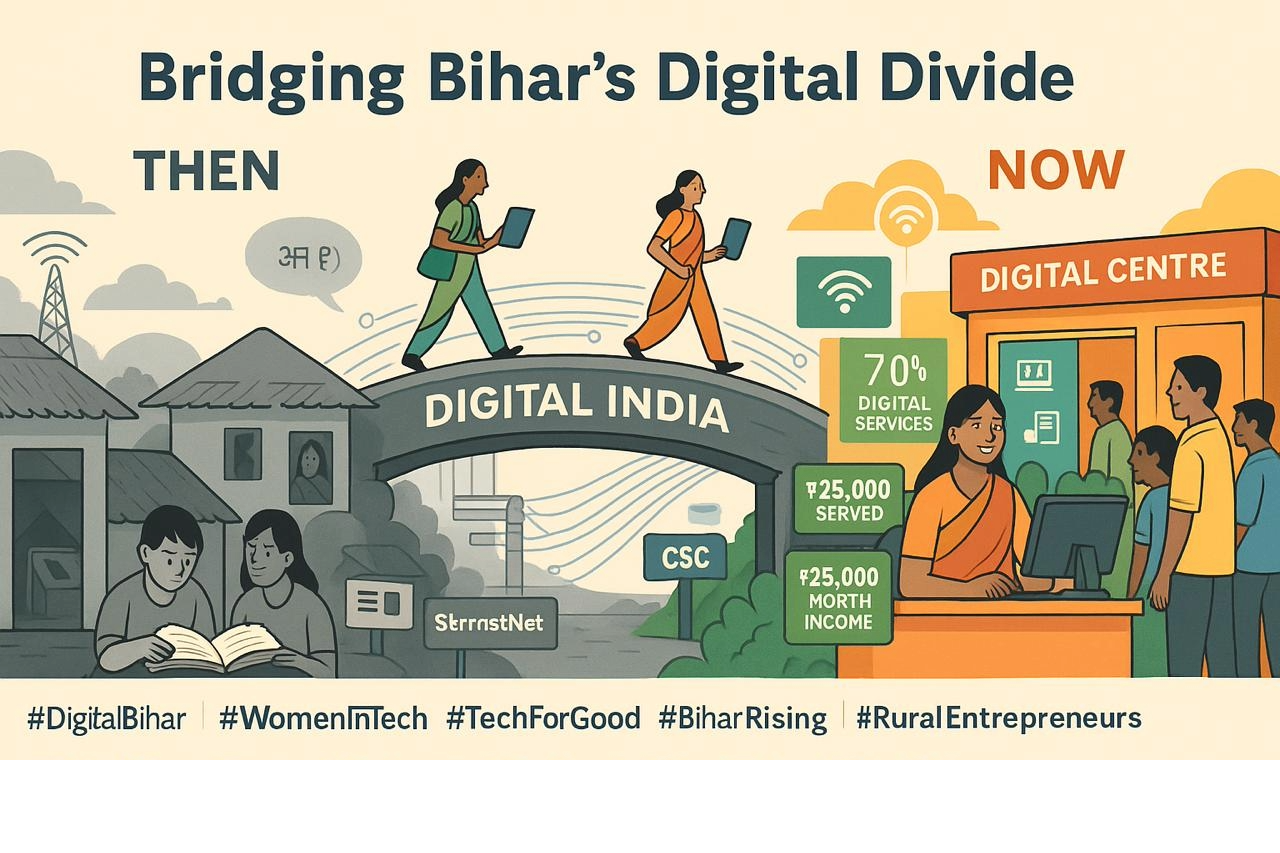
For bridging the digital divide, a digital entrepreneurship program in 500 villages from five districts, viz., Darbhanga, Samastipur, Patna, Nalanda, and Gaya was launched in 2023. Bihar is witnessing a transformative wave of service accessibility led by women digital entrepreneurs. These trailblazing women are not only redefining the entrepreneurial landscape but also catalyzing inclusive development across the state. This initiative provides capacity building and mentoring in digital skills, customer service, entrepreneurship development, financial support and resources, and digital tools to women from socially and economically disadvantaged communities, helping them become successful rural digital entrepreneurs and build a Digital Entrepreneurship Ecosystem. This holistic approach equips them to offer essential digital services in their communities, such as facilitating access to government schemes, online education, and digital financial services. From being computer illiterate to providing a host of over 70+ digital services, these digital entrepreneurs have come a long way only within 9 months of their venture-start in their villages. Some of their services include a large suite of G2C services, design & printing services, online form filling, Banking services, and Mobile payments, among several others. They have also been cross-selling and diversified in selling non-digital products. In this short period, they have already served over 250,000 rural customers (around 40% female customers), and is expected that as their businesses mature, they will be providing digital services to over 7.5 lakh population. Apart from making digital services easily accessible at the village level, they are generating income and securing their futures, with some of them steadily earning upwards of INR25,000 monthly. This program is not only bridging the digital divide but also promoting economic security and social equity, local inclusive economic development, gender equality, awareness, and opening opportunities for skills development.

While government efforts are underway, a coordinated approach involving public-private partnerships, local community engagement, and targeted digital inclusion programs is essential. Programs like these need to be scaled up across the state covering the entire 8,387 Gram Panchayats for bridging the digital divide and contributing significantly to Bihar’s and India’s digital economy.


Data is Divine

In God we trust. All others must bring data.” This quote, made by W. Edwards Deming holds true (and may even supersede God for some as Divine).

I have been in love with data right from my school years and the mysteries of the world it holds. I have tried to develop data driven models on human relationships, the movement of animals, finding patterns in the ways of the world, and later designing programs of social impact for challenging poverty, and policy development. In the end, we all are data, from the moment we are an idea until long after we pass away.

“Data is divine” highlights the growing understanding of data’s vital significance in modern society, in much the same way that religious or spiritual values have directed civilizations throughout history. In today’s digital age, data powers innovation, decision-making, and advancement in all fields, including governance, research, business, healthcare, and lifestyle.

1. Data as a source of truth: Data is frequently regarded as an impartial depiction of reality, providing information on trends and occurrences that may be imperceptible to anecdotal experience or intuition. In this way, data has a unique position as the basis for making well-informed decisions and uncovering hidden facts.

2. The power of data in innovation: Data is driving advancements in domains like healthcare, finance, and climate science and is revolutionizing industries as it powers AI/ML and sophisticated analytics. This emphasizes how data has the “divine” ability to spark significant change. The use of data for enhancing human welfare, from preventing pandemics through data-driven epidemiology to lowering inequality by studying societal trends has been in use. When applied sensibly and morally, it can aid in resolving some of the most pressing issues facing society.

3. Data as omnipresent: From the apps we use daily to the systems that manage our cities, data is present everywhere in the modern world. Its pervasiveness is comparable to a certain “divine” quality in that it affects almost every facet of contemporary life, whether we are conscious of it or not.

4. Data and ethics: Data carries a great deal of responsibility along with its power. Similar to supernatural knowledge, there are significant ethical ramifications to the way we collect, use, and safeguard data. Data misuse can result in inequality, manipulation, and privacy violations. As a result, it is crucial to handle data with dignity, openness, and ethics.

“Data is divine” also implies that we must treat it with deference and accountability while simultaneously appreciating its immense importance in shaping our future. We need to balance the power of data with ethical considerations as our world grows more and more data driven. The following are some crucial strategies to preserve this equilibrium,

1. Data privacy and informed consent: People ought to be in charge of how their information is gathered, kept, and utilized. It is not appropriate to force them to divulge information. Companies must be open and honest about their data practices so that users know what information is being gathered and why. Clear and informed consent should not be buried in complicated terms and conditions. Data literacy is essential among general population so that they are aware of the consequences of disclosing personal information, and the dangers of data misuse.

2. Data minimization: Only gather information that is absolutely required for the current job. This reduces the possibility of abuse and shields people from needless exposure. I’ve seen in recent years how social development initiatives gather and store vast amounts of data, with donors coercing their nonprofit partners to obtain it, yet this doesn’t address any societal issues. It is crucial to have a conscious grasp of what is needed.

3. Data bias and fairness: AI/ML systems may reinforce or increase biases found in the training data. Therefore, diversifying datasets, employing inclusive development techniques, and reviewing algorithms for bias are all necessary to ensure fairness.

4. Equitable data access: One way to lessen inequality is to make sure that data access and its advantages are shared equitably among all communities. This entails preventing the reinforcement of systemic disadvantages while ensuring that marginalized groups have access to data-driven insights.

5. Data governance and accountability: To ensure that data is utilized properly, organizations and governments must establish robust data governance policies and ethical frameworks. To stay up with the latest developments in technology, these policies must be revised regularly. It is imperative to establish unambiguous lines of accountability for the handling and utilization of data. Data practices can be kept moral and in line with social standards with the support of independent oversight organizations or ethics boards.

6. Regulation and legal safeguards: Strong data protection laws that impose restrictions on how businesses and organizations can gather, keep, and handle personal data must be enforced by governments. Laws that address issues like accountability for algorithmic judgments, eliminating discrimination, and safeguarding human rights in AI-driven systems are crucial for the ethical application of automation and artificial intelligence. Because technology is changing so quickly, regulatory models must be adaptable and flexible to support innovation and enable quick responses to emerging ethical dilemmas.

7. Data for social good: Data can and should also be used positive social impact including lowering inequality and poverty, combating climate change, and improving public health. Governments, corporations, and civil society organizations working together can help guarantee that data is used morally and for the good of society. These collaborations may result in common frameworks for the ethical use of data.

A multifaceted strategy including legislation, transparency, public education, and proactive governance is needed to strike a balance between the power of data and ethical issues. Prioritizing the defence of individual rights, maintaining equity, and advancing the common good while fostering innovation should be the main goals of ethical data use. Through cultivating a culture of accountability and responsibility, we can leverage data’s promise (and divinity) without sacrificing moral principles.

Disclaimer: The opinions expressed are those of the author and do not purport to reflect the views or opinions of any organization, foundation, CSR, non-profit or others

Cover Photo: This is an AI generated image.

Bamboo Ply Board

The main raw material for the production of bamboo ply/mat board is bamboo, which is the fastest growing plant and occurs naturally in the forests and is also suitable for plantation even over degraded lands. For manufacturing boards, bamboo is to be converted into mats. The sheets have been found to be resistant to water, fire, decay, termites, insects, etc.

Full Post HERE

7 value attributes of your product

Breakthrough products are driven by a complex combination of value attributes that connect with people’s lifestyles. If you are conceiving a new product, you must conduct a value opportunity analysis that evaluates the current state of products against seven major attributes of value, in the market where the new product requires significant improvement. This is an essential step in any new product development. Failure to thoroughly and thoughtfully complete this phase will have a negative impact down the line.

During the period of mass marketing, good value was based on the lowest cost-maximum features combination. The goal was to keep cost low, profits moderate, and sell in mass quantities (like Big Bazaar, K-mart etc). Value in its true sense, however, is lifestyle-driven, not cost-driven. So a product is valuable if it is useful, usable, and desirable. While cost is still an issue in the times of market segmentation, the more powerful factor is the consumer’s need to connect their product purchases with their own personal values. The higher a product’s perceived value, the more people will pay for it.

The seven attributes that adds value to any product are,

  1. Aesthetics that builds a positive association with the product.
  • Visual appeal
  • Products must be tactile
  • Elimination of all undesired sounds from the product
  • Agreeable smell
  1. Emotion that a consumer experiences with the product. There can be several emotions that a product can bring about, and they key ones are,
  • The product promotes excitement and adventure
  • Freedom from constraints
  • Feeling of safety and stability
  • Luxurious experience
  • User’s self-assurance about handling the product
  • Feeling of supremacy
  1. Ergonomics of your product that chiefly focuses on ‘ease of use’, ‘safety’, and ‘comfort’ of your target customers.
  2. Impact of your product through phases of development to end use. You should target your product for improving the social well-being of the stakeholders. Take care of negative environmental effect that your product might create, through green design that focuses on minimizing negative impacts on the environment due to manufacturing, resource use and recycling.
  3. Product Identity that also supports your brand identity. Your product should have the ability to fit among yet differentiate itself from its direct competition. Your product should also have a connection with the rest of the products produced by your start-up. Your product must be designed to fit into the context of use.
  4. Quality in the precision and accuracy of manufacturing process, material composition, and methods of attachment. Your product should be made with sufficient tolerances to meet performance expectations over time, and must hold up to the expected life of the product.
  5. Technology alone is not enough, but technology is essential. Your core technology must be appropriately advanced to provide sufficient features to your product. Remember, consumers expect technology in products to work consistently and at high level of performance over time.

Keep in mind while working on a new product that it should be aimed at fulfilling a fantasy by facilitating a more enjoyable way of doing something.