Are you time-poor?

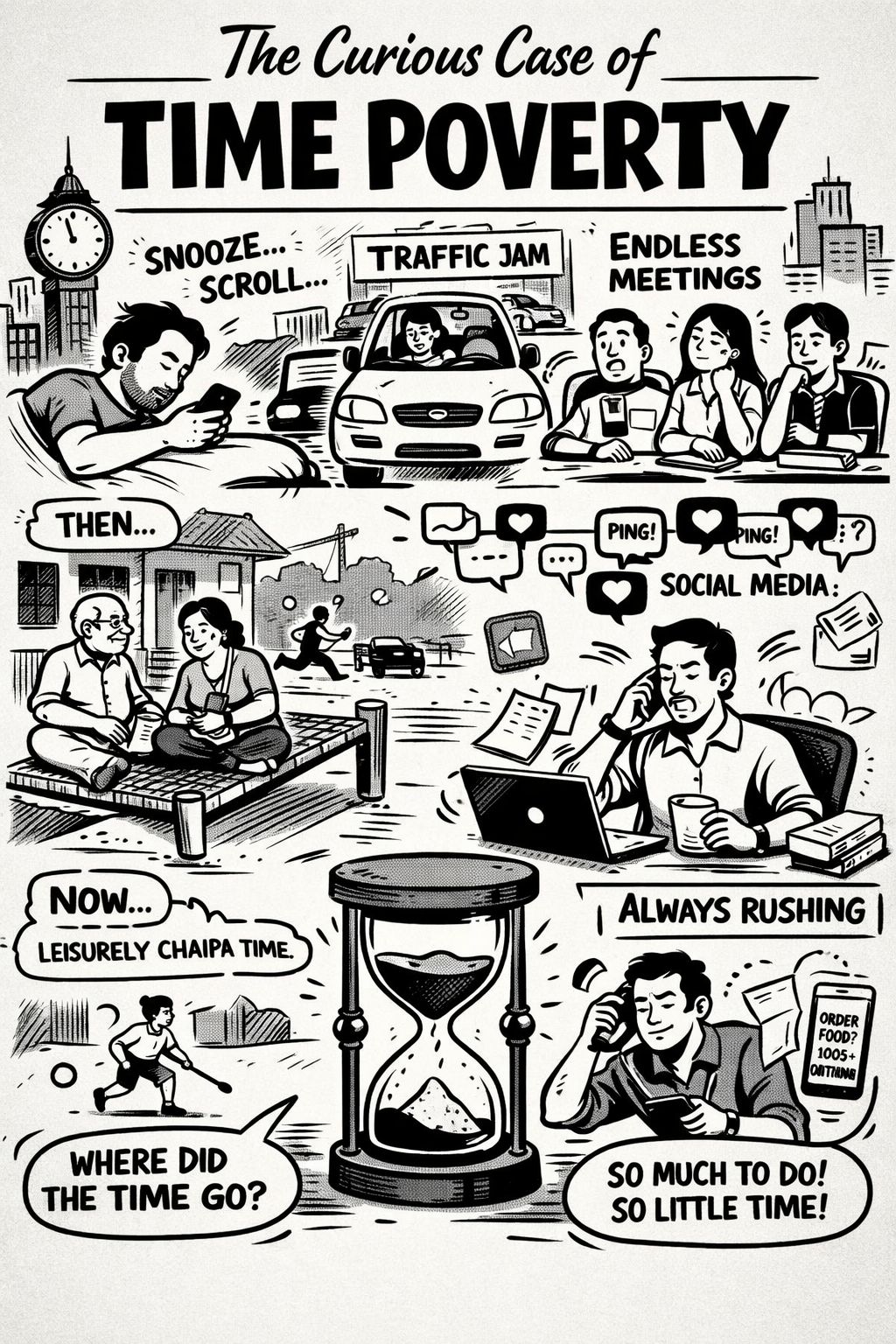
Somewhere between the invention of the pressure cooker and the arrival of 5G, we Indians collectively misplaced something really important: Time. Not lost in a dramatic, cinematic way, without violins or slow motion, but more like a wallet lifted from your back pocket in a crowded Metro. One moment it was there, lazy afternoons, unplanned conversations, the comforting stretch of doing nothing, and the next moment, gone. In its place, we now have Google Calendar reminders, WhatsApp notifications, and a persistent feeling that we are always slightly late for something, even when we are sitting still. Welcome to the era of time poverty, where your bank balance may look respectable, your Zomato order history may be thriving, and your LinkedIn profile may be aggressively inspirational, but your time account is permanently overdrawn.

Let’s rewind a bit, not to some sepia-toned village fantasy, but just a generation ago, in the same cities we inhabit today, where life had a different rhythm. Time was not abundant in a literal sense, as people still worked hard, commuted, raised families, but it felt less fractured. Evenings were events in themselves, when people sat outside their homes discussing politics and cricket over multiple cups of tea, and that one neighbour who always seemed to have too many visitors. Children played gully cricket until the ball inevitably landed in someone’s kitchen, leading to heated negotiations that doubled as character-building exercises. Mothers called out from balconies and verandahs with a mix of authority and affection, summoning children home before darkness turned into parental anxiety. There were fewer choices, yes, but also fewer decisions to make. Dinner was whatever was cooked, and nobody spent fifteen minutes comparing paneer butter masala across twelve delivery apps while reading 237 reviews written by people who clearly have too much time.

The great unifier, television, had one channel, Doordarshan, maybe two if you were fancy. If you missed your favourite show, you missed it, as there was no replay, no binge-watching, no existential spiral at 2 AM where you question your life choices while watching the fourth episode of something you don’t even like. And waiting, ah, waiting was a legitimate activity. We waited for letters, for phone calls on the clunky telephone sets, for exam results. Waiting was not seen as wasted time; it was just part of time itself, like monsoons or power cuts. Our minds wandered, conversations happened, and occasionally, we even ‘thought’ our own thoughts without an algorithm suggesting what to think next!

Now fast forward to urban India today, where time is not just scarce but seems to be actively hunted. A typical weekday begins with negotiation between you and your alarm clock, which has now evolved into a relentless life coach with a snooze button. Before your feet even touch the ground, your thumb has already scrolled through emails, news updates, Instagram reels, and three subtle reminders that everyone else seems to be doing better than you at 7:17 am in the morning. We often eat breakfast alongside a call that begins with ‘Can you hear me?’ and ends with ‘Let’s take this offline,’ a phrase that has single-handedly consumed more human hours than traffic jams.

If time poverty had a national symbol, it would undoubtedly be the urban traffic. Whether you are inching along the Delhi-Gurgaon expressway, contemplating your life choices at Bengaluru’s Central Silk Board junction, or performing advanced geometry in Mumbai’s local trains, your commute is not just a journey, but a full emotional experience. You begin with hope, perhaps even optimism, maybe today will be different, maybe traffic will be lighter, signals more cooperative, humanity kinder. Ten minutes later, you are recalibrating your expectations, bargaining with Google Maps, and listening to podcasts or FM radio not out of curiosity but as a coping mechanism. By the time you reach your destination, you have experienced a full spectrum of human emotion and possibly learned a new cuss word, none of which you will remember by lunchtime.

And then come the meetings, those sacred rituals of modern work culture where time doesn’t exactly die, it dissolves. Meetings to prepare for meetings, meetings to debrief previous meetings, and meetings that exist solely because someone somewhere feared the silence of not having a meeting. Entire hours are spent discussing action items that could have been bullet points in an email, that could have been a message, that could have been… nothing. Ironically, in our relentless pursuit of productivity, we have created systems so elaborate that they ensure we have no time left to actually produce anything. Efficiency has become a performance, and everyone is performing.

Of course, technology was supposed to save us, and in many ways, it has. Tasks that once took hours now take minutes, information is accessible instantly, and communication is effortless. But somewhere along the way, technology stopped being a tool and started behaving like a very needy companion. Your phone, that sleek little rectangle of promise, is now a workplace, an entertainment centre, a social hub, and an anxiety generator rolled into one. You pick it up to check the time and resurface twenty-seven minutes later, having watched three reels, replied to two messages, ignored five, read half an article, and completely forgotten why you picked it up in the first place. Time isn’t just being spent; it is being nibbled away in tiny, invisible bites.

Urban India today offers an abundance of choices in the form of food, experiences, careers, and content. But abundance comes with a hidden tax in the form of decision fatigue. Earlier, dinner was simple, and now it is an exercise in research, comparison, and occasional soul-searching. Even leisure has become labour, as watching a movie involves navigating multiple platforms, genres, languages, and algorithmic suggestions, each insisting it knows you better than you know yourself. By the time you decide what to watch, you are too tired to watch anything. The freedom to choose has quietly transformed into the burden of choosing.

Friendships, once spontaneous and effortless, are now managed with the precision of project timelines. ‘Let’s catch up’ translates into checking calendars, blocking slots, rescheduling due to unforeseen commitments, and finally meeting for exactly sixty minutes before someone inevitably says, ‘I have an early morning tomorrow.’ Even weddings, those grand celebrations of chaos and joy, have been optimised for efficiency. Destination weddings over long weekends, carefully curated guest lists, and itineraries that resemble conference agendas. Nothing says romance like a well-managed Google Sheet.

But perhaps the most insidious aspect of time poverty is lack of attention rather than the lack of hours. You may technically have free time, but your mind is rarely free. You are at dinner, but thinking about work. You are on vacation, but checking emails. You are resting but feeling guilty about it. The boundary between work and life hasn’t just blurred; it has politely excused itself and left the building. What remains is a constant hum of ‘I should be doing something,’ a background noise that turns even moments of rest into opportunities for anxiety.

In India, this phenomenon feels particularly intense because of the unique cocktail of factors at play. Rapid urbanisation has stretched infrastructure beyond its limits, turning simple commutes into endurance tests. Aspirational pressure ensures that everyone is constantly striving for better jobs, better salaries, better lifestyles. Digital adoption has been fast and enthusiastic, compressing decades of technological evolution into a few short years. And social expectations are layered on top of all this that rarely reduce, even as professional demands increase. The result is a society trying to operate at first-world speed with third-world infrastructure and fourth-world patience.

So are we truly poor in time? Or have we simply allowed time to be colonised and constantly interrupted? The uncomfortable truth is that it is a bit of both. We are busier, yes, but we are also more distracted. We have more tools, but less control. We are connected, but not always present. Time poverty, then, is not just about scarcity, but more about how we experience the time that we have. It is the difference between a long, uninterrupted conversation and a series of half-hearted replies. Between a meal savoured and a meal consumed while scrolling. Between living time and merely passing through it.

The solution, if there is one, is unlikely to be dramatic. Most of us are not about to quit our jobs and retreat to the Himalayas like some of our friends have, and even if we did, we would probably post about it online. But small shifts are possible, like protecting pockets of uninterrupted time, reducing unnecessary decisions, and occasionally allowing ourselves the radical act of doing nothing. These are not grand gestures, but they are meaningful ones. They remind us that time is not just something to be managed but something to be experienced.

We often say, ‘I don’t have time,’ when what we really mean is, ‘Something else has taken priority.’ Time poverty is not just a condition but a consequence of choices, both ours and the systems we inhabit. In a country that has mastered the art of jugaad, perhaps it is high time we apply that ingenuity to time itself. Because somewhere between the past we romanticise and the present we rush through lies a simple, almost rebellious idea that what if we stopped trying to save time and started trying to live it?

Circular economy solution for India’s cooking crisis

For the past decade, India’s clean cooking revolution was symbolised by a powerful image in the form of a woman in a rural village receiving her first LPG connection under the Pradhan Mantri Ujjwala Yojana (PMUY). It represented dignity, health, convenience, and liberation from the unpaid drudgery of firewood collection, respiratory illness, and smoky kitchens where women spent hours inhaling toxic fumes while cooking over firewood and dung cakes. And to be fair, it was a transformational policy intervention because it solved a critical access problem by expanding LPG connections to millions of low-income households. But as is often the case with development policy, solving access did not fully solve sustainability. 

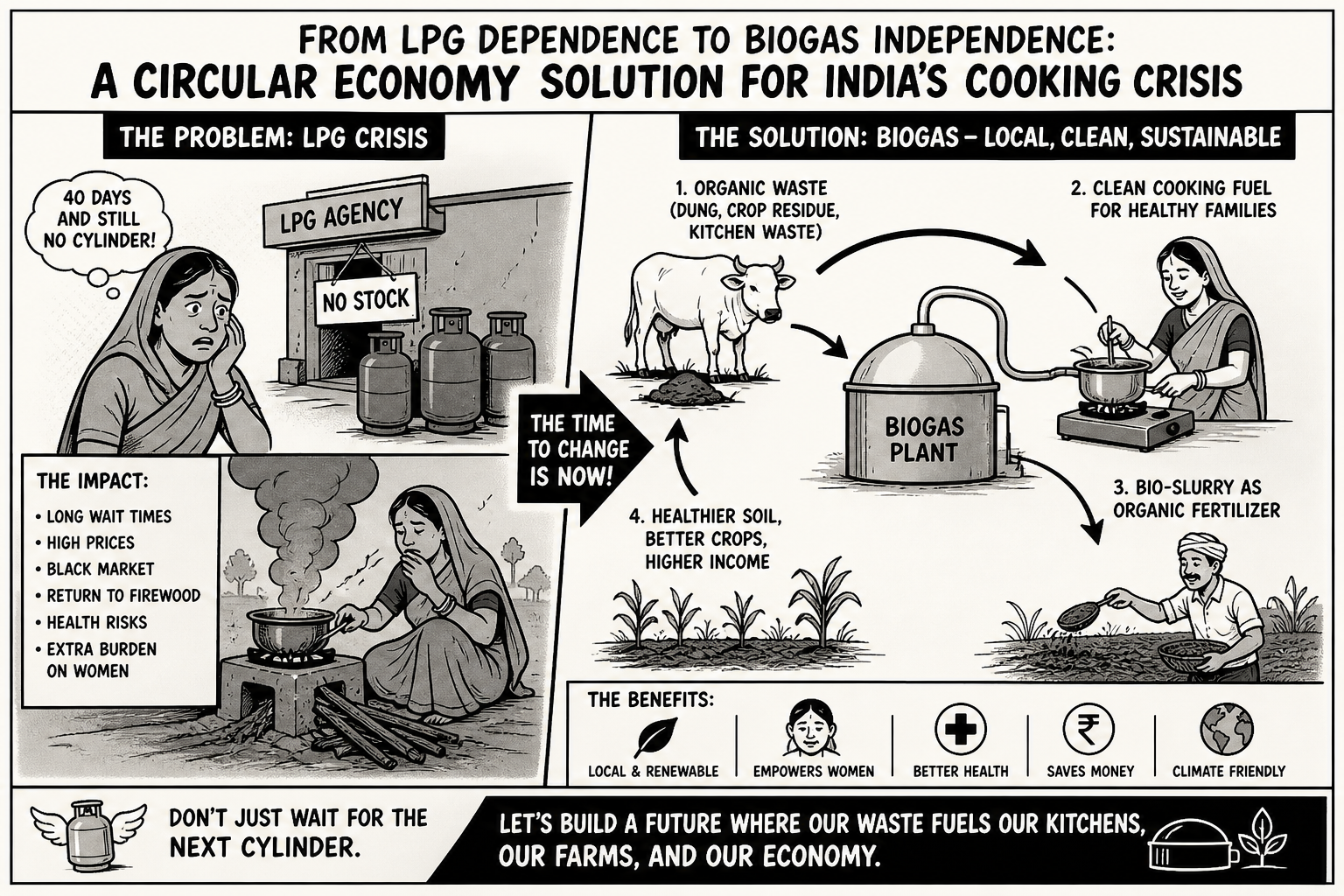
The recent conflict in West Asia has disrupted global energy supply chains and exposed India’s dangerous dependence on imported cooking fuel. With tensions around Iran and the closure of the Strait of Hormuz, India, where nearly 60% of LPG demand is met through imports, and over 90% of those imports typically transit through Hormuz, has found itself in an avoidable crisis. LPG supplies have tightened, transportation costs have increased, and delays in refill deliveries have become common in many rural districts and smaller towns. In several places, households are reportedly waiting over 40 days for a cylinder refill. Prices have surged, black market sales have flourished, and many low-income families are being pushed back toward firewood, charcoal, and kerosene. India is facing its first wave of ‘energy migrants’ as LPG shortages and soaring fuel prices have triggered reverse migration from cities to villages, especially from the major industrial hubs, including Delhi, Mumbai and Surat. A clean cooking transition built on imported fossil fuel has suddenly begun to look alarmingly vulnerable.

India imports a substantial share of its LPG requirements, and a large portion of these imports move through geopolitically sensitive shipping routes. While India is considered a leader in clean cooking access, millions of households remain dependent on an international supply chain shaped by wars, shipping disruptions, currency fluctuations, and global oil politics. The rural poor, as always, bear the highest burden of this volatility. A delayed LPG refill in an urban apartment may be an inconvenience, but in rural India, it often means a family returns to collecting wood, spending additional hours on unpaid labour, or cutting back on cooked meals altogether. Small roadside eateries reduce their menu options, and migrant workers spend more on food. Development gains achieved over the years begin reversing quietly, one delayed cylinder at a time.

Today, the villages struggling with LPG shortages often possess enormous untapped energy resources sitting in plain sight. Across rural India, cattle dung, agricultural residue, poultry waste, kitchen scraps, and other organic materials are abundantly available. India has one of the world’s largest livestock populations, producing massive quantities of dung every single day. Much of this waste is either left to decompose openly, releasing methane into the atmosphere, or converted into traditional dung cakes that burn inefficiently and create harmful smoke. What if this waste could instead become a reliable source of clean cooking fuel? That is precisely where biogas emerges not merely as an alternative, but as a strategic necessity.

Biogas is produced through anaerobic digestion, a process where organic waste decomposes in oxygen-free chambers and releases methane-rich gas that can be used for cooking. The leftover slurry becomes high-quality organic fertiliser. This is an excellent circular economy model where households generate fuel from waste while simultaneously reducing fertiliser costs for farming. For rural families, this means lower dependence on LPG refills, lower household expenditure, improved sanitation, reduced smoke exposure, and additional agricultural benefits. Unlike LPG, biogas is hyperlocal as it does not depend on international shipping routes, refinery outputs, or geopolitical stability. Unlike firewood, it burns cleanly. Unlike solar cookers, it works regardless of weather or time of day. Unlike electric induction stoves, it does not depend on stable electricity supply, which remains inconsistent in many rural areas. In a world increasingly shaped by supply chain disruptions, biogas offers resilience.

India does not need to invent this model from scratch because proven examples already exist. In parts of Rajasthan, Maharashtra, Gujarat, Karnataka, Punjab, and several other Indian states, communities have successfully adopted household and community biogas systems. Villages linked to dairy cooperatives have demonstrated how cattle waste can be transformed into reliable cooking fuel. Some communities have significantly reduced their dependence on LPG altogether. During recent supply disruptions, such villages and farming households were largely insulated from shortages because their cooking fuel was produced locally. No waiting for gas agencies, no inflated black-market prices, and no dependence on international conflict. Their kitchens continue to function because their fuel is local.

What makes India’s underinvestment in biogas particularly frustrating is that the policy architecture already exists. The government has long operated biogas programs through the Ministry of New and Renewable Energy, and initiatives like Sustainable Alternative Towards Affordable Transportation (SATAT) have promoted compressed biogas (CBG). Yet these efforts have often remained fragmented, underfunded, and treated as niche rural welfare programs rather than core components of national energy security. India tends to think big when discussing energy with large refineries, strategic petroleum reserves, international supply agreements, and mega infrastructure. These are important; however, true resilience often comes from decentralisation. A household biogas unit in a rural village may seem small compared to an oil refinery, but millions of such units can collectively create enormous national resilience.

Imagine if even a quarter of India’s livestock-owning rural households had access to functional biogas systems. Or village-level community digesters serving clusters of homes where individual ownership is not feasible. Imagine schools, Anganwadis, hostels, and community kitchens using biogas generated from local organic waste. Think of self-help groups running maintenance services for biogas units as local enterprises. Imagine MGNREGA funding village-level renewable energy infrastructure. Suddenly, biogas can move from being a sustainability experiment to becoming a serious economic and strategic asset.

The climate benefits further strengthen this strategy. Methane emissions from unmanaged livestock waste contribute significantly to global warming. Capturing this methane for productive use helps reduce greenhouse gas emissions. Every cubic meter unit of biogas reduces 2 tons CO2e/year. Reduced firewood usage can lower deforestation pressures. Bio-slurry reduces dependence on chemical fertilisers, moving towards sustainable agriculture. Lower LPG consumption reduces fossil fuel imports. Biogas sits at the intersection of climate policy, rural livelihoods, women’s empowerment, waste management, and energy security, a rare policy intervention that solves multiple problems simultaneously. Biogas directly contributes to SDG 5 (Gender Equality), SDG 7 (Affordable and Clean Energy), and Sustainable Energy for All (SE4ALL). It also delivers results that contribute to SDG 1 (Poverty Eradication), SDG 3 (Good Health and Well-being), and SDG 13 (Climate Action).

The current LPG crisis should serve as a warning. The war in the Middle East did not create India’s vulnerability, merely exposed it. A country aspiring to become a global economic power cannot allow millions of household kitchens to remain hostage to international conflict. Energy security cannot only be discussed in terms of crude oil imports and electricity generation. It must also include the daily cooking needs of ordinary citizens. The woman waiting 40 days for an LPG cylinder in a rural village is experiencing energy insecurity in its most human form. India’s future energy strategy must become far more diversified. LPG will continue to play an important role, particularly in urban areas and transitional markets. But it cannot remain the singular answer for rural cooking energy. Biogas offers India local control that imported LPG can never provide. It transforms waste into wealth, dependency into resilience, and vulnerability into self-reliance. In a century likely to be shaped by geopolitical instability, climate disruptions, and fragile global supply chains, the most strategic energy resource may not be buried deep underground or shipped across oceans. It may be sitting quietly in rural backyards, waiting for India to finally recognise its potential.

Who are urban marginalized people

Photo Credit: https://humana-india.org/

In last 2-3 years, I have been part of several discussions to define and build a consensus on understanding of urban marginalised and vulnerable population (UMVP) in the context of India, and how this population group has been evolving and growing in numbers. India’s rapid urbanization over the past few decades has transformed its cities into economic powerhouses contributing 60% of India’s GDP. While in 2023 around 37% of India’s population lived in urban areas, it is estimated that by 2036, half of India’s population will live in cities. However, this growth has also led to the marginalization of a significant portion of the population. Cities Alliance estimated that 25% of the population living in urban areas are below the poverty line. By this estimate, a shocking 125+ million people are marginalised and vulnerable living in the urban areas. The urban marginalized and vulnerable groups comprising of slum dwellers, informal workers, migrant labourers, women, children, and the homeless face numerous challenges like access to basic citizens’ rights, services, and opportunities. As India continues its urban transition, addressing the vulnerabilities of these populations is critical to achieving inclusive development.

The UMVPs live in precarious conditions, often lacking access to basic services like clean water, housing, sanitation, healthcare, and education. Their vulnerabilities are shaped by socio-economic, cultural, political, and structural factors that leave them excluded from mainstream urban life. They often lack the necessary documentation to access government schemes and services, such as ration cards, Aadhaar cards, or voter identification. This exclusion prevents them from benefiting from welfare programs like the Public Distribution System (PDS), healthcare subsidies, or housing schemes. The UMVPs can broadly be classified in five sub-groups,

  1. Slum Dwellers: According to the 2011 Census, about 65 million people in India live in urban slums. Slums across India have poor housing, lack of sanitation, overcrowding, and a high risk of diseases, especially communicable. People living in the slums often have insecure tenure, making them vulnerable to eviction and displacement due to urban development projects. Displacement not only disrupts their livelihoods but also pushes them further into poverty. Poor living conditions contribute to health problems, including respiratory diseases (especially TB) and waterborne infections.
  • Homeless Population: India’s urban homeless population is particularly vulnerable, facing extreme marginalization. With no permanent shelter, the homeless are exposed to harsh weather conditions, violence, and health risks. They have limited access to government welfare schemes and often fall outside the purview of census data, making it difficult to design targeted interventions. HLRN estimates that there could be more than 3 million homeless individuals. Extreme poverty, unemployment, displacement due to natural disasters, mental illness, substance abuse, runaways, are often the causes of homelessness, and their numbers are continuously increasing in urban India.
  • Informal Workers: The informal sector accounts for nearly 80% of India’s urban workforce. This includes daily wage labourers, street vendors, domestic workers, and construction workers, among others. Informal workers lack job security, social protection, and access to formal financial systems, leaving them vulnerable to economic shocks. The COVID-19 pandemic exposed the extreme vulnerability of informal workers, who faced sudden job losses and had low-to-no access to financial aid. Informal workers often are slum dwellers, or live in low income housing colonies, or are even homeless.
  • Migrant Laborers: Migration to cities in search of employment and better life is common in India. However, migrant labourers, often from rural areas both intra- and inter-state, face significant challenges in urban settings. They often find employment in low-paying jobs with little to no benefits, live in temporary or inadequate housing, and struggle to access public services due to a lack of local identification documents. Temporary migratory population is also a sub-set of this group, who come to cities for seasonal work, migrate from one place to another, also migrate within the cities in search of work. Construction workers and artisanal nomadic groups can be good examples of migratory population.
  • Women and Children: Women and children within urban marginalized communities living in slums or informal settlements often work in low-paid informal jobs while managing household responsibilities. They are more likely to experience gender-based violence, discrimination and exploitation, limited access to healthcare, and lack of educational/skilling opportunities. Children in these settings suffer from malnutrition, poor schooling, and limited opportunities for social mobility. They often attend poorly equipped government schools or are forced to drop out to contribute to household income.

India’s urban marginalized and vulnerable populations represent a significant and often overlooked segment of society. Ensuring their inclusion in the country’s urban development is essential for sustainable and equitable growth, while bestowing opportunity and dignity for all citizens as their Right.

Bamboo: The Green Gold for Poverty Reduction and Rural Growth

India has huge natural bamboo stocks that have been an integral part of Indian culture for many millennia. Bamboo in many ways is the mainstay of the rural Indian economy, sparking considerable social and ecological spin-offs. In the early part of the century, large tracts of bamboo occurred in many parts of the country but were treated by the forestry sector (which was then cast in a production forestry mode) as a weed of little economic value and was used mostly by the rural communities for crafts, making implements and as housing material. It was the discovery of bamboo as a source of long-fiber by the Forest Research Institute in Dehradun that started the process of using bamboo in a variety of industrial applications, so far unexplored, with several paper mills and rayon mills being set up. But in the absence of a clear policy there was rapid degradation and decimation of the resource in much of the country. Bamboo resources plummeted so alarmingly that at present the resource is limited to few pockets in the country. Two-thirds of the bamboo in the country is restricted to the North-Eastern Region (NER) while the remaining one-third is spread across the country.

But there is hope for the resurgence of bamboo, and this is based on evidence of significant new and contemporary economic opportunities that have emerged over the past decades. A bamboo revolution that holds the potential of reversing economic downturns and ensuring profitability, is very much possible.  Bamboo is an untapped avenue of economic growth, and a burgeoning bamboo sector can rope in prosperity, profits, and sustainable livelihoods.

Despite the severe degradation of the resource in the past, India still has a considerable growing stock of bamboo, and comparative annual harvest figures[1] still place India at the top of the global league. It is important to realize the considerable latent potential that bamboo has to contribute to economic growth, poverty alleviation, generating employment, rehabilitating vast tracts of degraded land generated due to past agricultural and industrial practices and policies, and revitalizing the social, economic and ecological well-being of rural economies.

In line with this, goals should be aimed at focusing on recovering the resources lost to the rural poor as it has been a natural capital that has helped them to keep their economies afloat even in times of significant cash crunches. Attempts should be made to replenish bamboo stocks, make it economically beneficial to rural communities in a way that it provides them opportunities to earn a sustainable income and improve their standard of living. Efforts should also be made to increase the economic opportunity from the use of bamboo as an industrial raw material, to raise employment opportunities (especially for the educated and unemployed rural youth), and to rehabilitate the degraded lands across the country (making available and productive a natural resource which is increasingly becoming scarce and expensive).

Over the years a variety of strategies have been developed to reduce the poverty of rural and rurban population through small enterprise development, based on various forest produce. In rural areas, the poor are overwhelmingly dependent on natural resources and in most cases, it is the only capital they possess. They have little power or ability to climb out of poverty. They are not only financially poor, but also opportunity-and knowledge-poor. In this respect, bamboo is one of the few natural resources that could provide a lifeline to sagging rural economies and help integrate them into the market economy. As bamboo is not one commodity but the fountainhead of many products, it could open up a number of markets simultaneously for the rural poor with the added advantage of being a low-risk option.

The bamboo sector also forges personal links with the rural community, allowing them to participate closely in production processes and directly access profits through value addition as compared to other industrialized processes. As the sector is dependent to a large extent on manual labour, it demands many hands to contribute to the cultivation, harvesting, preservation and value-added manufacturing processes. The upshot is that it provides livelihood options in varying activities to a large number of rural workers. This is the main reason why developing countries find it more viable to be involved with the sector whereas developed countries prefer becoming consumptive markets for these very products. Women in particular stand to gain from this sector as they secure means of livelihood due to their dexterity with the material and their ability to shape it into products and more important, they gain from the flexible work hours this sector affords. Bamboo can thus break marginalization through empowerment and also bridge gender divides.

Employment generation and livelihood creation are enabled through strong backward integration of bamboo production and processing. Though tree-like in stature, bamboo is best grown and managed like an agricultural crop or managed as such within the forest. This needs labour input, which calls for significant people involvement. Again, volume production in bamboo is achieved through a large number of unit poles, unlike timber where one large log provides a substantial quantity of wood. But on the other hand, the lightweight poles enable people participation in its transport. Furthermore, the easy linear splitting ability of bamboo, quite unlike that of wood, enables primary processing for a final industrial product to be undertaken by the rural community. The above properties lay the economic basis for definite win-win community-industry partnerships in bamboo, with the bamboo being managed or grown, and primary processing undertaken by communities in rural areas.

Experience has shown natural resources can be harvested sustainably if people stand to benefit from it. The development of bamboo as a cash crop will result in the conservation and protection of the existing resource, and the scaling up of cultivation, which would be a natural outcome of the increased cash value of the resource, as against its present low cash to mere-subsistence value. The environmental benefits from the economic development of bamboo can be very significant.

As a resource that can be harvested annually, it could provide a regular supply of construction material to the communities. If the use of wood could be replaced with that of bamboo, it could reverse the process of severe and rapid degradation of forests and forest cover. Bamboo also helps protect soil from erosion, especially in the upland areas. Bamboo should also be strategically grown to reduce or prevent soil cutting from riverbanks, which is perhaps the major cause of siltation of riverbanks, resulting in reduced carrying capacity of rivers and flooding during the peak rainy season.

In last 3-4 decades, intensifying patterns of land and resource utilization, primarily due to pressure from the rapidly increasing population, have caused land and natural resource degradation in many parts of India. Bamboo is an ideal resource for rehabilitation, even in extremely degraded situations such as land used for brick making.

India with its rich potential of bamboo resources has only just started to develop bamboo marketing and trade.  However, the significant bamboo resources in India make it ideally placed to benefit from the experience of China and other countries around the globe. Bamboo holds within it the promise of bailing people out from below poverty line levels.

Bamboo finds many uses today in addition to its conventional uses for handicrafts, scaffolding and the paper industry.  It can be used as construction material, as a wood substitute and as food, fuel and a filtration medium. Its real contribution to housing lies in the dual role it can play – of providing a cheap and affordable wood alternative to the homeless while at the same time generating livelihood options for those involved with it.

Bamboo can propel economic growth through increased local production and the sale of high-value wood-substitute products, especially in bamboo-rich states. Robust local production of a local natural resource capital like bamboo will lead to the retention and circulation of cash within the state economies itself, rather than the cash flowing out for purchase of goods from outside the state. Export of cash value-added bamboo products to markets outside the bamboo states could enable incremental cash earnings that will add to the economic growth of the state. Asset creation and local consumption can get a fillip from the increased circulation of money within the state economy from local consumption of locally manufactured products. This consumption will be enabled not only by government purchases, but also as a result of the higher disposable incomes that will be generated.

In India, as elsewhere in other developing countries, strong correlative linkages exist between economic growth, rural poverty and the environment. Firstly, the poor are more vulnerable to the health effects of pollution because of their inadequate nutrition, poor access to health care and their unhealthy living environment. Secondly, the poor are affected faster by degradation of natural resources because of their greater reliance on them to meet basic needs. Environmental degradation, in turn, adversely affects the economy’s capacity to grow, because growth relies on the sustainable productivity of natural resources and the health of the population.

It is a vicious circle, which can be broken through a growth solution that is not only income generating for rural communities but also environmentally sound. Bamboo, a natural resource and one that protects the environment, enables the development of industries, which function through a symbiotic linkage between small and large enterprise that significantly benefits the community. 

Bamboo is available throughout the country barring the states of Jammu and Kashmir and Rajasthan (except for some areas). Existing traditional bamboo and cane handicraft products, though not many, could be improved, diversified, produced along industrial assembly lines and converted into value-added products that are already a part of mainstream industry. Value additions could be made to its use in the paper industry and its use in the unorganized scaffolding industry can be doubled.  Simultaneously, other mainstream micro and small enterprise products such as matchsticks, pencils, toothpicks, skewer sticks, and blinds, as well as medium-scale industrial panel products that rival wood products, with strong backward community linkages and benefits can be explored. An increase in bamboo products and market opportunities will also result in increases in demand for raw bamboo, besides the production of fresh bamboo shoots and their processed products. There is considerable potential to set up medium and large-scale industries for generating value-added food and wood-substitute products for export markets.

The value-added bamboo industry is ideally placed to adopt that model. Given the right policy atmosphere and thrust, the value-added bamboo industry in India has the potential of reaching a size of USD 2.3 billion (USD 131.5 billion globally) in the next 10 years with a CAGR of 10.3%, employing 11-15 million people in the primary, secondary and tertiary sectors[2].

The bamboo industry also fulfils the criteria needed by sectors that aim to achieve double-digit economic growth. Bamboo has a very strong and direct with rural communities, which would allow them to partake directly and in a more significant way to value addition as compared to other industrialized processes. The value-added bamboo industry thus provides an integrated solution that uses an abundant natural resource that protects the environment and can be processed and generated through community-owned enterprises, both small and large.


[1] INBAR 2002, Market Opportunities Report

[2] https://www.futuremarketinsights.com/reports/bamboo-products-market

Photo Credit: NMBA

Disclaimer: The opinions expressed are those of the author and do not purport to reflect the views or opinions of any organization, foundation, CSR, non-profit or others

Data is Divine

In God we trust. All others must bring data.” This quote, made by W. Edwards Deming holds true (and may even supersede God for some as Divine).

I have been in love with data right from my school years and the mysteries of the world it holds. I have tried to develop data driven models on human relationships, the movement of animals, finding patterns in the ways of the world, and later designing programs of social impact for challenging poverty, and policy development. In the end, we all are data, from the moment we are an idea until long after we pass away.

“Data is divine” highlights the growing understanding of data’s vital significance in modern society, in much the same way that religious or spiritual values have directed civilizations throughout history. In today’s digital age, data powers innovation, decision-making, and advancement in all fields, including governance, research, business, healthcare, and lifestyle.

1. Data as a source of truth: Data is frequently regarded as an impartial depiction of reality, providing information on trends and occurrences that may be imperceptible to anecdotal experience or intuition. In this way, data has a unique position as the basis for making well-informed decisions and uncovering hidden facts.

2. The power of data in innovation: Data is driving advancements in domains like healthcare, finance, and climate science and is revolutionizing industries as it powers AI/ML and sophisticated analytics. This emphasizes how data has the “divine” ability to spark significant change. The use of data for enhancing human welfare, from preventing pandemics through data-driven epidemiology to lowering inequality by studying societal trends has been in use. When applied sensibly and morally, it can aid in resolving some of the most pressing issues facing society.

3. Data as omnipresent: From the apps we use daily to the systems that manage our cities, data is present everywhere in the modern world. Its pervasiveness is comparable to a certain “divine” quality in that it affects almost every facet of contemporary life, whether we are conscious of it or not.

4. Data and ethics: Data carries a great deal of responsibility along with its power. Similar to supernatural knowledge, there are significant ethical ramifications to the way we collect, use, and safeguard data. Data misuse can result in inequality, manipulation, and privacy violations. As a result, it is crucial to handle data with dignity, openness, and ethics.

“Data is divine” also implies that we must treat it with deference and accountability while simultaneously appreciating its immense importance in shaping our future. We need to balance the power of data with ethical considerations as our world grows more and more data driven. The following are some crucial strategies to preserve this equilibrium,

1. Data privacy and informed consent: People ought to be in charge of how their information is gathered, kept, and utilized. It is not appropriate to force them to divulge information. Companies must be open and honest about their data practices so that users know what information is being gathered and why. Clear and informed consent should not be buried in complicated terms and conditions. Data literacy is essential among general population so that they are aware of the consequences of disclosing personal information, and the dangers of data misuse.

2. Data minimization: Only gather information that is absolutely required for the current job. This reduces the possibility of abuse and shields people from needless exposure. I’ve seen in recent years how social development initiatives gather and store vast amounts of data, with donors coercing their nonprofit partners to obtain it, yet this doesn’t address any societal issues. It is crucial to have a conscious grasp of what is needed.

3. Data bias and fairness: AI/ML systems may reinforce or increase biases found in the training data. Therefore, diversifying datasets, employing inclusive development techniques, and reviewing algorithms for bias are all necessary to ensure fairness.

4. Equitable data access: One way to lessen inequality is to make sure that data access and its advantages are shared equitably among all communities. This entails preventing the reinforcement of systemic disadvantages while ensuring that marginalized groups have access to data-driven insights.

5. Data governance and accountability: To ensure that data is utilized properly, organizations and governments must establish robust data governance policies and ethical frameworks. To stay up with the latest developments in technology, these policies must be revised regularly. It is imperative to establish unambiguous lines of accountability for the handling and utilization of data. Data practices can be kept moral and in line with social standards with the support of independent oversight organizations or ethics boards.

6. Regulation and legal safeguards: Strong data protection laws that impose restrictions on how businesses and organizations can gather, keep, and handle personal data must be enforced by governments. Laws that address issues like accountability for algorithmic judgments, eliminating discrimination, and safeguarding human rights in AI-driven systems are crucial for the ethical application of automation and artificial intelligence. Because technology is changing so quickly, regulatory models must be adaptable and flexible to support innovation and enable quick responses to emerging ethical dilemmas.

7. Data for social good: Data can and should also be used positive social impact including lowering inequality and poverty, combating climate change, and improving public health. Governments, corporations, and civil society organizations working together can help guarantee that data is used morally and for the good of society. These collaborations may result in common frameworks for the ethical use of data.

A multifaceted strategy including legislation, transparency, public education, and proactive governance is needed to strike a balance between the power of data and ethical issues. Prioritizing the defence of individual rights, maintaining equity, and advancing the common good while fostering innovation should be the main goals of ethical data use. Through cultivating a culture of accountability and responsibility, we can leverage data’s promise (and divinity) without sacrificing moral principles.

Disclaimer: The opinions expressed are those of the author and do not purport to reflect the views or opinions of any organization, foundation, CSR, non-profit or others

Cover Photo: This is an AI generated image.