Circular economy solution for India’s cooking crisis

For the past decade, India’s clean cooking revolution was symbolised by a powerful image in the form of a woman in a rural village receiving her first LPG connection under the Pradhan Mantri Ujjwala Yojana (PMUY). It represented dignity, health, convenience, and liberation from the unpaid drudgery of firewood collection, respiratory illness, and smoky kitchens where women spent hours inhaling toxic fumes while cooking over firewood and dung cakes. And to be fair, it was a transformational policy intervention because it solved a critical access problem by expanding LPG connections to millions of low-income households. But as is often the case with development policy, solving access did not fully solve sustainability. 

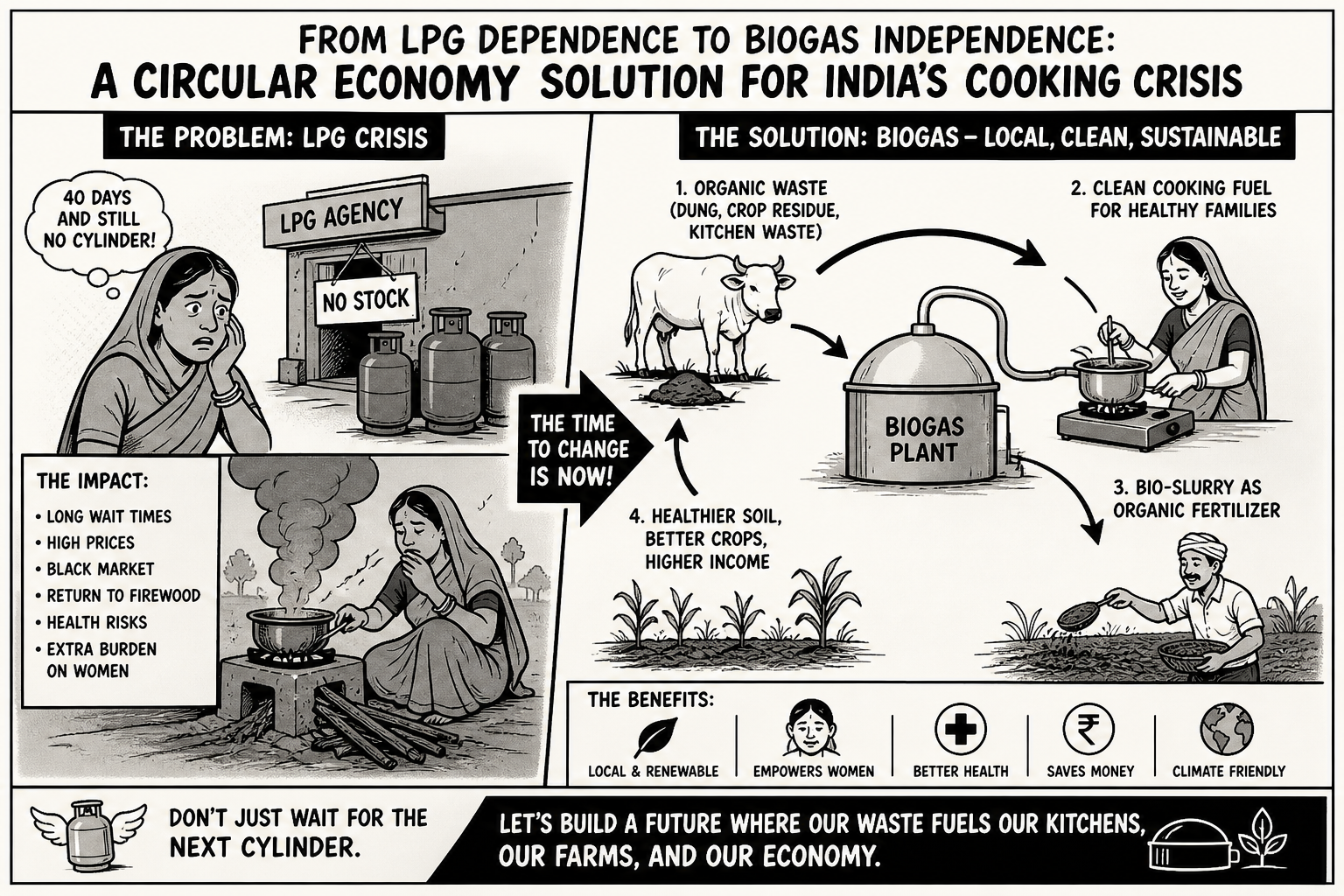
The recent conflict in West Asia has disrupted global energy supply chains and exposed India’s dangerous dependence on imported cooking fuel. With tensions around Iran and the closure of the Strait of Hormuz, India, where nearly 60% of LPG demand is met through imports, and over 90% of those imports typically transit through Hormuz, has found itself in an avoidable crisis. LPG supplies have tightened, transportation costs have increased, and delays in refill deliveries have become common in many rural districts and smaller towns. In several places, households are reportedly waiting over 40 days for a cylinder refill. Prices have surged, black market sales have flourished, and many low-income families are being pushed back toward firewood, charcoal, and kerosene. India is facing its first wave of ‘energy migrants’ as LPG shortages and soaring fuel prices have triggered reverse migration from cities to villages, especially from the major industrial hubs, including Delhi, Mumbai and Surat. A clean cooking transition built on imported fossil fuel has suddenly begun to look alarmingly vulnerable.

India imports a substantial share of its LPG requirements, and a large portion of these imports move through geopolitically sensitive shipping routes. While India is considered a leader in clean cooking access, millions of households remain dependent on an international supply chain shaped by wars, shipping disruptions, currency fluctuations, and global oil politics. The rural poor, as always, bear the highest burden of this volatility. A delayed LPG refill in an urban apartment may be an inconvenience, but in rural India, it often means a family returns to collecting wood, spending additional hours on unpaid labour, or cutting back on cooked meals altogether. Small roadside eateries reduce their menu options, and migrant workers spend more on food. Development gains achieved over the years begin reversing quietly, one delayed cylinder at a time.

Today, the villages struggling with LPG shortages often possess enormous untapped energy resources sitting in plain sight. Across rural India, cattle dung, agricultural residue, poultry waste, kitchen scraps, and other organic materials are abundantly available. India has one of the world’s largest livestock populations, producing massive quantities of dung every single day. Much of this waste is either left to decompose openly, releasing methane into the atmosphere, or converted into traditional dung cakes that burn inefficiently and create harmful smoke. What if this waste could instead become a reliable source of clean cooking fuel? That is precisely where biogas emerges not merely as an alternative, but as a strategic necessity.

Biogas is produced through anaerobic digestion, a process where organic waste decomposes in oxygen-free chambers and releases methane-rich gas that can be used for cooking. The leftover slurry becomes high-quality organic fertiliser. This is an excellent circular economy model where households generate fuel from waste while simultaneously reducing fertiliser costs for farming. For rural families, this means lower dependence on LPG refills, lower household expenditure, improved sanitation, reduced smoke exposure, and additional agricultural benefits. Unlike LPG, biogas is hyperlocal as it does not depend on international shipping routes, refinery outputs, or geopolitical stability. Unlike firewood, it burns cleanly. Unlike solar cookers, it works regardless of weather or time of day. Unlike electric induction stoves, it does not depend on stable electricity supply, which remains inconsistent in many rural areas. In a world increasingly shaped by supply chain disruptions, biogas offers resilience.

India does not need to invent this model from scratch because proven examples already exist. In parts of Rajasthan, Maharashtra, Gujarat, Karnataka, Punjab, and several other Indian states, communities have successfully adopted household and community biogas systems. Villages linked to dairy cooperatives have demonstrated how cattle waste can be transformed into reliable cooking fuel. Some communities have significantly reduced their dependence on LPG altogether. During recent supply disruptions, such villages and farming households were largely insulated from shortages because their cooking fuel was produced locally. No waiting for gas agencies, no inflated black-market prices, and no dependence on international conflict. Their kitchens continue to function because their fuel is local.

What makes India’s underinvestment in biogas particularly frustrating is that the policy architecture already exists. The government has long operated biogas programs through the Ministry of New and Renewable Energy, and initiatives like Sustainable Alternative Towards Affordable Transportation (SATAT) have promoted compressed biogas (CBG). Yet these efforts have often remained fragmented, underfunded, and treated as niche rural welfare programs rather than core components of national energy security. India tends to think big when discussing energy with large refineries, strategic petroleum reserves, international supply agreements, and mega infrastructure. These are important; however, true resilience often comes from decentralisation. A household biogas unit in a rural village may seem small compared to an oil refinery, but millions of such units can collectively create enormous national resilience.

Imagine if even a quarter of India’s livestock-owning rural households had access to functional biogas systems. Or village-level community digesters serving clusters of homes where individual ownership is not feasible. Imagine schools, Anganwadis, hostels, and community kitchens using biogas generated from local organic waste. Think of self-help groups running maintenance services for biogas units as local enterprises. Imagine MGNREGA funding village-level renewable energy infrastructure. Suddenly, biogas can move from being a sustainability experiment to becoming a serious economic and strategic asset.

The climate benefits further strengthen this strategy. Methane emissions from unmanaged livestock waste contribute significantly to global warming. Capturing this methane for productive use helps reduce greenhouse gas emissions. Every cubic meter unit of biogas reduces 2 tons CO2e/year. Reduced firewood usage can lower deforestation pressures. Bio-slurry reduces dependence on chemical fertilisers, moving towards sustainable agriculture. Lower LPG consumption reduces fossil fuel imports. Biogas sits at the intersection of climate policy, rural livelihoods, women’s empowerment, waste management, and energy security, a rare policy intervention that solves multiple problems simultaneously. Biogas directly contributes to SDG 5 (Gender Equality), SDG 7 (Affordable and Clean Energy), and Sustainable Energy for All (SE4ALL). It also delivers results that contribute to SDG 1 (Poverty Eradication), SDG 3 (Good Health and Well-being), and SDG 13 (Climate Action).

The current LPG crisis should serve as a warning. The war in the Middle East did not create India’s vulnerability, merely exposed it. A country aspiring to become a global economic power cannot allow millions of household kitchens to remain hostage to international conflict. Energy security cannot only be discussed in terms of crude oil imports and electricity generation. It must also include the daily cooking needs of ordinary citizens. The woman waiting 40 days for an LPG cylinder in a rural village is experiencing energy insecurity in its most human form. India’s future energy strategy must become far more diversified. LPG will continue to play an important role, particularly in urban areas and transitional markets. But it cannot remain the singular answer for rural cooking energy. Biogas offers India local control that imported LPG can never provide. It transforms waste into wealth, dependency into resilience, and vulnerability into self-reliance. In a century likely to be shaped by geopolitical instability, climate disruptions, and fragile global supply chains, the most strategic energy resource may not be buried deep underground or shipped across oceans. It may be sitting quietly in rural backyards, waiting for India to finally recognise its potential.

Why can’t you have it all

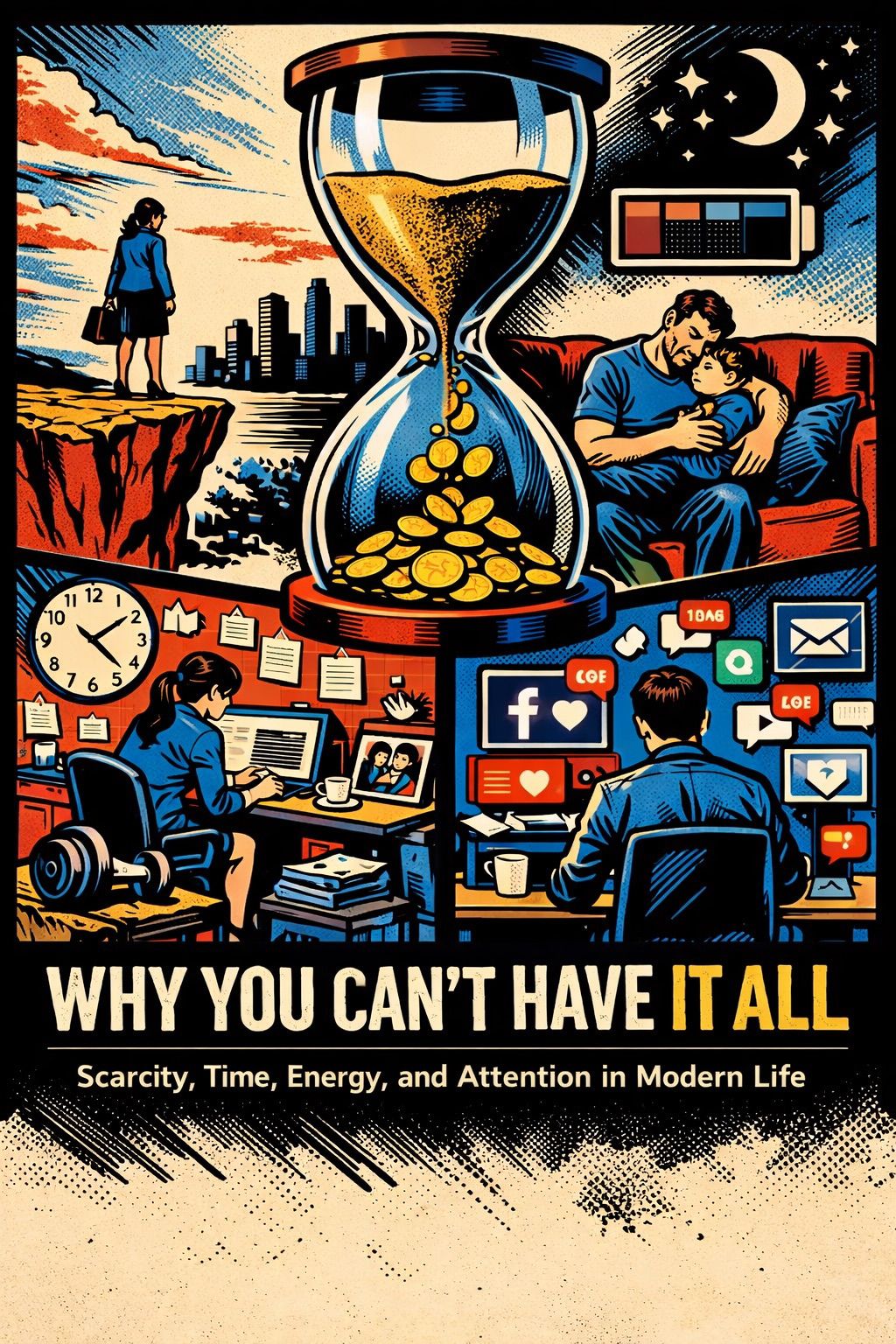
We grew up on a promise that if we worked hard enough, planned carefully, and optimised intelligently, we could have it all. Modern culture reinforces this belief on a daily basis that we can have a successful career, a loving family, financial security, good health, lasting friendships, purpose, and inner peace. Social media displays curated snapshots of people who appear to be excelling simultaneously in every domain of life. We have been hearing since our childhoods that balance is achievable with the right morning routine of ‘early to bed, early to rise, makes a person healthy, wealthy and wise’. Yet beneath this narrative lies a simple truth that you can’t have it all, at least not all at once, not at full intensity, and certainly not without significant trade-offs. The reason is not a lack of ambition or discipline, but scarcity, which is the most fundamental principle governing both economics and human life.

Scarcity is often associated with money, but today, the scarcest resources are time, energy, and attention. Every human being, regardless of wealth or status, receives the same twenty-four hours each day, making time the most democratic of all constraints. No one can accumulate unused hours or borrow from the future without cost. We speak casually about ‘managing time,’ yet time itself cannot be managed as it flows at a constant pace. Every hour invested in one activity is an hour unavailable for another, managing only the choices between time availability. The professional who chooses to work late trades time that could have been spent with family. The parent who prioritises caring for children may delay career advancement. The entrepreneur who pours weekends into building a venture sacrifices leisure and rest. These trade-offs are often invisible in the moment, but they accumulate quietly over the years. Life does not unfold in parallel tracks where everything progresses simultaneously. It unfolds sequentially, through seasons that demand different commitments.

If time is the vehicle of life, energy is its fuel. Two individuals may possess identical schedules yet operate at dramatically different capacities. Energy fluctuates with sleep, nutrition, stress, age, emotional well-being, and sense of purpose. Modern ambition frequently assumes that energy can be summoned indefinitely through willpower, caffeine/nicotine, or motivation. But biology imposes limits, cognitive fatigue reduces clarity and creativity, and emotional exhaustion diminishes patience and empathy, while physical depletion erodes resilience. Burnout is not a failure of time management but is the inevitable consequence of sustained energy misallocation. Many high achievers discover that even when their calendars appear optimised, their internal reserves are depleted. They attempt to excel in multiple demanding roles of being a professional, parent, partner, and friend simultaneously without acknowledging that each role draws from the same finite energy pool. Over time, the system protests, sleep suffers, health declines, and relationships strain. The pursuit of ‘having it all’ quietly converts into chronic exhaustion.

Perhaps more than time or energy, attention defines scarcity. In the digital age, attention has become a commodity aggressively competed for by corporations and platforms. Notifications, news feeds, emails, and endless streams of content fragment focus into micro-intervals, with us being connected to everything and fully present in almost nothing. Attention determines lived experience; whatever captures our focus becomes our reality. When attention is scattered across dozens of stimuli each hour, depth disappears, and conversations become half-engaged exchanges. Work becomes interrupted bursts of activity, and leisure becomes simultaneous scrolling. Creativity, which requires uninterrupted thought, struggles to emerge in fragmented environments. Intimacy, which depends on sustained presence, weakens under constant distraction. The desire to ‘have it all’ often leads to diluted attention spread thinly across many domains, leaving none fully nourished.

Technology reinforces the thinking that multitasking is efficient, but cognitive science consistently demonstrates the cost of task switching. Each shift of focus consumes mental energy and reduces performance quality. We may believe we are building a career, nurturing relationships, maintaining fitness, staying informed, and cultivating a side project all at once. We may be engaging partially in each, achieving adequacy but rarely excellence. To choose one path intensely is to decline others, at least temporarily, as excellence is exclusive by nature and rewards those willing to concentrate rather than diversify endlessly.

The pressure to ‘have it all’ is further amplified by comparison, especially as digital platforms present curated narratives where achievements are showcased without context. We compare our daily struggles to others’ peak moments and conclude that we are falling behind. Yet every visible success rests upon invisible trade-offs. The CxO with rapid career progression may have sacrificed personal time. The entrepreneur enjoying autonomy may endure financial uncertainty. The individual projecting calm online may be filled with anxiety privately. Role overload has become a defining feature of modern adulthood. We inflate our identities, attempting to be accomplished professionals, devoted family members, socially conscious citizens, physically fit individuals, and culturally relevant participants all at once. Without conscious prioritisation, this multiplicity breeds internal conflict.

Trade-offs are not signs of failure but are expressions of values. Every yes carries an implicit no. When we resist acknowledging trade-offs, we drift into reactive living, responding to emails, obligations, and external demands rather than intentional priorities. Economics teaches that scarce resources must be allocated toward what yields the highest perceived value. The same principle applies to life, and time, energy, and attention must be directed consciously. Without deliberate allocation, they will be consumed by urgency rather than importance. The question shifts from ‘Can I have it all?’ to ‘What is worth the cost?’ Clarity transforms scarcity from limitation into guidance.

Fragmentation carries hidden consequences as shallow engagement reduces satisfaction. When attention is dispersed continuously, creativity declines and emotional presence weakens. We may touch many aspects of life but rarely hold any deeply. The paradox of modern abundance is experiential thinness. Surrounded by options, we struggle to experience fullness. Having everything available does not equate to inhabiting it meaningfully.

Perhaps the problem lies in our definition of ‘having it all.’ If it means maximising every measurable domain simultaneously, which is unattainable. But if it means living in alignment with consciously chosen priorities, it becomes possible. Fulfilment may not require expansion in all directions, but it does require coherence. When time, energy, and attention align with core values, life feels integrated even if certain ambitions are deferred. We may not achieve extreme wealth, recognition, and perfect physical condition simultaneously, yet we may experience deep contentment through purposeful work, loving relationships, and sustainable health practices.

Designing a life within scarcity requires discipline and ruthless prioritisation to clarify which domains deserve peak focus. Protecting energy through sleep, movement, and boundaries preserves capacity. Practising attention hygiene, limiting digital intrusion and creating focused blocks enhances depth. Strategic neglect acknowledges that some areas will temporarily receive minimal investment without inducing guilt. Redefining success as alignment rather than accumulation reduces external pressure. These practices do not eliminate scarcity, but teaches us to navigate it wisely.

There is liberation in accepting limits, where comparison loses some of its sting when we acknowledge that no human can optimise every dimension simultaneously. Even the most accomplished individuals operate within constraints. Everyone trades something. The artist may trade financial stability for creative freedom. The corporate leader may trade time for influence. The activist may trade comfort for impact. The parent may trade professional acceleration for presence. No path is without a cost, and recognising this universal truth fosters humility and self-compassion.

Ultimately, the longing to ‘have it all’ often masks deeper desires for security, significance, love, belonging, or meaning. When these needs are identified clearly, excess pursuits lose their urgency. One may discover that respect matters more than status, intimacy more than visibility, and contribution more than accumulation. You cannot maximise career, family, health, wealth, friendships, and personal growth simultaneously at peak intensity. Human existence is bounded by time, powered by finite energy, and shaped by limited attention. Yet within those boundaries lies possibility. You may not have everything, but you can choose what receives your best. In a culture obsessed with expansion, the rare act is deliberately selecting what truly matters and committing to it fully. You cannot have it all, but you can have enough, deeply experienced and consciously chosen. And in the arithmetic of a scarce world, that may be the closest approximation of abundance available to us.

Bamboo Charcoal and Activated Carbon

Bamboo charcoal and active carbon are new products developed in recent years. Bamboo being of special microstructure possesses extreme absorbing and other special capacities after carbonization. Their uses in the areas of new technology are of importance.

Variety of Bamboo Charcoal: There are many kinds of bamboo charcoal. In line with their origin, bamboo charcoal can be divided into two parts: raw bamboo charcoal and charcoal stick of chips. Raw bamboo charcoal is made of small sized bamboo, old bamboo, and bamboo tops, roots, which are not fit for making other bamboo products. Charcoal stick of chips is made of residue from bamboo processing industries. In the process of making different kinds of industrialized products, there will be residue, which should be broken in chips, dried, and pressed into sticks before carbonization.

Full Post HERE