The cost of saying Yes 

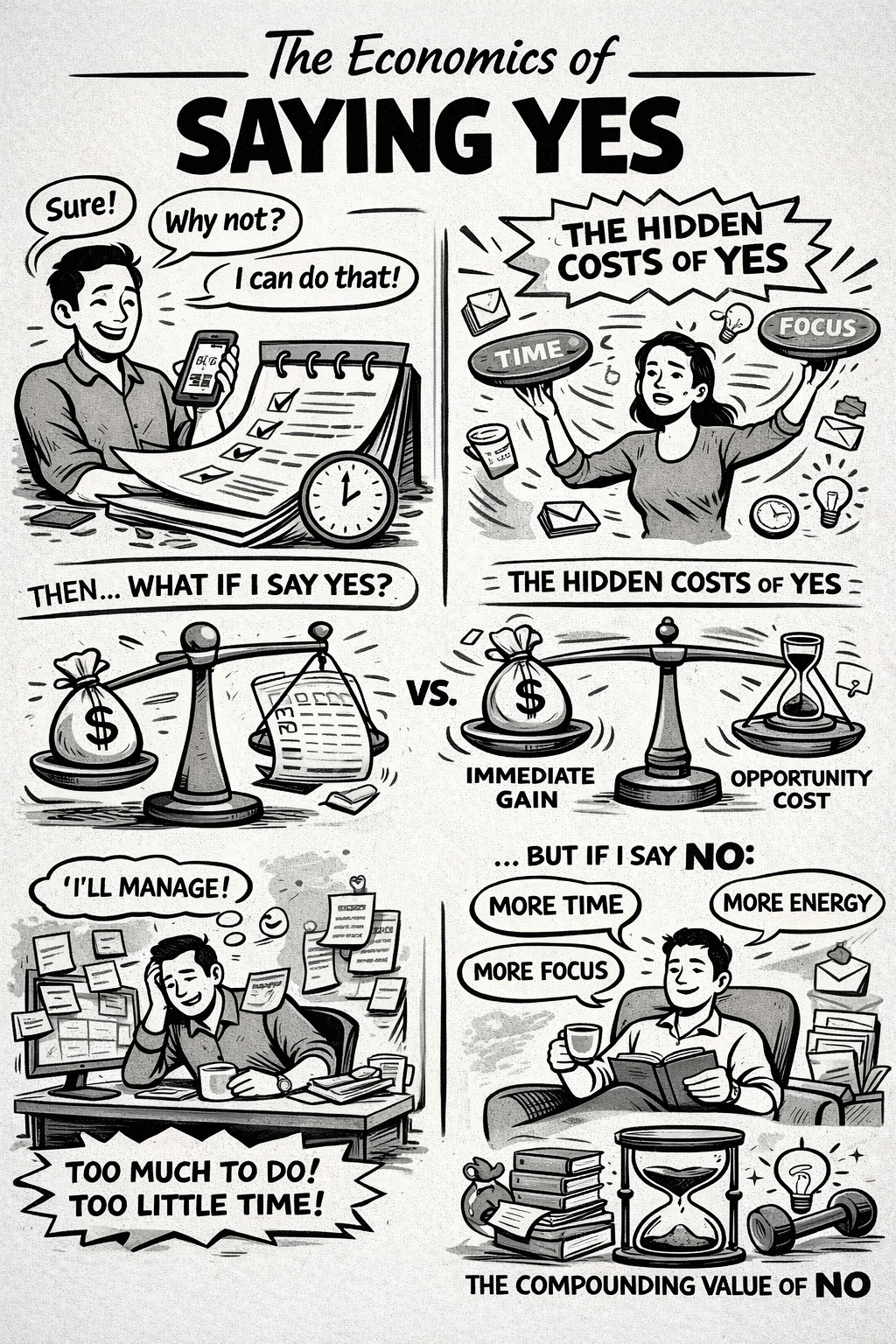
I used to think that saying ‘yes’ was a virtue as it made me feel useful, reliable, even noble at times. I often ended up saying yes to a meeting, yes to a request, yes to a friend, yes to a ‘quick call,’ yes to a ‘small favour,’ yes to that extra responsibility that would ‘hardly take any time.’ My life looked like a well diversified portfolio of yeses. And like many portfolios built on optimism rather than fundamentals, it was collapsing. No one teaches you this early on in life, but every yes is a transaction. It has a cost, a return, and often hidden liabilities. Unlike money, the currency you are spending here is time, attention, and energy, and those accounts don’t send monthly statements! They just end up depleting until one day you find yourself staring at your calendar, wondering why everything feels full and nothing feels meaningful.

When someone says, ‘Can you just hop on a quick call?’ it sounds harmless, as ‘quick’ is a very reassuring word. It suggests efficiency, minimal disruption, and a small and contained transaction. In reality, a ‘quick call’ is rarely just a call. It is context switching, mental preparation, the call itself, the afterthoughts, and the residual distraction that lingers long after the call ends. Economists would call this a hidden cost, and I call it the reason my day disappears in fragments. I remember agreeing to review a document for a colleague. ‘It won’t take long,’ they said, and they were technically correct, as the act of reviewing took about only 20 minutes. But the real cost was closer to an hour. I had to pause what I was doing, understand a different context, switch cognitive gears, and then find my way back to my original work. The 20-minute task came with a 40-minute tax. Multiply that across a week, and you begin to understand how entire days vanish without a trace.

Then there is the opportunity cost of the yes you don’t see. In economics, every choice comes with the value of the next best alternative you give up. When I say yes to a meeting at 6 PM, I am not just committing to that meeting, I am also saying no to my evening unwind, a conversation with family, reading, thinking, or simply doing nothing. The problem is, I don’t feel that loss immediately, and so I consistently undervalue what I am giving up. This is how you end up living a life where your time is fully allocated but poorly invested. I once agreed to attend a weekend workshop because it sounded interesting and, more importantly, because it felt rude to decline. That weekend, I missed a relaxing lunch at home that I didn’t realise I needed. The workshop was fine, but if I am honest, it wasn’t worth what I gave up. The return on that yes was modest, but the opportunity cost was high. The economy of my time had a deficit, which I wasn’t accounting for properly.

If saying yes were purely an economic decision, we would all be much better at it, but it is also deeply social. We say yes because we want to be liked, and we don’t want to disappoint someone. We say yes because somewhere along the way, we learned that being agreeable is a sign of being good. There is also a subtle reputational economy at play, and saying yes signals availability, cooperation, and enthusiasm. It makes you look like a team player, a dependable friend, a responsive colleague. Saying no, on the other hand, feels risky as it might signal disinterest, arrogance, or boundaries. And so, we keep saying yes, not because it makes sense, but because it feels safer. I have done this more times than I can count—agreed to calls I didn’t need to be on, events I didn’t want to attend, responsibilities that stretched me thinner than I should have allowed. Each yes was small, reasonable, and socially acceptable, and together, they created a life that felt crowded but curiously unfulfilling.

There is also the law of diminishing returns quietly operating in the background. The first few yeses in your day are productive as they move things forward, create value, and strengthen relationships. But beyond a certain point, each additional yes adds less value and more strain. The sixth meeting of the week on the same thing is not as useful as the first. The fifth commitment in a day is not as meaningful as the second. The twentieth favour you agree to does not make you twenty times more helpful, and only makes you feel exhausted. I realised this one evening when I found myself in a meeting, nodding at the right moments, contributing just enough to appear engaged, but mentally somewhere else entirely. I wasn’t adding value anymore and was just present in body, absent in mind. That was a negative return on yes, a clear sign that my internal economy was out of balance.

There is a phrase I have used liberally in my life, ‘I will manage.’ It is a beautiful phrase because it is optimistic, confident, and slightly heroic. It suggests resilience, capability, and a willingness to take things on. It is also, more often than not, a lie. ‘I will manage’ is what we tell others when we overcommit. It is what we tell ourselves when we ignore constraints. It is the verbal equivalent of taking on more debt without checking your balance, which keeps accumulating steadily. Until one day, you are not managing, only barely coping, moving from one commitment to another with a vague sense of urgency and a constant feeling of being behind.

If saying no is so rational, why is it so difficult? Because no is final and forces you to prioritise. Yes, on the other hand, keeps options open as it delays decision making. It allows you to feel helpful without immediately confronting the cost. There is also a psychological discomfort in saying no. It creates a moment of tension, however brief, between you and the other person, and we are wired to avoid that tension. But every time we avoid that small discomfort, we create a larger one for ourselves later. The stress simply shifts location from a brief external awkwardness to a prolonged internal burden.

What I have slowly come to realise is that no has compounding benefits. The first few noes feel awkward, even slightly uncomfortable. You second guess yourself, wondering if you were too blunt, too inflexible, or too selfish. But over time, your calendar starts to breathe, your days have space, and your work becomes more focused. Your relationships become more intentional because you are choosing them, not squeezing them in. When I started saying no more consciously, I noticed a real shift. I had time to think, to read, to do things without constantly rushing to the next commitment. The quality of my yeses improved because they were fewer and more deliberate.

For me, saying no is not about rejecting others, but more about protecting something. Sometimes it is protecting my time, energy, attention, and occasionally, my sanity. Instead of thinking, ‘I am letting someone down,’ I think, ‘I am choosing where to show up fully with intent.’ Of course, saying no does not require bluntness or indifference. There is an art to it, though I am still in the learning phase. A thoughtful no acknowledges the request but remains clear about the boundary. You need not overexplain or apologise excessively. ‘I won’t be able to take this on right now.’ Or ‘I would love to, but I don’t have the bandwidth this week.’ Or ‘I am focusing on a few priorities at the moment, so I’ll have to pass.’ These are decisions and not rejections, and they make life coherent.

The goal is not to eliminate yes, but to make it meaningful again. A well placed yes to a project you care about, a conversation that matters, a moment that enriches your life has immense value. But for that yes to exist, it must be protected by many noes. In economics, scarcity creates value, therefore, if your yes is abundant, it is cheap. If it is scarce, it is meaningful. I still say yes, probably more than I should, as old habits die hard. But I am more aware now, as I try to pause a little longer before responding. I ask myself simple questions, like what is the real cost, what am I giving up, and is this the best use of my time right now? Sometimes the answer is still yes, but increasingly, it is no. In the end, the economics of saying yes is not about maximising how much you can take on. It is about optimising what truly matters, because a life filled with yeses may look productive from the outside, but a life shaped by thoughtful noes is a life that actually adds up.

Why can’t you have it all

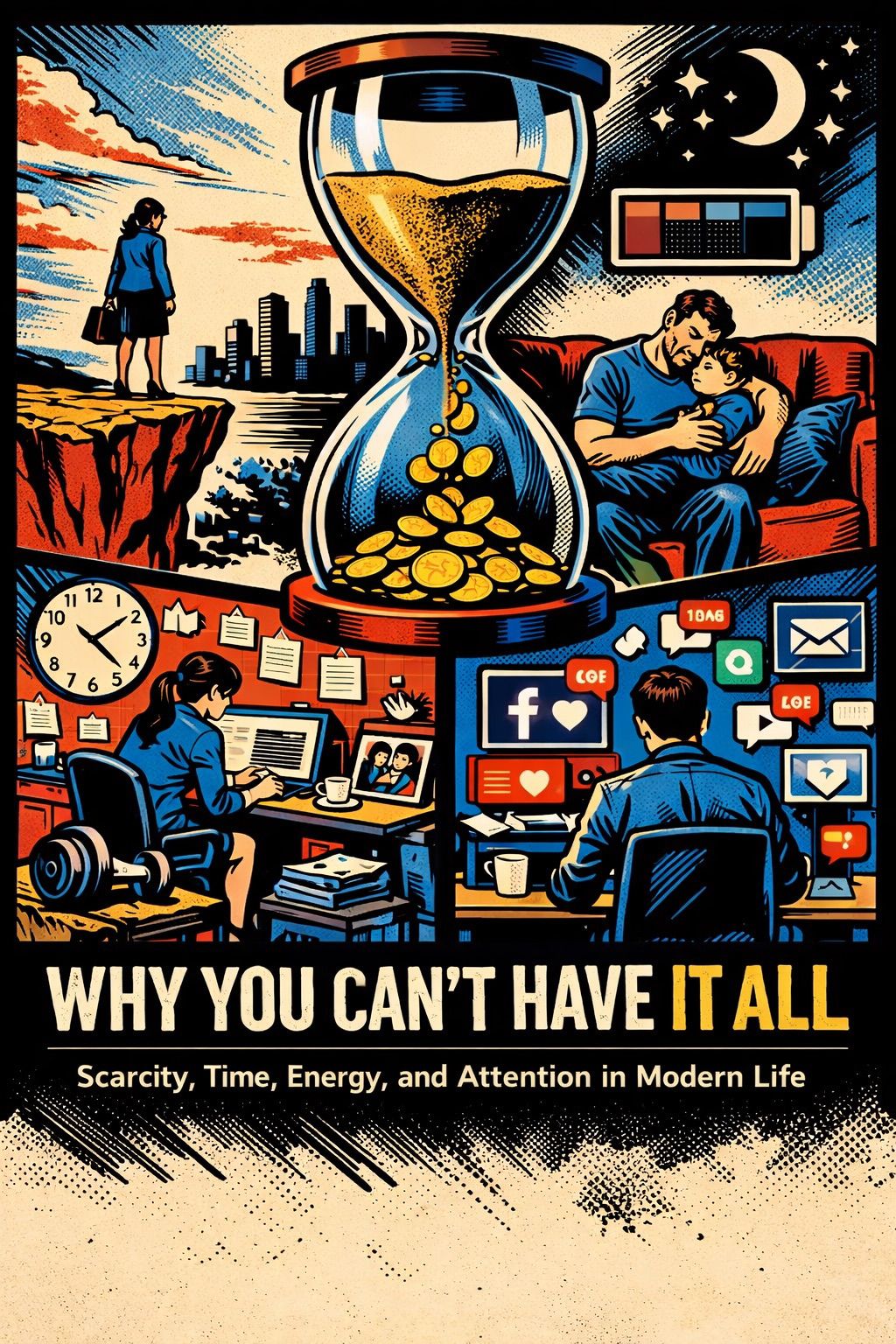
We grew up on a promise that if we worked hard enough, planned carefully, and optimised intelligently, we could have it all. Modern culture reinforces this belief on a daily basis that we can have a successful career, a loving family, financial security, good health, lasting friendships, purpose, and inner peace. Social media displays curated snapshots of people who appear to be excelling simultaneously in every domain of life. We have been hearing since our childhoods that balance is achievable with the right morning routine of ‘early to bed, early to rise, makes a person healthy, wealthy and wise’. Yet beneath this narrative lies a simple truth that you can’t have it all, at least not all at once, not at full intensity, and certainly not without significant trade-offs. The reason is not a lack of ambition or discipline, but scarcity, which is the most fundamental principle governing both economics and human life.

Scarcity is often associated with money, but today, the scarcest resources are time, energy, and attention. Every human being, regardless of wealth or status, receives the same twenty-four hours each day, making time the most democratic of all constraints. No one can accumulate unused hours or borrow from the future without cost. We speak casually about ‘managing time,’ yet time itself cannot be managed as it flows at a constant pace. Every hour invested in one activity is an hour unavailable for another, managing only the choices between time availability. The professional who chooses to work late trades time that could have been spent with family. The parent who prioritises caring for children may delay career advancement. The entrepreneur who pours weekends into building a venture sacrifices leisure and rest. These trade-offs are often invisible in the moment, but they accumulate quietly over the years. Life does not unfold in parallel tracks where everything progresses simultaneously. It unfolds sequentially, through seasons that demand different commitments.

If time is the vehicle of life, energy is its fuel. Two individuals may possess identical schedules yet operate at dramatically different capacities. Energy fluctuates with sleep, nutrition, stress, age, emotional well-being, and sense of purpose. Modern ambition frequently assumes that energy can be summoned indefinitely through willpower, caffeine/nicotine, or motivation. But biology imposes limits, cognitive fatigue reduces clarity and creativity, and emotional exhaustion diminishes patience and empathy, while physical depletion erodes resilience. Burnout is not a failure of time management but is the inevitable consequence of sustained energy misallocation. Many high achievers discover that even when their calendars appear optimised, their internal reserves are depleted. They attempt to excel in multiple demanding roles of being a professional, parent, partner, and friend simultaneously without acknowledging that each role draws from the same finite energy pool. Over time, the system protests, sleep suffers, health declines, and relationships strain. The pursuit of ‘having it all’ quietly converts into chronic exhaustion.

Perhaps more than time or energy, attention defines scarcity. In the digital age, attention has become a commodity aggressively competed for by corporations and platforms. Notifications, news feeds, emails, and endless streams of content fragment focus into micro-intervals, with us being connected to everything and fully present in almost nothing. Attention determines lived experience; whatever captures our focus becomes our reality. When attention is scattered across dozens of stimuli each hour, depth disappears, and conversations become half-engaged exchanges. Work becomes interrupted bursts of activity, and leisure becomes simultaneous scrolling. Creativity, which requires uninterrupted thought, struggles to emerge in fragmented environments. Intimacy, which depends on sustained presence, weakens under constant distraction. The desire to ‘have it all’ often leads to diluted attention spread thinly across many domains, leaving none fully nourished.

Technology reinforces the thinking that multitasking is efficient, but cognitive science consistently demonstrates the cost of task switching. Each shift of focus consumes mental energy and reduces performance quality. We may believe we are building a career, nurturing relationships, maintaining fitness, staying informed, and cultivating a side project all at once. We may be engaging partially in each, achieving adequacy but rarely excellence. To choose one path intensely is to decline others, at least temporarily, as excellence is exclusive by nature and rewards those willing to concentrate rather than diversify endlessly.

The pressure to ‘have it all’ is further amplified by comparison, especially as digital platforms present curated narratives where achievements are showcased without context. We compare our daily struggles to others’ peak moments and conclude that we are falling behind. Yet every visible success rests upon invisible trade-offs. The CxO with rapid career progression may have sacrificed personal time. The entrepreneur enjoying autonomy may endure financial uncertainty. The individual projecting calm online may be filled with anxiety privately. Role overload has become a defining feature of modern adulthood. We inflate our identities, attempting to be accomplished professionals, devoted family members, socially conscious citizens, physically fit individuals, and culturally relevant participants all at once. Without conscious prioritisation, this multiplicity breeds internal conflict.

Trade-offs are not signs of failure but are expressions of values. Every yes carries an implicit no. When we resist acknowledging trade-offs, we drift into reactive living, responding to emails, obligations, and external demands rather than intentional priorities. Economics teaches that scarce resources must be allocated toward what yields the highest perceived value. The same principle applies to life, and time, energy, and attention must be directed consciously. Without deliberate allocation, they will be consumed by urgency rather than importance. The question shifts from ‘Can I have it all?’ to ‘What is worth the cost?’ Clarity transforms scarcity from limitation into guidance.

Fragmentation carries hidden consequences as shallow engagement reduces satisfaction. When attention is dispersed continuously, creativity declines and emotional presence weakens. We may touch many aspects of life but rarely hold any deeply. The paradox of modern abundance is experiential thinness. Surrounded by options, we struggle to experience fullness. Having everything available does not equate to inhabiting it meaningfully.

Perhaps the problem lies in our definition of ‘having it all.’ If it means maximising every measurable domain simultaneously, which is unattainable. But if it means living in alignment with consciously chosen priorities, it becomes possible. Fulfilment may not require expansion in all directions, but it does require coherence. When time, energy, and attention align with core values, life feels integrated even if certain ambitions are deferred. We may not achieve extreme wealth, recognition, and perfect physical condition simultaneously, yet we may experience deep contentment through purposeful work, loving relationships, and sustainable health practices.

Designing a life within scarcity requires discipline and ruthless prioritisation to clarify which domains deserve peak focus. Protecting energy through sleep, movement, and boundaries preserves capacity. Practising attention hygiene, limiting digital intrusion and creating focused blocks enhances depth. Strategic neglect acknowledges that some areas will temporarily receive minimal investment without inducing guilt. Redefining success as alignment rather than accumulation reduces external pressure. These practices do not eliminate scarcity, but teaches us to navigate it wisely.

There is liberation in accepting limits, where comparison loses some of its sting when we acknowledge that no human can optimise every dimension simultaneously. Even the most accomplished individuals operate within constraints. Everyone trades something. The artist may trade financial stability for creative freedom. The corporate leader may trade time for influence. The activist may trade comfort for impact. The parent may trade professional acceleration for presence. No path is without a cost, and recognising this universal truth fosters humility and self-compassion.

Ultimately, the longing to ‘have it all’ often masks deeper desires for security, significance, love, belonging, or meaning. When these needs are identified clearly, excess pursuits lose their urgency. One may discover that respect matters more than status, intimacy more than visibility, and contribution more than accumulation. You cannot maximise career, family, health, wealth, friendships, and personal growth simultaneously at peak intensity. Human existence is bounded by time, powered by finite energy, and shaped by limited attention. Yet within those boundaries lies possibility. You may not have everything, but you can choose what receives your best. In a culture obsessed with expansion, the rare act is deliberately selecting what truly matters and committing to it fully. You cannot have it all, but you can have enough, deeply experienced and consciously chosen. And in the arithmetic of a scarce world, that may be the closest approximation of abundance available to us.