Why can’t you have it all

We grew up on a promise that if we worked hard enough, planned carefully, and optimised intelligently, we could have it all. Modern culture reinforces this belief on a daily basis that we can have a successful career, a loving family, financial security, good health, lasting friendships, purpose, and inner peace. Social media displays curated snapshots of people who appear to be excelling simultaneously in every domain of life. We have been hearing since our childhoods that balance is achievable with the right morning routine of ‘early to bed, early to rise, makes a person healthy, wealthy and wise’. Yet beneath this narrative lies a simple truth that you can’t have it all, at least not all at once, not at full intensity, and certainly not without significant trade-offs. The reason is not a lack of ambition or discipline, but scarcity, which is the most fundamental principle governing both economics and human life.

Scarcity is often associated with money, but today, the scarcest resources are time, energy, and attention. Every human being, regardless of wealth or status, receives the same twenty-four hours each day, making time the most democratic of all constraints. No one can accumulate unused hours or borrow from the future without cost. We speak casually about ‘managing time,’ yet time itself cannot be managed as it flows at a constant pace. Every hour invested in one activity is an hour unavailable for another, managing only the choices between time availability. The professional who chooses to work late trades time that could have been spent with family. The parent who prioritises caring for children may delay career advancement. The entrepreneur who pours weekends into building a venture sacrifices leisure and rest. These trade-offs are often invisible in the moment, but they accumulate quietly over the years. Life does not unfold in parallel tracks where everything progresses simultaneously. It unfolds sequentially, through seasons that demand different commitments.

If time is the vehicle of life, energy is its fuel. Two individuals may possess identical schedules yet operate at dramatically different capacities. Energy fluctuates with sleep, nutrition, stress, age, emotional well-being, and sense of purpose. Modern ambition frequently assumes that energy can be summoned indefinitely through willpower, caffeine/nicotine, or motivation. But biology imposes limits, cognitive fatigue reduces clarity and creativity, and emotional exhaustion diminishes patience and empathy, while physical depletion erodes resilience. Burnout is not a failure of time management but is the inevitable consequence of sustained energy misallocation. Many high achievers discover that even when their calendars appear optimised, their internal reserves are depleted. They attempt to excel in multiple demanding roles of being a professional, parent, partner, and friend simultaneously without acknowledging that each role draws from the same finite energy pool. Over time, the system protests, sleep suffers, health declines, and relationships strain. The pursuit of ‘having it all’ quietly converts into chronic exhaustion.

Perhaps more than time or energy, attention defines scarcity. In the digital age, attention has become a commodity aggressively competed for by corporations and platforms. Notifications, news feeds, emails, and endless streams of content fragment focus into micro-intervals, with us being connected to everything and fully present in almost nothing. Attention determines lived experience; whatever captures our focus becomes our reality. When attention is scattered across dozens of stimuli each hour, depth disappears, and conversations become half-engaged exchanges. Work becomes interrupted bursts of activity, and leisure becomes simultaneous scrolling. Creativity, which requires uninterrupted thought, struggles to emerge in fragmented environments. Intimacy, which depends on sustained presence, weakens under constant distraction. The desire to ‘have it all’ often leads to diluted attention spread thinly across many domains, leaving none fully nourished.

Technology reinforces the thinking that multitasking is efficient, but cognitive science consistently demonstrates the cost of task switching. Each shift of focus consumes mental energy and reduces performance quality. We may believe we are building a career, nurturing relationships, maintaining fitness, staying informed, and cultivating a side project all at once. We may be engaging partially in each, achieving adequacy but rarely excellence. To choose one path intensely is to decline others, at least temporarily, as excellence is exclusive by nature and rewards those willing to concentrate rather than diversify endlessly.

The pressure to ‘have it all’ is further amplified by comparison, especially as digital platforms present curated narratives where achievements are showcased without context. We compare our daily struggles to others’ peak moments and conclude that we are falling behind. Yet every visible success rests upon invisible trade-offs. The CxO with rapid career progression may have sacrificed personal time. The entrepreneur enjoying autonomy may endure financial uncertainty. The individual projecting calm online may be filled with anxiety privately. Role overload has become a defining feature of modern adulthood. We inflate our identities, attempting to be accomplished professionals, devoted family members, socially conscious citizens, physically fit individuals, and culturally relevant participants all at once. Without conscious prioritisation, this multiplicity breeds internal conflict.

Trade-offs are not signs of failure but are expressions of values. Every yes carries an implicit no. When we resist acknowledging trade-offs, we drift into reactive living, responding to emails, obligations, and external demands rather than intentional priorities. Economics teaches that scarce resources must be allocated toward what yields the highest perceived value. The same principle applies to life, and time, energy, and attention must be directed consciously. Without deliberate allocation, they will be consumed by urgency rather than importance. The question shifts from ‘Can I have it all?’ to ‘What is worth the cost?’ Clarity transforms scarcity from limitation into guidance.

Fragmentation carries hidden consequences as shallow engagement reduces satisfaction. When attention is dispersed continuously, creativity declines and emotional presence weakens. We may touch many aspects of life but rarely hold any deeply. The paradox of modern abundance is experiential thinness. Surrounded by options, we struggle to experience fullness. Having everything available does not equate to inhabiting it meaningfully.

Perhaps the problem lies in our definition of ‘having it all.’ If it means maximising every measurable domain simultaneously, which is unattainable. But if it means living in alignment with consciously chosen priorities, it becomes possible. Fulfilment may not require expansion in all directions, but it does require coherence. When time, energy, and attention align with core values, life feels integrated even if certain ambitions are deferred. We may not achieve extreme wealth, recognition, and perfect physical condition simultaneously, yet we may experience deep contentment through purposeful work, loving relationships, and sustainable health practices.

Designing a life within scarcity requires discipline and ruthless prioritisation to clarify which domains deserve peak focus. Protecting energy through sleep, movement, and boundaries preserves capacity. Practising attention hygiene, limiting digital intrusion and creating focused blocks enhances depth. Strategic neglect acknowledges that some areas will temporarily receive minimal investment without inducing guilt. Redefining success as alignment rather than accumulation reduces external pressure. These practices do not eliminate scarcity, but teaches us to navigate it wisely.

There is liberation in accepting limits, where comparison loses some of its sting when we acknowledge that no human can optimise every dimension simultaneously. Even the most accomplished individuals operate within constraints. Everyone trades something. The artist may trade financial stability for creative freedom. The corporate leader may trade time for influence. The activist may trade comfort for impact. The parent may trade professional acceleration for presence. No path is without a cost, and recognising this universal truth fosters humility and self-compassion.

Ultimately, the longing to ‘have it all’ often masks deeper desires for security, significance, love, belonging, or meaning. When these needs are identified clearly, excess pursuits lose their urgency. One may discover that respect matters more than status, intimacy more than visibility, and contribution more than accumulation. You cannot maximise career, family, health, wealth, friendships, and personal growth simultaneously at peak intensity. Human existence is bounded by time, powered by finite energy, and shaped by limited attention. Yet within those boundaries lies possibility. You may not have everything, but you can choose what receives your best. In a culture obsessed with expansion, the rare act is deliberately selecting what truly matters and committing to it fully. You cannot have it all, but you can have enough, deeply experienced and consciously chosen. And in the arithmetic of a scarce world, that may be the closest approximation of abundance available to us.

Why good projects struggle for funding

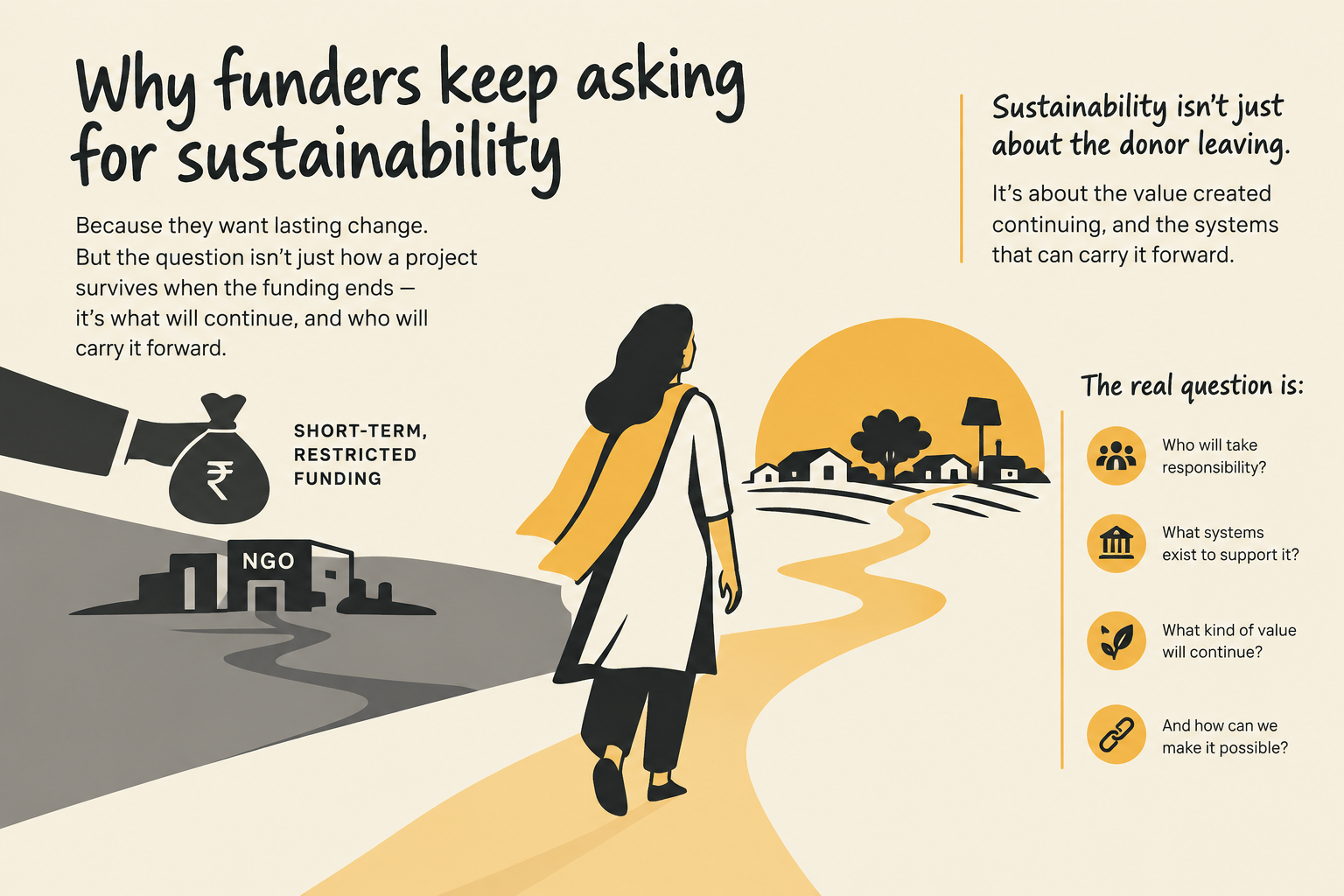
The social impact sector’s irony is that some of the most thoughtful, community-centred, transformative projects struggle to secure funding, while others that are not so well designed, and sometimes even superficial, find their way into donor portfolios. This contradiction is often explained as a failure of proposal writing or organisational capacity, but such explanations only scratch the surface. The deeper truth lies in understanding donor behaviour, including the incentives, constraints, and biases that shape funding decisions. Good projects are overlooked not because they lack merit, as ‘merit’ is not the primary currency in the funding ecosystem, but because of factors like alignment, risk perception, measurability, and institutional incentives.

At the core of the problem is the simple fact that donors do not fund the ‘best’ projects; instead, they support those that align with their priorities. Every donor operates within a specific thematic, geographic, and strategic framework, often influenced by board directives, political factors, or institutional legacy. A project that is highly relevant to a particular community may still be rejected if it does not fit neatly into a donor’s current focus areas. This creates a subtle but significant distortion in the sector, as organisations begin to design projects around donors’ language and preferences rather than the lived realities of communities. In this process, genuinely valuable ideas can become invisible, not because they lack worth, but because they are misaligned with funding narratives.

This is further compounded by the deeply risk-averse nature of development funding. Donors are not neutral actors, and they are accountable upward to their boards, governments, shareholders, or trustees. This shapes a cautious approach to funding, where the emphasis is on minimising risk rather than maximising impact. Established nonprofits with proven track records are preferred over emerging grassroots organisations, even when the latter may have deeper contextual understanding. Similarly, tried-and-tested models are favoured over experimental or innovative approaches. The consequence is a filtering mechanism that systematically excludes many high-potential projects simply because they appear uncertain or difficult to manage. Ironically, the very qualities like innovation, localisation, and adaptability that make a project transformative are often the ones that make it seem risky.

Now there’s a growing emphasis on measurability in funding decisions. Donors desire clear metrics, defined outputs, and quantifiable results for results-based management and data-driven accountability of projects. While this has enhanced transparency, it has also created a bias toward interventions that can demonstrate immediate, tangible results. Projects focused on infrastructure, service delivery, or training programmes tend to perform better because their outputs are easily measurable. Conversely, initiatives aimed at changing social norms, empowering communities, or strengthening institutions struggle to articulate their impact within the same frameworks. The most complex and deeply rooted development challenges are often the least measurable within the funding cycle, and therefore the least fundable. Good projects operating in these areas are disadvantaged not because they are ineffective, but because their effectiveness cannot be readily quantified.

The nature of donor engagement further complicates the picture, despite frequent references to ‘partnership,’ much of development funding remains transactional. Organisations submit proposals in competitive, opaque processes with limited opportunity for dialogue or feedback. In such an environment, relationships matter enormously. Organisations with prior visibility, networks, or access to donor ecosystems often have a significant advantage, even if their projects are not fundamentally stronger. Trust, built over time, can outweigh the intrinsic quality of a proposal. Conversely, new or lesser-known organisations, particularly those operating at the grassroots level, find it difficult to break into these networks. As a result, good projects often fail not on their own terms, but because they are evaluated in isolation, without the benefit of relational context.

This dynamic is closely tied to a broader structural bias within the global development ecosystem. Local organisations, despite being closest to the communities they serve, receive only a small fraction of direct funding. Donors frequently cite concerns around compliance, financial risk, and administrative capacity, which leads them to channel funds through larger intermediaries. While this may simplify management from the donor’s perspective, it creates a distance between resources and realities. Local initiatives, which may be highly effective and deeply embedded, often remain underfunded or entirely excluded. This is not merely an operational issue, but reflects an implicit hierarchy of trust, where proximity to power and familiarity with donor systems are valued over contextual knowledge and lived experience.

Equally important is what might be called the ‘proposal illusion’, with the tendency to compare the quality of a project with the quality of its documentation. In practice, donors assess proposals, not projects. This places a premium on articulation, structure, and the ability to translate complex realities into donor-friendly language. Organisations with access to skilled writers, consultants, or international exposure are better positioned to succeed, even if their fieldwork is not exceptional. On the other hand, grassroots organisations that may be doing outstanding work often struggle to present it in ways that resonate with donor expectations. The result is a system where storytelling can overshadow reality, and where good projects are overlooked because they are not packaged effectively.

Time horizons further skew funding decisions as donors tend to operate within short funding cycles, typically ranging from one to three years, with success evaluated within this limited timeframe. This creates a preference for projects that can demonstrate quick wins, rather than those that require sustained engagement over longer periods. Yet most of the development challenges, like education reform, livelihood transformation, and social cohesion, are inherently long-term and demand patience, continuity, and iterative learning. When funding is short-term, even well-designed projects can struggle to show meaningful results, making them less attractive to donors. This leads to what is often described as the ‘pilot trap,’ where innovative ideas receive initial funding but fail to scale or sustain due to a lack of long-term commitment.

Another big challenge is the persistent reluctance to fund organisational overheads. Donors often prefer to allocate resources directly to programmatic activities, placing limits on administrative costs such as salaries, systems, and governance. This undermines the very foundations that enable effective implementation. Strong organisations require robust systems, skilled personnel, and institutional stability. When these are underfunded, the quality of implementation suffers, reinforcing donor perceptions of risk and inefficiency. This creates a vicious cycle in which organisations are unable to build capacity, and good projects become difficult to execute at scale.

Underlying all of these factors are the incentives that shape donor behaviour. Funding decisions are rarely neutral as they are often influenced by a range of external and internal considerations. Corporate donors are often guided by brand alignment and visibility, favouring projects that can be showcased or communicated easily. Philanthropic foundations may be influenced by leadership vision, legacy goals, or thematic interests. In each case, the logic of funding extends beyond impact alone. Good projects that do not align with these broader incentives may struggle to gain traction, regardless of their potential.

Bilateral and multilateral donors operate within geopolitical frameworks, where aid allocation may reflect strategic interests as much as development priorities. In the wake of global economic slowdowns, traditional sources of Official Development Assistance (ODA) are shrinking. The U.S., U.K., and several European governments have all announced significant cuts to their ODA budgets. These reductions should have sparked debates about the failures of the aid system, but they largely passed with little reflection. The outcome is a development finance environment that’s simultaneously more selective and more risk-averse. Funders now prioritise large-scale, measurable, and politically ‘safe’ projects that can boast short-term, quantifiable results. Small-scale social initiatives, particularly those addressing systemic or cultural issues like inequality or governance, find themselves outside the funding radar. Even when progressive funding streams exist, for example, climate justice or inclusive innovation programs, they come wrapped in new conditionalities of alignment with national development strategies, ESG benchmarks, or private-sector co-financing. These conditions further alienate grassroots actors who can’t meet such formal requirements.

It is also important to acknowledge a more fundamental constraint of scarcity, as the pool of available funding is limited, while the number of worthy projects is vast. Even in a perfectly functioning system, not all good ideas can be supported. This introduces an element of competition that is not purely based on merit. Projects must not only be good, but must also be timely, visible, and strategically positioned. In such an environment, marginal differences in presentation, alignment, or relationships can determine outcomes, leaving many strong proposals unfunded.

Projects that are technically sound but insufficiently rooted in community realities often struggle to convince donors of their sustainability. Funders have been increasingly looking for evidence of participation, co-creation, and local ownership. However, these elements are difficult to demonstrate within conventional proposal formats, leading to a gap between genuine engagement and its representation. Good projects that are deeply participatory may still fall short if they cannot adequately convey this dimension to donors.

These dynamics suggest that the funding ecosystem does not necessarily reward the intrinsic quality of projects. Instead, it rewards alignment, clarity, measurability, and perceived reliability. This does not mean that donors are acting in bad faith; rather, they are responding to their own constraints and accountability structures. The system, in many ways, is functioning as designed. However, the consequences are significant, as innovative, context-specific, and potentially transformative projects often remain unfunded, while safer, more conventional interventions dominate.If we are serious about tackling poverty, inequality, and climate injustice, we must start by rethinking how funding itself operates. It is not enough to design good projects, but one must also learn to translate them into the language of donors without diluting their essence. This requires strategic proposal architecture, effective communication, and relationship-building. For donors, the challenge is more profound as it involves rethinking risk, expanding definitions of impact, and creating funding mechanisms that are flexible, inclusive, and long-term. Without such shifts, the sector will continue to produce good ideas that never see the light of day, not because they are unworthy, but because they do not fit the system that is meant to support them.

Why India needs a circular textile reuse revolution

The clothes we wear have a hidden afterlife. Even after a garment is worn a few times and forgotten at the back of a wardrobe, its environmental footprint remains in landfills, waterways, and the atmosphere. The global fashion industry today has a material and emissions footprint so large that it rivals that of entire nations. Each year, around 92 million tonnes of textile waste are generated worldwide, most of it ending up in landfills or incinerators, even though a large share of it is still wearable or recyclable. This is not just a lifestyle problem; it is a climate, water, and waste crisis rolled into one. In countries like India, Brazil, and the United States, the scale of textile waste varies, but the pattern remains the same, with fast fashion fuelling overconsumption, linear disposal systems leaking value, and communities paying the price through polluted land, stressed water systems, and rising emissions.

A practical alternative exists, and it is already visible in the reuse models emerging across cities and communities. The ‘collection-sorting-reuse-recycling model’, where clothes donated by households are graded and channelled into resale, regional redistribution, or material recycling, offers a rare triple win. It can save energy and water by avoiding virgin production, reduce landfill pressure and carbon emissions, and create dignified livelihoods across the value chain. In a world searching for climate solutions that also create jobs, textile reuse is a low-hanging fruit hiding in plain sight.

The environmental logic of reuse is powerful. Producing new clothing is energy and water-intensive, especially when fibres are grown, dyed, finished, shipped, and marketed across continents. Cotton alone accounts for massive freshwater use, while polyester is derived from fossil fuels and contributes to microplastic pollution. The fashion sector contributes an estimated 2–8% of global greenhouse gas emissions, making it one of the most carbon-intensive consumer industries.[i] When a garment is reused even once, a large portion of that embedded energy, water, and carbon footprint is avoided. Lifecycle assessments consistently show that resale and reuse pathways can cut emissions per garment by more than half compared to producing a new equivalent, while also sparing thousands of litres of water per kilogram of clothing.[ii] In practical terms, every shirt reused is a shirt not produced, and every kilogram diverted from landfill is methane not emitted during decomposition.

India’s case illustrates both the urgency of the problem and the promise of the solution. The country generates around eight million tonnes of textile waste every year, which is 8.5% of global post-consumer textile discards. India’s textile and apparel sector generates close to four million tonnes of post-consumer textile waste annually, making it one of the country’s largest contributors to landfill, water consumption, and greenhouse gas emissions. While an estimated 57% of used textiles are reused or recycled, these processes take place almost entirely through informal, fragmented, and unregulated channels. The remaining 43% ends up in landfills or is incinerated, reflecting an unsustainable linear ‘buy-use-discard’ consumption pattern that continues to accelerate with the growth of fast fashion[iii].

While India has long traditions of repair and hand-me-downs, rapid urbanisation and fast fashion consumption are overwhelming these cultural buffers. The result is a growing stream of clothing waste in municipal dumps, often mixed with organic waste, making recycling harder and environmental harm more acute. Yet India also hosts some of the world’s most innovative reuse ecosystems. Organisations such as Humana People to People India is demonstrating how urban surplus clothing can be collected and sold through retail channels, and income used for funding social development outcomes[iv], and Goonj collection channelled to rural communities in dignified ways, linking redistribution to community development and livelihoods.[v] Informal networks of sorters, repairers, and traders already keep a significant portion of textiles in circulation, proving that reuse is culturally and economically viable when supported by the right infrastructure. 

Brazil presents a parallel story shaped by urban consumerism and rising awareness. The country generates millions of tonnes of textile waste annually, with a large fraction still going to landfills due to limited formal recycling and reuse systems.[vi] Yet a growing thrift and resale movement, especially among younger Brazilians, is reframing second-hand fashion as both affordable and aspirational.[vii] Community cooperatives and small recyclers are beginning to integrate textile waste into circular micro-economies, creating jobs in sorting, resale, and upcycling. The lesson from Brazil is that cultural acceptance of reuse can shift quickly when affordability, sustainability narratives, and local entrepreneurship align.

The United States, often seen as the epicentre of fast fashion consumption, offers a different scale of lessons. Tens of millions of tonnes of textiles are discarded each year, but the country also has one of the world’s most established second-hand markets, supported by charities, social enterprises, and commercial resale platforms. Organisations collecting used clothing divert billions of pounds from landfills annually, channelling them into domestic resale, international reuse markets, and recycling streams.[viii] Even in a high-consumption society, reuse systems demonstrate that scale is possible when logistics, sorting infrastructure, and consumer awareness are aligned. The American experience shows that reuse is not marginal, but can be commercially viable, and environmentally meaningful at the national scale.

There could be lessons learnt from Brazil and the USA, and good practices replicated in India. Beyond environmental benefits, reuse models unlock employment that matters deeply for India. Every stage of the circular value chain creates work, from collection crews and logistics managers, sorting centre workers trained in grading and repair, retail staff in reuse shops, resellers in Tier II and III towns, and recycling technicians handling end-of-life textiles. Unlike capital-intensive manufacturing, reuse and sorting are labour-intensive, making them ideal for employment generation in peri-urban and rural contexts. India’s textile and apparel ecosystem already employs tens of millions of people, and circular extensions of this value chain can add new layers of income while formalising parts of the informal economy.[ix] For women and youth, especially in low-income communities, reuse enterprises can offer accessible entry points into entrepreneurship and wage work, from operating neighbourhood collection hubs to running small resale outlets.

Such models fit well within India’s national climate adaptation priorities. The National Action Plan on Climate Change[x]emphasises sustainable consumption, waste reduction, and resource efficiency as pillars of climate resilience. Textile reuse contributes to mitigation by cutting emissions embedded in production and avoiding landfill methane, while also supporting adaptation by reducing pressure on water systems and urban waste infrastructure. In water-stressed cities, every litre saved through avoided textile production matters. In flood-prone regions, reducing landfill volume lowers the risk of waste-choked drainage and secondary pollution. Circular textile systems thus become part of urban resilience, not just waste management.

The social enterprise model further adds public value, where profits from resale and recycling can cover operating costs and fund social programs. By reinvesting surpluses into community education, skills training, or local environmental projects, reuse systems can close the loop between consumption and social impact. This can become an excellent example of regenerative economics, where waste becomes a revenue stream that sustains both the enterprise and the communities it serves. When scaled across cities through partnerships with RWAs, municipalities, and CSR programmes, such models can become a distributed infrastructure for circularity, embedded in everyday life rather than confined to pilot projects.

While reuse alone cannot solve fashion’s environmental crisis, overproduction must be addressed, and durable design, extended producer responsibility, and recycling innovation are all necessary. But reuse is the fastest, cheapest, and most socially inclusive solution available today. It requires no new technology breakthroughs, only better organisation of what already exists and conscious consumerism. 

Embracing circular textile reuse at scale in India is not just an environmental choice, but an essential development strategy. It aligns climate action with employment, urban resilience with rural markets, and consumer behaviour with community benefit. Brazil’s cultural shift towards thrift and the USA’s large-scale reuse infrastructure show that such transitions are possible across income levels and cultures. The question is no longer whether reuse works, but whether policy, capital, and civic will can come together to make it the norm rather than the exception. If India gets this right, it will not only reduce its textile footprint but also demonstrate how climate action can be woven into the fabric of everyday economic life.

References 


[i] https://news.un.org/en/story/2025/03/1161636#:~:text=The%20fashion%20industry%20is%20one,of%20global%20greenhouse%20gas%20emissions

[ii] Number Analytics. “The Impact of Recycled Textiles on the Environment.” Lifecycle assessment review, 2024.

[iii] https://reports.fashionforgood.com/report/sorting-for-circularity-india-wealth-in-waste/chapterdetail?reportid=813&chapter=3

[iv] Humana People to People India. “Reuse and Circularity in Textiles”, 2026

[v] Goonj (India). Organisational model and impact summaries, publicly available reports.

[vi] Upcycle4Better. “Textile Recycling in Brazil.” Country brief, 2023.

[vii] Greenbook. “The Thrifting Revolution in Brazil.” Market insight report, 2024.

[viii] Planet Aid

[ix] CSTEP. “India’s Textile and Apparel Sector: Ecosystem and Readiness for EPR.” Policy report, 2024.

[x] National Action Plan on Climate Change (NAPCC), Govt. of India

Economics is not about money

Most people think economics is about money, but it’s not. If it were, your life would make far more sense than it does. Economics begins much earlier than money, as it starts the moment you realise that you cannot have everything at once. You cannot have a high-paying job and abundant free time. You cannot have absolute security and complete freedom. You cannot say yes to every opportunity without saying no to something else. Economics is not about how much you earn, but what you give up for it. That invisible sacrifice, ‘what you could have done but didn’t, ‘ is the true currency of economics. We seldom talk about it, but it quietly shapes every decision we make.

Think of any random normal day of your life. You wake up earlier than you would like because traffic can be unpredictable. You scroll your phone while sipping morning tea, not because you want to, but because silence feels uncomfortable. You choose a quicker breakfast over a healthier one. You delay a difficult conversation at home. You tolerate a job you dislike because it pays the bills. None of these choices feels ‘economic.’ They feel personal. But every choice that you make is a trade-off. When you choose speed over health, comfort over honesty, income over meaning, you are doing economics. You are allocating scarce resources, such as time, energy, attention, and emotional capacity. Money enters later, as a convenient measuring tool, but the logic is already at work.

In India and several other similar developing countries, we live in a constant state of trade-offs. Long commutes to work steal hours from families. Overcrowded classrooms dilute learning. Low wages are compensated by the promise of stability. We accept these compromises so routinely that they stop feeling like choices at all and begin to feel like fate. Economics helps us see that they are not.

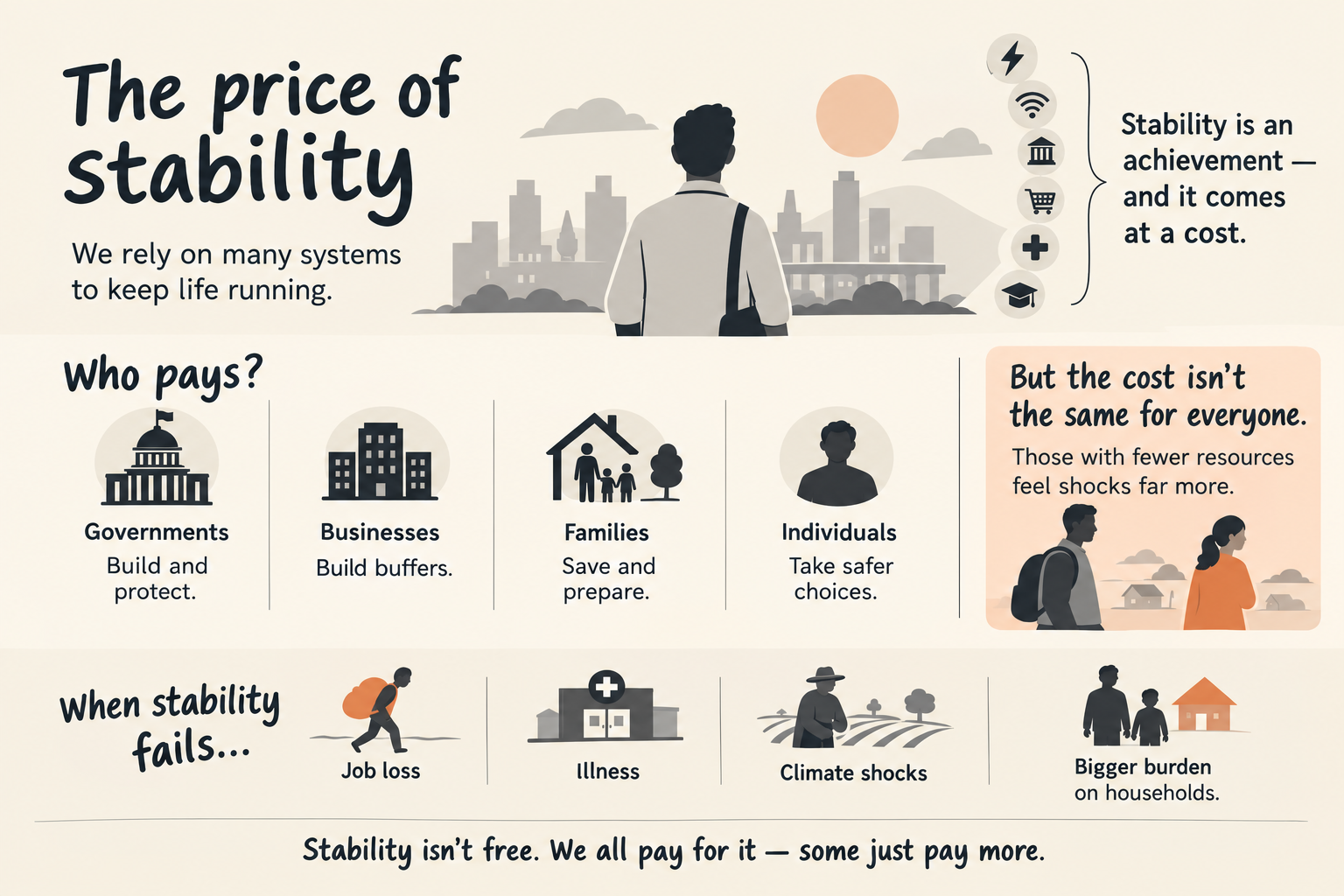
No matter how rich or poor you are, time is always in limited supply. A billionaire has the same twenty-four hours as a daily-wage worker. A student in Delhi and a farmer in Bihar both face limited days and uncertain futures. What differs is not scarcity itself but how it is managed and who bears its cost. Scarcity forces choices, which create trade-offs, and ultimately, trade-offs determine winners and losers.

If economics is about trade-offs, then the most important question is not about what we want, but what we are willing to give up, and who decides? This is where economics moves from being a personal lens to a political one. In democracies, these decisions are meant to be collective, negotiated through debate, budgets, and votes.  When a government invests heavily in urban infrastructure but underfunds primary healthcare, it is not simply prioritising growth over welfare, but is choosing whose time matters. The commuter stuck in traffic benefits from a flyover, while the woman who walks kilometres to a hospital pays the price. These outcomes are often defended as efficiency, but efficiency for whom is rarely asked. Economics reminds us that aggregate gains can coexist with deep individual losses, and that averages hide pain as effectively as they reveal progress.

This way of thinking also changes how we view success. Growth figures, income levels, and productivity rates dominate economic conversations, but they measure outputs, not experiences. A country can grow richer while its people grow more anxious. A company can become more profitable while its workers burn out. A household can earn more while spending less time together. When we ignore these costs, we risk building systems that look successful on paper but feel unbearable in practice. 

There is also a moral dimension to trade-offs that markets alone cannot resolve. Markets are excellent at responding to purchasing power, but often silent about need. They reward those who can pay, not those who suffer most. That is why leaving everything to ‘the market’ is itself a choice, one that often shifts costs onto the weakest. When clean air, safe housing, or quality education are treated purely as commodities, inequality is not an accident, but it is an outcome. Economics helps us see that fairness is not automatic, but must be designed.

This is the uncomfortable truth economics insists on. Every policy, every system, every personal decision benefits one and burdens someone else. There is no free lunch, only cleverly hidden bills. When a city prioritises flyovers over footpaths, it chooses cars over pedestrians. When an education system rewards rote learning, it sacrifices curiosity. When a company celebrates long working hours, it quietly taxes family life. These are not moral failures but are economic decisions. However, pretending they are natural or inevitable prevents us from questioning them.

The most dangerous costs are the ones we don’t notice. When an app is free, we assume there is no price. When a government scheme promises something for nothing, we rarely ask who is paying. When a product is cheap, we celebrate efficiency, not exploitation. But every benefit has a cost. If you don’t see it, it’s probably being paid by someone else, or even by your future self. Cheap food often means underpaid farmers. Free social media means monetised attention. Low taxes can mean broken public services. Fast growth can mean polluted air and exhausted bodies. Economics trains us to ask an unfashionable question: compared to what? Without this lens, we mistake convenience for progress.

At an individual level, thinking economically can be liberating. It replaces guilt with clarity. If you understand that your exhaustion is not just a personal failure but the result of incentives that reward overwork, you can begin to question those incentives. If you recognise that your inability to save is linked to rising living costs rather than laziness, you can demand better policies instead of harsher self-judgment. Awareness does not eliminate constraints, but it changes how we respond to them.

One of the quiet cruelties of modern life is how easily individuals are blamed for structural problems. If you are unemployed, you are told to upskill. If you are stressed, you are told to meditate. If you are poor, you are told to work harder. But you are rarely told to examine the system that made these outcomes likely in the first place. Economics reveals patterns where we see only personal failure. It shows how incentives shape behaviour, how power hides behind ‘market outcomes,’ and how rules written long ago continue to decide who gets ahead today. This does not absolve individuals of responsibility, but it does bring honesty to the conversation. You cannot fix what you refuse to name.

Economics is not about predicting stock prices or defending ideologies, but is more about clarity. About seeing how choices are shaped, how costs are distributed, and how power operates quietly through everyday decisions. You do not need equations to think economically. Instead, you need curiosity and courage to ask uncomfortable questions. And you need the humility to accept that every solution creates new problems. Once you start seeing life this way, it becomes difficult to unsee. You begin to notice the price tags on things that never claimed to be for sale, like time, trust, dignity, and attention. That awareness does not make life easier, but it makes it more honest. And honesty, in the long run, is the most valuable currency we have. When we see costs clearly, we can finally argue about whether they are worth paying, and whether the bill is being shared fairly. India is a masterclass in everyday economics. Families choose stability over passion, young people choose migration over belonging, villages trade environment for employment, and women trade ambition for safety. These are not random decisions but often are rational responses to constraints. When options are limited, even painful choices begin to make sense. Understanding this limitation is empowerment.

Empowered, yet edited

At a recent social impact conference that I attended, a woman from a village in Gujarat took the stage to share her success story. She spoke in Gujarati, her native language, addressing an audience that mostly did not understand her language. To bridge this gap, an educated, articulate, and well-positioned man was tasked with translating her words into Hindi. What followed was not a simple act of linguistic mediation but a revealing demonstration of how women’s agency is often compromised, even in spaces that claim to celebrate their empowerment. The translator did not translate her speech faithfully, and instead, he offered a compressed interpretation, presenting what he believed to be the ‘gist.’ Sensing that her meaning was being altered, the woman interjected repeatedly, attempting to reclaim her narrative. This was not a one-off, and I have witnessed this often at several conferences and during multi-stakeholder field visits to villages.

This moment captures a broader and deep-rooted pattern. Translation is rarely a neutral act, and it is more like an exercise of power. The person who translates decides what matters, what can be omitted, and what should be softened or sharpened. When men translate for rural women who are less formally educated, speaking to urban or elite audiences, they often filter lived experience through institutional and patriarchal lenses. Emotion becomes excess, complexity becomes confusion, and struggle is smoothed into success. In the process, women’s narratives are made more palatable but less truthful. What the audience receives is not the woman’s voice, but a curated version shaped by male interpretation.

The woman’s interjections were particularly instructive. Her repeated attempts to stop the translator were efforts to assert control over her own story. A man interrupting to ‘clarify’ is viewed as confident and authoritative, while a woman interrupting to reclaim her meaning is seen as difficult or ungrateful. This double standard reflects a long-standing patriarchal belief that women are unreliable narrators of their own lives and that male mediation is both necessary and superior. The conference scene I described is simply a contemporary indicator of this enduring injustice.

There is also a fundamental difference between how women often choose to speak and how men often interpret. Women from marginalised contexts tend to narrate their lives through stories that are relational, nonlinear, and emotionally textured. They speak of collective effort, ongoing uncertainty, unpaid labour, and the fragility that coexists with success. Male interpreters, shaped by institutional norms, often prioritise outcomes, efficiency, and coherence. In translation, vulnerability is trimmed away, contradictions are resolved, and struggle is reframed as triumph. This is not a harmless simplification; rather, it is an injustice that strips women’s knowledge of its depth and political significance.

The quest for gender equity requires more than symbolic representation. It demands that women retain control over their narratives, including how they are translated and transmitted. This means valuing verbatim translation over interpretation, and creating spaces where speech is not rushed or sanitised. It also requires a cultural shift in how interruptions are understood. When a woman interrupts a translator, it should be recognised as an assertion of dignity and agency, not as a breach of decorum. Gender justice is not achieved by merely giving women a mic, but will only be achieved when their words are allowed to travel without being reshaped by male authority. Until then, even the most empowered women will remain vulnerable to having their voices lost—not in silence, but in translation.