Why can’t you have it all

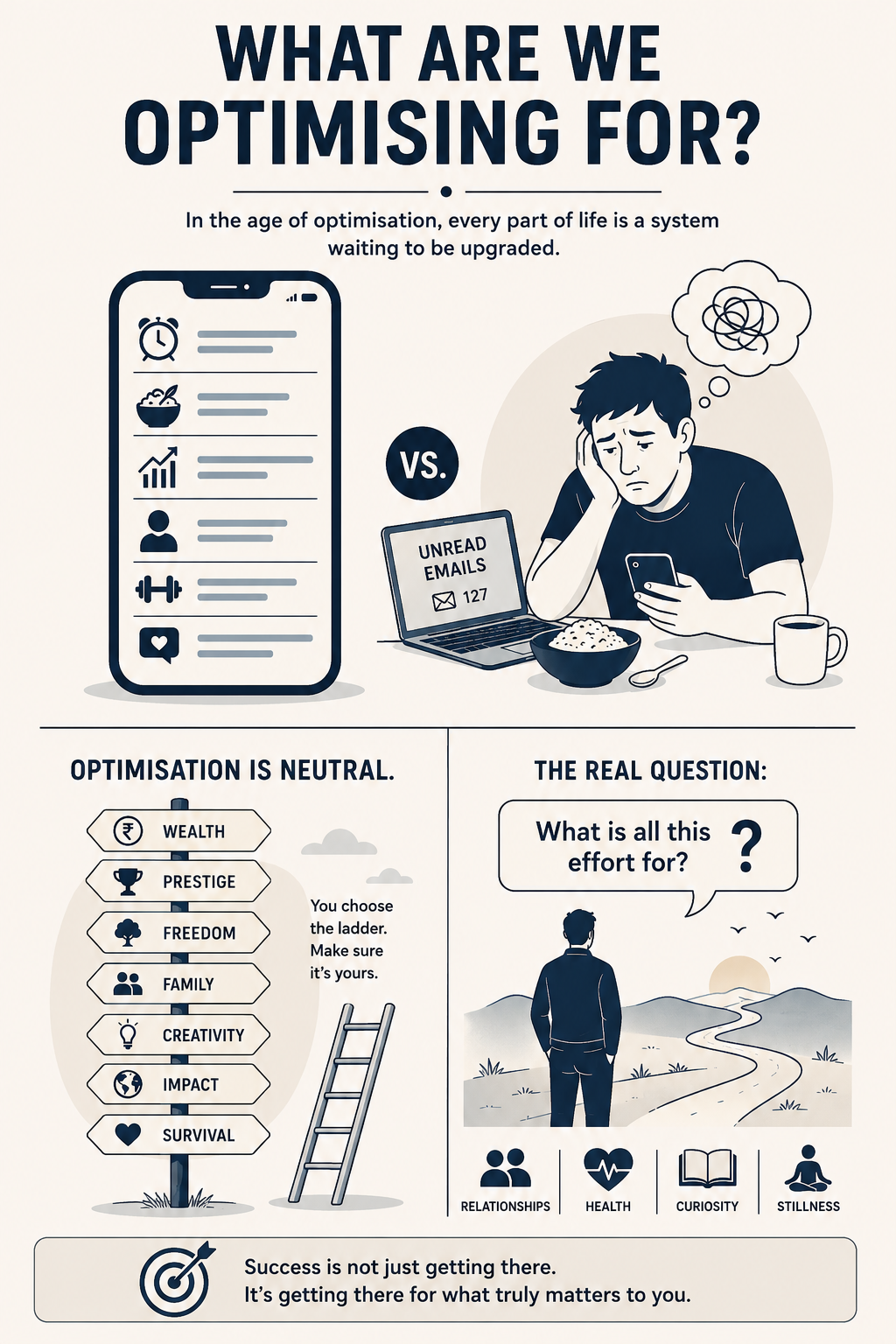
We grew up on a promise that if we worked hard enough, planned carefully, and optimised intelligently, we could have it all. Modern culture reinforces this belief on a daily basis that we can have a successful career, a loving family, financial security, good health, lasting friendships, purpose, and inner peace. Social media displays curated snapshots of people who appear to be excelling simultaneously in every domain of life. We have been hearing since our childhoods that balance is achievable with the right morning routine of ‘early to bed, early to rise, makes a person healthy, wealthy and wise’. Yet beneath this narrative lies a simple truth that you can’t have it all, at least not all at once, not at full intensity, and certainly not without significant trade-offs. The reason is not a lack of ambition or discipline, but scarcity, which is the most fundamental principle governing both economics and human life.

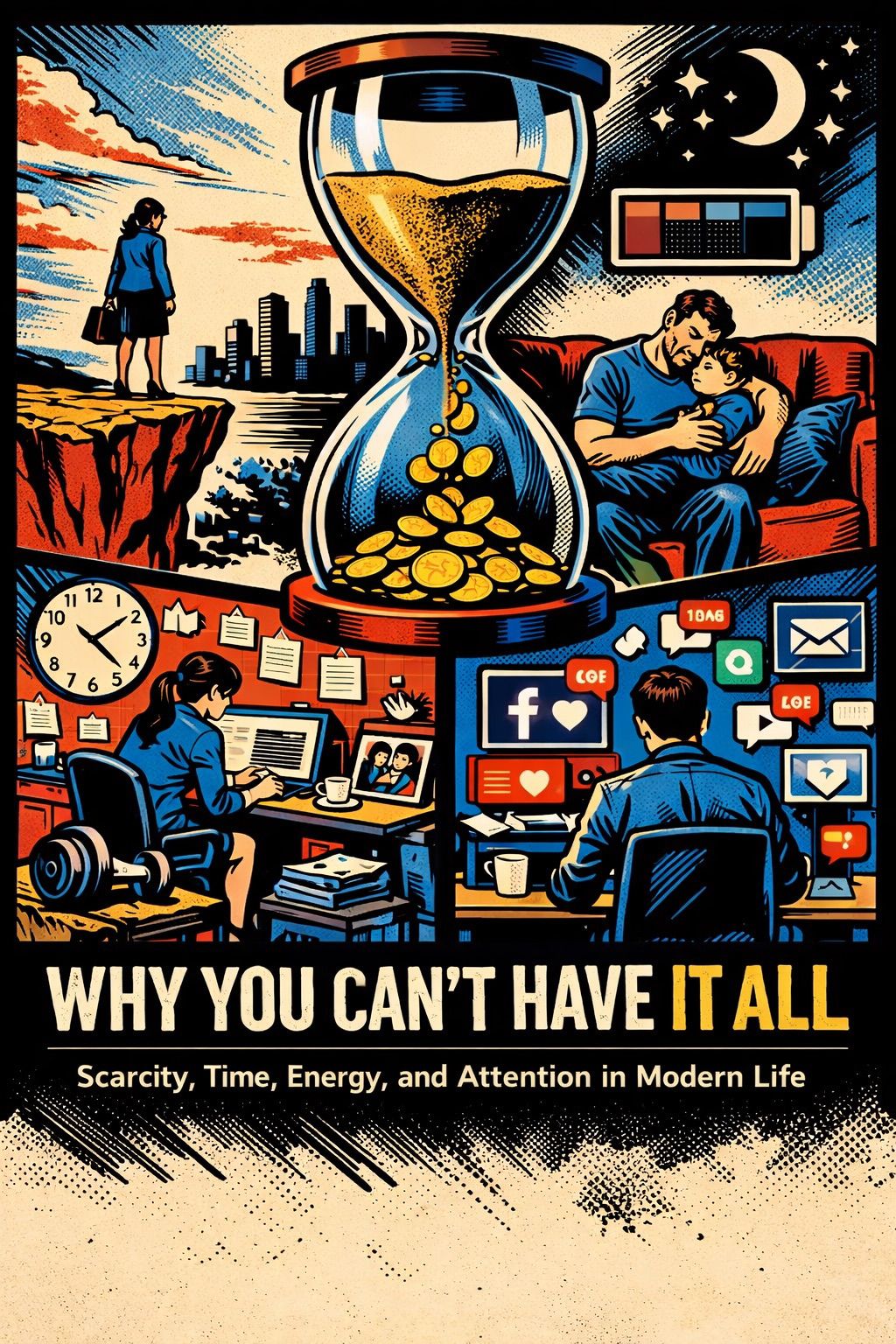
Scarcity is often associated with money, but today, the scarcest resources are time, energy, and attention. Every human being, regardless of wealth or status, receives the same twenty-four hours each day, making time the most democratic of all constraints. No one can accumulate unused hours or borrow from the future without cost. We speak casually about ‘managing time,’ yet time itself cannot be managed as it flows at a constant pace. Every hour invested in one activity is an hour unavailable for another, managing only the choices between time availability. The professional who chooses to work late trades time that could have been spent with family. The parent who prioritises caring for children may delay career advancement. The entrepreneur who pours weekends into building a venture sacrifices leisure and rest. These trade-offs are often invisible in the moment, but they accumulate quietly over the years. Life does not unfold in parallel tracks where everything progresses simultaneously. It unfolds sequentially, through seasons that demand different commitments.

If time is the vehicle of life, energy is its fuel. Two individuals may possess identical schedules yet operate at dramatically different capacities. Energy fluctuates with sleep, nutrition, stress, age, emotional well-being, and sense of purpose. Modern ambition frequently assumes that energy can be summoned indefinitely through willpower, caffeine/nicotine, or motivation. But biology imposes limits, cognitive fatigue reduces clarity and creativity, and emotional exhaustion diminishes patience and empathy, while physical depletion erodes resilience. Burnout is not a failure of time management but is the inevitable consequence of sustained energy misallocation. Many high achievers discover that even when their calendars appear optimised, their internal reserves are depleted. They attempt to excel in multiple demanding roles of being a professional, parent, partner, and friend simultaneously without acknowledging that each role draws from the same finite energy pool. Over time, the system protests, sleep suffers, health declines, and relationships strain. The pursuit of ‘having it all’ quietly converts into chronic exhaustion.

Perhaps more than time or energy, attention defines scarcity. In the digital age, attention has become a commodity aggressively competed for by corporations and platforms. Notifications, news feeds, emails, and endless streams of content fragment focus into micro-intervals, with us being connected to everything and fully present in almost nothing. Attention determines lived experience; whatever captures our focus becomes our reality. When attention is scattered across dozens of stimuli each hour, depth disappears, and conversations become half-engaged exchanges. Work becomes interrupted bursts of activity, and leisure becomes simultaneous scrolling. Creativity, which requires uninterrupted thought, struggles to emerge in fragmented environments. Intimacy, which depends on sustained presence, weakens under constant distraction. The desire to ‘have it all’ often leads to diluted attention spread thinly across many domains, leaving none fully nourished.

Technology reinforces the thinking that multitasking is efficient, but cognitive science consistently demonstrates the cost of task switching. Each shift of focus consumes mental energy and reduces performance quality. We may believe we are building a career, nurturing relationships, maintaining fitness, staying informed, and cultivating a side project all at once. We may be engaging partially in each, achieving adequacy but rarely excellence. To choose one path intensely is to decline others, at least temporarily, as excellence is exclusive by nature and rewards those willing to concentrate rather than diversify endlessly.

The pressure to ‘have it all’ is further amplified by comparison, especially as digital platforms present curated narratives where achievements are showcased without context. We compare our daily struggles to others’ peak moments and conclude that we are falling behind. Yet every visible success rests upon invisible trade-offs. The CxO with rapid career progression may have sacrificed personal time. The entrepreneur enjoying autonomy may endure financial uncertainty. The individual projecting calm online may be filled with anxiety privately. Role overload has become a defining feature of modern adulthood. We inflate our identities, attempting to be accomplished professionals, devoted family members, socially conscious citizens, physically fit individuals, and culturally relevant participants all at once. Without conscious prioritisation, this multiplicity breeds internal conflict.

Trade-offs are not signs of failure but are expressions of values. Every yes carries an implicit no. When we resist acknowledging trade-offs, we drift into reactive living, responding to emails, obligations, and external demands rather than intentional priorities. Economics teaches that scarce resources must be allocated toward what yields the highest perceived value. The same principle applies to life, and time, energy, and attention must be directed consciously. Without deliberate allocation, they will be consumed by urgency rather than importance. The question shifts from ‘Can I have it all?’ to ‘What is worth the cost?’ Clarity transforms scarcity from limitation into guidance.

Fragmentation carries hidden consequences as shallow engagement reduces satisfaction. When attention is dispersed continuously, creativity declines and emotional presence weakens. We may touch many aspects of life but rarely hold any deeply. The paradox of modern abundance is experiential thinness. Surrounded by options, we struggle to experience fullness. Having everything available does not equate to inhabiting it meaningfully.

Perhaps the problem lies in our definition of ‘having it all.’ If it means maximising every measurable domain simultaneously, which is unattainable. But if it means living in alignment with consciously chosen priorities, it becomes possible. Fulfilment may not require expansion in all directions, but it does require coherence. When time, energy, and attention align with core values, life feels integrated even if certain ambitions are deferred. We may not achieve extreme wealth, recognition, and perfect physical condition simultaneously, yet we may experience deep contentment through purposeful work, loving relationships, and sustainable health practices.

Designing a life within scarcity requires discipline and ruthless prioritisation to clarify which domains deserve peak focus. Protecting energy through sleep, movement, and boundaries preserves capacity. Practising attention hygiene, limiting digital intrusion and creating focused blocks enhances depth. Strategic neglect acknowledges that some areas will temporarily receive minimal investment without inducing guilt. Redefining success as alignment rather than accumulation reduces external pressure. These practices do not eliminate scarcity, but teaches us to navigate it wisely.

There is liberation in accepting limits, where comparison loses some of its sting when we acknowledge that no human can optimise every dimension simultaneously. Even the most accomplished individuals operate within constraints. Everyone trades something. The artist may trade financial stability for creative freedom. The corporate leader may trade time for influence. The activist may trade comfort for impact. The parent may trade professional acceleration for presence. No path is without a cost, and recognising this universal truth fosters humility and self-compassion.

Ultimately, the longing to ‘have it all’ often masks deeper desires for security, significance, love, belonging, or meaning. When these needs are identified clearly, excess pursuits lose their urgency. One may discover that respect matters more than status, intimacy more than visibility, and contribution more than accumulation. You cannot maximise career, family, health, wealth, friendships, and personal growth simultaneously at peak intensity. Human existence is bounded by time, powered by finite energy, and shaped by limited attention. Yet within those boundaries lies possibility. You may not have everything, but you can choose what receives your best. In a culture obsessed with expansion, the rare act is deliberately selecting what truly matters and committing to it fully. You cannot have it all, but you can have enough, deeply experienced and consciously chosen. And in the arithmetic of a scarce world, that may be the closest approximation of abundance available to us.

Why Philanthropy Needs to Evolve

Philanthropy has been a force for good across continents, building hospitals, funding schools and universities, feeding communities in crises, taking action to solve social challenges, and underwriting research. While intending to create positive and lasting change in people’s lives and strengthening communities, often, take the form of that giving is the classic ‘donor → beneficiary’ pipeline, which has serious limits. When well-meaning philanthropic entities simply transfer money or material goods to presumed beneficiaries without sharing power, listening deeply, or tracking outcomes with humility, aid can be inefficient, short-lived, and even harmful. To move from transactional charity to transformative social change, philanthropy must evolve toward participatory, locally led, and evidence-based models that empower communities to define problems, choose solutions, and steward resources. Several philanthropic models need to evolve into a new, pluralistic philanthropy that can deliver better, fairer, and more sustainable impact.

The donor-beneficiary model often centres on donors’ priorities. Funders set agendas, design programs, select implementing partners, and measure success by indicators they choose, often from a distance. This creates several structural problems, like,

  • Power asymmetry occurs when donors decide what counts as a problem and which solutions are legitimate. Communities become recipients rather than partners, and local knowledge is sidelined, reducing relevance and local ownership.
  • Templates developed for ease of scale often ignore social-cultural and political nuances at the local level. Programs that look good in donor reports may fail on the ground due to ‘One-size-fits-all interventions.’
  • Short funding horizons and volatility of donors with grants tied to campaign cycles, leftover funds, or financial year budgets can stop abruptly, leaving services unsustainable and organisations stranded.
  • When philanthropy substitutes for systemic public investment, it can relieve governments of responsibility or create dependency among groups who lack the voice to advocate for longer-term change.
  • Donors are accountable to boards or taxpayers, with limited accountability to the communities they aim to serve; evaluation is often internal and narrowly framed.

These limitations are not theoretical as reviews of philanthropic practice repeatedly find that participation is often performative, i.e., consultation exercises without power transfer. Scholarly and practitioner literature has called out the gap between rhetoric and sustainable commitment to community-led approaches. This is the moment for a pivot to an evolved philanthropic approach that can complement the traditional giving through,

  1. Participatory and community-led decision-making: Communities should help set priorities and co-design programs. Participatory grant-making moves power to those closest to problems, bringing lived experience into funding decisions and increasing the legitimacy and likely effectiveness of interventions.
  • Local leadership and capacity building: Funding should invest in local institutions (community groups, cooperatives, NGOs, social enterprises), and not only project outputs. That means unrestricted core support, leadership development, and multi-year commitments that enable organisations to mature and adapt.
  • Data-driven learning and accountability: Rigorous use of data and learning systems can help tailor solutions, track impact, and course correct. Data must be used ethically, with local ownership and attention to privacy and power dynamics.

When combined, this approach will shift philanthropy from a mere supplier of goods to an enabler of agency. Some good practices from around the world show how participatory and locally led philanthropy can function in practice, and who can act as torchbearers for philanthropic communities in their regions.

Indian philanthropic institutions combine traditional grant-making with newer models. Tata Trusts has invested heavily in the Data-Driven Governance (DELTA: Data, Evaluation, Learning, Technology, and Analysis) framework for strengthening local governance and planning. Their approach works with government entities and communities to build data systems that inform local decision-making rather than impose external solutions. This demonstrates how philanthropy can facilitate evidence-based public systems while engaging local institutions rather than bypassing them.  

Azim Premji University and Foundation have made community engagement in educational work prominent, emphasising long-term partnerships with local schools and communities rather than one-off interventions. Their community engagement model underscores the importance of listening, iterative learning, and strengthening public institutions rather than substituting for them.  

In Southeast Asia, funder collaboratives demonstrate a shift from isolated donors to pooled funds that support locally relevant priorities. The Asia Community Foundation’s 30×30 Southeast Asia Ocean Fund, launched in January 2025, is a recent example. The fund pools resources to protect coastal and marine ecosystems with an emphasis on inclusion and equity, supporting local stewards and communities rather than exporting conservation blueprints. Collaborative funds like this allow donors to align with regional expertise, reduce duplication, and focus on communities affected by interventions.  

The USA has been an incubator for participatory grant-making experiments. Major foundations and movements, spurred by crises such as the COVID-19 pandemic and racial-justice mobilisations, have explored models that transfer decision-making authority to communities. For instance, mainstream philanthropic institutions like Ford Foundation have published reflections on why participatory grant-making mattered during crises and how it can be institutionalised, noting its capacity to surface local priorities and accelerate equitable responses. While the U.S. landscape is mixed (with many foundations still operating traditionally), the growing body of practice shows that community-led funding can be both rapid and rights-respecting when donors cede control.  

The literature and practice of participatory and community-led philanthropy are growing across Africa, rooted in traditional values of solidarity, mutuality, and shared support. Researchers and practitioners have documented participatory grant-making and community governance innovations, arguing that ceding decision rights to local actors helps align funding with local priorities and sustains outcomes. While capacity and infrastructure challenges exist, the momentum toward locally governed funding systems is notable in contexts where external donors historically dominated the agenda. Recent examples of participatory grant-making (such as Harambee in Kenya, Ujamaa in Tanzania, and Ubuntu across the continent) synthesise these trends and highlight both promise and challenges.  

Participation, local leadership, and data are crucial for effective philanthropy because they shift power dynamics, increase relevance and impact, and improve decision-making based on evidence rather than assumption. This approach moves away from traditional, top-down models toward more equitable, efficient, and sustainable processes. Participatory philanthropy and grant-making processes will lead to,

  • Greater relevance when communities help design interventions, uptake and adaptation increase. Local actors understand cultural norms, political constraints, and practical hurdles that external project designers often miss.
  • Sustainability of programs that are owned by communities beyond the grant cycle. Unrestricted support and capacity building enable organisations to respond flexibly to emerging needs.
  • Data systems that include local stakeholders enable rapid feedback loops, like what’s not working can be quickly spotted and fixed, and successes can be scaled responsibly, improving impact through iterative learning.
  • Participatory philanthropy is not neutral, as it intentionally rebalances power by giving those affected by problems a say in solutions.
  • Cost-effectiveness through local knowledge increases returns on investment.

To evolve to the new and effective models of philanthropy, funders should take practical steps such as shifting money and power by moving a significant percentage of grant money into participatory processes and community-governed pools. They should offer multi-year, unrestricted funding and simplify application and reporting requirements. Investing in intermediary infrastructure is crucial, so supporting local philanthropy platforms, community foundations, and capacity builders, incubators, and accelerators who can channel funds and help communities administer grants is essential. Building data partnerships with communities by funding local data systems, such as community scorecards, participatory monitoring, and open data platforms that are owned and governed by communities, while ensuring ethical data practices, is also important. Co-designing evaluation frameworks with community actors to develop success metrics that prioritise outcomes valued by the community, such as economic stability, dignity, and local governance, rather than just donor KPIs, is very much required. Additionally, funders should reward adaptive learning by creating grant mechanisms that allow for iteration of ‘pilot-learn-adapt-scale’ rather than penalising change as ‘failure.’ Lastly, funders should role model humility and plan for their responsible exit by strengthening local institutions so they can sustain without perpetual external support.

However, it’s important to understand that not every ‘participatory’ label signals a real transfer of power. Donors must avoid superficial practices, like convening consultations for optics, creating advisory committees without decision rights, or funding only projects that align with preselected agendas. Genuine participation requires structural changes like in the boards, budgets, and governance processes, that reflect shared authority.

Philanthropy has great potential to speed up solutions to poverty, climate change, governance problems, and social inequality. To shift from charity to meaningful change, funders need to be willing to relax control, invest in local leaders, and support strong, community-led data and learning systems. Examples from India, Southeast Asia, the U.S., and Africa demonstrate various approaches such as data partnerships that improve governance, pooled funds that empower local stewards, and participatory grant making that changes who makes decisions. Effective, equitable, and sustainable change emerges when those affected by problems help define and lead the response. Philanthropy’s evolution from a one-way pipeline of resources to a platform for shared power is not just desirable, it’s necessary if we want charitable funding to do more than temporarily relieve suffering. They must catalyse systems that let communities thrive on their own terms.