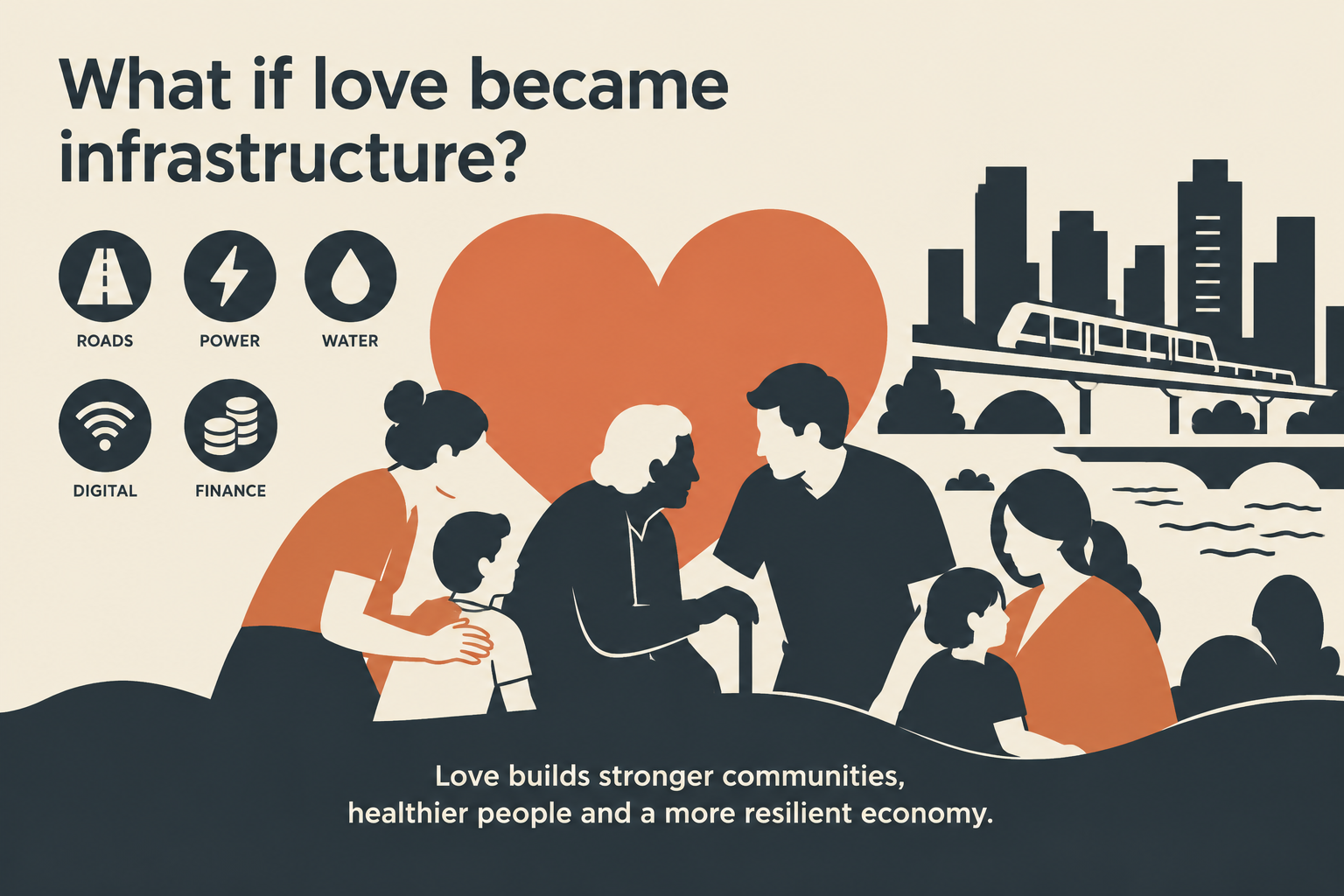
I got the title (more like borrowed) from a WhatsApp group where a member shared the theme of the ‘At One Impact Week 2026’ conference in Singapore. This one powerful phrase, ‘what if love became infrastructure,’ made me think deeply from romantic and philosophical perspectives initially, and finally from an economist’s viewpoint, and I ended up doing a visioning exercise (sort of) for the future. Ideating and eventually writing this essay took me back down memory lane when I was a student of Social Planning.
We think of infrastructure as something tangible, visible and measurable, like roads, bridges, electricity, water systems, digital networks and financial systems. We know how to calculate their construction costs, estimate their economic returns, and argue over who should pay for them. We even understand that infrastructure can determine the destiny of societies and can alter the trajectory of an entire generation. But there is another infrastructure without which none of these systems ultimately works, and yet it rarely appears in our economic imagination. It is invisible, difficult to measure and almost impossible to commodify. It is love, not romantic love, though that matters too, but the broader human capacity to care, to notice, to remain, to take responsibility for another person’s wellbeing. We have traditionally treated love as a private emotion and have failed to recognise it as a public resource.
Every society runs on enormous quantities of unpaid love, like a parent getting up in the middle of the night for a sick child, or a daughter accompanying an ageing parent to hospital. However, none of these acts is generally counted as economic output. They do not appear in national accounts and are not part of productivity statistics. However, if we remove it altogether, hospitals will become more crowded because there will be nobody to care for people after discharge. Children will require more formal intervention because fewer adults will be available to support them. Elder-care systems will become unaffordable. Workplaces will become less resilient because employees have no one to rely upon outside them. We have created elaborate systems to compensate for the absence of care while rarely acknowledging the care that prevents those systems from collapsing in the first place.
The more efficiently we organise modern economic life, the more we seem to separate it from the relationships that make life worth living. We have become remarkably good at producing things and increasingly uncertain about how to sustain one another. We can deliver almost anything to a doorstep within minutes, but we cannot guarantee that someone will sit beside an elderly person who is lonely. We can communicate instantly with someone on the other side of the planet, but millions of people live without a person they can call when they are frightened. We can build increasingly intelligent machines, but many people struggle to find another human being willing to listen without looking at a screen. The technological revolution has reduced distance while, in some unexpected ways, increased emotional distance. Perhaps this is not a contradiction, and perhaps we simply solved the wrong problem. We became extraordinarily good at connecting devices, markets and information, while leaving the architecture of human connection largely to chance.
If love were infrastructure, loneliness would become an infrastructure deficit. That may sound absurd today, as we are used to thinking of loneliness as a psychological condition, a personal problem or sometimes a consequence of individual choices. But imagine applying the logic we already use elsewhere. If a community has no reliable public transport, we do not tell every resident to become better at walking, instead, we investigate the transport system. If people have no access to clean water, we do not blame them for being thirsty. If an entire generation has inadequate access to education, we do not simply advise young people to become more self-motivated. We build schools and institutions. Why, then, when millions of people experience profound social isolation, do we so quickly individualise the problem? Perhaps some loneliness is personal and inevitable. But some of it is produced by the environments we have built, like cities designed around cars rather than encounters, housing designed around privacy rather than community, workplaces designed around productivity rather than belonging, digital platforms designed around engagement rather than connection, and economic systems that leave people with less time for the relationships they depend upon.
The future city may therefore have to answer a question that today’s urban planning rarely asks if the city make it easy or difficult to belong? A well-designed neighbourhood might not simply be one where people can reach work quickly. It might be one where an elderly person can walk to a park, a child can meet other children, a young professional can enter a community without already knowing someone, and a person living alone has places to go where consumption is not the price of admission. Public libraries, community kitchens, parks, sports facilities, cultural centres, pedestrian streets and shared spaces are not mere amenities but relational infrastructure. Their purpose would be partly to create the conditions under which relationships can emerge naturally. Nobody can be ordered to make a friend. Governments cannot manufacture affection, but governments can certainly create environments in which human beings are more likely to meet one another, spend time together and develop trust.
This would require us to rethink the economics of care. Our economic systems are designed to value what enters markets. Care becomes visible when it is professionalised and paid, like a nurse, childcare worker, therapist, home-care worker, etc. But when the same work is performed by a spouse, parent, sibling, friend or neighbour, its economic value often disappears. What we fail to measure, we tend to underinvest in. And what we underinvest in eventually becomes a crisis. The care economy is therefore not an alternative to the productive economy; rather, it is one of its foundations. Every employee who arrives at work has already been sustained by some network of care. Every entrepreneur has had someone who tolerated their uncertainty. Every successful professional has, somewhere along the way, benefited from someone else’s patience, encouragement, childcare, emotional support or practical help. Economic independence is rarely as independent as we like to imagine.
Perhaps the next stage of capitalism will involve recognising this by redesigning institutions around the reality that people have caring responsibilities. Not by putting a price on love itself, because the moment love becomes a transaction, we risk destroying precisely what makes it valuable. Parental leave, elder care, flexible working, community services and mental-health support are not corporate generosity or welfare expenditure but investments in the infrastructure of human capability. The question would no longer be how much care we can extract from individuals before they burn out, but how we can design economies that reproduce care rather than consume it.
The 20th century built welfare states around the assumption that governments could provide a substantial share of social security. And now, the 21st century is discovering that governments cannot provide human presence, which is increasingly scarce. As populations around the world age and families become smaller, geographically dispersed and increasingly mobile, the question of who will provide everyday human care will become one of the defining social questions of the century.
We are approaching a world in which machines can converse, remember, personalise and simulate empathy with extraordinary sophistication. An AI companion may be available 24 hours a day, never become bored, never interrupt and never judge. For millions of lonely people, this may provide genuine comfort. There is nothing inherently tragic about that. However, if machines become exceptionally good at giving us the feeling of being understood, will we become less willing to tolerate the inconvenience of understanding another human being?
Human relationships are inefficient as they demand time, contain misunderstandings, and require compromise. Other people have needs that compete with ours, and they disappoint us, change, and sometimes even leave. But these inconveniences are not defects in the human system but are more part of what relationships teach us. A machine can perhaps simulate unconditional attention; another human being offers the possibility of mutual responsibility. The challenge for technology, therefore, should not be to replace human relationships but to protect the conditions under which they can flourish. The best AI may ultimately be the AI that saves time for us by reducing bureaucracy for doctors, helping families care for distant parents, assisting teachers, making public services easier to navigate and freeing people from repetitive work. Technology should ideally expand the space available for human presence rather than fill that space itself.
If this sounds utopian, consider how many things that once seemed private have already become legitimate subjects of public policy. We once treated literacy as an individual matter, and now we build education systems. We once treated disease as fate, and now we build healthcare systems. We once treated poverty as personal failure, and now we debate social protection. Our definition of what society owes its members has expanded repeatedly. Perhaps relational wellbeing will be the next frontier.
Imagine a future national wellbeing report that contains a metric nobody takes seriously today: the capacity to care. It might measure how much time people have for family, whether older people have regular social contact, whether young people have trusted adults, how many neighbourhoods possess accessible community spaces, whether workers can take time off for caregiving without economic punishment and whether people feel that they belong somewhere. Imagine a company reporting not only employee turnover but whether its organisational culture leaves people with enough time and psychological capacity to maintain lives outside work. Imagine investors recognising that communities with high levels of trust and social connection are more resilient in crises. These ideas may sound soft compared with infrastructure spending today. But history repeatedly demonstrates that societies often collapse because the relationships holding them together become brittle.
Love, in this broader sense, is demanding and requires boundaries, accountability and difficult choices. A society organised around love would not be one in which everyone agrees with everyone else or where harm is excused because the perpetrator is human. It would be one in which disagreement does not automatically turn the other person into an enemy, where vulnerability does not become a source of shame and where the dignity of a person is not entirely dependent on their economic usefulness. It would ask a different and radical political question: What do we owe one another?
Perhaps this is where the idea of love as infrastructure becomes most disruptive. Infrastructure is usually associated with physical capital, but civilisation also accumulates relational capital, like trust, friendship, community, reputation and reciprocity. The ability to call someone in a crisis is a form of wealth. Knowing that someone will notice when you disappear is a form of security. Having people who will help you when your circumstances change is resilience. These things are not equally distributed. Some people inherit enormous reservoirs of relational capital through families, communities and social networks, while others inherit almost none. We talk endlessly about inequality of income and increasingly about inequality of opportunity. Perhaps it’s time we should also talk about inequality of belonging.
The most interesting possibility is that love may eventually become a new way of thinking about development itself. It will be a recognition that human beings are profoundly relational creatures and that any civilisation that ignores this will eventually pay for it through other systems like healthcare, welfare, policing, education, mental-health services and lost productivity. What we fail to provide through relationships, we eventually attempt to provide through institutions, often at vastly greater cost.
And perhaps the deepest irony is that we already know how to build this infrastructure. We do not need a revolutionary technology. We need to rediscover ordinary human practices that modern life has made increasingly difficult, like sitting with someone, listening without checking the phone, knowing the names of neighbours, sharing food, visiting the elderly, creating public spaces where nobody needs to buy anything, giving people time to care, allowing friendships to develop slowly and treating presence as something valuable rather than unproductive. The infrastructure of love is built in minutes, conversations, gestures and acts of attention.
When we imagine the future, we tend to imagine what technology will allow us to do. Perhaps a more important question is what technology will allow us to stop doing, and what we will choose to do with the time we recover. If AI does our paperwork, who will we visit? If autonomous vehicles drive us, who will we meet on the journey? If machines educate our children, who will teach them how to care? If algorithms know our preferences better than our friends do, will we still make the effort to know one another?
The future will not be short of infrastructure. It may, however, be short of reasons to use it together. Perhaps the civilisation that comes after ours will judge progress differently. It may look back at our obsession with highways, buildings, bandwidth, productivity and growth and wonder why we spent so much effort making things faster while allowing relationships to become harder. It may find it strange that we measured national wealth but not the wealth of human connection, counted houses but not homes, calculated healthcare expenditure but ignored the unpaid care that kept millions alive, and celebrated technological connectivity while tolerating extraordinary levels of loneliness. And perhaps the great infrastructure revolution of the future will begin with a deceptively simple realisation that the purpose of infrastructure is not to connect roads, machines, markets or data, but to enable human beings to live meaningful lives together.
(The cover image is generated using AI)