Coffee and Concept Notes

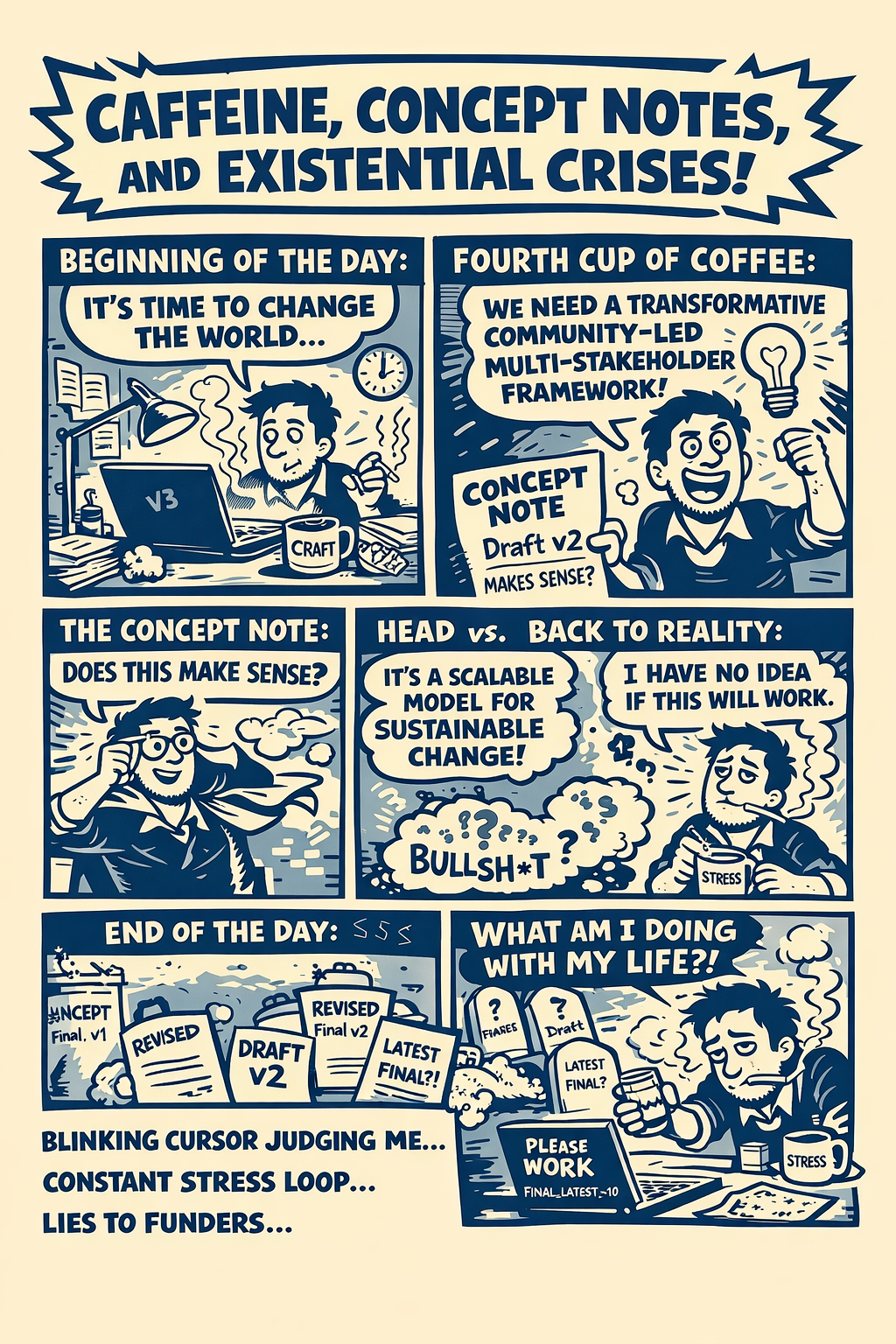
There is a very specific kind of person who measures time through cups of tea/coffee consumed, number of smokes, and versions of concept notes. I am that person. My day does not begin at 9 AM like everybody else. It begins when the first sip of tea and a puff of grey poetry hits my bloodstream and convinces my brain that solving structural poverty through a two-page document is a reasonable life goal. By the third sip/puff, I am ready to change the world. By the fourth, I am opening last year’s concept note and renaming it “Final_Updated_Latest_UseThisOne_v3.0.”

There is something deeply optimistic, almost delusional, about writing a concept note. It always starts innocently: ‘Let’s improve livelihoods in rural communities.’ Twenty minutes later, I find myself writing sentences like, ‘This integrated, community-led, multi-stakeholder convergence model seeks to catalyse sustainable socio-economic transformation…’ At this point, I pause and admire my own ability to say absolutely nothing in 21 words. Concept notes exist in a strange parallel universe where every problem is solvable, every intervention is scalable, every outcome is measurable, and every budget is ‘indicative.’ Of course, the reality is sitting quietly in the corner, waiting for implementation to begin so it can laugh.

Starting a concept note is a ritual that starts with my caffeine fix, opening a blank document, and staring at it as if it owes me money. The blinking cursor is not neutral as it blinks with judgment. ‘Go on,’ it seems to say, ‘design systemic change.’ So I begin with writing a suitable title, then change it, make it sound more ‘strategic,’ add the word ‘transformative,’ remove it because it feels too ambitious, and then add it back because the funder likes ambition. Thirty minutes later, the only thing I have finalised is the font.

At some point in my career as a fundraising professional, I have accepted that coffee/tea is a programmatic input and not just a beverage. Without caffeine/nictone fix, there is no Theory of Change, no LFA, no pathway to impact. With the ‘fix’, there are frameworks, diagrams, and a dangerous amount of confidence. This fix makes me believe things like, ‘Yes, we can align community aspirations with institutional frameworks through participatory convergence.’ Without the fix, I would simply say, ‘We will try our best and see what happens,’ but that is not a fundable language.

Every concept note reaches an uncomfortable moment, usually around page two. I have written the problem statement, objectives, and proposed intervention, and now I am staring at the section titled ‘Expected Outcomes.’ This is where things get philosophical. Will this actually work? Are we solving the problem, or just describing it better? Is this impact, or just well-structured optimism? I leave my desk, go for a quick fix, and look at the skies as if answers are stored there, but they are not.

If you have written enough concept notes, you develop ‘the donor voice’ in your head as your second personality. It appears uninvited and asks uncomfortable questions like, ‘Can you make this more scalable?’ ‘What is the innovation here?’ ’How will you measure impact?’ ‘Can you reduce overheads?’ The last one hurts the most. So I return to the document and start adjusting reality. I make things more efficient on paper, outcomes more certain, risks more ‘mitigated.’ At some point, I realise that I am not just writing a concept note, instead I am negotiating between truth and fundability.

Have you heard about a fine art in fundraising called strategic vagueness? You must say enough to sound intelligent, but not so much that you become accountable. Instead of writing, ‘We will train 1000 farmers,’ you write, ‘We will build the capacity of local stakeholders through targeted interventions.’ Who are these stakeholders? What interventions? That is a journey for another day.

One of my favourite moments is when a concept note meets the field. In the document, community participation is enthusiastic, systems respond efficiently, and timelines are respected. In reality, the meeting starts late, half the participants are confused, and the system is ‘on leave today.’ And yet, the report will still say, ‘The intervention was successfully initiated with active community engagement.’ Because technically, there was engagement, and someone did show up!

Concept notes also have a strange relationship with time, as they do not end, but they evolve. There is Draft, Final Draft, Final_Final, Final_Reviewed, Final_Reviewed_Updated, and the legendary ‘Final_Reviewed_Updated_Latest with version 1.0 to versions n.n. And just when you think you are done, someone sends an email saying, ‘Can we make a few small changes?’ This is how legends are born.

What concept notes really offer is the illusion of control. You design inputs, outputs, outcomes, and impact, and everything flows neatly in arrows and boxes. But development work is not a flowchart; it is more like a messy, unpredictable, human conversation. And yet, we keep drawing boxes, because boxes are fundable.

Every now and then, after multiple cups of coffee, endless sticks of ‘(un)holy smoke’ and several minor existential crises, something magical happens, which is clarity. I suddenly see the program for what it is, what matters, what is unnecessary, what is real. I delete half the document, simplify, and write something honest. For a brief moment, the concept note feels true, and then, almost instinctively, I complicate it again. My colleagues say that I write in Russian! (No offence to Russians here). Because honesty is risky, I add a framework, a diagram, and a few strategic words, and just like that, I am back in the safe zone.

Despite everything, including the caffeine and nicotine dependency, the document gymnastics, and the existential crises, we keep writing concept notes. Somewhere in between the jargon and the formatting, there is a real intention. A belief that things can improve, systems can shift, and people can live better. The concept note is simply the translation of that belief into a language that institutions understand. At the end of the day, I close my laptop. The concept note is sent, the cup is finished, and the existential questions remain unresolved. And still there’s satisfaction, not because the document is perfect, but because I tried to make sense of something complex. Tomorrow, there will be another concept note, another fix, and another moment of staring at a blinking cursor. And I will begin again because this is what we do. We drink coffee and smoke cigarettes, we write concept notes, and occasionally, we question the meaning of it all, preferably before the next deadline.

Poetry in a cup

My love for cappuccino goes back 25 years, when a friend of mine took me to a fancy cafe for coffee and cake. Until then, I had only enjoyed Nescafé from those old coffee machines and served in paper cups. One sip of this elixir, which was creamy, velvety, and audaciously flavourful, and I was ruined forever. This coffee in a ceramic mug not only brought a new flavour but won my taste buds and heart for all eternity. It was proof enough that nirvana sometimes comes with foam.

Since then, Capp, as I affectionately call it, and I have been the best of buddies. I have made new friends, dated, had breakups, found my startup partners, discovered new employers, hired employees, pitched to clients, met strangers, mentors, mentees, colleagues, inventors, professors, and who’s who over mugs of cappuccino. Capp has been my best mate during my ‘me’ time. Capp has helped (and continues to do so) me think, innovate, write articles and poetry, introspect, and just be me.

Capp has played roles that most people reserve for therapists, advisors, or wise friends. It has seen me through emotional crisis, creativity bursts, writer’s blocks, existential questions, and Mondays. It has provided intellectual companionship, whether I am solving crosswords or writing a new blog post. Every time I’ve needed clarity, I have found it swirling somewhere between the foam and the last sip. Forget meditation, real introspection happens when your hands are wrapped around a warm cappuccino mug, and you’re staring into the nothingness like a philosopher lost in thought.

I think Cappuccino is one of the greatest social equalisers ever invented! At almost all the cafés, you’ll find students, entrepreneurs, artists, engineers, poets, procrastinators, and people pretending to work, all looking thoughtful and slightly existential when holding a cappuccino mug. Over the years, I have met strangers who later became collaborators, collaborators who became friends, and friends who introduced me to even more cappuccinos. If networking had an official beverage, Capp would be printed on the business cards. At this point, if LinkedIn allowed a ‘coffee quotient,’ mine would be among the highest across generations.

But beyond work, people, and the illusion of productivity, Capp has been the guardian of my ‘me-time.’ While the world insists on shouting through notifications, deadlines, and existential adulthood, a mug of cappuccino quietly reminds me to breathe. Those quiet moments in cafés with just me, Capp, my lit B & H regulars, a notebook or iPad, or a newspaper are where most of my thinking actually happens. Poems, ideas, reflections, plans, memories, confessions, and stories have all been brewed with Capp as my thinking cap. If a cappuccino had consciousness, it would be quietly judging me for the number of drafts I’ve abandoned midway, and they now decorate the ‘Notes’ app in my iPhone/iPad.

There is a ritualistic romance to the warmth of the mug, the gentle collapse of foam, keeping the coffee art till the last few sips, and the world slowing just enough to let me feel human again. Somehow, every sip feels like a reminder that life doesn’t unfold only through big milestones, but often, it’s held together by tiny pauses over coffee.

After a quarter of a century, my love for cappuccino is still burning bright, even though I have tried its other cousins. But I always return to Capp because Capp is comfort, consistency, creativity, and companionship poured into a single mug. So, here’s to the witness to my chaos, the co-author of my ideas, the soundtrack to my solitude, and the warm friend who has been present in more chapters of my life than any human possibly could. If love could be brewed, steamed, and topped with foam art, it would taste exactly like this.

And after 25 years, I’m still not done sipping.

Stressed, blessed, and cappuccino-obsessed, that’s my motto, I confess!

How Social Media Reels are Redefining Relationships

Social media has evolved over the last decade and more so during and post COVID-19 from a casual means of communication to a complex social ecosystem where relationships are not only maintained but also publicly measured, performed, and often misunderstood. The act of tagging someone in a post or sending a reel now frequently carries more weight than the content itself and appears to be a new language of intimacy, loyalty, and belonging.

Human relationships were always forged and maintained through physical presence, shared experiences, and mutual conversation. While those elements still hold value, social media platforms like Instagram, WhatsApp, and Facebook have changed social interaction. Friendship seems to have become ‘performative’ and is now getting increasingly defined by our digital gestures, who we tag, send content to, and frequently react to on social media. The exchange of DMs, reels, memes, and story replies may seem petty, but they have become the new currency of connection. In this new digital age, being remembered in someone’s “share” list is a modern affirmation of your place in their emotional world where time is divided and attention is commodified. It’s no longer the maturity of the friendship built over years defining the strength of the connection, this new phenomenon has been affecting and afflicting across all age groups from teens to people in their 70s!

What used to be simple rules for friendship, like coffee, conversations, and sharing silly jokes over text, has now changed. Friendship is now measured in direct messages, tags, and who receives the meme first. It’s no longer just about being included; it’s about being the first and only one included. Because nothing says “you matter to me” like a cat video at 3 AM. Social media platforms promote visibility and engagement. As a result, users develop interaction patterns that reflect this trend. Relationships are increasingly maintained through small interactions: likes, reactions, emojis, replies, and short content exchanges. These replace deeper communication, creating the illusion of closeness without needing much time or vulnerability.

Algorithmic affection is growing. If you engage often with someone’s content, they will show up more in your feed, and vice versa. This strengthens some relationships while quietly undermining others. Sometimes, a drop in communication doesn’t stem from emotional distance but rather because an algorithm has quietly removed someone from your digital view. Social media has turned even the smallest actions into emotional signals that are often unintentional. Reels are like modern-day carrier pigeons of affection, flying through algorithmic skies and delivering 60 seconds of inside jokes, shared interests, or passive-aggressive messages.

A subtle but clear hierarchy has formed in social groups based on digital content. Who sees the funny video first? Who is tagged in the inside joke? Who gets included in close friends’ stories? These digital hierarchies provide new social cues about belonging, preference, and even exclusion. This change creates anxiety and social tension, particularly for those who often read omissions or changes in online behaviour as signs of personal problems. We’ve all experienced this. You’re casually scrolling through the group chat, dodging memes and unwanted life updates, when you notice that your friend has been sending reels, but not to you. Instead, they are sending them to someone else in your friend circle. Betrayal has never looked so clear.

With constant connectivity and “always on” friendships comes an unintended consequence: relational burnout. There was a time when friendships were tested by forgotten birthdays. Now, deep emotional hurt comes from not being tagged in a reel or story about something entirely unrelated. The pressure to respond quickly, stay updated, and keep up with every friend’s online persona can drain the joy of connection. Friendship, once based on depth, now often depends on speed and consistency, two measures that reflect platforms more than people. This urgency leads to miscommunication. A late reply, a missed tag, or a seen-but-not-responded reel can be seen as disinterest or rejection, even if the reason is trivial. As a result, friendships suffer not from real conflict but from imagined slights born from the overly sensitive nature of digital interaction.

Soon, new measures of connection and relationships will emerge, and platforms will introduce new tools to assess your FQ (Friendship Quotient). Measure these three indicators, and you’ll have your FQ. Like quarterly or annual performance reviews at school, these FQ levels will shape the future of friendship.

Quality of friendship = (number of reels received × frequency of tags) / number of mutual story reacts. 

Closeness coefficient = number of times you get the reel before it appears on your public feed/total reels posted. 

Emotional intimacy level = number of times and frequency they send you the reel with “this reminded me of you” instead of a lifeless emoji.

Despite the challenges, social media offers new ways to show care and share thoughts. A well-timed meme or relevant reel can bring laughter, validation, and a shared moment of joy across distances. In an increasingly busy and scattered world, these exchanges can be lifelines.

But, like all technologies, mindful use is essential. As we adjust to this new relational landscape, we should consider, 

– Are we truly connecting, or just maintaining a facade of connection?

– Are we sharing to include others, or to show how close we are? 

– Are we interpreting digital silence too severely, or using it too carelessly?

In the end, while the medium has changed, the need for empathy, intention, and presence remains the same. Whether through reels, texts, or face-to-face conversations, what we all want is simple: to be seen, to be valued, and to know we matter.

Story of a Startup – part 2

Next day, armed with our ‘Green-Pop’ idea & never say die approach and enthusiasm, we met S at a coffee shop (CCD). We discussed the idea at length over several cups of coffee. We discussed the target market, pyramid marketing structure to set up the sales chain, sourcing design and in turn starting a pop-art movement in India, identifying and managing vendors, value addition, financial requirements. We were happy that we are on verge of creating something innovative, and with that we decided to meet the following day with some background research on various modalities. Read the full post HERE