The cost of ‘free’ in India

The word ‘free’ carries a unique emotional and political charge in India. It signals relief, generosity, access, and sometimes even justice. In a country marked by deep inequality and historical deprivation, the idea of receiving something without having to pay for it feels not just attractive but morally right. Free school meals, free healthcare camps, free ration, free mobile data, free apps, free advice—these are not fringe phenomena but central features of everyday life. Yet as ‘free’ becomes more pervasive, it becomes more urgent to interrogate what it actually costs in reality. Because nothing in this world is truly free. Even when money is not exchanged, value is still transferred, quietly, unevenly, and often invisibly.

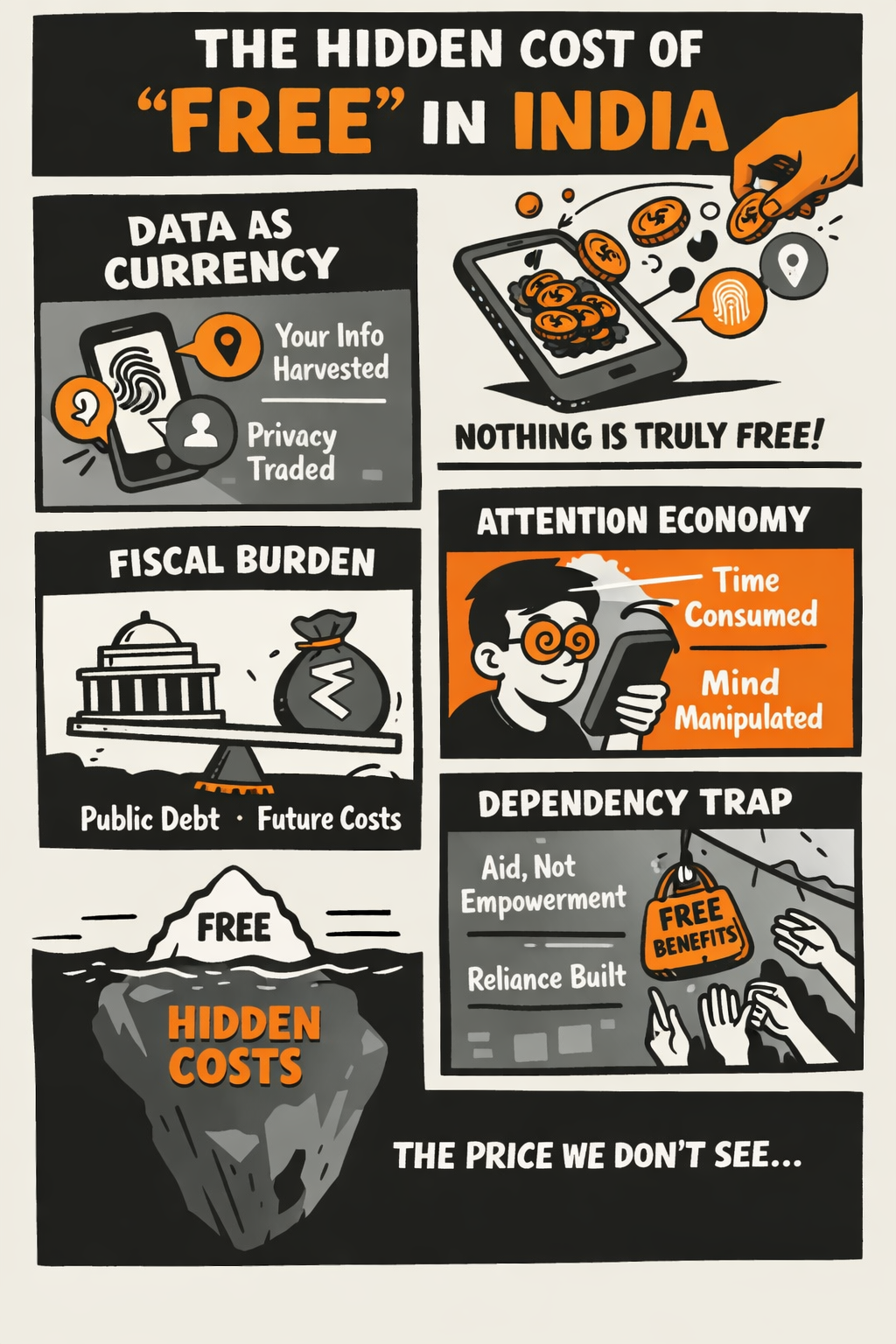
The digital revolution has made ‘free’ feel natural, even inevitable. India’s smartphone explosion, driven by affordable devices and some of the world’s cheapest mobile data, has brought hundreds of millions online in a short span of time. For first-time internet users, free apps are often the internet itself. Messaging platforms, video-sharing apps, digital wallets, navigation tools, shopping platforms, and learning apps promise unlimited access at zero cost. Downloading them requires no financial transaction, only a tap on a screen. This apparent absence of cost masks a different economy altogether, one where data, attention, and behaviour are the currencies being traded.

Every free app extracts value as it collects personal information, tracks usage patterns, studies preferences, and monitors behaviour across platforms. In return for convenience and access, we surrender fragments of our digital selves, often without fully understanding the implications. In India, where digital literacy has not kept pace with digital adoption, this exchange is especially asymmetrical. We routinely accept terms and conditions that we cannot realistically read or comprehend, granting permissions that would be alarming if framed in simpler language. Location data, contact lists, browsing habits, voice samples, and even biometric identifiers become assets in a vast data economy. We do not pay in rupees, but we pay in terms of our privacy, autonomy, and long-term exposure.

This is not a small concern, as data is power, and not merely information. When aggregated at scale, it allows companies to predict behaviour, shape consumption, influence opinion, and nudge decision-making. In India, where hundreds of millions engage daily with free digital platforms, this concentration of behavioural data in private hands has far-reaching consequences. It affects what we see, what we buy, how we think, and even how we vote. The cost of free apps is not just about individual privacy but collective vulnerability to influence and manipulation. What appears to be a harmless trade in terms of free services for data becomes a structural imbalance when we lack meaningful choice or awareness.

Free apps are designed to maximise engagement because engagement drives advertising revenue. Endless scrolling, autoplay videos, push notifications, algorithmic recommendations, and gamified feedback loops are not accidental features; instead, they are engineered mechanisms to capture and hold attention. Time spent on these platforms is monetised elsewhere, converted into impressions, clicks, and behavioural insights. For us, this translates into hours lost daily to digital consumption. The opportunity cost is immense in terms of time not spent on learning, work, rest, relationships, or reflection. In a country where time poverty is already acute for large sections of the population, the extraction of attention is a high but rarely acknowledged cost of ‘free.’

Alongside free apps, free government schemes occupy a central place in India’s public imagination. Welfare programs offering free food, free electricity, free healthcare, free education, and direct cash transfers are often framed as moral imperatives in a society with widespread poverty. And indeed, many such schemes have had transformative impacts. Free school meals have improved nutrition and attendance. Subsidised healthcare has saved lives. Social security schemes have provided safety nets in times of crisis. To dismiss free schemes outright would be both inaccurate and unjust.

However, the scale and politics of ‘free’ in governance demand scrutiny. Government schemes are funded by public money, either through taxation or borrowing. When services are offered for free, the cost is distributed across society, including future generations. Fiscal resources are finite, and every rupee allocated to a subsidy is a rupee not spent elsewhere. The real question is not whether the state should provide support, but how that support is designed, targeted, and sustained. Poorly designed free schemes can strain public finances, crowd out long-term investments, and create distortions that are difficult to reverse.

One of the most persistent risks associated with free government schemes is the shift from empowerment to dependency. When benefits are delivered without clear pathways to capability-building, translating into skills, livelihoods, ownership, or agency, they can trap beneficiaries in cycles of reliance. This is not a failure of intent but of design. Welfare that does not evolve into opportunity risks becoming permanent relief rather than temporary support. Over time, political incentives can encourage the expansion of free entitlements without corresponding investments in productivity, institutional capacity, or economic growth. The cost, then, is borne in slower development, rising debt, and reduced fiscal flexibility.

There is also a less visible social cost when citizens begin to relate to the state primarily as a provider of free goods rather than as a facilitator of opportunity, and expectations shift. Accountability becomes transactional, and long-term policy thinking gives way to short-term appeasement. This dynamic can erode democratic deliberation, reducing complex governance challenges to simplistic promises of free distribution. In such an environment, the language of rights is often mixed with the politics of giveaways, weakening the deeper idea of citizenship rooted in participation, contribution, and shared responsibility.

In India, ‘free’ advice is abundant and rarely priced. Friends, relatives, colleagues, social media influencers, and anonymous online forums dispense guidance on everything from investments and careers to health, parenting, and mental well-being. At one level, this reflects strong social bonds and collective problem-solving. Knowledge-sharing has always been part of Indian society. But in the contemporary context, the proliferation of free advice, especially online, has begun to undermine the value of expertise itself. Professional knowledge is produced through years of education, training, practice, and ethical accountability. When expert advice is expected to be free, its perceived value diminishes. Professionals are pressured to give away labour without compensation, while advice-seekers are encouraged to treat complex problems as easily solvable through quick opinions. The result is often superficial guidance applied to situations that demand nuance. In fields like finance, law, and health, the consequences can be serious, resulting in misdiagnoses, financial losses, legal complications, and long-term harm.

Digital platforms have amplified this problem dramatically. Social media rewards confidence, not competence. Algorithms favour content that is engaging, simplified, and emotionally charged. As a result, the loudest voices often drown out the most qualified ones. Free advice becomes entertainment, stripped of context and accountability. Influencers monetise indirectly through advertising, brand deals, or lead generation, while audiences consume advice under the illusion that it is altruistic. The hidden cost here is the ability to distinguish reliable knowledge from persuasive noise.

Behavioural economics shows that people disproportionately favour free options, even when they are inferior to low-cost alternatives. The absence of price triggers a sense of gain that overrides rational evaluation. In India, this bias plays out repeatedly when users choose free digital services with weak privacy protections over modestly priced, safer alternatives,  beneficiaries prefer immediate free benefits over long-term investments in capability, or individuals trust free advice over paid expertise because payment itself is mistaken for bias. These patterns are not signs of ignorance but of how human psychology interacts with scarcity and aspiration.

Free social media platforms, while enabling connection, intensify comparison. Carefully curated images of success, beauty, and happiness circulate endlessly, shaping aspirations and insecurities. The cost is stress, anxiety, and diminished self-worth, especially among young users. These effects are not accidental side-effects but structural outcomes of platforms designed to maximise engagement rather than well-being.

When platforms subsidise services to gain scale, smaller players struggle to compete. Local businesses, creators, and service providers are often forced into ecosystems where they generate value but capture little of it. Revenue flows upward and outward, concentrating power in a few large entities. Price signals weaken, making it difficult for sustainable, high-quality alternatives to emerge. Over time, consumers accustomed to free access become resistant to paying for quality, undermining the viability of independent work and innovation.

Yet it would be a mistake to conclude that free is inherently harmful. Free education, free public healthcare, free libraries, and free public infrastructure have historically been among the most powerful tools for social progress. The issue is not free versus paid, but opaque free versus conscious free. When free services are transparent about costs, respectful of users, and oriented toward empowerment rather than extraction, they create genuine public value. When free becomes a strategy to harvest data, attention, votes, or dependency, its costs far outweigh its benefits.

The challenge for India is to develop a more mature relationship with ‘free.’ This requires stronger regulation of digital platforms, particularly around data protection, transparency, and competition. It requires better design and evaluation of welfare schemes, ensuring they build capabilities and not just deliver consumption. It requires cultural shifts that restore respect for expertise and recognise that paying for knowledge is not exploitation but investment. And most importantly, it requires citizens to ask harder questions when something is offered at no cost.

Who is paying for this? What am I giving up? Who benefits in the long run? Is this making me more capable or more dependent? These questions are not cynical, but are of utmost importance. In a complex society, the absence of price does not mean the absence of cost. It only means the cost has been displaced onto privacy, time, dignity, judgment, or the future. India’s relationship with ‘free’ will shape its developmental trajectory in profound ways. If used wisely, then free access can level the playing field and unlock human potential; else it can deepen inequalities, hollow out institutions, and quietly extract value from those least equipped to see it. Free is never just an economic choice; instead, it is a moral, political, and social one. And in a country as large and consequential as India, the true cost of free is something we can no longer afford to ignore.

How Social Media Reels are Redefining Relationships

Social media has evolved over the last decade and more so during and post COVID-19 from a casual means of communication to a complex social ecosystem where relationships are not only maintained but also publicly measured, performed, and often misunderstood. The act of tagging someone in a post or sending a reel now frequently carries more weight than the content itself and appears to be a new language of intimacy, loyalty, and belonging.

Human relationships were always forged and maintained through physical presence, shared experiences, and mutual conversation. While those elements still hold value, social media platforms like Instagram, WhatsApp, and Facebook have changed social interaction. Friendship seems to have become ‘performative’ and is now getting increasingly defined by our digital gestures, who we tag, send content to, and frequently react to on social media. The exchange of DMs, reels, memes, and story replies may seem petty, but they have become the new currency of connection. In this new digital age, being remembered in someone’s “share” list is a modern affirmation of your place in their emotional world where time is divided and attention is commodified. It’s no longer the maturity of the friendship built over years defining the strength of the connection, this new phenomenon has been affecting and afflicting across all age groups from teens to people in their 70s!

What used to be simple rules for friendship, like coffee, conversations, and sharing silly jokes over text, has now changed. Friendship is now measured in direct messages, tags, and who receives the meme first. It’s no longer just about being included; it’s about being the first and only one included. Because nothing says “you matter to me” like a cat video at 3 AM. Social media platforms promote visibility and engagement. As a result, users develop interaction patterns that reflect this trend. Relationships are increasingly maintained through small interactions: likes, reactions, emojis, replies, and short content exchanges. These replace deeper communication, creating the illusion of closeness without needing much time or vulnerability.

Algorithmic affection is growing. If you engage often with someone’s content, they will show up more in your feed, and vice versa. This strengthens some relationships while quietly undermining others. Sometimes, a drop in communication doesn’t stem from emotional distance but rather because an algorithm has quietly removed someone from your digital view. Social media has turned even the smallest actions into emotional signals that are often unintentional. Reels are like modern-day carrier pigeons of affection, flying through algorithmic skies and delivering 60 seconds of inside jokes, shared interests, or passive-aggressive messages.

A subtle but clear hierarchy has formed in social groups based on digital content. Who sees the funny video first? Who is tagged in the inside joke? Who gets included in close friends’ stories? These digital hierarchies provide new social cues about belonging, preference, and even exclusion. This change creates anxiety and social tension, particularly for those who often read omissions or changes in online behaviour as signs of personal problems. We’ve all experienced this. You’re casually scrolling through the group chat, dodging memes and unwanted life updates, when you notice that your friend has been sending reels, but not to you. Instead, they are sending them to someone else in your friend circle. Betrayal has never looked so clear.

With constant connectivity and “always on” friendships comes an unintended consequence: relational burnout. There was a time when friendships were tested by forgotten birthdays. Now, deep emotional hurt comes from not being tagged in a reel or story about something entirely unrelated. The pressure to respond quickly, stay updated, and keep up with every friend’s online persona can drain the joy of connection. Friendship, once based on depth, now often depends on speed and consistency, two measures that reflect platforms more than people. This urgency leads to miscommunication. A late reply, a missed tag, or a seen-but-not-responded reel can be seen as disinterest or rejection, even if the reason is trivial. As a result, friendships suffer not from real conflict but from imagined slights born from the overly sensitive nature of digital interaction.

Soon, new measures of connection and relationships will emerge, and platforms will introduce new tools to assess your FQ (Friendship Quotient). Measure these three indicators, and you’ll have your FQ. Like quarterly or annual performance reviews at school, these FQ levels will shape the future of friendship.

Quality of friendship = (number of reels received × frequency of tags) / number of mutual story reacts. 

Closeness coefficient = number of times you get the reel before it appears on your public feed/total reels posted. 

Emotional intimacy level = number of times and frequency they send you the reel with “this reminded me of you” instead of a lifeless emoji.

Despite the challenges, social media offers new ways to show care and share thoughts. A well-timed meme or relevant reel can bring laughter, validation, and a shared moment of joy across distances. In an increasingly busy and scattered world, these exchanges can be lifelines.

But, like all technologies, mindful use is essential. As we adjust to this new relational landscape, we should consider, 

– Are we truly connecting, or just maintaining a facade of connection?

– Are we sharing to include others, or to show how close we are? 

– Are we interpreting digital silence too severely, or using it too carelessly?

In the end, while the medium has changed, the need for empathy, intention, and presence remains the same. Whether through reels, texts, or face-to-face conversations, what we all want is simple: to be seen, to be valued, and to know we matter.

Data is Divine

In God we trust. All others must bring data.” This quote, made by W. Edwards Deming holds true (and may even supersede God for some as Divine).

I have been in love with data right from my school years and the mysteries of the world it holds. I have tried to develop data driven models on human relationships, the movement of animals, finding patterns in the ways of the world, and later designing programs of social impact for challenging poverty, and policy development. In the end, we all are data, from the moment we are an idea until long after we pass away.

“Data is divine” highlights the growing understanding of data’s vital significance in modern society, in much the same way that religious or spiritual values have directed civilizations throughout history. In today’s digital age, data powers innovation, decision-making, and advancement in all fields, including governance, research, business, healthcare, and lifestyle.

1. Data as a source of truth: Data is frequently regarded as an impartial depiction of reality, providing information on trends and occurrences that may be imperceptible to anecdotal experience or intuition. In this way, data has a unique position as the basis for making well-informed decisions and uncovering hidden facts.

2. The power of data in innovation: Data is driving advancements in domains like healthcare, finance, and climate science and is revolutionizing industries as it powers AI/ML and sophisticated analytics. This emphasizes how data has the “divine” ability to spark significant change. The use of data for enhancing human welfare, from preventing pandemics through data-driven epidemiology to lowering inequality by studying societal trends has been in use. When applied sensibly and morally, it can aid in resolving some of the most pressing issues facing society.

3. Data as omnipresent: From the apps we use daily to the systems that manage our cities, data is present everywhere in the modern world. Its pervasiveness is comparable to a certain “divine” quality in that it affects almost every facet of contemporary life, whether we are conscious of it or not.

4. Data and ethics: Data carries a great deal of responsibility along with its power. Similar to supernatural knowledge, there are significant ethical ramifications to the way we collect, use, and safeguard data. Data misuse can result in inequality, manipulation, and privacy violations. As a result, it is crucial to handle data with dignity, openness, and ethics.

“Data is divine” also implies that we must treat it with deference and accountability while simultaneously appreciating its immense importance in shaping our future. We need to balance the power of data with ethical considerations as our world grows more and more data driven. The following are some crucial strategies to preserve this equilibrium,

1. Data privacy and informed consent: People ought to be in charge of how their information is gathered, kept, and utilized. It is not appropriate to force them to divulge information. Companies must be open and honest about their data practices so that users know what information is being gathered and why. Clear and informed consent should not be buried in complicated terms and conditions. Data literacy is essential among general population so that they are aware of the consequences of disclosing personal information, and the dangers of data misuse.

2. Data minimization: Only gather information that is absolutely required for the current job. This reduces the possibility of abuse and shields people from needless exposure. I’ve seen in recent years how social development initiatives gather and store vast amounts of data, with donors coercing their nonprofit partners to obtain it, yet this doesn’t address any societal issues. It is crucial to have a conscious grasp of what is needed.

3. Data bias and fairness: AI/ML systems may reinforce or increase biases found in the training data. Therefore, diversifying datasets, employing inclusive development techniques, and reviewing algorithms for bias are all necessary to ensure fairness.

4. Equitable data access: One way to lessen inequality is to make sure that data access and its advantages are shared equitably among all communities. This entails preventing the reinforcement of systemic disadvantages while ensuring that marginalized groups have access to data-driven insights.

5. Data governance and accountability: To ensure that data is utilized properly, organizations and governments must establish robust data governance policies and ethical frameworks. To stay up with the latest developments in technology, these policies must be revised regularly. It is imperative to establish unambiguous lines of accountability for the handling and utilization of data. Data practices can be kept moral and in line with social standards with the support of independent oversight organizations or ethics boards.

6. Regulation and legal safeguards: Strong data protection laws that impose restrictions on how businesses and organizations can gather, keep, and handle personal data must be enforced by governments. Laws that address issues like accountability for algorithmic judgments, eliminating discrimination, and safeguarding human rights in AI-driven systems are crucial for the ethical application of automation and artificial intelligence. Because technology is changing so quickly, regulatory models must be adaptable and flexible to support innovation and enable quick responses to emerging ethical dilemmas.

7. Data for social good: Data can and should also be used positive social impact including lowering inequality and poverty, combating climate change, and improving public health. Governments, corporations, and civil society organizations working together can help guarantee that data is used morally and for the good of society. These collaborations may result in common frameworks for the ethical use of data.

A multifaceted strategy including legislation, transparency, public education, and proactive governance is needed to strike a balance between the power of data and ethical issues. Prioritizing the defence of individual rights, maintaining equity, and advancing the common good while fostering innovation should be the main goals of ethical data use. Through cultivating a culture of accountability and responsibility, we can leverage data’s promise (and divinity) without sacrificing moral principles.

Disclaimer: The opinions expressed are those of the author and do not purport to reflect the views or opinions of any organization, foundation, CSR, non-profit or others

Cover Photo: This is an AI generated image.