The cost of ‘free’ in India
May 4, 2026 Leave a comment
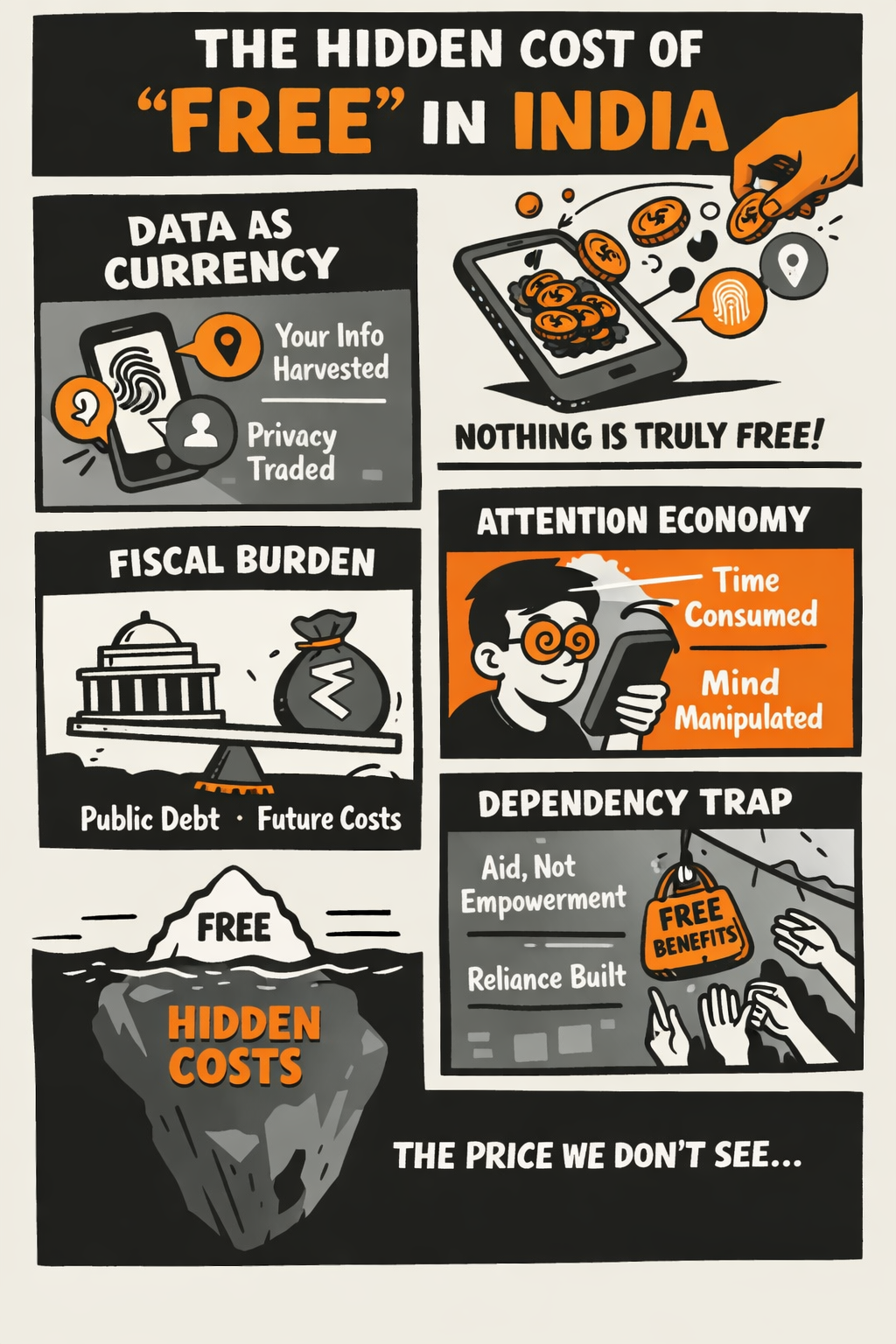
The word ‘free’ carries a unique emotional and political charge in India. It signals relief, generosity, access, and sometimes even justice. In a country marked by deep inequality and historical deprivation, the idea of receiving something without having to pay for it feels not just attractive but morally right. Free school meals, free healthcare camps, free ration, free mobile data, free apps, free advice—these are not fringe phenomena but central features of everyday life. Yet as ‘free’ becomes more pervasive, it becomes more urgent to interrogate what it actually costs in reality. Because nothing in this world is truly free. Even when money is not exchanged, value is still transferred, quietly, unevenly, and often invisibly.
The digital revolution has made ‘free’ feel natural, even inevitable. India’s smartphone explosion, driven by affordable devices and some of the world’s cheapest mobile data, has brought hundreds of millions online in a short span of time. For first-time internet users, free apps are often the internet itself. Messaging platforms, video-sharing apps, digital wallets, navigation tools, shopping platforms, and learning apps promise unlimited access at zero cost. Downloading them requires no financial transaction, only a tap on a screen. This apparent absence of cost masks a different economy altogether, one where data, attention, and behaviour are the currencies being traded.
Every free app extracts value as it collects personal information, tracks usage patterns, studies preferences, and monitors behaviour across platforms. In return for convenience and access, we surrender fragments of our digital selves, often without fully understanding the implications. In India, where digital literacy has not kept pace with digital adoption, this exchange is especially asymmetrical. We routinely accept terms and conditions that we cannot realistically read or comprehend, granting permissions that would be alarming if framed in simpler language. Location data, contact lists, browsing habits, voice samples, and even biometric identifiers become assets in a vast data economy. We do not pay in rupees, but we pay in terms of our privacy, autonomy, and long-term exposure.
This is not a small concern, as data is power, and not merely information. When aggregated at scale, it allows companies to predict behaviour, shape consumption, influence opinion, and nudge decision-making. In India, where hundreds of millions engage daily with free digital platforms, this concentration of behavioural data in private hands has far-reaching consequences. It affects what we see, what we buy, how we think, and even how we vote. The cost of free apps is not just about individual privacy but collective vulnerability to influence and manipulation. What appears to be a harmless trade in terms of free services for data becomes a structural imbalance when we lack meaningful choice or awareness.
Free apps are designed to maximise engagement because engagement drives advertising revenue. Endless scrolling, autoplay videos, push notifications, algorithmic recommendations, and gamified feedback loops are not accidental features; instead, they are engineered mechanisms to capture and hold attention. Time spent on these platforms is monetised elsewhere, converted into impressions, clicks, and behavioural insights. For us, this translates into hours lost daily to digital consumption. The opportunity cost is immense in terms of time not spent on learning, work, rest, relationships, or reflection. In a country where time poverty is already acute for large sections of the population, the extraction of attention is a high but rarely acknowledged cost of ‘free.’
Alongside free apps, free government schemes occupy a central place in India’s public imagination. Welfare programs offering free food, free electricity, free healthcare, free education, and direct cash transfers are often framed as moral imperatives in a society with widespread poverty. And indeed, many such schemes have had transformative impacts. Free school meals have improved nutrition and attendance. Subsidised healthcare has saved lives. Social security schemes have provided safety nets in times of crisis. To dismiss free schemes outright would be both inaccurate and unjust.
However, the scale and politics of ‘free’ in governance demand scrutiny. Government schemes are funded by public money, either through taxation or borrowing. When services are offered for free, the cost is distributed across society, including future generations. Fiscal resources are finite, and every rupee allocated to a subsidy is a rupee not spent elsewhere. The real question is not whether the state should provide support, but how that support is designed, targeted, and sustained. Poorly designed free schemes can strain public finances, crowd out long-term investments, and create distortions that are difficult to reverse.
One of the most persistent risks associated with free government schemes is the shift from empowerment to dependency. When benefits are delivered without clear pathways to capability-building, translating into skills, livelihoods, ownership, or agency, they can trap beneficiaries in cycles of reliance. This is not a failure of intent but of design. Welfare that does not evolve into opportunity risks becoming permanent relief rather than temporary support. Over time, political incentives can encourage the expansion of free entitlements without corresponding investments in productivity, institutional capacity, or economic growth. The cost, then, is borne in slower development, rising debt, and reduced fiscal flexibility.
There is also a less visible social cost when citizens begin to relate to the state primarily as a provider of free goods rather than as a facilitator of opportunity, and expectations shift. Accountability becomes transactional, and long-term policy thinking gives way to short-term appeasement. This dynamic can erode democratic deliberation, reducing complex governance challenges to simplistic promises of free distribution. In such an environment, the language of rights is often mixed with the politics of giveaways, weakening the deeper idea of citizenship rooted in participation, contribution, and shared responsibility.
In India, ‘free’ advice is abundant and rarely priced. Friends, relatives, colleagues, social media influencers, and anonymous online forums dispense guidance on everything from investments and careers to health, parenting, and mental well-being. At one level, this reflects strong social bonds and collective problem-solving. Knowledge-sharing has always been part of Indian society. But in the contemporary context, the proliferation of free advice, especially online, has begun to undermine the value of expertise itself. Professional knowledge is produced through years of education, training, practice, and ethical accountability. When expert advice is expected to be free, its perceived value diminishes. Professionals are pressured to give away labour without compensation, while advice-seekers are encouraged to treat complex problems as easily solvable through quick opinions. The result is often superficial guidance applied to situations that demand nuance. In fields like finance, law, and health, the consequences can be serious, resulting in misdiagnoses, financial losses, legal complications, and long-term harm.
Digital platforms have amplified this problem dramatically. Social media rewards confidence, not competence. Algorithms favour content that is engaging, simplified, and emotionally charged. As a result, the loudest voices often drown out the most qualified ones. Free advice becomes entertainment, stripped of context and accountability. Influencers monetise indirectly through advertising, brand deals, or lead generation, while audiences consume advice under the illusion that it is altruistic. The hidden cost here is the ability to distinguish reliable knowledge from persuasive noise.
Behavioural economics shows that people disproportionately favour free options, even when they are inferior to low-cost alternatives. The absence of price triggers a sense of gain that overrides rational evaluation. In India, this bias plays out repeatedly when users choose free digital services with weak privacy protections over modestly priced, safer alternatives, beneficiaries prefer immediate free benefits over long-term investments in capability, or individuals trust free advice over paid expertise because payment itself is mistaken for bias. These patterns are not signs of ignorance but of how human psychology interacts with scarcity and aspiration.
Free social media platforms, while enabling connection, intensify comparison. Carefully curated images of success, beauty, and happiness circulate endlessly, shaping aspirations and insecurities. The cost is stress, anxiety, and diminished self-worth, especially among young users. These effects are not accidental side-effects but structural outcomes of platforms designed to maximise engagement rather than well-being.
When platforms subsidise services to gain scale, smaller players struggle to compete. Local businesses, creators, and service providers are often forced into ecosystems where they generate value but capture little of it. Revenue flows upward and outward, concentrating power in a few large entities. Price signals weaken, making it difficult for sustainable, high-quality alternatives to emerge. Over time, consumers accustomed to free access become resistant to paying for quality, undermining the viability of independent work and innovation.
Yet it would be a mistake to conclude that free is inherently harmful. Free education, free public healthcare, free libraries, and free public infrastructure have historically been among the most powerful tools for social progress. The issue is not free versus paid, but opaque free versus conscious free. When free services are transparent about costs, respectful of users, and oriented toward empowerment rather than extraction, they create genuine public value. When free becomes a strategy to harvest data, attention, votes, or dependency, its costs far outweigh its benefits.
The challenge for India is to develop a more mature relationship with ‘free.’ This requires stronger regulation of digital platforms, particularly around data protection, transparency, and competition. It requires better design and evaluation of welfare schemes, ensuring they build capabilities and not just deliver consumption. It requires cultural shifts that restore respect for expertise and recognise that paying for knowledge is not exploitation but investment. And most importantly, it requires citizens to ask harder questions when something is offered at no cost.
Who is paying for this? What am I giving up? Who benefits in the long run? Is this making me more capable or more dependent? These questions are not cynical, but are of utmost importance. In a complex society, the absence of price does not mean the absence of cost. It only means the cost has been displaced onto privacy, time, dignity, judgment, or the future. India’s relationship with ‘free’ will shape its developmental trajectory in profound ways. If used wisely, then free access can level the playing field and unlock human potential; else it can deepen inequalities, hollow out institutions, and quietly extract value from those least equipped to see it. Free is never just an economic choice; instead, it is a moral, political, and social one. And in a country as large and consequential as India, the true cost of free is something we can no longer afford to ignore.
If this article made you think differently about time, work, or society, subscribe to my blog for one article every week in your mailbox. No spam. Just ideas worth stealing :)
(Cover image is generated using AI)