Why donors keep asking for sustainability
October 26, 2026 Leave a comment
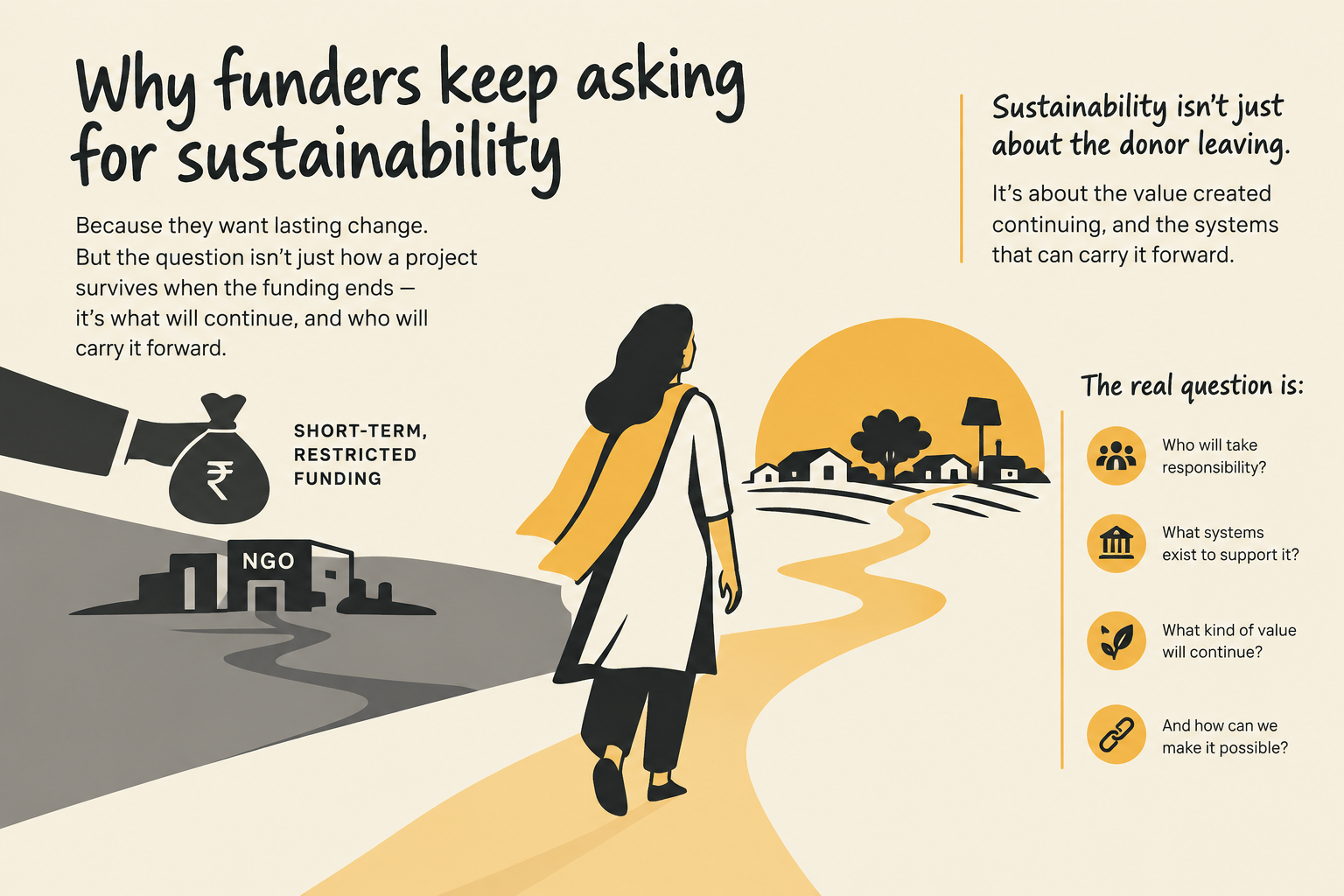
I have often been asked by the funding partners, ‘How will this project be sustained after the funding ends?’ While it is a reasonable question, it is also often the wrong one. The development sector has turned ‘sustainability’ into a synonym for ‘what will happen when the donor stops paying?’ The donors ask NGOs to build lasting solutions while often funding them through short-term, restricted projects that make long-term institutional and financial resilience harder to achieve. The real test of sustainability is the possibility of value created by the funding that can continue beyond the project cycle, and whether the economic, institutional or public systems exist to carry that value forward.
If a donor spends money on training women entrepreneurs, establishing community institutions, improving health services or creating livelihood opportunities, it is entirely reasonable to ask what happens when the grant ends. Nobody wants an intervention to disappear the moment the donor’s logo disappears from the last banner. But before asking how a project will survive without the donor, we should ask what exactly is supposed to continue, who is expected to take responsibility for it, and whether the conditions exist to make that possible.
A three-year project can be financially unsustainable but socially transformative, and it can end because its purpose has been achieved. A community institution can survive without the NGO but require continued public or market support. A livelihood intervention can become sustainable because participants increase their incomes, while the organisation delivering it remains dependent on philanthropy. And sometimes ‘sustainability’ simply means that the NGO promises to find another donor, which often is the least convincing of all. For years, development organisations have been encouraged to think about sustainability as an exit strategy. The donor funds the intervention often for 1-3 years, the NGO builds capacity, creates local ownership, establishes linkages and prepares an exit plan, and then the donor leaves and the model is expected to continue. While the logic is attractive, ending external funding and creating sustainability are not necessarily the same thing.
The OECD’s longstanding definition of sustainability in development evaluation focuses on the benefits of an intervention continuing after donor funding ends. That is a useful starting point, but it immediately raises a more important question of what will allow those benefits to continue? Government may take over, communities may contribute, users may pay, markets may generate revenue, or another institution may assume responsibility. Or the intervention may change behaviour or strengthen systems sufficiently that continued external support is no longer necessary. These are fundamentally different pathways, yet grant proposals often treat sustainability as a generic quality that can be added through a paragraph near the end of a concept note.
Consider a women’s entrepreneurship program that trains 5,000 rural women, organises producer collectives, provides business support and connects them to markets. If a donor asks how the program will be sustained after three years, the answer depends entirely on the model. Perhaps producer collectives will become commercially viable, or an anchor company will continue purchasing from the enterprises, while the financial institutions in the entrepreneurial ecosystem will provide working capital, and women will eventually pay for business services. Each possibility requires a different intervention design. If sustainability depends on markets, the project must build a viable market proposition. If it depends on government, public institutions need to be involved from the beginning. If it depends on producer collectives, those organisations need governance, capital and commercial capability. If another donor will be required, the project should be honest about that rather than presenting donor substitution as financial sustainability.
Donors increasingly expect NGOs to be resilient, adaptive and financially sustainable, while many NGOs are funded through short-term, restricted project grants that make precisely that difficult. Recent evidence from Bridgespan’s 2025 research, based on responses from 460 nonprofits and interviews with 51 nonprofit leaders, funders and intermediaries from India, found growing movement towards multiyear funding and greater recognition of core organisational costs, but continuing gaps in organisational development and financial reserves, particularly among smaller and non-metro organisations. Earlier Bridgespan research found that 83% of Indian NGOs surveyed had difficulty securing funding for indirect costs, while more than half had fewer than three months of reserves. Only 18% said they invested adequately in organisational development. Another analysis of 40 relatively well-funded Indian nonprofits found that actual core costs ranged from 5% to 51% of total costs and averaged 19%, while the average coverage provided by key donors was only 9%.
Funders ask organisations to be resilient while funding them as if their only legitimate expenditure is the activity that can be photographed and counted. Donor grants fund the field worker but not always enough of the management system that supports the field worker, training but not necessarily the organisational learning required to improve it, and program delivery while hesitating to fund reserves. Funders ask NGOs to diversify their funding while providing little unrestricted money with which to build their fundraising capacity. Then, three years later, the funder asks why NGOs are not sustainable.
Instead of asking an NGO, ‘How will you sustain this project when our funding ends?’, donors should instead ask, ‘What needs to be true for the benefits of this intervention to continue, and what role should our funding play in creating those conditions?’ This question recognises that philanthropy is often most useful when it finances a transition between two states. A grant can demonstrate that an idea works, absorb early-stage risk, strengthen institutions, develop markets, improve technology or support innovations that government and commercial finance are not yet prepared to fund. The grant should help create the conditions for the next stage. That may mean public financing, market revenue, community ownership, institutional adoption, commercial investment or another form of philanthropy. The appropriate pathway will vary by intervention, for example, a rural entrepreneurship program and a community health program should not be expected to arrive at sustainability through the same route.
This also means donors should sometimes be prepared to fund the less glamorous parts of sustainability. Financial systems are not exciting, NGO reserves are not photogenic, good middle management rarely features in impact stories, and neither do information systems, HR, audit, leadership development or fundraising capacity. Yet these capabilities determine whether an organisation can survive shocks, retain good people, manage resources and deliver programs consistently. Flexible funding is therefore not necessarily the opposite of accountability. It can be an investment in the organisational capacity required to deliver accountability well. A strong organisation with adequate systems and reserves may actually be better positioned to manage restricted program funding, and respond to changing circumstances and protect donor resources.
Then there’s another very important aspect of development programs, where everything cannot be sustained. Some projects end and achieve the desired results/purpose during their lifecycle. A delivery model may become obsolete, a technology may get replaced, a program may fail to produce meaningful results, or a community may no longer need an external intermediary. Continuing to fund something simply because it has existed for five years is institutional inertia and not sustainability.
The objective should therefore be sustainable value, not sustainable projects. This matters because many development challenges are systemic. Poverty, women’s economic exclusion, malnutrition, tuberculosis, climate vulnerability and the lack of decent employment cannot generally be ‘solved’ by a three-year project. At best, a project can change part of the system like improve a service, strengthen an institution, alter incentives, demonstrate a model, influence policy or help people acquire assets and capabilities.
Sometimes the honest answer will be that an intervention requires long-term funding, and there is nothing inherently unsustainable about that. Governments continuously spend money on education, public health, roads, social protection and environmental management. We do not ask whether a public hospital will become financially self-sustaining after three years, but are more interested in it producing sufficient public value to justify continued investment. Perhaps philanthropy should adopt some of the same logic. A community health program that requires continued financing may still be highly valuable if it prevents disease at a cost society is willing to pay. A program supporting children with special needs may never generate revenue, yet its social value can be substantial.
So sustainability cannot always mean, ‘Can this generate its own revenue?’ That is a business-model question. For many social interventions, the better question is that, Who has a legitimate reason and capacity to pay for this value over the long term? The answer is an appropriate combination of market, government, communities, and philanthropy as per the need. This also places a responsibility on NGOs to become more honest in how they answer sustainability questions. A reassuring paragraph about capacity building, community ownership and exit strategies is not necessarily a credible plan. It’s better to be honest about it and say that the interventions may require continued public expenditure, or a livelihood project would need several more years beyond the grant cycle before it can cover its operating costs, and show the pathway. If another donor will be required, explain why and what will be different by then.
Sustainability becomes more credible when it is treated as a theory of how an intervention will continue to create value, rather than as a promise that the NGO will somehow find money after the current grant ends. We have turned a ,legitimate development objective into a ritual of grant writing. Every proposal has a sustainability section, a sustainability framework, and an exit strategy. Yet none of these, by themselves, answers the fundamental question of what will make this intervention continue to work when the source of money ends. A serious answer requires thinking about incentives, markets, institutions, behaviour, public finance, community ownership and organisational capability. It may require more than one source of funding and more than one institution. It may take five years rather than three. It may require unrestricted funding rather than another tightly earmarked project grant. And sometimes it may require accepting that the value created by a program is important enough to warrant continued investment. Perhaps, then, donors should stop treating sustainability as the final question in a grant proposal, but should be one of the first. So, instead of ‘How will you survive without us?’, the donor should ask, ‘What will exist, who will own it, who will pay for it, who will maintain it, and what should our role be when the grant ends to make the impact sustainable?’ While these are harder questions, I think, they can also lead to better projects. The most sustainable thing a donor can fund is NGOs capability, institution, market, public system or community ownership that makes the original grant less necessary over time.
(Disclaimer: The opinions expressed are those of the author and do not purport to reflect the views or opinions of any organisation, foundation, CSR, non-profit or others.)
The cover image is generated using AI