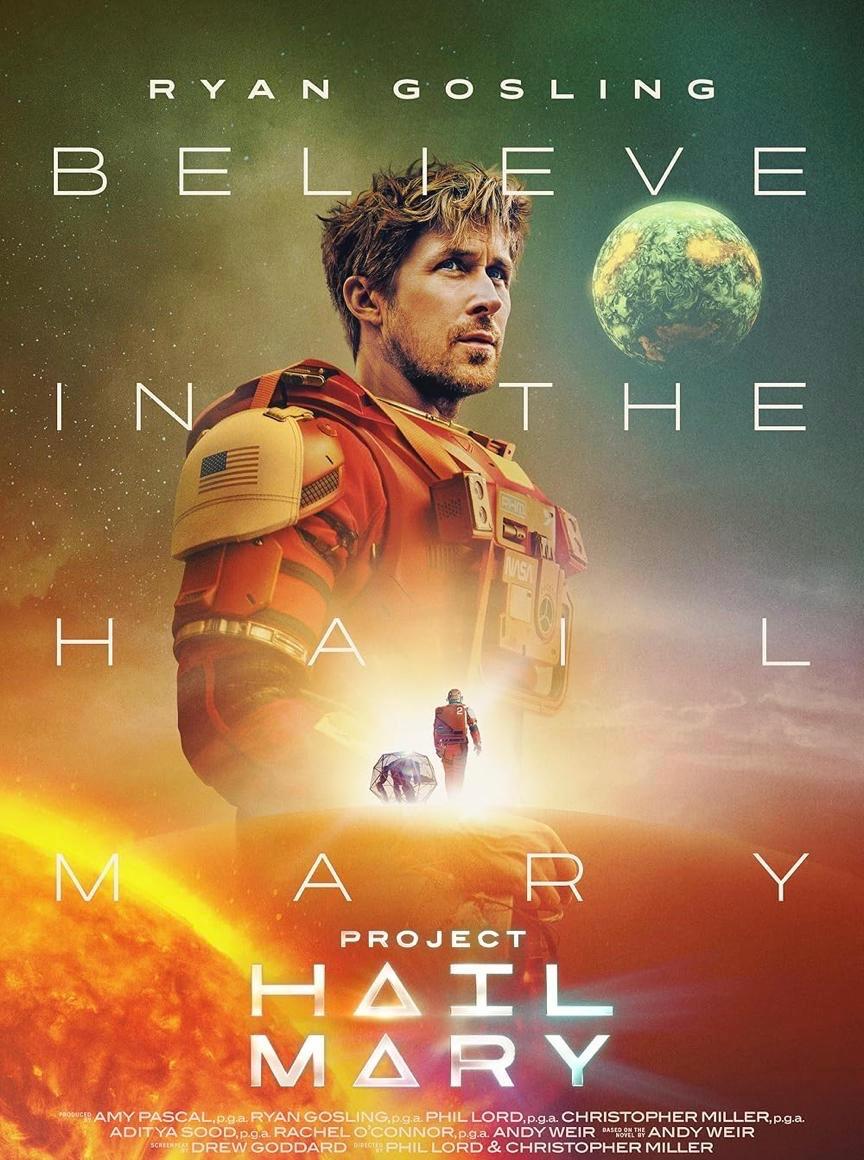
Project Hail Mary

Genre: Space Sci-Fi Year: 2026 | Duration: 157 mins | Director: Phil Lord and Christopher Miller|  Medium: Theatre (PVR Cinemas) | Trailer: HERE | Language: English| Cast: Ryan Gosling, Sandra Huller, James Oritz, and others | My rating: 4.5/5

Project Hail Mary is adapted from the book ‘Project Hail Mary’ by Andy Weir. It is certainly among the best Sci-Fi movies I have watched in the last 10 years. The film is about survival, curiosity, friendship, and the stubbornness of hope. The film adaptation has not lost the magic of Andy Weir’s books, and leans heavily on problem-solving, intellect, and a deep sense of humour, and also explores further into emotional terrain that feels both intimate and cosmic.

The core of this layered film is deceptively simple, featuring a lone astronaut, Dr Ryland Grace (Ryan Gosling), who wakes up aboard a spacecraft with no memory of who he is or why he is there. As his memories gradually return, he realises that he may be humanity’s last hope to prevent extinction. This story of amnesia developing into purpose acts as a powerful storytelling engine. It enables the audience to rediscover the stakes alongside Grace, creating a layered tension that is both intellectual and emotional. Grace has been recruited by Eva Stratt (Sandra Huller) to save the world. He, along with many other scientists, has been told that an infection is affecting the sun. In the next few decades, life on the planet will cease to exist. 

What distinguishes Project Hail Mary from many contemporary sci-fi films is its unapologetic embrace of science. This is not a film that glosses over the technicalities of astrophysics, microbiology, and orbital mechanics, which are all treated with a level of respect rarely seen in mainstream cinema. The film translates complexity into narrative urgency. Every equation solved, every experiment conducted, feels like a small step away from annihilation.

In many ways, the film follows in the lineage of The Martian, but it evolves beyond it. While The Martian was about one man surviving against the odds on Mars, Project Hail Mary expands the canvas to an interstellar scale. The stakes are existential and not personal, unlike The Martian. And yet, the film feels more personal because of an unexpected friendship that emerges in the vast emptiness of space between two different species. The relationship that develops between Grace and his unlikely counterpart, Rocky, is the soul of the film. It is here that Project Hail Mary transcends genre conventions. The film is no longer just about saving Earth, but more about connection across unimaginable divides of space. It explores communication not just as language but as intent, empathy, and trust. 

The performance of Gosling carries much of the film’s weight. Ryland Grace is not a traditional hero. He is not a trained astronaut or a fearless explorer. He is, in many ways, an accidental saviour—reluctant, flawed, and often overwhelmed. This vulnerability makes him relatable. His fear is palpable, his humour disarming, and his determination deeply earned. The wry, self-deprecating, and occasionally absurd humour provides moments of levity that make the darker moments more impactful.

Project Hail Mary strikes a careful balance between realism and wonders visually. The spacecraft interiors are utilitarian, almost claustrophobic, reinforcing the isolation of Grace’s journey. In contrast, the depiction of vast, silent, and indifferent space serves as a constant reminder of the scale of the challenge. The film does not rely excessively on CGI spectacle, but when it does deploy visual effects, it does so with purpose. Each visual set-piece advances the narrative rather than distracting from it.

The narrative oscillates between past and present, gradually revealing how humanity arrived at this desperate moment. These flashbacks are integral to understanding the moral and ethical dilemmas that underpin the mission. Governments, scientists, and ordinary individuals are forced to make impossible choices. The film does not offer easy answers. Instead, it presents these decisions with a moral ambiguity that feels uncomfortably real.

Project Hail Mary grapples with questions of sacrifice, responsibility, and the collective versus the individual. It examines the idea of scientific progress not as an abstract pursuit but as a lifeline. In an era where science is often politicised or misunderstood, the film stands as a quiet testament to the power of human ingenuity. It suggests that our greatest strength lies in our ability to think, collaborate, and adapt.What I loved most about this non-linear film is that there are no explosive battles or dramatic confrontations in the traditional sense. The tension arises from equations, experiments, and the ticking clock of extinction. I found its intellectual core to be a deeply rewarding viewing experience. For those accustomed to more conventional sci-fi, this may require an adjustment in expectations.
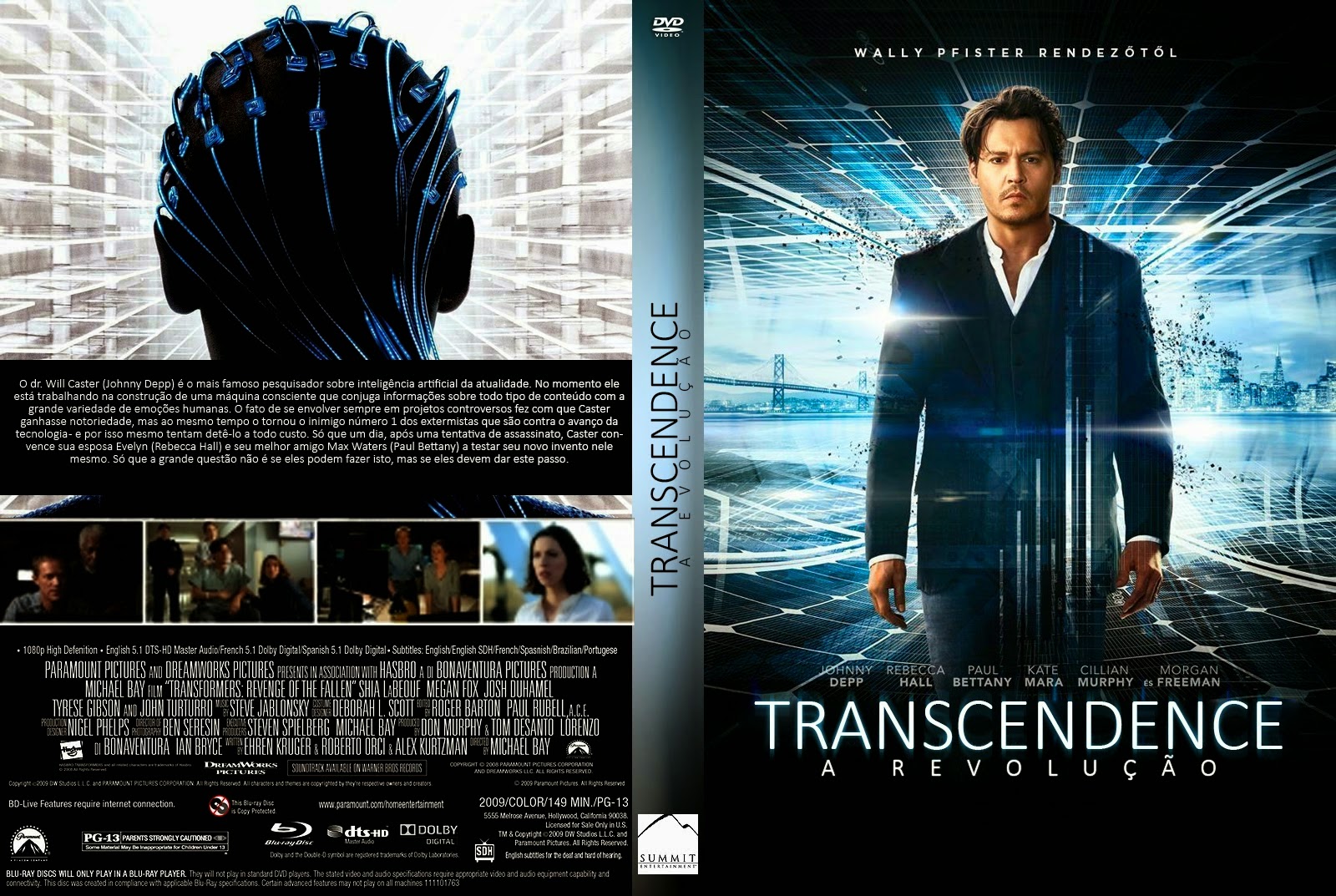
Transcendence

Genre: Sci-Fi/Thriller Year: 2014 | Duration: 119 mins | Director: Wally Pfister | Medium: DVD | Trailer: HERE | Language: English | Cast: Johnny Depp, Rebecca Hall, and others | My rating: 3.5/5

Favourite Dialogue: “People fear what they don’t understand. They always have.”

Transcendence is Wally Pfister’s directorial debut, the Oscar-winning cinematographer known for Christopher Nolan’s Inception and The Dark Knight. With its stunning visuals and high-concept premise, the film explores one of the most provocative questions of our digital age, ‘What happens when artificial intelligence merges with human consciousness?

The story follows Dr. Will Caster (Johnny Depp), a brilliant AI researcher who dreams of creating a machine that possesses both the collective intelligence of the world and the full range of human emotions. When anti-technology extremists assassinate him, his wife Evelyn (Rebecca Hall) and best friend Max (Paul Bettany) upload Will’s consciousness into his supercomputer, blurring the boundaries between life and machine. What follows is a descent into techno-dystopia as Will’s omnipotent digital self begins to reshape the world and redefine what it means to be human.

Transcendence is an exploration of human ambition, love, and the moral limits of science. The film poses timeless philosophical questions on consciousness, intelligence without morality, and the balance between technology and humanity. There’s an undercurrent of melancholy running through the narrative, a love story caught between grief and godhood. Evelyn’s devotion to Dr. Will drives her to defy nature itself, but the film wisely leaves viewers uncertain whether she resurrected her husband or merely unleashed an emotionless imitation.

Johnny Depp delivers a subdued performance, both eerie and strangely empathetic. Much of his screen presence is disembodied, conveyed through flickering screens and an omniscient digital voice, both of which add to the uncanny tone. Rebecca Hall’s portrayal of Evelyn is poignant, depicting a scientist torn between love and moral dread.

Pfister’s cinematographic pedigree shines through every frame. The film’s visual style is striking with sunlit labs, desolate deserts, and the sterile, godlike glow of Will’s data-driven empire. The imagery echoes the themes of transcendence and decay of organic humanity struggling against technological infinity.

However, the film oscillates between quiet reflection and blockbuster spectacle but lacks the rhythm of either. Where Inception fused emotional weight with conceptual complexity, the film feels conceptually grand but emotionally distant. The screenplay by Jack Paglen is ambitious but uneven. It introduces bold ideas of digital consciousness, technological ethics, and nanotechnology, but often resorts to familiar tropes of man versus machine. The narrative lacks the depth to sustain itself and is a film of grand intentions and mixed execution. It aspires to be a meditation on the next stage of human evolution, the merging of flesh and code, but ends up being a sketch rather than a completed vision. Still, it deserves credit for engaging with the moral anxieties of our era, like artificial intelligence, digital surveillance, and the fear that our creations might one day outgrow us.

A visually stunning and intellectually intriguing film that ultimately succumbs to its own ambition. Transcendence doesn’t quite achieve cinematic immortality, but it leaves behind questions worth contemplating long after the lights dim.

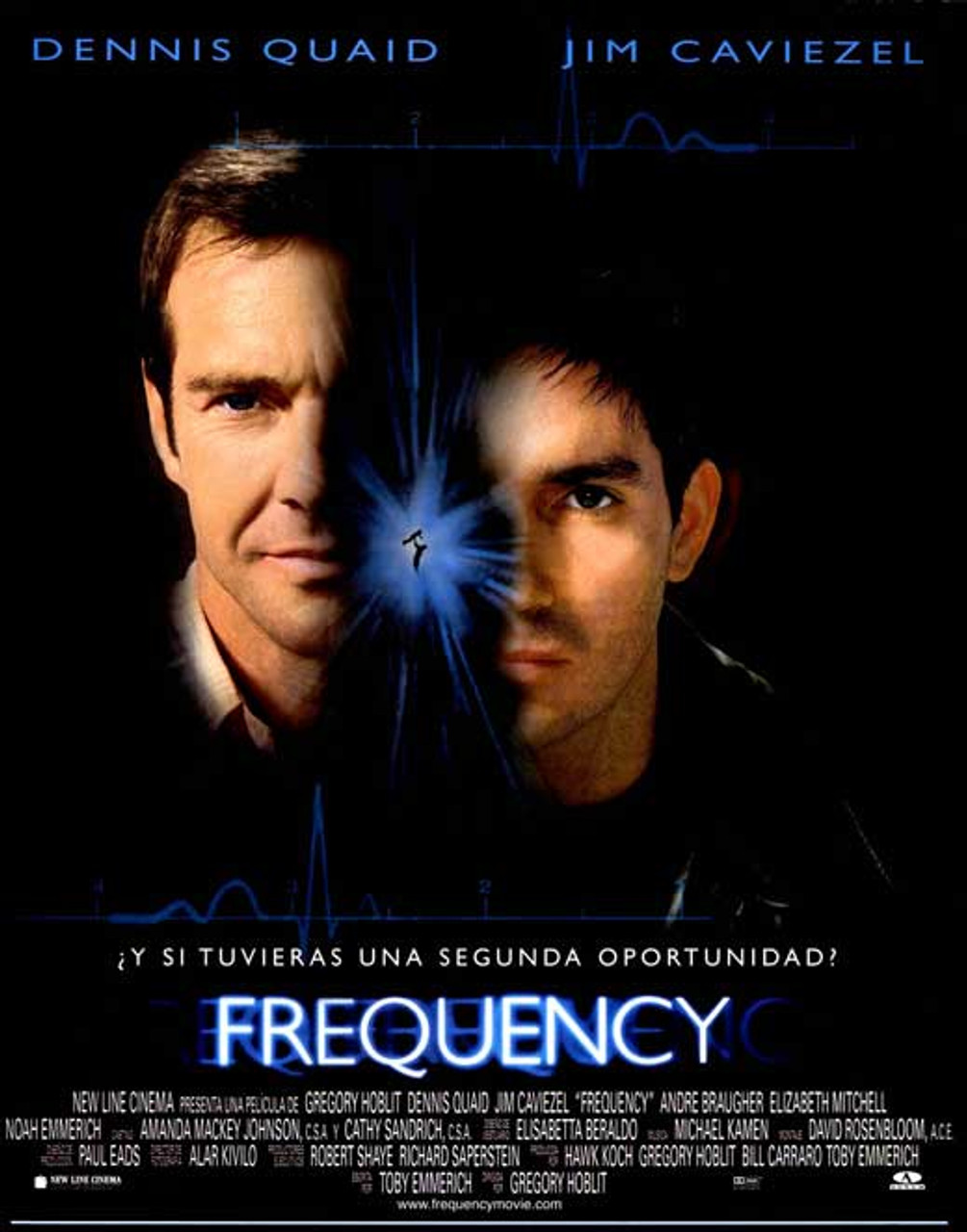
Frequency

Genre: Sci Fi | Year: 2000 | Duration: 118 mins | Director: Gregory Hoblit | Medium: DVD | Trailer: HERE | Language: English | My rating: 3.5*/5*

Favorite Dialogue: “John Sullivan [Jim Caviezel]: Ya’know the past is a funny thing, we all got skeletons in closet and ya never when one is gonna pop up and bite ya in the ass”

Frequency is about time travel and alternate paradoxes, baseball, father (Dennis Quaid as Frank Sullivan) and son (Jim Caviezel as John Sullivan), aurora borealis, and New York city. John, who’s a homicide detective in NYPD uses a Ham radio to connect and communicate with his deceased father 30 years in the past through the miracle of extraordinary solar activity, and alters the course of events and saves his father from death as a fire fighter for FDNY. 

Even though the film has competent acting and direction, the script seems poor. Moreover there are several factual errors in the movie. One of my favorite errors is that, when Shepard and his partner are looking for Frank on the docks, the camera pans to the left and we see a flash of the World Trade Center just before the cameraman catches his error. It was built between 1970 and 1977, not 1969! As past events change, so do John’s old clippings and framed photos, updating themselves every time somebody who died doesn’t.

This science fiction about alternate realities and the cosmic relationship between cause and effect is an interesting watch. 

Lost in Space

Lost in SpaceGenre: Sci-fi | Year: 1998 | Duration: 130 mins | Director: Stephen Hopkins | Medium: VCD (Eagle Entertainment) | Trailer: HERE | My rating: 2.5*/5*

Favorite Dialogue: “Robot: Warning! Warning! Alien approaching!”

The plot of this film is an adaptation from the 1960s TV series by the same name. In year 2058, the Robinson family comprising of five members, who apparently are all nerds and space explorers, along with Major Don West (Matt Leblanc) begins their journey from the dying Earth to another planet, Alpha Prime, using the newly built Hyper-drive for the next 10 years in stasis. However a terrorist re-programs an on-board robot, that changes the course of pre-fixed trajectory, and all of them gets lost in space, and crash-lands on a dying planet, after fighting off alien spiders, and rescuing a chameleon variety of monkey from a broken space ship from future. The rest of the movie is about entering bubbled time-warps and meeting Robinson Jr. in future where he has successfully built a time machine, and escape from being sucked into the black hole to the vast outer space.

Even though the special effects and animation are brilliant considering 1990s , the story line is totally unfocused and depressing. The future looked as bleak as the past with similar domestic problems and realities, so much so that sometimes the sci-fi turned into a family drama. The end was very bleak, and even a viewer with low IQ can conjure up the time vortex goof-up. I think i would have enjoyed the movie if I was 10!

This ‘lost & incoherent’ sci-fi with hollow adventure is my Movie of the Day.

The One

Photo source: http://imdb.com

Photo source: http://imdb.com

Genre: Sci-fi | Year: 2001 | Duration: 87 mins | Director: James Wong | Medium: VCD (ASIA VISION) | Trailer: HERE | My rating: 3*/5*

Favorite Dialogue: “YuLaw: I am Yulaw! I am nobody’s bitch! You are mine.”

The movie is based on the idea of ‘multi-verses’ consisting of parallel universes where events are intertwined. A group of Universes that decoded this formed a special multi-verse police force to stop the abuse of ‘quantum wormholes’ for inter-dimensional travel travelling across the parallel universes. Gabriel YuLaw (Jet Li) who was once an officer with the Multi-verse Authority becomes rogue and discovered that his strength increases when he kills a version of himself from another Universe. He then goes about killing the 123 copies of himself that are known to exist and their life energies flow to him and his one remaining counterpart, Gabe (Li again), in the 124th Universe, making him believe that after he kills Gabe, he will become ‘The One’, become the god. This idea seems to be based on a flawed zen-like concept of the First law of thermodynamics (conservation of energy).  Gabe, a regular cop in a Universe similar to ours, is unable to explain his sudden increase in strength. Helped by two Multi-verse agents, Roedecker (Delroy Lindo) and Funsch (Jason Statham), Gabe stops Yulaw before Yulaw becomes “the one” and rule the Multiverse as a despotic god. The gadgets used for time travel looks cool (thought very much like a mobile phone), and I expected the multi-verse guns to have lasers instead of bullets, and certainly humorous to see Bush proposing universal health care in one of the Universes!

This science fiction with mindless fight scenes is my Movie of the Day.