Confessions of a Fundraiser

By a Head of Development, who has been there, done that. 

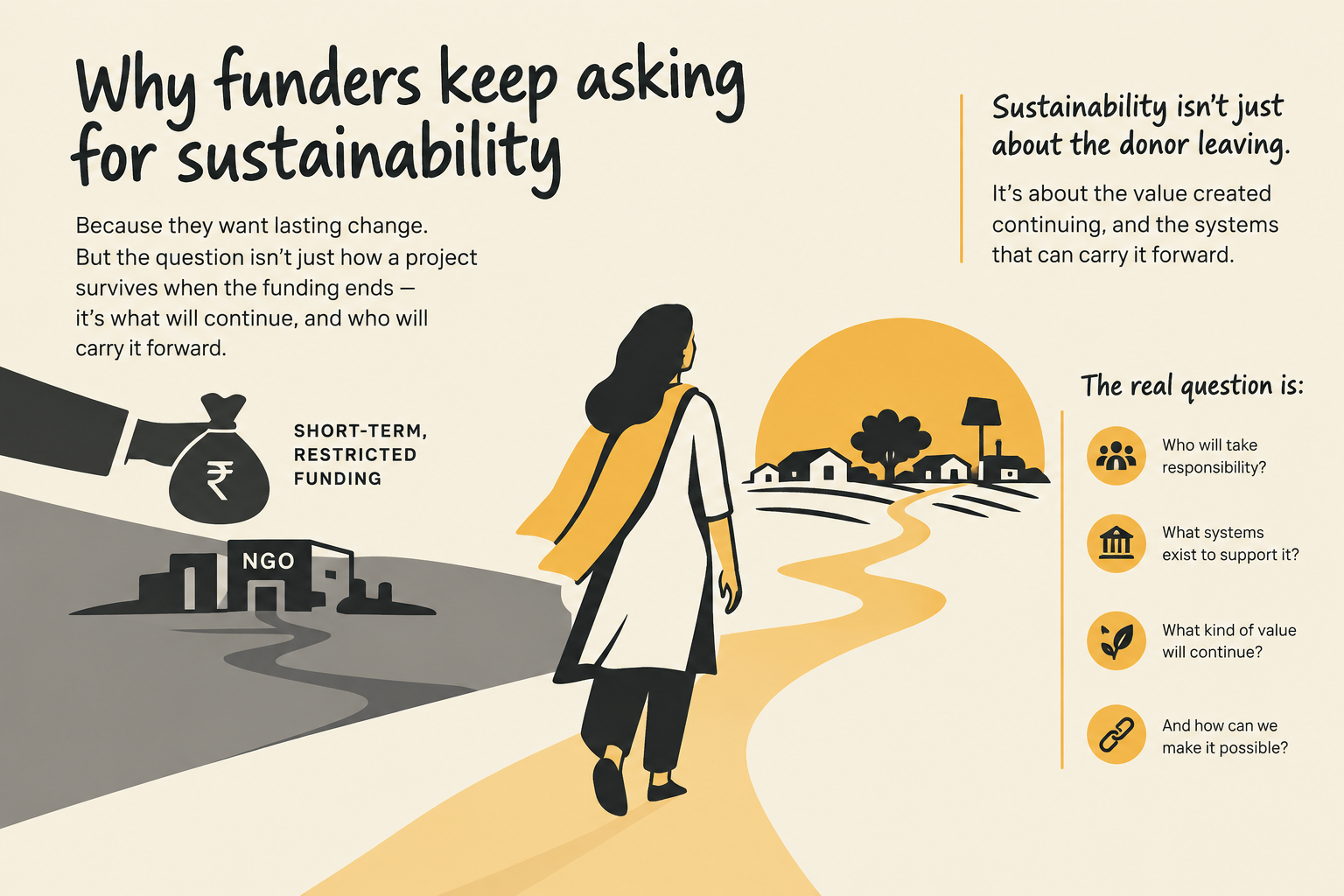
I have spent a good part of my career raising funds for livelihoods and entrepreneurship, environmental sustainability, and digital inclusion. These are kinds of work that everyone agrees are deeply important, and expects to be delivered at miraculous speed, near-zero overheads, and with measurable transformation visible by the next board meeting! Over the years, I have learned that in India’s funding universe, March is not just a month but a mood, where phone calls are returned with unprecedented urgency, proposals are rediscovered with fresh enthusiasm, and sustainability plans are requested even before the first grant tranche has cleared. I have learnt to speak fluently about empowerment while explaining, with equal conviction, why empowerment requires trainers, coordinators, field activities, local transport, and a field office. I have learnt that pilots can run for a decade and still be called pilots, that social impact is expected to be both transformative and inexpensive, and that the most common expression of donor admiration is, ‘This is excellent work. Can you replicate in two districts with 20% less budget?’ And yet, I have also learnt that when trust is built patiently, and partnerships are approached as shared responsibility rather than transactional funding, the system does work, unevenly, imperfectly, but often just in time.

If you ever want to test your emotional resilience, professional patience, and metaphysical belief in destiny, try becoming a fundraiser for social impact in India. Not as a hobby or a phase in life, but as a full-time, salaried, KPI-driven profession where your success is measured in crores raised, relationships sustained, and hopes renewed, often all before lunch. Fundraising in India is not a job; it is a personality type. It is a slow-burning spiritual practice. It is also, on some days, a contact sport.

Most fundraisers do not grow up dreaming of this life. No child has ever said, ‘When I grow up, I want to write concept notes, follow up politely seven times, and still be told the CSR budget has already been exhausted for this year.’ Fundraisers are usually people who joined the development sector with good intentions and then stayed because they discovered a rare combination of optimism, masochism, and an above-average tolerance for ambiguity. In India, fundraising also requires fluency in multiple dialects, not linguistic ones, but donor dialects. You must speak CSR, philanthropy, family office, multilateral, HNI, trust, and the particularly tricky language known as ‘let’s take this offline.’

Every fundraising journey begins with a proposal that is equal parts strategy and speculative fiction. A document that must be simultaneously visionary and realistic, innovative yet ‘scalable,’ rooted in community voice and at the same time aligned to the donor’s thematic priorities for the current financial year. The proposal must do many things at once: ‘Solve poverty + empower women + be sustainable by the third year + align with SDGs (preferably all of them) + cost exactly the amount the funder has available + have low overheads but world-class MEL.’ You will spend weeks refining language, perfecting logframes, and polishing budgets, only to be asked in the first meeting, ‘Can you explain this in two lines?’ You will smile, compress your knowledge of years of community work into a sentence, and remind yourself that clarity is a virtue, even when it hurts.

Sooner or later, every fundraiser in India faces the great philosophical question of our time: Why do you need staff to run a project? Recently, another question got added to my great list when a funder asked me, ‘Why do you need field offices to implement a community-based high-touch project?’ Mind you, I managed a straight-faced answer, without any smirk or sarcasm, even though I cursed the day I decided to be a fundraiser.

Admin costs are a suspicious category in the minds of Indian donors. They include dangerous items like salaries, rent, electricity, and internet, none of which, apparently, contribute to impact. As a fundraiser, you become adept at explaining that projects do not run on goodwill and sunlight alone. That field teams do not teleport. That data does not collect itself. You learn to say ‘lean but adequate,’ ‘efficient yet ethical,’ and ‘value for money’ with full sincerity. I have even attempted some humour at times on the negotiation tables, saying, ‘Without admin costs, the project will still exist, but just as an idea.’ Results vary post such statements.

What I have understood is that fundraising in India is less about money and more about relationships. Money is merely the by-product of trust built over years, conversations, coffees, conferences, and carefully worded WhatsApp messages. I have learnt that a ‘quick call’ can last an hour or more, a ‘small grant’ can require six levels of approvals and may take two years; silence doesn’t mean rejection (or acceptance); words from leadership are golden, but if you don’t have that in writing, you are screwed. The fundraiser’s greatest skill is not writing; it is patience. You patiently wait for responses, for board meetings, for the next quarter, for the funder who loved your work but is noncommittal. You wait with optimism, and dignified reminders, gentle ones every couple of weeks.

Then comes the project visit by the funder, usually by some of their board members and senior leadership. Often, they bring moments of high drama along with it. For the donor, it is a glimpse into our community-connect and implementation efficiency. For a fundraiser, it often turns into a logistical marathon involving vehicles, weather, community leaders, beneficiaries, translators, photographers, and a strong hope that nothing goes wrong. In all such visits, we fundraisers pray to some invisible power that the roads are navigable, community meetings start on time, funder’s visibility is primed, and no one asks an unplanned question about funding gaps. If all goes well, the funder says, ‘This is so impactful.’ You nod, beaming. You make a mental note to follow up in three days. At the beginning of my fundraising career in India two decades ago, I often ended up being shocked by the variety of demands by donor representatives visiting project sites. Thanks to the information age, the visiting representatives nowadays are well informed and often invested in social change.

Fundraisers also live at the intersection of data and dignity, translating lived experience into metrics without stripping it of meaning.Indian donors want data and stories, and at times, even at the cost of losing the bigger picture. You learn to convert human change into numbers without losing the soul of the work. You say things like, ‘4025 women trained’, and then you add, ‘Meet Sunita, who now earns independently and negotiates at home.’ You know that neither is sufficient alone, and the narrative together, they might just unlock the next tranche.

How can I forget the ultimate sword of big NO! Rejection is a constant companion of us fundraisers, like a dark shadow. Sometimes polite, sometimes vague, and sometimes dressed up as ‘great work, but not this year.’ You learn not to take it personally, mostly. You also learn that today’s rejection can be tomorrow’s opportunity, because India’s funding ecosystem is small, relational, and cyclical. The donor who said no last year may say yes next year, after changing jobs, priorities, or perspectives. So you keep the door open, always.

Fundraising is emotional labour. You hold hope for communities, for organisations, for teams whose salaries depend on your ability to convince someone that change is worth investing in. You are optimistic on behalf of others, even on days you feel tired. You absorb anxiety, translate urgency, and project confidence. You celebrate quietly when funds come through, and cushion disappointment when they don’t. You are expected to be resilient, persuasive, strategic, and endlessly positive. No one tells you this in job descriptions.

And yet, despite the follow-ups, the spreadsheets, the rejections, the ‘please reduce your budget by 15-20%,’ and often ending up becoming a football between the funder and the grantee management, we choose to stay. Because once in a while, a funder truly listens. Once in a while, a partnership feels equal. Once in a while, funding aligns perfectly with need, timing, and trust. And in those moments, you remember why fundraising matters. Because social impact does not scale on passion alone. It scales on resources, relationships, and people willing to ask again and again for something better.

So here’s to the fundraisers in India: The translators. The bridge-builders. The professional optimists. May your proposals be read, your follow-ups answered, and your impact always exceed your budgets. And may you never lose your sense of humour. Wishing you strong coffee, timely approvals, and generous funders, today and always.

May the force be with you! 

Shanghai

Genre: Thriller | Year: 2012 | Duration: 105 mins | Director: Dibakar Banerjee | Medium: DVD | Trailer: HERE | Language: Hindi | My rating: 4*/5*

‘Shanghai’, set in Bharat Nagar, a fictitious town in India, is based on Vassilis Vassilikos’s Greek novel ‘Z’. Dibakar Banerjee has done full justice with the screenplay and direction, and the actors, with their brilliant performances, have portrayed the different moral dilemmas that various characters face in circumstances created, making it an engrossing and thought-provoking film. The movie doesn’t take sides on good or bad, and instead holds a mirror to the contemporary political greed and bureaucratic corruption that riddle India.

A prominent social activist, Dr. Ahemadi (Prosenjeet Chaterjee) is mowed down by a tempo while protesting against the upcoming International Business Park project (IBP), which is the brainchild of the State’s CM ‘Madam ji’ (Supriya Pathak) that plans to demolish Bharat Nagar and make it the next Shanghai. IAS officer Krishnan, who’s the vice chairman of IBP, is put in head an inquiry commission by the CM and her principal secretary, Kaul (Farooq Sheikh). He discovers incontrovertible evidence with the help of Shalini Sahay (Kalki Koechlin), a student and lover of Dr. Ahemadi, and Jogi (Emraan Hashmi), a complex small-time porn film maker, which shows that the politicians were involved in the attack. In this serious movie, Emraan’s character provides the genuine laughs from time to time, and clearly, this is his best performance to date. The climax of the movie is brilliantly done, not so commonly seen in the movies made by Bollywood.

This engaging and fast-paced political thriller with characters in grey is my Movie of the Day.

Role of values and ethics in community practice

Community practice sits at the intersection of social change, participatory development, and human wellbeing. It involves working with individuals, groups, and institutions to enhance quality of life, challenge structural inequalities, and strengthen collective agency. Yet, this transformative process is impossible without a strong foundation of values and ethical principles. Values shape the vision and intention behind community action, while ethics guide the methods and behaviours used to pursue that vision. The integrity of community practice, including its legitimacy, trustworthiness, and long-term impact, depends on how practitioners understand and embody these principles. The presentation on Values and Ethics emphasises core values such as service, social justice, dignity and worth of every person, human relationships, integrity, and competence, alongside ethical guidelines including respect, informed consent, confidentiality, and non-discrimination. These are essential elements of responsible and democratic engagement with communities.

Values represent deeply held beliefs about how the world should be and how people ought to behave. They are moral compasses that guide decisions, priorities, and relationships. Values reflect strong beliefs about desired conditions of life and preferred moral behaviour. In community practice, values shape not only personal conduct but also the philosophies of development interventions, determining whether they foster empowerment or dependency, solidarity or charity, rights or favours.

The value of Service embodies commitment to supporting individuals, families, and communities through concrete actions, volunteerism, and compassionate engagement. During the COVID-19 pandemic, undergraduate and high school student volunteers in India demonstrated extraordinary service through fundraising, relief distribution, care work, and digital support for vulnerable households. Their example illustrates that service is not passive goodwill but active participation in alleviating suffering and building resilience. In development studies, service aligns with Paulo Freire’s notion of praxis, which is reflection combined with action to transform reality.

Community practice is inherently political as it confronts power structures, resource inequities, and systemic barriers that perpetuate marginalization. Social justice means equality, human rights, diversity, and opportunities, ultimately contributing to a happier world. A social justice lens ensures that community work moves beyond charitable assistance to structural transformation. From a development studies perspective, the struggle for social justice requires practitioners to advocate for fair distribution of resources, break discriminatory norms, and amplify voices historically excluded from decision-making. Community practice, therefore, demands values aligned with the SDG 5, SDG 10, and SDG 16. 

Recognizing each individual’s inherent dignity and worth is central to ethical community practice. This aligns with human rights frameworks and Amartya Sen’s capabilities approach, which sees development as expanding freedoms and choices. When community practitioners honour dignity, they see people not just as beneficiaries but as partners, experts in their own lived experience. Respecting dignity involves listening without judgment, avoiding stereotypes, and making sure that interventions do not reduce agency.

Building strong relationships and networks for meaningful community development is very important. Trust is the currency of community practice, developed through transparency, empathy, and accountability. Sustainable change cannot be imposed; it emerges from collaborative relationships among stakeholders such as residents, civil society institutions, governments, and markets. Relational practice aligns with theories of social capital, which argue that cohesive communities with strong networks are better positioned to solve collective problems. When practitioners prioritise relationships, they enable shared ownership and long-term stewardship of change processes.

Integrity, which is non-negotiable and rooted in keeping promises, respecting boundaries, and never betraying trust, is essential for legitimacy in community work. Without integrity, community actors can reproduce harmful dynamics of exploitation or manipulation. Practitioners must therefore be consistent in values and actions, resist corruption, and maintain transparency in financial decisions, participation processes, and communication. Integrity also requires humility in recognizing limitations, acknowledging mistakes, and being accountable for consequences. In a context where communities may have experienced decades of unmet promises, integrity becomes a radical act of restoration.

Competence requires practitioners to continuously build knowledge, develop skills, engage in research, and translate learning into action. Competence includes interdisciplinary understanding of poverty, gender, climate resilience, social policy, participatory methodologies, and cultural sensitivity. Competence protects communities from poorly designed interventions that may cause unintended harm. Attending conferences, reading research, and grounding practice in evidence strengthens professionalism and promotes innovation. Competence also means knowing when to collaborate with subject-matter experts instead of assuming expertise.

Ethics provide guidelines to translate values into action. Ethical principles like commitment, respect, informed consent, privacy & confidentiality, non-discrimination, self-determination, social diversity, and boundaries in physical contact and communication are important. These principles prevent abuse of power, ensure fairness, and build trust. Respect and Informed Consent ensure that community members’ rights are upheld and that participation is voluntary and based on understanding. Informed consent is especially important when dealing with research, data collection, health interventions, or sensitive personal histories. Confidentiality and Privacy protect personal information and reinforce psychological safety. Violating confidentiality can cause social harm and erode trust permanently. Self-determination requires practitioners to facilitate agency rather than impose solutions. Communities must remain decision-makers in development processes, consistent with participatory development frameworks. Non-discrimination and respect for diversity demand active challenge to caste, gender, disability, sexuality, religion, and class barriers. A commitment to inclusion transforms communities into spaces of belonging. Ethical conduct concerning physical boundaries, language, and sexual harassment protects dignity and safety. Such ethics create a culture of accountability that strengthens collective values.

Values and ethics together shape the culture of development practice. They influence how decisions are made, how conflicts are resolved, and how change is pursued. Without ethical foundations, community work risks becoming transactional or extractive. Conversely, when values and ethics guide practice, communities become co-architects of development and not mere beneficiaries. Values and ethics also guide practitioners through complexity. Community practice involves tension, competing expectations, and uncertain environments. Ethical frameworks provide a compass and define clear boundaries, ensuring that actions remain aligned with justice and human dignity.

Values and ethics are not supplementary components of community practice. Values such as service, social justice, integrity, dignity, competence, and the importance of human relationships guide development practitioners to commit to empowerment rather than charity and partnership rather than control. Ethical principles like informed consent, confidentiality, respect, and non-discrimination protect the rights of communities and uphold trust. Together, they create moral, relational, and intellectual foundations necessary for transformative development processes. Ultimately, community practice grounded in strong values and ethics nurtures societies where human potential can flourish, justice is prioritized, and diversity is celebrated. When practitioners act with humility, integrity, and commitment, they not only support community change but also become participants in shaping a more equitable and compassionate world.

Read more

  • Freire, P. (1970). Pedagogy of the Oppressed. Penguin.
  • International Federation of Social Workers (2018). Global Social Work Statement of Ethical Principles.
  • Jenkins, R., & Goetz, A. M. (1999). Accounts and accountability: Theoretical implications of the Right to Information movement in India. Third World Quarterly, 20(3).
  • Roy, B. (2010). Learning from Barefoot College. TED.
  • Sen, A. (1999). Development as Freedom. Oxford University Press.

120 Bahadur 

Genre: War Drama Year: 2025 | Duration: 160 mins | Director: Razneesh Ghai|  Medium: Theatre (PVR Cinemas) | Trailer: HERE | Language: Hindi | Cast: Farhan Akhtar, Raashil Khanna, and others | My rating: 3.5/5

120 Bahadur is based on the real-life sacrifice of the 120 soldiers of Charlie Company, 13 Kumaon Regiment of the Indian Army at the Battle of Rezang La during the 1962 Sino-Indian War. It chronicles the extraordinary courage of 120 Indian soldiers who stood their ground against 3000 Chinese troops. The film focuses on Major Shaitan Singh Bhati (played by Farhan Akhtar), showcasing the grit, sacrifice, and valour of soldiers fighting in the brutal cold and high altitude of Ladakh. The story is narrated through the memories of a surviving soldier, and it unfolds as a tribute to the heroism of a band of brothers whose courage came at the highest cost.  

The film’s strongest suit is its war sequences and immersive realism. The battle sequences at Rezang La, rifle fire, bayonet charges, final close-quarters combat, the harsh terrain, bone-chilling cold, and the almost claustrophobic desperation when ammunition runs out are realised with a fierce intensity that’s rare for many modern Hindi war films.  The film features brilliant cinematography by Tetsuo Nagata, with breathtaking shots of snow-covered mountains, freezing desolation, and the starkness of high-altitude warfare.  The film mostly avoids glorifying war for its own sake and is a sober portrayal of the events. This sincerity gives the film humility as it doesn’t frame itself as a triumphant spectacle, but a respectful tribute and remembrance. 

Farhan Akhtar delivers a thoughtful performance. He largely avoids the larger-than-life histrionics often associated with Bollywood war heroes. Instead, he feels rooted, authoritative yet human, decisive yet burdened.  At the same time, the supporting cast, many of them lesser-known actors, bring the infantrymen to life with grit, camaraderie, humour, and vulnerability. Their messy friendships, small conversations, homesickness, and occasional fears humanise what might otherwise have been just a war drama with guns and trenches.  

However, the film seemed to have weak character development; their individual stories were barely sketched out. This makes certain deaths feel less impactful emotionally, more like casualties on a battlefield than deeply personal losses. Because of that, while the collective sacrifice hits home, personal grief and tragedy often don’t. The film’s narrative isn’t always smooth, as flashbacks to family life, interspersed with the lead-up to battle, sometimes break the tension. The prelude drags at times, and the buildup to the climax lacks the steady escalation that such stories need for maximum impact.  

I felt that the depiction of Chinese soldiers has been overly simplified and tends to lean towards caricature: monolithic, villainous, almost cartoonish, robbing them of nuance or complexity. This weakens the moral weight of the conflict and reduces it to a binary ‘good vs evil’ war movie. In parts, storytelling relies heavily on familiar Bollywood popular drama of last-minute motivational speeches, montage-heavy sequences, formula flashbacks and emotional beats, which keep the film from feeling fully original.  

120 Bahadur is not a perfect film, but it is an earnest, important one. It doesn’t glamourise war, and it doesn’t demand you leave the theatre cheering mindlessly. Instead, it makes you reflect on duty, courage, and sacrifice. As a cinematic recreation of a tragic but heroic moment in India’s history, the film succeeds more often than it fails. Its war sequences are unflinching and immersive; its portrayal of brotherhood and sacrifice is heartfelt; its lead performance is measured and credible.

But beneath the combat and solemn patriotism, it made me think that India’s rural society holds the backbone of India’s defence forces. The film also has a sociological moment where rural identity, class, caste, and nationhood intersect. The men of Charlie Company came largely from agrarian communities, especially the Ahir (Yadav) belt of Haryana and Western UP. Their lives before the war were shaped by farming cycles, monsoon anxieties, livestock, joint families, and deeply rooted village cultures. The film becomes a testament to how rural young men, in search of dignity, livelihood, and service, become the face of national defence but rarely the face of national storytelling.

Despite its narrative shortcomings, 120 Bahadur performs a cultural service of returning Rezang La to public consciousness.

The invisible cost of GRAP 

Delhi slips into a public health emergency as air pollution reaches hazardous levels every winter. The government responds by invoking the most stringent measures under the Graded Response Action Plan (GRAP III and IV), suspending all construction and demolition activities, halting infrastructure projects, and restricting dust-generating work. These steps are necessary and justified for pollution control and the health of people. However, the cost of Delhi’s clean air policies is disproportionately borne by construction workers and daily wage labourers, whose livelihoods are abruptly and completely cut off.

Delhi has a massive daily wage construction labour force, estimated between 10-12 lakhs workers, with only around 5.4 lakhs officially registered (around 2.6 lakh active). Construction restrictions under GRAP III and IV are designed to curb particulate pollution, particularly PM10, a major contributor to Delhi’s smog. However, the construction sector is sustained almost entirely by informal labour. Migrant workers, hired through layers of contractors, work without written contracts, income security, or social protection. When work stops, wages stop instantly. There are no savings to fall back on, no paid leave, and often no local support systems. For these workers, a week-long (or longer) pollution shutdown can mean hunger, unpaid rent, mounting debt, or forced return to their native places under distress.

The injustice lies in the fact that these workers are not the architects of Delhi’s pollution crisis. Air pollution is the result of long-term structural failures, like unchecked urbanisation, rising private vehicle use, industrial emissions, poor public transport planning, weak enforcement of environmental norms, and regional factors like stubble burning. Construction workers operate within this system, responding to demand created by the city’s growth. Yet, when pollution peaks, their labour is the first to be criminalised, as if survival itself were an environmental offence.

The common defence of GRAP rests on a false dichotomy between public health and livelihoods. This framing assumes that income loss is a tolerable short-term sacrifice in the interest of long-term health. For daily wage labourers, livelihood and health are inseparable. Loss of income leads to undernutrition, stress, untreated illness, and increased vulnerability. Clean air achieved by pushing workers out of their wages is a policy failure and not a public health success. India’s environmental governance has consistently overlooked this social dimension. While regulations effectively restrict polluting activities, there is little institutional thought given to compensating those who lose income due to regulatory action. 

On 18th December 2025, the Delhi Government announced financial assistance of  INR 10,000 through Direct Benefit Transfer (DBT) to registered construction workers affected by the curbs under GRAP. While this is a welcome announcement by the Government, a clear policy solution is required in the long run for the provision of minimum wages to construction workers and daily wage labourers, both registered and unregistered, for the duration of GRAP shutdowns. This compensation should not be framed as charity or welfare, but as a rightful payment for income loss imposed by public policy in the interest of collective well-being. If the state mandates a halt to work for environmental reasons, it must also accept responsibility for the economic consequences of that mandate.

The most viable way to finance this support is through a dedicated ‘pollution tax.’ Delhi already collects various environment-linked charges, including green cess on vehicles, environmental compensation from polluting industries, and penalties for regulatory violations. These revenues can be consolidated into a Pollution Mitigation and Compensation Fund. Additional sources could include congestion charges in high-traffic zones, higher fees on large real estate developments, and stricter fines on construction firms that violate dust-control norms. Those who contribute most to pollution should bear the cost of its social mitigation.

Beyond immediate compensation, such a policy would also strengthen environmental compliance. When workers are protected from income loss, resistance to pollution-control measures will also decline. Environmental regulation will become a shared responsibility rather than an imposed punishment. Over time, this approach can build public trust in pollution governance, which is currently eroded by perceptions of unfairness and elite insulation from consequences.In the longer term, Delhi must move towards cleaner construction technologies, year-round dust control enforcement, better urban planning, and formalisation of labour. But these structural reforms will take time. Until then, compensating workers during pollution-induced shutdowns is a matter of basic justice. Environmental policy that ignores inequality risks becoming morally hollow and politically fragile. Clean air should be a shared achievement, not one built on empty stomachs and silent suffering.

First published at LinkedIn on 22nd December 2025