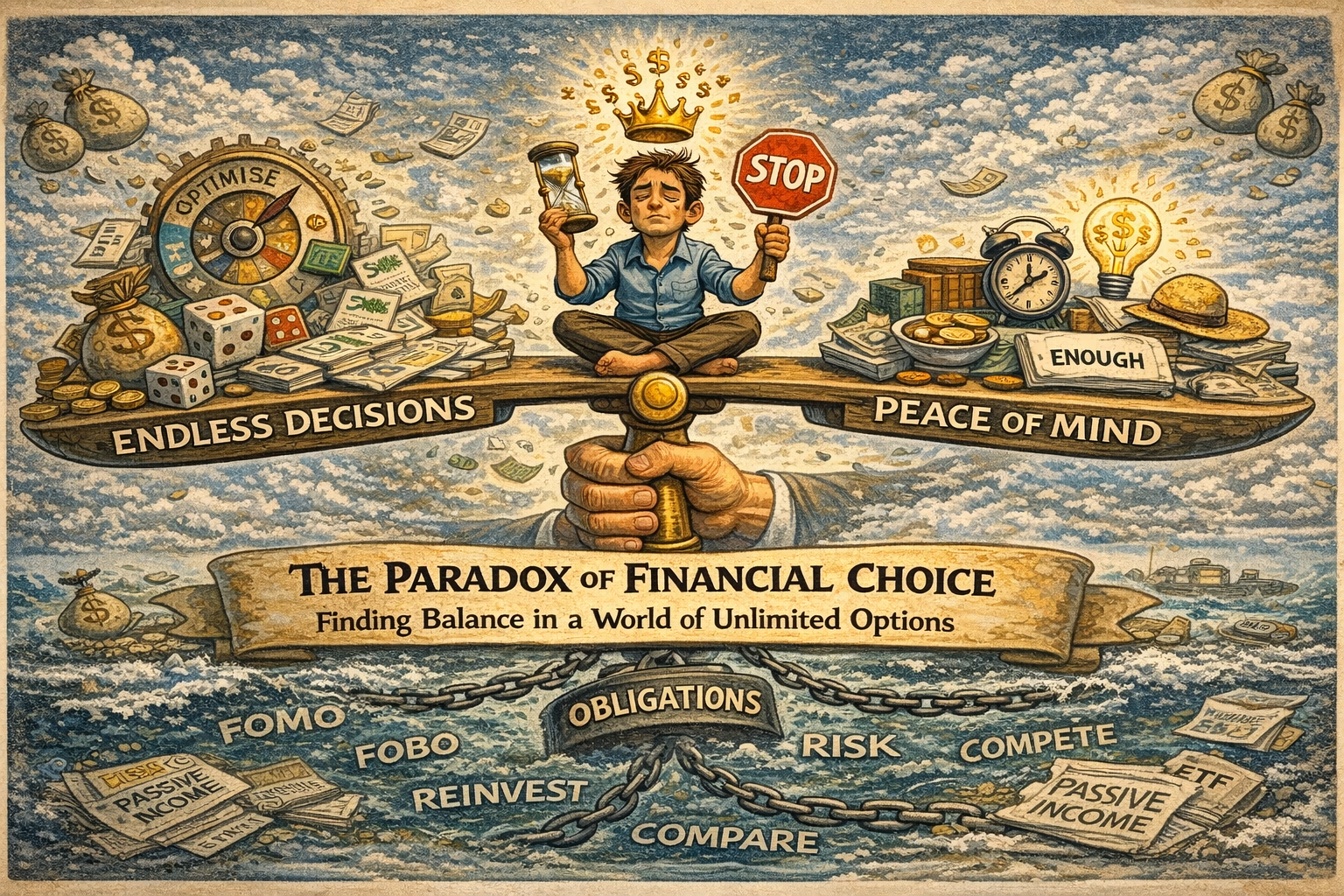
The Paradox of Choice

Today when we can open a trading account in minutes using multitudes of apps on our smartphones, start a side hustle overnight, and invest in everything from mutual funds to crypto, it’s easy to assume that greater financial freedom leads to greater happiness and security. After all, classical economics taught us that more choice expands utility and that having more options allows individuals to maximise satisfaction according to their preferences.

However, paradoxically, the modern reality is quite the opposite. The very availability of multiple financial choices, from investment platforms and passive income streams to flexible careers, has made us more anxious, instead of more secure. This tension between freedom and fatigue is at the core of what psychologist Barry Schwartz famously called The Paradox of Choice, that when faced with too many options, people often experience paralysis, regret, and dissatisfaction. In the financial world, this paradox is amplified by behavioural biases, social pressures, and the illusion of control. The promise of ‘financial freedom’ is increasingly becoming a source of stress and decision fatigue.

At the core of neoclassical economics lies the assumption of the rational consumer, an individual seeking to maximise utility given available resources and information. In theory, having more options allows a person to reach a higher indifference curve, implying greater satisfaction. However, this theory assumes two conditions of perfect information and bounded rationality that modern life rarely satisfies. In reality, our capacity to process and evaluate financial information is limited. According to Nobel laureate Herbert Simon, bounded rationality doesn’t really exist as people settle for ‘good enough’ decisions given cognitive constraints.

When applied to financial decisions of choosing mutual funds, stocks, insurance policies, side gigs, or career shifts, the cognitive load of evaluating multiple dimensions (returns, risk, time, opportunity cost, tax impact, and ethical values) becomes overwhelming. And, eventually, this results in anxiety, procrastination, and in many cases, decision paralysis.

Behavioural economics has consistently challenged the rational agent model by introducing psychological realism. The ‘overchoice effect,’ as demonstrated in Sheena Iyengar and Mark Lepper’s famous “jam experiment” (formally published in 2000), found that too many options reduce the likelihood of making any decision at all, instead of motivating consumers.

Translating this into financial behaviour, investors today face an explosion of options:

  • Thousands of mutual funds and ETFs, each claiming a unique advantage
  • Multiple investment apps with different algorithms and influencers
  • Gig economy trends from freelancing to affiliate marketing to AI content creation
  • Cryptocurrencies, NFTs, index funds, and more

Every new choice promises empowerment but demands research, comparison, and ongoing monitoring. Instead of creating financial autonomy, it traps individuals in a constant state of vigilance, which is the fear of missing out (FOMO) combined with the fear of making the wrong call (FOBO). The result is not empowerment but exhaustion or decision fatigue. Each micro-decision (Should I invest this month? Which stock to pick? Should I switch careers or start a podcast?) depletes mental energy. Over time, this erodes not just financial confidence but emotional well-being.

Daniel Kahneman’s Prospect Theory helps explain why financial freedom can be anxiety-inducing. The theory suggests that people are loss averse as the pain of losing 100 rupees is psychologically twice as intense as the pleasure of gaining the same amount. In an environment overflowing with options, every choice implies multiple foregone alternatives. Every decision carries not just the risk of loss but the weight of opportunity cost. This constant mental simulation of missed opportunities amplifies anticipated regret, a core feature of financial anxiety. Ironically, the very flexibility that defines financial freedom multiplies the avenues for potential regret. The ideology of ‘financial freedom’ is closely tied to neoliberal individualism, which believes that individuals are solely responsible for their economic success or failure. The gig economy and self-investing culture are framed as the democratisation of opportunity, but in practice, they shift systemic risk from institutions to individuals.

In the past, financial security was linked to stable employment, pensions, and collective risk-sharing. Today’s economy glorifies personal agency: ‘be your own boss,’ ‘invest smart, ‘create multiple income streams.’ This narrative sounds empowering, but simultaneously imposes a moral burden that if you are not financially thriving, it’s because you didn’t hustle enough or make the right investments. Digital technology has magnified this paradox. Social media and fintech apps blur the line between information and manipulation. Platforms gamify investing (colourful charts, animations, notifications) to keep users engaged. Influencers promote ‘hot’ stocks on popular social media or ‘passive income secrets’ that fuel financial comparison and insecurity.

The attention economy transforms finance from a domain of prudence into one of performance. People aren’t just managing money, instead they’re managing an identity. The psychological cost is immense and full of information overload, impulsive trading, and the erosion of long-term financial discipline. It is a proven fact that dopamine spikes from small gains, mimicking gambling behaviour, creating cycles of thrill and despair. 

This anxiety can be visualised through diminishing marginal utility of choice. Initially, increasing options enhances utility as people enjoy flexibility. However, beyond a threshold, the utility curve flattens and then declines as cognitive costs exceed the benefits of freedom.

Mathematically, if U = f(C) represents utility derived from choice (C), then

            for small CdU/dC > 0 (freedom increases satisfaction),

            for large CdU/dC < 0 (freedom decreases satisfaction).
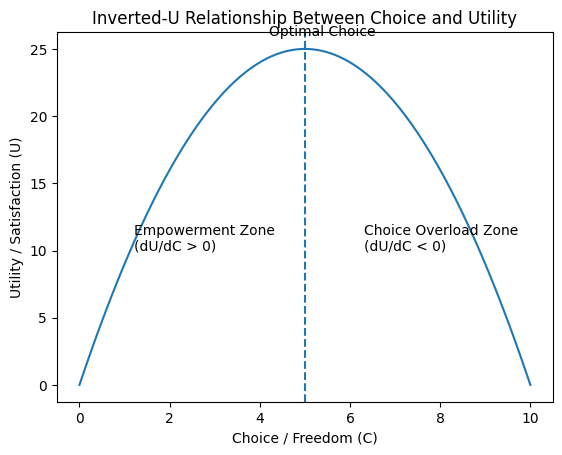
This inverted-U relationship illustrates that optimal well-being arises not from maximum freedom but from structured freedom, where choice is curated, meaningful, and bounded by context or expertise.

The paradox of financial choice reveals a deeper human truth that enjoying freedom without boundaries can be as imprisoning as constraint. The promise of financial autonomy has mutated into an obligation to constantly optimise, compare, and compete. It seems like we are drowning in option value as every unrealised choice weighs on our psyche. We are victims of decision fatigue as we are living through the privatisation of financial risk disguised as empowerment. True financial freedom, therefore, is not about multiplying options but mastering them and knowing when to choose, when to stop, and when to rest. As with most paradoxes, the solution lies in the balance of the freedom to simplify, ignore, and define what ‘enough’ means in a world that always demands more.

Gold Rush

As the festive season in India is ongoing, jewellers across India are ready, investors tracking bullion prices, and families waiting eagerly for the most “auspicious” day of the year to buy gold. Dhanteras, celebrated two days before Diwali, has long been associated with the purchase of the precious metal, a tradition believed to bring prosperity and good fortune. Similar buying frenzies occur during Akshaya Tritiya, weddings, Karwa Chauth, and harvest festivals, when gold is not merely an adornment but a cultural marker of wealth and status.

Market reports celebrate the crores spent, but beneath the sparkle lies a complex story of culture, aspiration, and economics. Is festival gold-buying a timeless symbol of financial prudence and cultural continuity, or is it a cycle of consumption propelled by social pressure, marketing, and habit?

India’s love affair with gold is centuries old. From the time of the Indus Valley civilisation to the Mauryan emperors to our modern nuclear families, gold has been a medium of exchange, a store of value, and a token of spiritual significance. For millions, gold is not just metal, it is Lakshmi, the goddess of wealth herself. Dhanteras literally means “the thirteenth day of wealth,” and families believe that buying gold on this day invites abundance.

This cultural reverence made economic sense in a pre-banking era. Gold’s intrinsic value and portability provided a hedge against famine, emergency, and currency devaluation. Rural households, lacking access to formal savings mechanism, used jewellery as insurance and collateral. Even today, India remains the world’s second-largest consumer of gold, with annual demand often exceeding 700–800 tonnes. For many, gold remains the most trusted form of intergenerational wealth transfer.

Yet, today’s festival buying is no longer just about family heirlooms or prudent savings. It has evolved into a multi-billion-rupee economic event. According to trade bodies like the All-India Gem and Jewellery Domestic Council, Dhanteras sales often spike by 20–25% year-on-year, depending on price trends. In 2024, for example, despite gold hovering at record highs of around INR61,000 per 10 grams, jewellers reported robust demand, with many urban consumers opting for lighter designs or digital gold to keep up with tradition.

Specific estimates for festival (especially Dhanteras) sales in recent years help show the proportion of demand tied to ritual buying. During Dhanteras in 2024, around 20-22 tonnes of gold were sold, worth nearly INR 16,000 crore. The full jewellery sector during the festival period saw sales in the INR 18,000-20,000 crore.

The annual figures show India’s gold demand continues to be immense, though shifting in nature,

  • In 2024, India’s total gold demand rose to around 802.8 tonnes, up from 761 tonnes in 2023.  
  • The value of gold purchases in 2024 was estimated at INR 5.15 lakh crore (~US$60-70 billion depending on gold price).  
  • Jewellery demand in 2024 was ~ 563 tonnes, with the non-ornamental purchases (coins/bars) making up ~ 239 tonnes.   

These numbers reflect overall demand, not just festival or Dhanteras purchases, but festivals remain a major driver. The data show that although overall demand has often crept upward in value terms (driven by price inflation), the volume of jewellery demand has at times fallen or stagnated. For example, in 2024 jewellery tonnage demand dropped ~2% compared to 2023 even as value increased.

Targeted marketing plays a huge role. Advertisements link gold to auspiciousness and emotional milestones, “Gift prosperity,” “Secure her future,” “Start your Diwali with gold.” Social media influencers and celebrity endorsements reinforce the message that a festival without gold is incomplete. This creates a powerful psychological loop: buying gold is not just desirable, it is expected.

The Dhanteras gold rush is fuelled by a mix of fear and aspiration. Gold retains a near-mystical aura as a hedge against uncertainty. Global financial instability, inflation, and geopolitical tensions often send prices higher, reinforcing the perception of gold as a “safe haven.” For middle-class families, a few grams bought every year feels like both a celebration and a safety net.

But there is also the quieter pressure of status. Weddings, festivals, and social gatherings often showcase jewellery as a measure of success. The fear of “falling behind” relatives or neighbours can nudge families, especially in smaller towns and rural areas, into stretching budgets and even getting into debt trap to maintain appearances. What was once a hedge against uncertainty can change into a source of financial strain.

From a macroeconomic perspective, India’s gold obsession is a double edged sword. While the jewellery industry supports millions of jobs, from miners to artisans to retailers, it also represents a massive outflow of capital. India imports more than 90% of its gold, spending billions of dollars in foreign exchange each year. Economists have long argued that this “dead investment” locks up household savings in a non-productive asset, diverting funds from sectors like manufacturing, infrastructure, or technology that could generate higher returns and employment.

For individual households, the opportunity cost is equally significant. A family buying gold at festival-time may forgo investing in equity markets, mutual funds, or even bank deposits that could provide compounding growth. Gold prices, while generally stable over the long term, are not immune to volatility as we are witnessing now with gold prices rising to INR 120K+ per 10 grams. The metal offers no dividends or interest; its value lies only in resale or emotional satisfaction.

Beyond economics lies an often-ignored cost, the environmental impact of gold mining. Extracting gold is an energy-intensive process that generates toxic waste and contributes to deforestation, soil erosion, and water pollution. Globally, gold mining is associated with mercury contamination and significant carbon emissions. While India imports much of its gold, domestic refining and artisanal mining also pose environmental challenges.

Consumers rarely connect their festival purchases to these ecological consequences. The cultural narrative of purity and prosperity masks the fact that every bangle and coin carries a hidden footprint. Ethical sourcing, such as recycled gold or fair-trade certifications, is slowly gaining traction among urban, environmentally conscious buyers, but remains a niche segment.

As India’s economy digitises, a quiet transformation is underway. Younger consumers, especially in cities, are exploring alternatives to physical gold. Digital gold platforms, gold exchange-traded funds (ETFs), and sovereign gold bonds (SGBs) allow individuals to invest in gold without worrying about purity, storage, or theft.

These products offer flexibility and sometimes better returns. Sovereign gold bonds, for instance, pay annual interest and are exempt from capital gains tax if held to maturity. Yet they also challenge the cultural core of gold-buying: there is no ornament to wear, no glitter to display, no festive ritual of walking into a jewellery shop on Dhanteras. For many families, the emotional experience is as important as the investment itself. Still, the shift is undeniable. Digital gold platforms have reported double-digit growth during recent festivals, particularly among younger investors who value convenience and liquidity over tradition.

So where does this leave the Indian consumer? To dismiss festival gold-buying as mere superstition would be simplistic. Traditions provide continuity, identity, and joy. For rural households with limited access to financial products, gold remains a practical and trusted savings tool.

But to ignore the economic, environmental, and social pressures embedded in this ritual is equally shortsighted. When a practice once rooted in prudence becomes a compulsive annual expense, it risks becoming a trap. The symbolism of prosperity can mask financial strain, and the celebration of abundance can conceal environmental degradation. Festivals can retain their joy without becoming economic burdens. A few grams of gold bought with intention, rather than compulsion, can honour tradition while respecting modern realities.

Dhanteras will always hold a special place in the Indian calendar. The sight of families entering jewellery shops, and elders blessing the new purchase is undeniably heartwarming. Yet it is worth remembering that true prosperity lies not in the weight of gold but in the wisdom of choice.

As India strides into a digital, climate conscious future, perhaps the most auspicious act is not buying more gold, but buying it mindfully acknowledging its beauty, its history, and its hidden costs. The goddess of wealth, after all, smiles brightest on those who balance tradition with thoughtfulness.

Buy thoughtfully. Celebrate responsibly. Live consciously.

Social Entrepreneurship

Click on the link for the Power Point Presentation. Social Entrepreneurship