Are you time-poor?

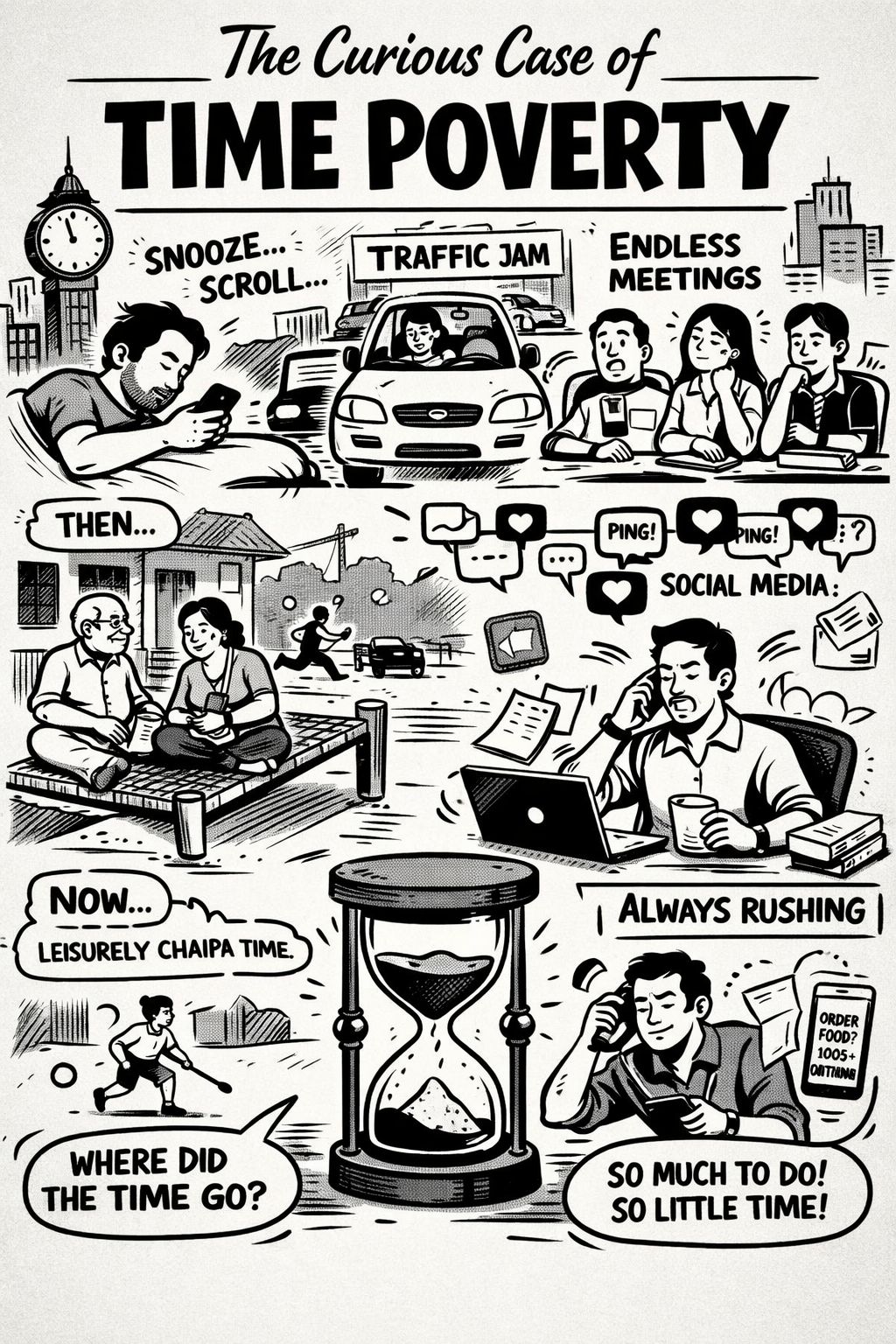
Somewhere between the invention of the pressure cooker and the arrival of 5G, we Indians collectively misplaced something really important: Time. Not lost in a dramatic, cinematic way, without violins or slow motion, but more like a wallet lifted from your back pocket in a crowded Metro. One moment it was there, lazy afternoons, unplanned conversations, the comforting stretch of doing nothing, and the next moment, gone. In its place, we now have Google Calendar reminders, WhatsApp notifications, and a persistent feeling that we are always slightly late for something, even when we are sitting still. Welcome to the era of time poverty, where your bank balance may look respectable, your Zomato order history may be thriving, and your LinkedIn profile may be aggressively inspirational, but your time account is permanently overdrawn.

Let’s rewind a bit, not to some sepia-toned village fantasy, but just a generation ago, in the same cities we inhabit today, where life had a different rhythm. Time was not abundant in a literal sense, as people still worked hard, commuted, raised families, but it felt less fractured. Evenings were events in themselves, when people sat outside their homes discussing politics and cricket over multiple cups of tea, and that one neighbour who always seemed to have too many visitors. Children played gully cricket until the ball inevitably landed in someone’s kitchen, leading to heated negotiations that doubled as character-building exercises. Mothers called out from balconies and verandahs with a mix of authority and affection, summoning children home before darkness turned into parental anxiety. There were fewer choices, yes, but also fewer decisions to make. Dinner was whatever was cooked, and nobody spent fifteen minutes comparing paneer butter masala across twelve delivery apps while reading 237 reviews written by people who clearly have too much time.

The great unifier, television, had one channel, Doordarshan, maybe two if you were fancy. If you missed your favourite show, you missed it, as there was no replay, no binge-watching, no existential spiral at 2 AM where you question your life choices while watching the fourth episode of something you don’t even like. And waiting, ah, waiting was a legitimate activity. We waited for letters, for phone calls on the clunky telephone sets, for exam results. Waiting was not seen as wasted time; it was just part of time itself, like monsoons or power cuts. Our minds wandered, conversations happened, and occasionally, we even ‘thought’ our own thoughts without an algorithm suggesting what to think next!

Now fast forward to urban India today, where time is not just scarce but seems to be actively hunted. A typical weekday begins with negotiation between you and your alarm clock, which has now evolved into a relentless life coach with a snooze button. Before your feet even touch the ground, your thumb has already scrolled through emails, news updates, Instagram reels, and three subtle reminders that everyone else seems to be doing better than you at 7:17 am in the morning. We often eat breakfast alongside a call that begins with ‘Can you hear me?’ and ends with ‘Let’s take this offline,’ a phrase that has single-handedly consumed more human hours than traffic jams.

If time poverty had a national symbol, it would undoubtedly be the urban traffic. Whether you are inching along the Delhi-Gurgaon expressway, contemplating your life choices at Bengaluru’s Central Silk Board junction, or performing advanced geometry in Mumbai’s local trains, your commute is not just a journey, but a full emotional experience. You begin with hope, perhaps even optimism, maybe today will be different, maybe traffic will be lighter, signals more cooperative, humanity kinder. Ten minutes later, you are recalibrating your expectations, bargaining with Google Maps, and listening to podcasts or FM radio not out of curiosity but as a coping mechanism. By the time you reach your destination, you have experienced a full spectrum of human emotion and possibly learned a new cuss word, none of which you will remember by lunchtime.

And then come the meetings, those sacred rituals of modern work culture where time doesn’t exactly die, it dissolves. Meetings to prepare for meetings, meetings to debrief previous meetings, and meetings that exist solely because someone somewhere feared the silence of not having a meeting. Entire hours are spent discussing action items that could have been bullet points in an email, that could have been a message, that could have been… nothing. Ironically, in our relentless pursuit of productivity, we have created systems so elaborate that they ensure we have no time left to actually produce anything. Efficiency has become a performance, and everyone is performing.

Of course, technology was supposed to save us, and in many ways, it has. Tasks that once took hours now take minutes, information is accessible instantly, and communication is effortless. But somewhere along the way, technology stopped being a tool and started behaving like a very needy companion. Your phone, that sleek little rectangle of promise, is now a workplace, an entertainment centre, a social hub, and an anxiety generator rolled into one. You pick it up to check the time and resurface twenty-seven minutes later, having watched three reels, replied to two messages, ignored five, read half an article, and completely forgotten why you picked it up in the first place. Time isn’t just being spent; it is being nibbled away in tiny, invisible bites.

Urban India today offers an abundance of choices in the form of food, experiences, careers, and content. But abundance comes with a hidden tax in the form of decision fatigue. Earlier, dinner was simple, and now it is an exercise in research, comparison, and occasional soul-searching. Even leisure has become labour, as watching a movie involves navigating multiple platforms, genres, languages, and algorithmic suggestions, each insisting it knows you better than you know yourself. By the time you decide what to watch, you are too tired to watch anything. The freedom to choose has quietly transformed into the burden of choosing.

Friendships, once spontaneous and effortless, are now managed with the precision of project timelines. ‘Let’s catch up’ translates into checking calendars, blocking slots, rescheduling due to unforeseen commitments, and finally meeting for exactly sixty minutes before someone inevitably says, ‘I have an early morning tomorrow.’ Even weddings, those grand celebrations of chaos and joy, have been optimised for efficiency. Destination weddings over long weekends, carefully curated guest lists, and itineraries that resemble conference agendas. Nothing says romance like a well-managed Google Sheet.

But perhaps the most insidious aspect of time poverty is lack of attention rather than the lack of hours. You may technically have free time, but your mind is rarely free. You are at dinner, but thinking about work. You are on vacation, but checking emails. You are resting but feeling guilty about it. The boundary between work and life hasn’t just blurred; it has politely excused itself and left the building. What remains is a constant hum of ‘I should be doing something,’ a background noise that turns even moments of rest into opportunities for anxiety.

In India, this phenomenon feels particularly intense because of the unique cocktail of factors at play. Rapid urbanisation has stretched infrastructure beyond its limits, turning simple commutes into endurance tests. Aspirational pressure ensures that everyone is constantly striving for better jobs, better salaries, better lifestyles. Digital adoption has been fast and enthusiastic, compressing decades of technological evolution into a few short years. And social expectations are layered on top of all this that rarely reduce, even as professional demands increase. The result is a society trying to operate at first-world speed with third-world infrastructure and fourth-world patience.

So are we truly poor in time? Or have we simply allowed time to be colonised and constantly interrupted? The uncomfortable truth is that it is a bit of both. We are busier, yes, but we are also more distracted. We have more tools, but less control. We are connected, but not always present. Time poverty, then, is not just about scarcity, but more about how we experience the time that we have. It is the difference between a long, uninterrupted conversation and a series of half-hearted replies. Between a meal savoured and a meal consumed while scrolling. Between living time and merely passing through it.

The solution, if there is one, is unlikely to be dramatic. Most of us are not about to quit our jobs and retreat to the Himalayas like some of our friends have, and even if we did, we would probably post about it online. But small shifts are possible, like protecting pockets of uninterrupted time, reducing unnecessary decisions, and occasionally allowing ourselves the radical act of doing nothing. These are not grand gestures, but they are meaningful ones. They remind us that time is not just something to be managed but something to be experienced.

We often say, ‘I don’t have time,’ when what we really mean is, ‘Something else has taken priority.’ Time poverty is not just a condition but a consequence of choices, both ours and the systems we inhabit. In a country that has mastered the art of jugaad, perhaps it is high time we apply that ingenuity to time itself. Because somewhere between the past we romanticise and the present we rush through lies a simple, almost rebellious idea that what if we stopped trying to save time and started trying to live it?

Economics of Diwali

As we celebrate the sparkle of Diwali festivities with lights, the Indian economy, too, is glowing with festive energy. Diwali is not only a cultural and spiritual event but also an economic phenomenon that mobilizes consumption, trade, and emotion on a scale unmatched by any other festival in India. It is a festival where faith, finance, and family come together to illuminate not just homes but entire markets.

Diwali blends culture and commerce. Traditionally marking the return of Lord Ram to Ayodhya after 14 years of vanavasa (exile), the festival has evolved into India’s largest consumption cycle. According to industry estimates, Diwali season alone accounts for 30–40% of annual sales in sectors like jewellery, automobiles, electronics, apparel, and consumer goods.

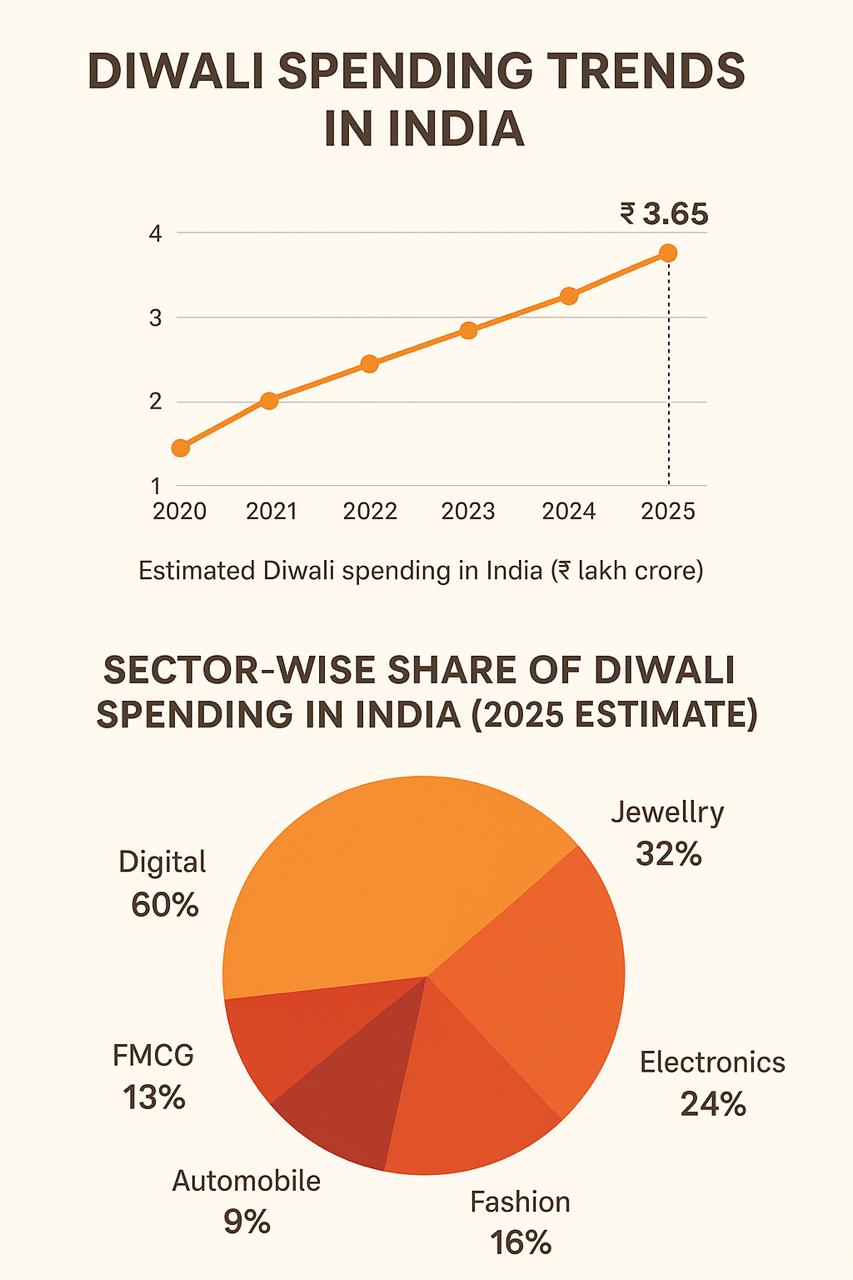
In 2024, India’s festive spending during Diwali week was estimated at INR 3.2 lakh crore, reflecting a 17% rise over 2023, driven by rising disposable incomes, pent-up post-pandemic demand, and digital retail penetration. Retail chains, e-commerce platforms, and even microenterprises depend on this period to recover annual profits. For small traders, Diwali is often the difference between a good year and a bad one. The festival also synchronizes the Indian economy’s emotional rhythm—consumer sentiment peaks as the festival approaches, heightened by work bonuses, gifts, and an almost cultural belief that new purchases bring prosperity.

Two days before Diwali, Indians celebrate Dhanteras, considered the most auspicious day to buy gold, silver, or anything of value. Historically, this practice was rooted in agrarian prosperity cycles during which, farmers who had completed the harvest season invested their earnings in tangible assets like metals. Today, the sentiment remains, but the scale has exploded. The symbolism has migrated from the vault to the marketplace, aligning tradition with modern consumption.

Diwali’s economic landscape has been radically redrawn by digital commerce. In 2024, online festive sales crossed INR 90,000 crore, driven by e-commerce platforms like Amazon, Flipkart, and Meesho. Tier-II and Tier-III cities accounted for more than 60% of new shoppers, an indication that India’s digital inclusion is now deeply linked with its festive economy.

Algorithms have replaced astrologers in predicting purchasing patterns. AI-driven recommendations, influencer marketing, and digital payment ecosystems like UPI have made the act of buying faster and impulsive. While urban consumers enjoy massive discounts, small offline retailers struggle to match online prices. Many traditional businesses like sweet shops, garment stores, and gift outlets are now adapting with hybrid models, selling on WhatsApp or through community platforms. The local bazaar is not dying; it is simply going online.

Behind the glitter of malls and advertisements lies a quieter but equally powerful story of the informal and rural economy that powers Diwali. Across India, millions of artisans, potters, weavers, and small manufacturers depend on the season for a significant portion of their income. From handmade diyas in Bihar to terracotta idols from Bankura, paper lanterns in Maharashtra, and bamboo crafts from Northeastern states, Diwali sustains local creative economies that embody both tradition and entrepreneurship. In recent years, several NGOs and social enterprises have helped rural producers connect directly with urban buyers through digital platforms. For instance, self-help groups (SHGs) supported by government programs like NRLM (National Rural Livelihoods Mission) and private CSR initiatives now sell festive handicrafts on e-commerce sites and social media. The “Make in Village” movement during Diwali is becoming a quiet counter-narrative to imported mass-produced goods. Every diya sold is not just a source of light but a livelihood.

Gifting is central to Diwali’s economic ecosystem. From corporate gift hampers to sweets exchanged among families, the ritual symbolizes goodwill, reciprocity, and status. In 2024, India’s corporate gifting industry was valued at ₹12,000 crore, with strong growth projected for 2025. Beyond sweets and dry fruits, companies now gift experiences like wellness vouchers, eco-friendly hampers, and handmade products to reflect social consciousness and sustainability. The gifting economy also reveals deeper social psychology. Gifts during Diwali are not just commodities; they are currencies of relationship. In economic terms, they create “social capital”, the trust and goodwill that sustain business and personal networks alike.

In last decade or so, Diwali’s environmental impact has come under scrutiny. Delhi is the best (or worst) example of this intense air pollution from firecrackers making the environment unbreathable, plastic waste from packaging, and excessive electricity consumption have led to rising calls for a Green Diwali. The market is responding with conscious choices. In 2025, the sale of eco-friendly crackers and biodegradable decorations is expected to grow by 30%. Solar-powered lighting, organic sweets, and recycled packaging are becoming mainstream. Conscious consumers, especially younger urban Indians, are now demanding sustainable alternatives that align celebration with responsibility. The shift from conspicuous consumption to conscious consumption marks a new chapter in the economics of Diwali, one where prosperity is measured not just by spending, but by sustainability.

However, Diwali’s prosperity is not evenly distributed. Inflation affects the purchasing power of lower-income families who often face higher food and fuel prices during the season despite the recent GST reforms, which has significantly brought down the prices of most of the consumer goods. While the urban affluent splurge on gadgets and gold, many households cut back on essentials.

This divergence reflects the broader K-shaped recovery post-pandemic of the Indian economy, where upper segments surge ahead while those on the lower segments struggle. The festive glow, though radiant, hides shadows of inequality. For small retailers, rising input costs and competition from online giants have squeezed margins. For daily wage earners, the festival may mean temporary income spikes but little long-term security. Diwali illuminates both the promise and paradox of India’s growth story.

At its core, Diwali celebrates renewal of hope, homes, and human spirit. Economically too, it acts as a reset button for the nation’s consumer sentiment. The act of cleaning homes, buying new things, and lighting lamps mirrors the cyclical nature of economic optimism. For policymakers and economists, the festive season is a real-time barometer of demand. For families, it’s a reminder that prosperity is not just about wealth, but about togetherness and gratitude. In many ways, Diwali teaches an enduring lesson in economics that growth is sustainable only when it is inclusive, joyful, and mindful.

The economics of Diwali is not just about expenditure, but it is also about the exchange of energy, emotion, and enterprise. It reflects India’s evolving story of modernization rooted in tradition, digital transformation anchored in ritual, and capitalism softened by culture. The future of India’s festive economy will shine brightest when it balances profit with purpose, growth with gratitude, and consumption with conscience.

Gold Rush

As the festive season in India is ongoing, jewellers across India are ready, investors tracking bullion prices, and families waiting eagerly for the most “auspicious” day of the year to buy gold. Dhanteras, celebrated two days before Diwali, has long been associated with the purchase of the precious metal, a tradition believed to bring prosperity and good fortune. Similar buying frenzies occur during Akshaya Tritiya, weddings, Karwa Chauth, and harvest festivals, when gold is not merely an adornment but a cultural marker of wealth and status.

Market reports celebrate the crores spent, but beneath the sparkle lies a complex story of culture, aspiration, and economics. Is festival gold-buying a timeless symbol of financial prudence and cultural continuity, or is it a cycle of consumption propelled by social pressure, marketing, and habit?

India’s love affair with gold is centuries old. From the time of the Indus Valley civilisation to the Mauryan emperors to our modern nuclear families, gold has been a medium of exchange, a store of value, and a token of spiritual significance. For millions, gold is not just metal, it is Lakshmi, the goddess of wealth herself. Dhanteras literally means “the thirteenth day of wealth,” and families believe that buying gold on this day invites abundance.

This cultural reverence made economic sense in a pre-banking era. Gold’s intrinsic value and portability provided a hedge against famine, emergency, and currency devaluation. Rural households, lacking access to formal savings mechanism, used jewellery as insurance and collateral. Even today, India remains the world’s second-largest consumer of gold, with annual demand often exceeding 700–800 tonnes. For many, gold remains the most trusted form of intergenerational wealth transfer.

Yet, today’s festival buying is no longer just about family heirlooms or prudent savings. It has evolved into a multi-billion-rupee economic event. According to trade bodies like the All-India Gem and Jewellery Domestic Council, Dhanteras sales often spike by 20–25% year-on-year, depending on price trends. In 2024, for example, despite gold hovering at record highs of around INR61,000 per 10 grams, jewellers reported robust demand, with many urban consumers opting for lighter designs or digital gold to keep up with tradition.

Specific estimates for festival (especially Dhanteras) sales in recent years help show the proportion of demand tied to ritual buying. During Dhanteras in 2024, around 20-22 tonnes of gold were sold, worth nearly INR 16,000 crore. The full jewellery sector during the festival period saw sales in the INR 18,000-20,000 crore.

The annual figures show India’s gold demand continues to be immense, though shifting in nature,

  • In 2024, India’s total gold demand rose to around 802.8 tonnes, up from 761 tonnes in 2023.  
  • The value of gold purchases in 2024 was estimated at INR 5.15 lakh crore (~US$60-70 billion depending on gold price).  
  • Jewellery demand in 2024 was ~ 563 tonnes, with the non-ornamental purchases (coins/bars) making up ~ 239 tonnes.   

These numbers reflect overall demand, not just festival or Dhanteras purchases, but festivals remain a major driver. The data show that although overall demand has often crept upward in value terms (driven by price inflation), the volume of jewellery demand has at times fallen or stagnated. For example, in 2024 jewellery tonnage demand dropped ~2% compared to 2023 even as value increased.

Targeted marketing plays a huge role. Advertisements link gold to auspiciousness and emotional milestones, “Gift prosperity,” “Secure her future,” “Start your Diwali with gold.” Social media influencers and celebrity endorsements reinforce the message that a festival without gold is incomplete. This creates a powerful psychological loop: buying gold is not just desirable, it is expected.

The Dhanteras gold rush is fuelled by a mix of fear and aspiration. Gold retains a near-mystical aura as a hedge against uncertainty. Global financial instability, inflation, and geopolitical tensions often send prices higher, reinforcing the perception of gold as a “safe haven.” For middle-class families, a few grams bought every year feels like both a celebration and a safety net.

But there is also the quieter pressure of status. Weddings, festivals, and social gatherings often showcase jewellery as a measure of success. The fear of “falling behind” relatives or neighbours can nudge families, especially in smaller towns and rural areas, into stretching budgets and even getting into debt trap to maintain appearances. What was once a hedge against uncertainty can change into a source of financial strain.

From a macroeconomic perspective, India’s gold obsession is a double edged sword. While the jewellery industry supports millions of jobs, from miners to artisans to retailers, it also represents a massive outflow of capital. India imports more than 90% of its gold, spending billions of dollars in foreign exchange each year. Economists have long argued that this “dead investment” locks up household savings in a non-productive asset, diverting funds from sectors like manufacturing, infrastructure, or technology that could generate higher returns and employment.

For individual households, the opportunity cost is equally significant. A family buying gold at festival-time may forgo investing in equity markets, mutual funds, or even bank deposits that could provide compounding growth. Gold prices, while generally stable over the long term, are not immune to volatility as we are witnessing now with gold prices rising to INR 120K+ per 10 grams. The metal offers no dividends or interest; its value lies only in resale or emotional satisfaction.

Beyond economics lies an often-ignored cost, the environmental impact of gold mining. Extracting gold is an energy-intensive process that generates toxic waste and contributes to deforestation, soil erosion, and water pollution. Globally, gold mining is associated with mercury contamination and significant carbon emissions. While India imports much of its gold, domestic refining and artisanal mining also pose environmental challenges.

Consumers rarely connect their festival purchases to these ecological consequences. The cultural narrative of purity and prosperity masks the fact that every bangle and coin carries a hidden footprint. Ethical sourcing, such as recycled gold or fair-trade certifications, is slowly gaining traction among urban, environmentally conscious buyers, but remains a niche segment.

As India’s economy digitises, a quiet transformation is underway. Younger consumers, especially in cities, are exploring alternatives to physical gold. Digital gold platforms, gold exchange-traded funds (ETFs), and sovereign gold bonds (SGBs) allow individuals to invest in gold without worrying about purity, storage, or theft.

These products offer flexibility and sometimes better returns. Sovereign gold bonds, for instance, pay annual interest and are exempt from capital gains tax if held to maturity. Yet they also challenge the cultural core of gold-buying: there is no ornament to wear, no glitter to display, no festive ritual of walking into a jewellery shop on Dhanteras. For many families, the emotional experience is as important as the investment itself. Still, the shift is undeniable. Digital gold platforms have reported double-digit growth during recent festivals, particularly among younger investors who value convenience and liquidity over tradition.

So where does this leave the Indian consumer? To dismiss festival gold-buying as mere superstition would be simplistic. Traditions provide continuity, identity, and joy. For rural households with limited access to financial products, gold remains a practical and trusted savings tool.

But to ignore the economic, environmental, and social pressures embedded in this ritual is equally shortsighted. When a practice once rooted in prudence becomes a compulsive annual expense, it risks becoming a trap. The symbolism of prosperity can mask financial strain, and the celebration of abundance can conceal environmental degradation. Festivals can retain their joy without becoming economic burdens. A few grams of gold bought with intention, rather than compulsion, can honour tradition while respecting modern realities.

Dhanteras will always hold a special place in the Indian calendar. The sight of families entering jewellery shops, and elders blessing the new purchase is undeniably heartwarming. Yet it is worth remembering that true prosperity lies not in the weight of gold but in the wisdom of choice.

As India strides into a digital, climate conscious future, perhaps the most auspicious act is not buying more gold, but buying it mindfully acknowledging its beauty, its history, and its hidden costs. The goddess of wealth, after all, smiles brightest on those who balance tradition with thoughtfulness.

Buy thoughtfully. Celebrate responsibly. Live consciously.

Algorithmic Self

In today’s digital landscape, our identities are increasingly shaped by algorithms. These complex sets of rules and calculations determine the content we see on social media, the advertisements we encounter, and even the news we consume. This phenomenon, often referred to as the ‘algorithmic self,’ highlights the interplay between technology and personal identity. Algorithmic mechanisms on digital media are powered by social drivers, creating a feedback loop complicating the role of algorithms and existing social structures. 

At the core of the algorithmic self is the idea that our online behaviours and interactions feed into algorithms that, in turn, influence our future actions. Are we becoming the people our feeds want us to be? Scroll long enough on social media platforms like Insta, Tube, or FB and you’ll notice that the content feels uncannily tailored to you. Your feed seems to know what you crave before you do, an oddly perfect mix of travel destinations, recipes, memes, news, workouts, and political takes. This can lead to a more personalised online experience, but it also raises questions about the extent to which our choices are truly our own. What began as a convenience has evolved into something far more consequential. We are not merely using algorithms anymore; we are slowly becoming the selves they design for us.

Algorithms are built to predict and keep us engaged. Every click, pause, like, or scroll is recorded and analysed. In return, the system feeds us more of what we have already consumed. This sounds harmless. After all, who wouldn’t want relevant recommendations? But personalization is never neutral. When a platform rewards the content that hooks us, it amplifies our biases and shrinks our curiosity. Over time, the feedback loop begins to define our worldview, narrowing the range of opinions, art, music, or even relationships we encounter.

The unsettling part is that the algorithm’s goal is not truth, diversity, or personal growth. It is engagement. If desire makes you scroll, it will serve you love. If envy fuels your clicks, it will curate envy-inducing lifestyles. What feels like a reflection of your taste is often a reflection of what keeps you online.

Human behaviour is always shaped by culture, but algorithmic influence is different in speed and precision. Traditional media might set trends, but it never recalibrated itself in real time for every individual. Today, AI systems track micro-reactions—how long your eyes linger on a video frame, how quickly you swipe away, and adjust instantly.

This raises a disturbing question. When you decide to buy a product, support a social cause, or adopt a new hobby, how much of that decision is you, and how much is a carefully engineered nudge? We still feel autonomous because the algorithm rarely forces choices. Instead, it quietly limits what enters the realm of possibility. You can’t choose what you don’t see. Is this the erosion of free will?

Living in an algorithmic world also reshapes identity. Our “digital selves” are rewarded for consistency. The more we like certain posts, the more similar content we receive, and the more we feel pressure to maintain that version of ourselves, whether it’s the fitness enthusiast, the foodie, the activist, or the minimalist. The feed trains us to be predictable because unpredictability breaks the machine’s efficiency.

The rise of the algorithmic self also brings about ethical considerations. There are concerns about privacy, as the data collected to fuel these algorithms often includes personal and sensitive information. Additionally, there is the issue of transparency. Many algorithms operate as ‘black boxes,’ with their inner workings hidden from users. This lack of transparency can make it difficult to understand how decisions are being made and to hold platforms accountable for their actions.

Many people feel a subtle dissonance, their offline preferences drift, but their online persona stays fixed. We perform for the algorithm, optimizing captions, hashtags, even our emotions, to remain visible. Our feeds don’t just reflect who we are, they encourage us to stay who we were yesterday.

But then how do we break the loop?  The answer is not to reject technology altogether. Algorithms are not inherently evil; they can help us discover music, connect with communities, find a job we want, or learn skills we might never find on our own. The challenge is to reclaim agency within the system.

Practical acts of resistance can be quite simple, like, disrupting the feed by clicking on unfamiliar topics or following people outside your cultural bubble; time-box social media use or schedule ‘algorithm-free’ days; read newsletters or listen podcasts where engagement isn’t the primary metric. There could be several other ways to disrupt and reintroduce randomness. However, the most important step, is awareness. Algorithms will always evolve faster than regulations or ethical guidelines. The only lasting defence is a conscious user, someone who understands that every scroll is a form of training data.

The algorithmic self represents a significant shift in how we navigate our identities in the digital age. The question is not whether technology shapes us. It always has. As we continue to integrate technology into our daily lives, it is essential to remain mindful of the ways in which algorithms shape our identities and to advocate for greater transparency and ethical considerations in their design and implementation. The real question is whether we allow a handful of opaque systems to quietly define what we desire, believe, and become. If we don’t actively resist, our algorithmic selves may thrive while our authentic selves quietly disappear into the feed.