Why are we always mentally tired

There was a time when exhaustion was easier to identify. We worked long hours in physically demanding jobs, worked on farms under harsh weather, commuted through polluted industrial cities, or managed households without modern conveniences. Fatigue had a visible cause as the body had been pushed beyond its limits. Sleep was recovery; weekends were respite, and holidays meant genuine distance from work. Today, however, many of us wake up after a full night’s sleep, scroll through our phones before even leaving bed, drink expensive coffee, attend meetings from climate controlled offices, or increasingly, from the comfort of our homes and still feel mentally drained before the day has properly begun. While we are physically more comfortable than many generations before us, yet psychologically exhausted. We automate chores, outsource tasks, order meals at the tap of a screen, and have technologies that promise convenience at every turn. Yet an unshakable sense of mental fatigue persists. Somewhere between smartphones, hyper-connectivity, and the rise of productivity culture, rest stopped feeling restorative.

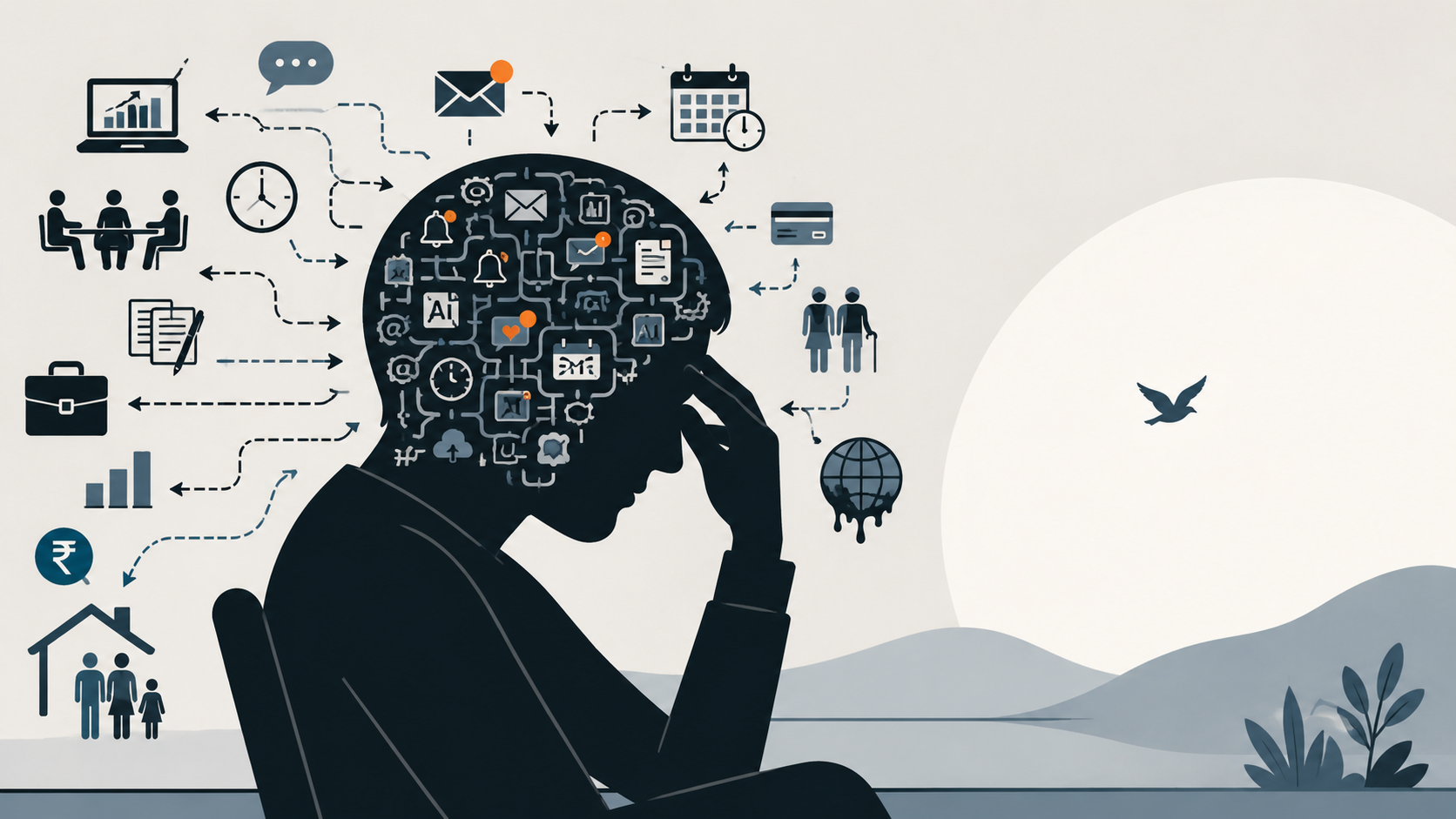
A major reason for this exhaustion is that much of modern work no longer looks like traditional labour. We may not be lifting heavy loads or working on factory floors, but our minds are constantly occupied by invisible labour. A typical day now involves hundreds of micro-decisions and mental calculations involving responding to emails, interpreting workplace messages, deciding whether to switch jobs, managing finances, maintaining health routines, learning new technologies, and staying professionally relevant in rapidly changing industries. Many white collar jobs are dominated by meetings, presentations, reporting systems, compliance paperwork, and endless communication loops that often create the feeling of working without producing anything tangible. Alongside this is the emotional labour of being perpetually available, maintaining workplace diplomacy, projecting enthusiasm on video calls, and managing social expectations. In India, this mental burden is often amplified by family structures and social pressures. A young professional in Bengaluru may simultaneously be managing a demanding job, financially supporting parents in Patna, paying off loans, and navigating expectations around marriage, property ownership, and children. The body may be still, but the mind rarely is.

Even rest has become strangely performative, as vacations are often curated for social media validation rather than genuine relaxation. People travel to scenic destinations only to spend significant time documenting the experience for Instagram. Meditation is increasingly packaged through apps that track streaks and productivity gains. Fitness devices convert sleep into measurable targets, making even rest feel like another metric to optimise. Reading books is replaced by listening to productivity podcasts at double speed. Leisure activities are routinely reframed as self-improvement exercises. Walking becomes hitting step goals, journaling becomes building mindfulness habits, and hobbies are often transformed into side hustles. Modern capitalism has shown an extraordinary ability to monetise downtime, and as a result many people return from vacations with travel fatigue, feeling as though they need another break to recover from their carefully curated break.

The smartphone has also fundamentally altered our relationship with boredom, and not for the better. For much of human history, boredom created opportunities for reflection and mental wandering. Waiting in line, sitting on a train, or standing at a bus stop often meant observing the world, thinking deeply, or simply letting the mind drift. Today, every idle moment is quickly filled by digital stimulation. We scroll while commuting, eating, waiting, and even during conversations. Notifications constantly interrupt our attention, creating an environment where our minds rarely experience stillness. Yet creativity, emotional processing, and deeper thinking often emerge during periods of mental quiet. Instead of such quiet, we are constantly consuming fragmented information like news updates, memes, political outrage, financial advice, celebrity gossip, and global crises, often within the span of a few minutes. The human brain was not designed to process wedding photos, economic anxieties, climate disasters, and viral dance videos in one endless stream.

The internet promised access to unlimited knowledge, but it also dramatically expanded the scale of social comparison. Earlier generations often compared themselves to neighbours, colleagues, or extended family members. Today, individuals compare their lives with influencers, entrepreneurs, celebrities, and strangers from across the globe. Social media ensures there is always someone younger, wealthier, more attractive, more successful, or apparently more fulfilled. This constant comparison fuels status anxiety. In India, where rapid economic mobility has transformed aspirations, this pressure can feel particularly intense. First-generation professionals moving from smaller towns to cities like Gurugram, Mumbai, or Hyderabad often carry the hopes of entire families. Success is rarely individual, as it is tied to broader expectations of upward mobility, making failure feel heavier and rest feel undeserved.

At the same time, many of the traditional institutions that once helped people cope with stress have weakened. Extended families are often geographically scattered. Friends have become fragmented, and neighbours frequently remain strangers. Young professionals frequently relocate for work, often living far from families and familiar support systems. Global cities create opportunity, but they can also intensify loneliness. Humans are deeply social beings, and managing life’s uncertainties without strong support systems creates an additional cognitive burden. Many people now seek connection through dating apps, therapy apps, social media, and digital entertainment that often provide temporary distraction but not necessarily meaningful belonging.

Technology has undoubtedly made life more convenient, but convenience should not be mistaken for ease. Ordering food online may save time, but it also introduces endless choices and decision fatigue. Streaming platforms eliminate the inconvenience of physical rentals but replace it with endless scrolling. Remote work reduces commuting but often erases boundaries between personal and professional life. Every convenience creates new layers of management. Earlier generations often had fewer options, which sometimes meant less mental clutter. Deciding what to eat for dinner today can involve navigating dietary preferences, delivery costs, health concerns, discount codes, and the occasional emotional justification that ordering biryani is a valid response to a difficult day, which, to be fair, it often is.

Perhaps most significantly, modern life is shaped by persistent uncertainty. Questions about job security, artificial intelligence, housing affordability, climate change, political instability, and retirement savings create a low-grade but constant sense of anxiety. These concerns are not abstract. Rising temperatures in Delhi, layoffs in technology sectors in Bengaluru, inflation affecting families in London and Lagos, and geopolitical instability all contribute to a sense that the future feels increasingly fragile. The human brain struggles with prolonged uncertainty, often interpreting it as a threat that demands constant vigilance.

The solutions to this exhaustion are unlikely to be found in another productivity hack or expensive wellness trend. What helps is often remarkably simple, like protecting boredom, taking walks without constant digital stimulation, nurturing relationships where no performance is required, setting boundaries with work, reducing unnecessary commitments, and accepting that not every aspect of life needs optimisation. Mental exhaustion is not always a sign of personal failure or poor discipline. In many cases, it is a rational response to systems designed to capture attention, maximise productivity, and blur the boundaries between labour and leisure. In a world that celebrates endless ambition, constant growth, and relentless hustle, perhaps the real skill of the future is learning how to preserve attention and protect mental stillness. It may involve resisting the urge to monetise every hobby, declining unnecessary busyness, and reclaiming genuine rest without guilt. In an era defined by noise, speed, and infinite demands on our attention, uninterrupted mental peace may be one of the rarest forms of luxury available and increasingly, one of the most necessary.

What are we optimising for

There is a peculiar anxiety that defines modern adulthood, which is the fear that somewhere, someone your age is living life better than you. They wake up at 5 AM to journal, meditate, go for a run or walk, consume protein-heavy breakfasts with ingredients you cannot even pronounce, maintain diversified investment portfolios, post thoughtful LinkedIn reflections about leadership, practice intermittent fasting, listen to podcasts at double speed, and somehow still find time to post photos captioned ‘grateful for the journey.’ Meanwhile, you are eating leftover biryani at 11 PM, ignoring unread emails, and wondering whether watching three back-to-back episodes of a series on OTT counts as self-care or surrender. Welcome to the age of optimisation, where every aspect of human life is treated as a system waiting to be upgraded.

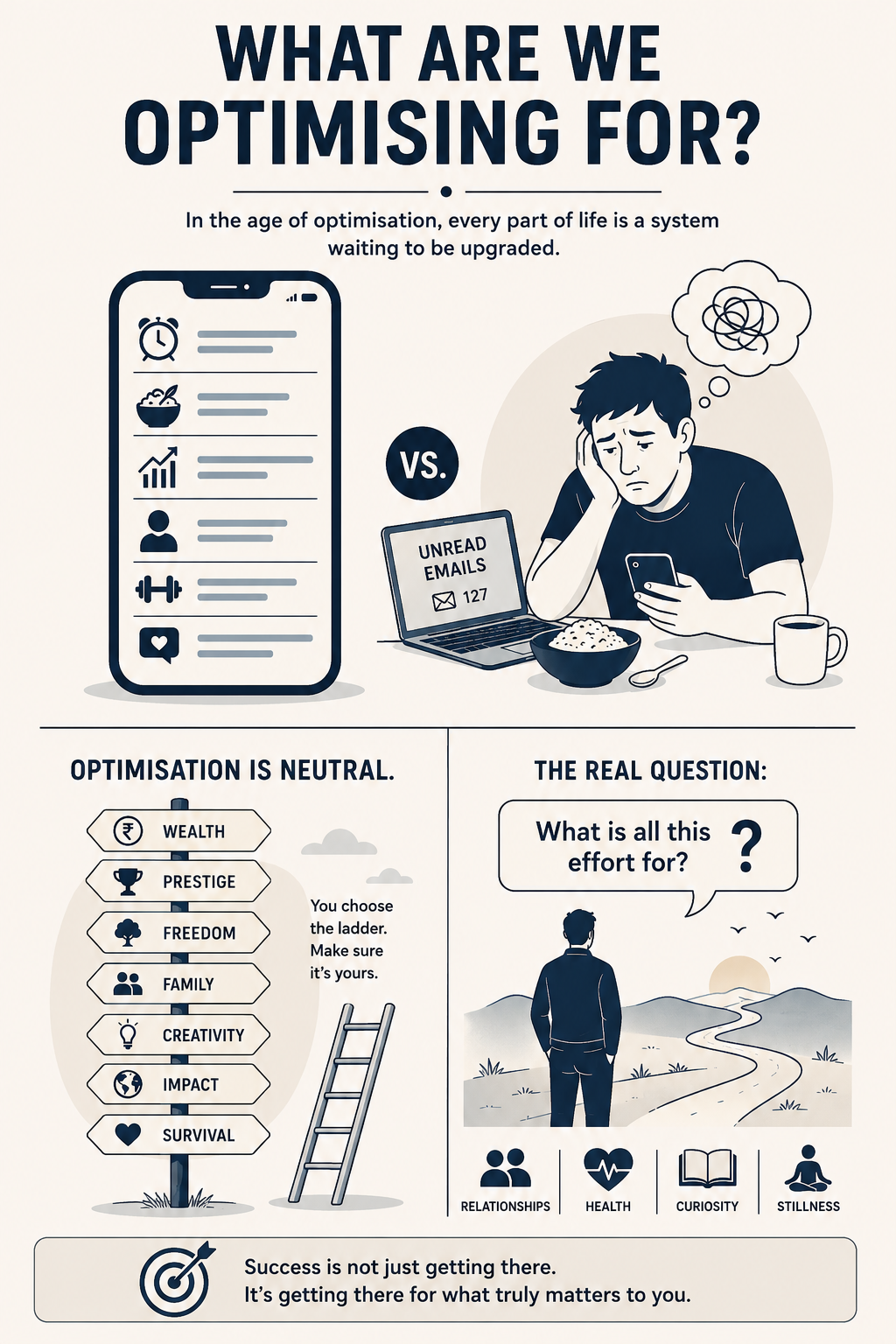
Every time I am on my Instagram, it is showing me posts and reels on how to work harder, sleep better, network smarter, manage my relationships more efficiently, eat cleaner, learn faster, age slower, retire earlier and build passive income streams. I keep receiving spam on how to track my calories, my mood, my steps, my productivity, and my screen time (usually through apps that require even more screen time!). Human beings have never had more tools to improve their lives, yet many seem increasingly unsure about what all this relentless optimisation is actually meant to achieve. That question matters because optimisation itself is morally neutral. One can optimise for wealth, prestige, freedom, family, creativity, impact, or simply survival. The real danger begins when people optimise by default, without consciously deciding what destination they are trying to reach.

For much of human history, life paths were shaped by geography, class, castes, family structures, religion, and social expectations. A farmer’s son often became a farmer, and family businesses were inherited. Communities dictated rhythms of marriage, work, and social responsibility. These systems could be deeply restrictive, but they also answered major life questions before individuals had to confront them. Modern life replaced those rigid structures with unprecedented freedom, but that freedom has created its own exhaustion. Today, individuals can theoretically become anything, from a founder, consultant, artist, social development specialist, creator, digital nomad, climate entrepreneur, venture capitalist, to a wellness coach, or any number of job titles that appear to have been invented inside a coworking space brainstorming session. But when every path appears open, every decision begins to feel like closing off another possibility.

This conundrum is particularly visible in India, where rapid economic transformation has dramatically expanded aspiration. In cities such as Bengaluru, Mumbai, and Gurugram, millions of first-generation professionals are participating in one of the largest upward mobility experiments in modern history. Many are children of doctors, teachers, farmers, small business owners, or government employees whose sacrifices created opportunities their children could only dream of. Their children now work in multinational firms, startups, for-purpose organisations, consulting companies, and global technology firms. The opportunities are real, but so is the pressure. Success often carries responsibilities beyond personal fulfilment, as it repays family debt, funds siblings’ education, supports parents, and becomes a symbol of collective social mobility. Ambition, therefore, becomes deeply emotional because it often carries the weight of inherited dreams.

This phenomenon is hardly unique to the geographic boundaries of India. Similar pressures shape immigrant families in the United States, first-generation professionals in Kenya, and upwardly mobile households across Southeast Asia and Latin America. However, India’s sheer population scale makes this phenomenon particularly visible. At the same time, global workplace culture has become remarkably effective at turning ambition into identity. Work is no longer simply something people do, but it is increasingly defining who they are. At networking events (and even social ones, as I am experiencing), the first question is almost always ‘What do you do?’ Rarely does anyone ask what brings someone joy, what relationships they value most, or whether they feel at peace with their lives.

Modern workplaces reward speed, availability, and measurable outcomes. There is always another promotion cycle, another certification, another startup opportunity, another productivity framework, and another way to feel perpetually behind. Entire industries now thrive by convincing people they are one habit away from becoming better versions of themselves. Even leisure has been absorbed into ambition, as travel becomes networking with other travellers you meet at the airports, next seat, at breakfast tables, sunset viewing, and in the swimming pools, reading becomes content consumption, exercise becomes data analytics on your smartphone, hobbies become monetisable side hustles, and rest becomes recovery for more work. Recently, a friend joked that he can no longer enjoy a morning run unless his smartwatch confirms he enjoyed it efficiently, which may be one of the most accurate summaries of modern life.

Technology has intensified this culture by expanding the scale of comparison. Earlier generations compared themselves to neighbours, relatives, or colleagues. Today, individuals compare themselves with startup founders in San Francisco, creators in Seoul, bankers in London, and influencers in Dubai before breakfast. Social media ensures that there is always someone younger, wealthier, fitter, more accomplished, and apparently more fulfilled. What social media rarely reveals are burnout, loneliness, failed ventures, strained marriages, anxiety medication, or the existential doubts that often accompany visible success.

One of the strangest contradictions of elite ambition is that many people spend decades optimising for lifestyles they barely have time to enjoy. Prestigious jobs leave little room for family, and dream vacations are interrupted by work calls. This is not an argument against ambition itself, as ambition can be deeply meaningful. It can lift families out of poverty, create institutions, solve major problems, produce art, and expand human progress. The problem is unconscious ambition. If someone wants to optimise for income, there is nothing inherently wrong with that. If someone prioritises freedom, impact, family, or creativity, those are equally valid choices. The important thing is understanding which game one is playing. Too many people are climbing ladders handed to them by parents, peers, employers, or algorithms without ever asking whether they wanted to climb those ladders in the first place.

The absurdities of optimisation culture become visible in everyday life. People optimise their routines while neglecting friendships, chase promotions while postponing health, expand professional networks while losing touch with siblings, or save aggressively for retirement while forgetting how to enjoy their lives in the present. Many work relentlessly for future freedom as though the future is guaranteed, but it is not, as layoffs and illness happen,  political systems become unstable, and entire industries disappear. The future remains far less controllable than optimisation culture would like people to believe.

That uncertainty can feel frightening, but it can also be liberating. If life is fundamentally unpredictable, perhaps the goal should not be maximum efficiency. Perhaps the goal should be building a life that feels coherent, a life where work matters but does not consume identity, where ambition exists without becoming an addiction, and where success includes relationships, health, curiosity, and moments of stillness. It may mean creating a calendar that reflects actual values rather than external expectations.Ultimately, every individual must confront the most important question for themselves: ‘What is all this effort for?’ Not what impresses employers, relatives, social media followers, or algorithms, but what genuinely matters on a personal level. For some, the answer may be financial security. For others, it may be family, entrepreneurship, public service, writing, travel, or a quieter life built around enough rather than endless accumulation. The greatest tragedy of modern life may not be failure, but may be becoming extraordinarily efficient at pursuing goals that were never truly your own.

Why everyone says, I am fine 

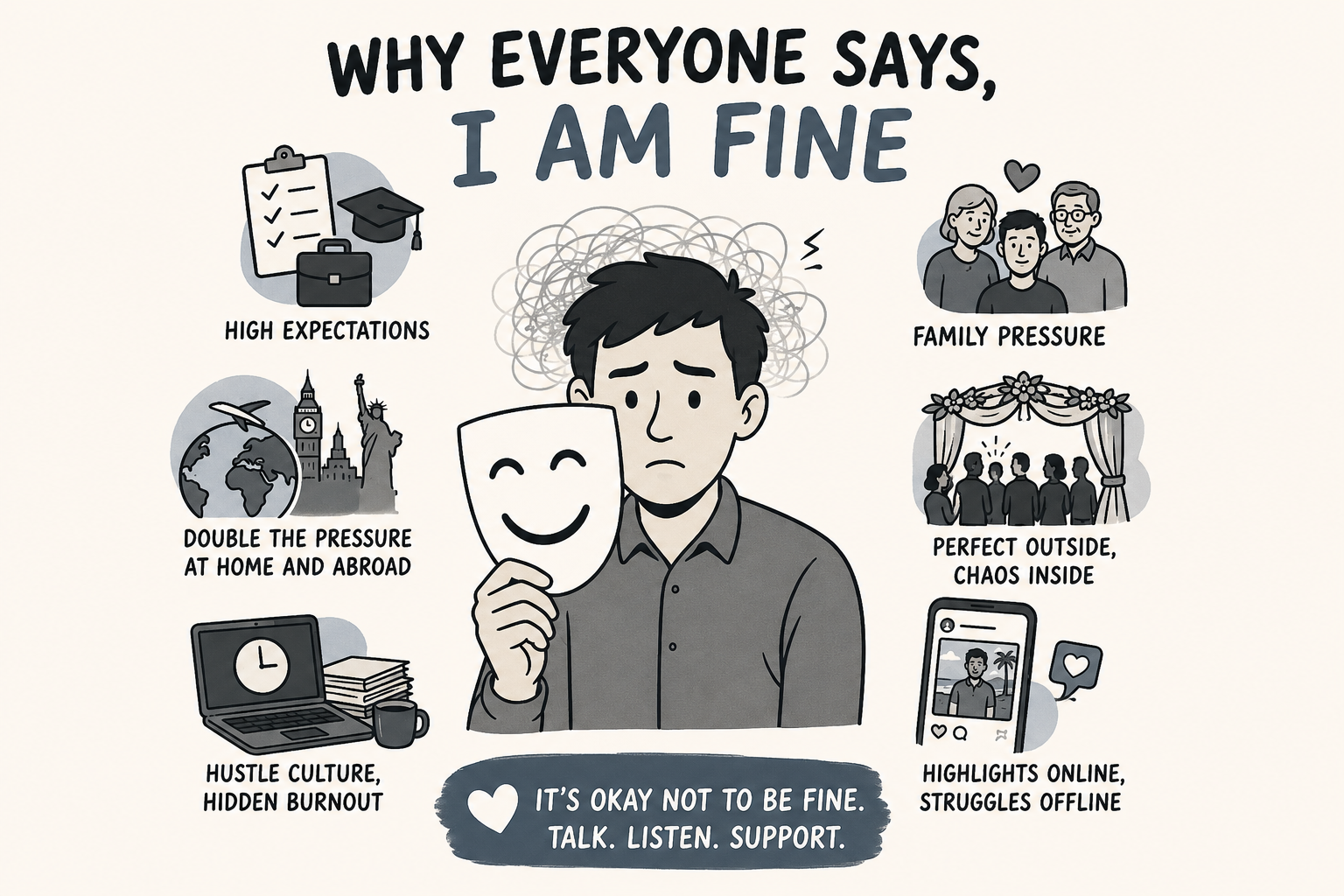
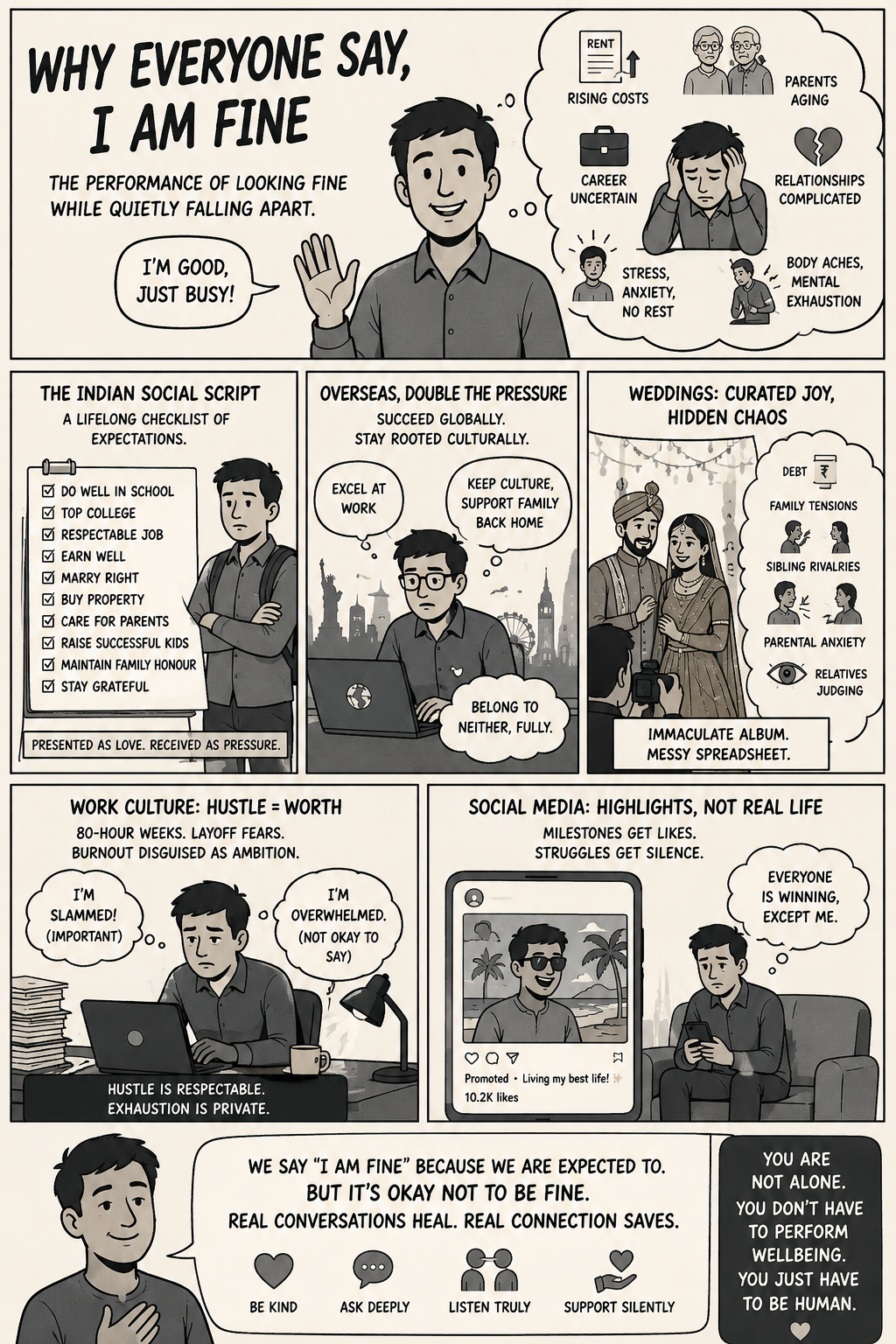
There is a performance that many people have mastered in modern life, of looking completely fine while quietly falling apart. It has become one of the most refined social skills of our time. You show up to work on time, reply to emails with professional warmth, attend weddings with coordinated outfits, post cheerful holiday photos, laugh at dinner parties, and reassure everyone that ‘all is well’ while your internal monologue resembles an emergency board meeting. Rent is rising, parents are ageing, careers feel uncertain, relationships are complicated, your back hurts for reasons your doctor politely describes as stress related, and you have not felt truly rested since sometime before the pandemic. Yet when someone asks how you are doing, the answer remains remarkably consistent, ‘Good, good. Just busy.’

Across the world, people are becoming increasingly fluent in this language of polished distress. Social media has trained us to curate competence, while professional culture rewards composure, and families often value stability over vulnerability. Entire societies function because millions of people continue showing up despite private exhaustion. But this performance feels particularly pronounced among Indians who are living both within India and across the global diaspora, where social expectations are often complex, relentless, and efficient at producing outward success alongside inward strain.

The Indian social script remains deeply achievement-oriented. From childhood, most of us are introduced to a familiar sequence of expectations that feels both culturally specific and globally recognisable, which includes performing well in school, attending a branded university/college, entering a respectable profession, earning well, marrying appropriately, buying property, caring for parents, raising successful children, and maintaining family honour while appearing effortlessly grateful for the opportunity. There are, of course, regional, class, and generational variations, but the broad architecture remains remarkably durable. Even among progressive urban families, conventional expectations often survive in modern packaging. Instead of explicit pressure to become a doctor or engineer, there may be subtle comparisons with cousins working at Google, Amazon, or investment firms in London. Marriage pressure may sound softer, but family Whatsapp groups can still function as passive-aggressive reminder systems.

The emotional burden becomes even more complicated because these expectations are rarely framed as pressure, as they are often presented as love, sacrifice, duty, and practical wisdom. Parents who invested heavily in their children’s education may genuinely believe they are guiding them toward security. Extended families may see their involvement as care. Communities may celebrate conformity because it appears stable. But good intentions do not eliminate psychological consequences. Many young professionals in Mumbai, Bengaluru, Delhi NCR, and Hyderabad are managing demanding careers while quietly navigating family expectations around marriage, caregiving responsibilities, home ownership, and financial support. They are often simultaneously trying to be globally competitive professionals and culturally responsible children. It is a difficult balancing act, made harder by the fact that neither side fully acknowledges the strain.

For Indians living overseas, the pressures often become even more complex. The immigrant success story remains one of the most celebrated narratives in many diaspora communities. The child of immigrants in the United States, Canada, the United Kingdom, or Australia may be expected to succeed professionally in highly competitive societies while also preserving cultural identity, supporting family back home, and remaining deeply connected to traditions that often become more rigid in migration. This produces a strange phenomenon where individuals feel pressure to excel in two worlds while fully belonging to neither. You are expected to understand tax laws in Seattle, maintain emotional fluency in Bihari family politics, and explain to relatives why you are still unmarried at 32 despite having what appears, on paper, to be an excellent and successful life!

Weddings deserve special mention as global showcases of curated wellbeing. Few events demonstrate collective emotional theatre quite like the fat Indian weddings. Families spend enormous amounts of money celebrating joy while quietly navigating interpersonal tensions, financial stress, unresolved conflicts, and logistical chaos. Guests arrive dressed magnificently, smiling for photographs that suggest a flawless communal celebration. Beneath the choreography, there may be sibling rivalries, debt, parental anxieties, and relatives evaluating everything from the food menu to life decisions. And though the wedding album looks immaculate, the emotional spreadsheet rarely does.

Professionally, employees are expected to remain productive through layoffs, economic uncertainty, technological disruption, and burnout. In India’s startup hubs and global financial centres alike, people casually describe 80-hour workweeks as ambition while quietly experiencing anxiety, insomnia, and emotional depletion. The language of hustle culture has simply provided respectable branding for exhaustion. Saying ‘I am slammed’ has become shorthand for importance. Saying ‘I am overwhelmed’ remains harder.

Social media has amplified all of this by turning life into a continuous public relations exercise. Platforms reward milestones like promotions, vacations, engagements, anniversaries, fitness transformations, children’s achievements, and entrepreneurial announcements. They are less enthusiastic about ambiguity, grief, stagnation, infertility struggles, career confusion, loneliness, or ordinary dissatisfaction. The result is a digital ecosystem where everyone appears to be thriving. You scroll through photographs of destination weddings in Udaipur, startup exits in San Francisco, babies in matching outfits, and beachfront holidays in Bali while sitting with your own uncertainty and wondering whether everyone else has somehow figured out adulthood.

Many people who appear successful are privately negotiating debt, loneliness, marital strain, workplace anxiety, fertility struggles, caregiving responsibilities, mental health challenges, or the exhausting task of meeting expectations they never consciously chose. The colleague who seems composed may be supporting parents through medical crises. The cousin posting anniversary photos may be managing deep relationship problems. The entrepreneur celebrating funding rounds may be unable to sleep. The family friend who constantly asks why you are not married may have spent years trapped in an unhappy marriage themselves. Human beings are remarkably skilled at editing their visible narratives.

Indian society’s combination of collectivist expectations, rapid economic change, intergenerational obligations, and intense social comparison creates a particularly sophisticated ecosystem of invisible pressure. What makes this dynamic especially difficult is that many people feel guilty for acknowledging it. After all, they may have stable jobs, supportive families, educational privilege, or material comfort relative to previous generations. Gratitude becomes weaponised against honest emotional reflection. ‘What do you have to complain about?’ remains one of the most efficient ways to shut down vulnerability in many households. 

The irony is that a genuine connection often begins the moment someone drops the performance. When one friend admits they are burnt out, another confesses they are anxious. When someone speaks honestly about marriage pressure, career confusion, depression, caregiving exhaustion, or loneliness, others often respond with relief rather than judgment. The collective illusion begins to weaken. Perhaps the challenge of modern adulthood is not learning how to appear fine. Most people have already mastered that skill. The real challenge is building lives, friendships, workplaces, and families where ‘I’m not okay right now’ does not feel like a social failure.Behind many polished LinkedIn profiles, family portraits, wedding photographs, and cheerful Whatsapp updates lies the same truth that everyone looks fine because that is what society often rewards. But many are carrying far more than they show, and sometimes the most radical act of honesty is answering ‘How are you?’ with something closer to the truth.

Are you time-poor?

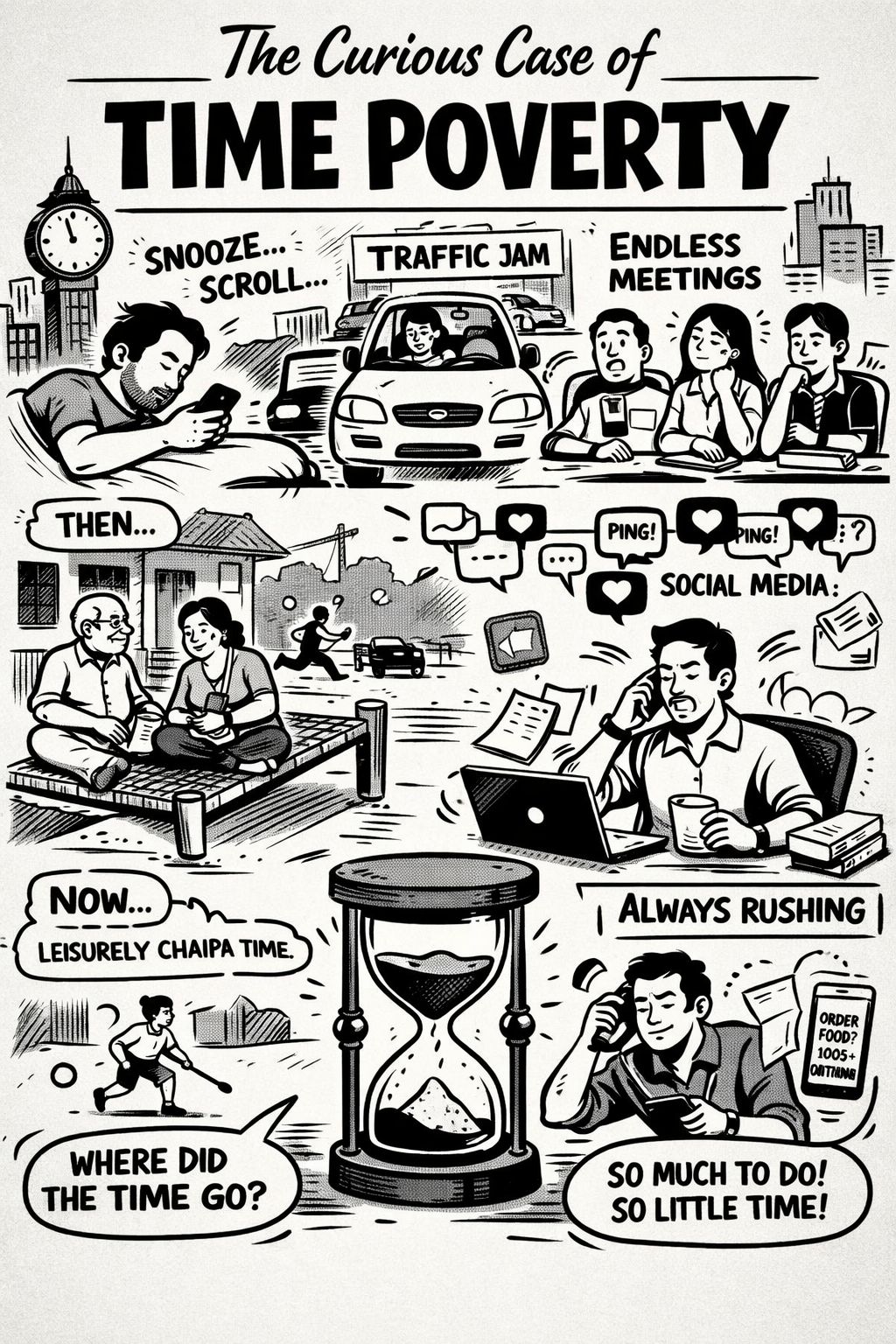
Somewhere between the invention of the pressure cooker and the arrival of 5G, we Indians collectively misplaced something really important: Time. Not lost in a dramatic, cinematic way, without violins or slow motion, but more like a wallet lifted from your back pocket in a crowded Metro. One moment it was there, lazy afternoons, unplanned conversations, the comforting stretch of doing nothing, and the next moment, gone. In its place, we now have Google Calendar reminders, WhatsApp notifications, and a persistent feeling that we are always slightly late for something, even when we are sitting still. Welcome to the era of time poverty, where your bank balance may look respectable, your Zomato order history may be thriving, and your LinkedIn profile may be aggressively inspirational, but your time account is permanently overdrawn.

Let’s rewind a bit, not to some sepia-toned village fantasy, but just a generation ago, in the same cities we inhabit today, where life had a different rhythm. Time was not abundant in a literal sense, as people still worked hard, commuted, raised families, but it felt less fractured. Evenings were events in themselves, when people sat outside their homes discussing politics and cricket over multiple cups of tea, and that one neighbour who always seemed to have too many visitors. Children played gully cricket until the ball inevitably landed in someone’s kitchen, leading to heated negotiations that doubled as character-building exercises. Mothers called out from balconies and verandahs with a mix of authority and affection, summoning children home before darkness turned into parental anxiety. There were fewer choices, yes, but also fewer decisions to make. Dinner was whatever was cooked, and nobody spent fifteen minutes comparing paneer butter masala across twelve delivery apps while reading 237 reviews written by people who clearly have too much time.

The great unifier, television, had one channel, Doordarshan, maybe two if you were fancy. If you missed your favourite show, you missed it, as there was no replay, no binge-watching, no existential spiral at 2 AM where you question your life choices while watching the fourth episode of something you don’t even like. And waiting, ah, waiting was a legitimate activity. We waited for letters, for phone calls on the clunky telephone sets, for exam results. Waiting was not seen as wasted time; it was just part of time itself, like monsoons or power cuts. Our minds wandered, conversations happened, and occasionally, we even ‘thought’ our own thoughts without an algorithm suggesting what to think next!

Now fast forward to urban India today, where time is not just scarce but seems to be actively hunted. A typical weekday begins with negotiation between you and your alarm clock, which has now evolved into a relentless life coach with a snooze button. Before your feet even touch the ground, your thumb has already scrolled through emails, news updates, Instagram reels, and three subtle reminders that everyone else seems to be doing better than you at 7:17 am in the morning. We often eat breakfast alongside a call that begins with ‘Can you hear me?’ and ends with ‘Let’s take this offline,’ a phrase that has single-handedly consumed more human hours than traffic jams.

If time poverty had a national symbol, it would undoubtedly be the urban traffic. Whether you are inching along the Delhi-Gurgaon expressway, contemplating your life choices at Bengaluru’s Central Silk Board junction, or performing advanced geometry in Mumbai’s local trains, your commute is not just a journey, but a full emotional experience. You begin with hope, perhaps even optimism, maybe today will be different, maybe traffic will be lighter, signals more cooperative, humanity kinder. Ten minutes later, you are recalibrating your expectations, bargaining with Google Maps, and listening to podcasts or FM radio not out of curiosity but as a coping mechanism. By the time you reach your destination, you have experienced a full spectrum of human emotion and possibly learned a new cuss word, none of which you will remember by lunchtime.

And then come the meetings, those sacred rituals of modern work culture where time doesn’t exactly die, it dissolves. Meetings to prepare for meetings, meetings to debrief previous meetings, and meetings that exist solely because someone somewhere feared the silence of not having a meeting. Entire hours are spent discussing action items that could have been bullet points in an email, that could have been a message, that could have been… nothing. Ironically, in our relentless pursuit of productivity, we have created systems so elaborate that they ensure we have no time left to actually produce anything. Efficiency has become a performance, and everyone is performing.

Of course, technology was supposed to save us, and in many ways, it has. Tasks that once took hours now take minutes, information is accessible instantly, and communication is effortless. But somewhere along the way, technology stopped being a tool and started behaving like a very needy companion. Your phone, that sleek little rectangle of promise, is now a workplace, an entertainment centre, a social hub, and an anxiety generator rolled into one. You pick it up to check the time and resurface twenty-seven minutes later, having watched three reels, replied to two messages, ignored five, read half an article, and completely forgotten why you picked it up in the first place. Time isn’t just being spent; it is being nibbled away in tiny, invisible bites.

Urban India today offers an abundance of choices in the form of food, experiences, careers, and content. But abundance comes with a hidden tax in the form of decision fatigue. Earlier, dinner was simple, and now it is an exercise in research, comparison, and occasional soul-searching. Even leisure has become labour, as watching a movie involves navigating multiple platforms, genres, languages, and algorithmic suggestions, each insisting it knows you better than you know yourself. By the time you decide what to watch, you are too tired to watch anything. The freedom to choose has quietly transformed into the burden of choosing.

Friendships, once spontaneous and effortless, are now managed with the precision of project timelines. ‘Let’s catch up’ translates into checking calendars, blocking slots, rescheduling due to unforeseen commitments, and finally meeting for exactly sixty minutes before someone inevitably says, ‘I have an early morning tomorrow.’ Even weddings, those grand celebrations of chaos and joy, have been optimised for efficiency. Destination weddings over long weekends, carefully curated guest lists, and itineraries that resemble conference agendas. Nothing says romance like a well-managed Google Sheet.

But perhaps the most insidious aspect of time poverty is lack of attention rather than the lack of hours. You may technically have free time, but your mind is rarely free. You are at dinner, but thinking about work. You are on vacation, but checking emails. You are resting but feeling guilty about it. The boundary between work and life hasn’t just blurred; it has politely excused itself and left the building. What remains is a constant hum of ‘I should be doing something,’ a background noise that turns even moments of rest into opportunities for anxiety.

In India, this phenomenon feels particularly intense because of the unique cocktail of factors at play. Rapid urbanisation has stretched infrastructure beyond its limits, turning simple commutes into endurance tests. Aspirational pressure ensures that everyone is constantly striving for better jobs, better salaries, better lifestyles. Digital adoption has been fast and enthusiastic, compressing decades of technological evolution into a few short years. And social expectations are layered on top of all this that rarely reduce, even as professional demands increase. The result is a society trying to operate at first-world speed with third-world infrastructure and fourth-world patience.

So are we truly poor in time? Or have we simply allowed time to be colonised and constantly interrupted? The uncomfortable truth is that it is a bit of both. We are busier, yes, but we are also more distracted. We have more tools, but less control. We are connected, but not always present. Time poverty, then, is not just about scarcity, but more about how we experience the time that we have. It is the difference between a long, uninterrupted conversation and a series of half-hearted replies. Between a meal savoured and a meal consumed while scrolling. Between living time and merely passing through it.

The solution, if there is one, is unlikely to be dramatic. Most of us are not about to quit our jobs and retreat to the Himalayas like some of our friends have, and even if we did, we would probably post about it online. But small shifts are possible, like protecting pockets of uninterrupted time, reducing unnecessary decisions, and occasionally allowing ourselves the radical act of doing nothing. These are not grand gestures, but they are meaningful ones. They remind us that time is not just something to be managed but something to be experienced.

We often say, ‘I don’t have time,’ when what we really mean is, ‘Something else has taken priority.’ Time poverty is not just a condition but a consequence of choices, both ours and the systems we inhabit. In a country that has mastered the art of jugaad, perhaps it is high time we apply that ingenuity to time itself. Because somewhere between the past we romanticise and the present we rush through lies a simple, almost rebellious idea that what if we stopped trying to save time and started trying to live it?

Arzee The Dwarf

arzee_the_dwarfArzee The Dwarf

by Chandrahas Choudhury | 184 Pages | Genre: Fiction| Publisher: HarperCollins India| Year: 2009 | My Rating: 8/10

“I am myself in my thoughts too much,
I seek recourse to myself too soon,
My days don’t stand up without a crutch,
I sing my own song out of tune.
I stand before the mirror too long,
Stare big at the eyes that return my gaze,
My shadow seems to me more strong
Than my shrunken heart, that lonely place.
My worries hang about me like clouds,
And my creditors they come calling,
My being is riven by spooks and doubts,
The walls of my house are falling.
In mine own alleys I traipse and turn,
Dreamlike I float through nights and days,
I watch the hours slowly burn,
And do not leave on time my trace.
I myself speak and myself hear,
And myself act and myself see,
My own self extends far and near,
And so I cannot myself be.”

– Chandrahas Choudhury, Arzee The Dwarf

In his debut novel, Chandrahas Choudhury has skillfully captured the nuances of intimate life and dreams of Arzee, who’s a midget, working at an old cinema hall in Mumbai as a deputy projectionist. Even though all the thirteen chapters revolve around him and he’s the protagonist of this novel, Choudhury has not projected him as a larger-than-life hero, which makes his world as interesting as that of a common man, yet one cannot stop feeling sympathy for that man whose all troubles stem from him being a midget or a dwarf. So much so that the characters around him forget his last name Gandhi, and instead address him as ‘Arzee the dwarf’. The beauty of this books lies in its prolific prose and colloquial dialogues portraying time and space, old world charm portrayed through the dying Noor cinema and modern day problems of love, money, and self-image, the memorable characters that even ‘The Babur’ the projection machine, which is Indian mutation of its German name Bauer seems to breath life. The novel ends without a definite ending as if Choudhury was overcautious to continue, leaving the readers to decipher it themselves about the new turns Arzee’s life is to take.

This novel full of pathos and pragmatism is my Read of the Week.