The price of stability in an unstable world
October 19, 2026 Leave a comment
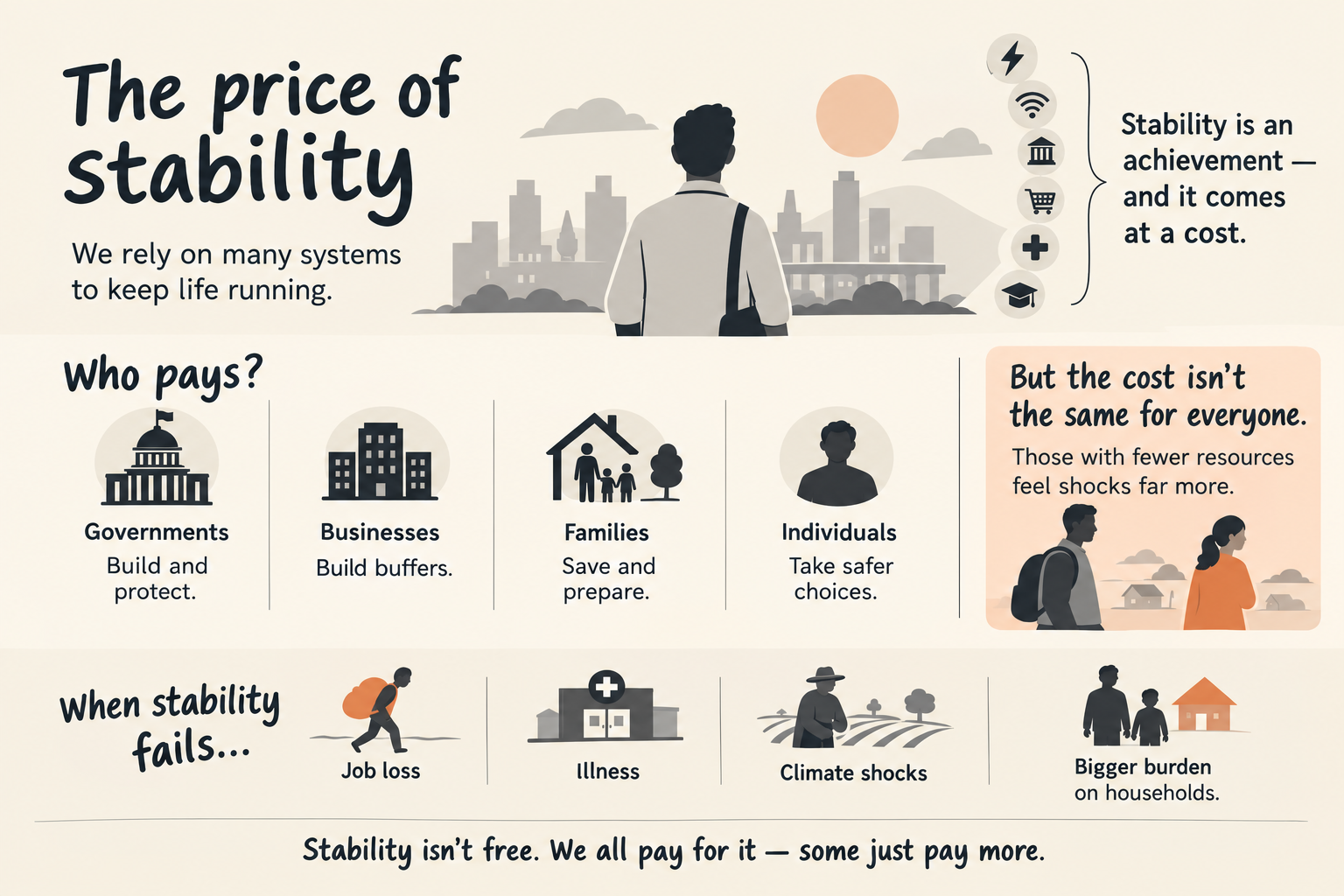
We have been sold a dangerous idea that stability is normal and disruption is the exception, but is it? Yes, stability is an achievement, though an expensive one! Every morning, when the electricity is on, the internet works, the bank processes a transaction, food reaches you from a quick-commerce platform, a child gets to school, a salary arrives on time, and a hospital has the medicines it needs, it means thousands of invisible systems are doing their job in the background. We notice them only when they fail. For most of modern history, perhaps the greatest privilege was not wealth but predictability, the reasonable expectation that tomorrow would look broadly like today. That expectation is now harder to sustain as wars are disrupting supply chains, climate events are destroying livelihoods, artificial intelligence is unsettling occupations, financial volatility travels across borders in milliseconds, and demographic change is altering the very structure of families and work. We are entering an era in which instability may no longer be a temporary interruption to ordinary life but may become the usual.
So, who pays for stability in an unstable world? The obvious answer is governments, which build roads, maintain electricity grids, regulate financial systems, run hospitals, banks, police, and borders, subsidise food, respond to disasters, and provide social protection. But businesses pay too, as they maintain inventories, assets, diversify suppliers, retain cash and build redundancy into systems that would otherwise be cheaper and more efficient. So do families, as they keep emergency savings, buy insurance, invest in education, maintain social networks and sometimes make profoundly conservative choices because the consequences of failure are too high. Individuals pay in ways that don’t appear anywhere on a balance sheet. They stay in jobs they dislike because they’re secure. They postpone starting a business because they cannot afford six months without an income. They choose a predictable career over an uncertain vocation. They save instead of spending. They remain in cities they don’t particularly love because the city offers better healthcare, schools and employment opportunities. Stability, in other words, is not free, and we purchase it every day, often without realising that we are doing so.
But we don’t all pay the same price for instability. A wealthy household can absorb a medical emergency, while a poor household may have to borrow, sell an asset or withdraw a child from school. Likewise, a large corporation can survive a temporary collapse in demand, whereas a small enterprise may shut down permanently. A professional with savings can spend six months learning a new skill, and at the same time a casual worker may not be able to afford six days without income. The ability to absorb a shock is itself becoming a form of wealth. We have traditionally measured inequality through income, consumption and assets. Perhaps we now need another measure: the unequal distribution of uncertainty. Two families earning the same amount can live completely different lives if one has savings, insurance, secure housing, social capital and access to credit while the other survives from one monthly payment to the next.
Consider the millions of informal workers in India whose economic lives were disrupted during the COVID-19 lockdown. For many, the crisis was not simply about losing a job. It meant losing the entire architecture through which survival happened, like their daily wages, transport, access to urban work and sometimes food itself. The images of migrant workers walking hundreds of kilometres home became one of the defining visual memories of the pandemic. The crisis revealed how much of India’s economic stability was being privately financed by people with almost no financial cushion. When formal systems failed, the burden was transferred to households, communities and individual workers, where families became the insurance company of last resort.
Something similar happens every day, at a smaller scale, when an illness strikes a low-income household. India has made enormous progress in expanding healthcare access, insurance and public health infrastructure, but for millions of families, healthcare expenditure can still become a destabilising financial event. The difference between a middle-class household experiencing a serious illness and a poor household experiencing the same illness is not simply the quality of medical treatment available. One family may recover financially after recovering medically, while the other may spend years repaying debt. The illness turns into a crisis cascade of healthcare expenses, debt, reduced consumption, interrupted education and sometimes the sale of productive assets.
Climate change is producing another version of the same problem. Take a small farmer in Bihar, Assam, Odisha or Rajasthan. Agriculture has always involved uncertainty, but climate volatility is changing the scale and frequency of that uncertainty. An unexpected flood, prolonged heat, irregular rainfall or pest outbreak can wipe out months of effort. We often respond by telling farmers to become ‘climate resilient’, adopt new practices, diversify crops or use technology. All of these can be useful, but we tend to forget that resilience requires resources. A farmer with savings, irrigation, crop insurance, access to credit and market information has options. A farmer who owns little land and depends entirely on one seasonal harvest has very few. We cannot keep asking the poorest citizens to become more resilient without asking whether we have given them the financial and institutional infrastructure with which resilience can actually be built.
The same contradiction is visible in India’s growing, small-enterprise economy. We celebrate entrepreneurship and tell young people to become entrepreneurs, women to start enterprises, rural communities to build businesses and small producers to enter digital markets. Yet entrepreneurship is, by definition, an encounter with uncertainty. A person with substantial capital can afford entrepreneurial failure, but, say, a woman investing her family’s only savings in a small enterprise cannot. When a rural woman starts a tailoring unit, food-processing business, handloom enterprise or digital service centre, she is not merely creating income but is taking a financial risk on behalf of her household. This is why access to credit alone is not enough and entrepreneurs need markets, digital access, business capabilities, working capital, insurance, peer networks and, perhaps most importantly, the ability to fail without falling into destitution.
And then there is the instability coming from new-age technology. AI may create extraordinary new opportunities, but it will also change the value of many existing skills. We tell older workers to remain employable in a labour market changing faster than the institutions designed to train them. But learning itself requires time, money and psychological space. The person working ten hours a day to pay rent cannot effortlessly become an AI-enabled professional at night. The person supporting a family cannot always afford to experiment with a new career. Adaptability is not simply an attitude; it is an economic resource.
This is where our understanding of resilience needs to change. We have increasingly turned resilience into an individual virtue of being adaptable, keep learning, diversify your income, build an emergency fund, exercise, take care of your mental health, prepare for the future, etc., etc. There is nothing wrong with any of this, but we risk creating a society in which structural instability is increasingly privatised. At some point we have to ask whether we are confusing resilience with the ability of individuals to absorb risks that should partly be shared by institutions.
How to prevent uncertainty from becoming catastrophic for ordinary people, perhaps, will be the central economic challenge of the next few decades. We cannot promise a farmer that the monsoon will behave, a worker that her job will exist for thirty years, or that the next pandemic, financial crisis or geopolitical shock will never happen. But we can design systems in which these events do not permanently destroy a person’s future. That would require a different conception of social protection. The welfare state of the industrial era was largely built around protecting people from particular risks of unemployment, old age, illness, disability and poverty. The unstable world ahead may require something more dynamic, like systems that help people move through disruption.
The cost of living without psychological certainty is another hidden cost of instability that economists struggle to capture, where uncertainty consumes mental bandwidth. When you don’t know whether your job will survive, whether a medical emergency could wipe out your savings or whether your child’s education will remain affordable, some part of your mind is permanently occupied by contingency planning. And that has implications beyond individual wellbeing. A society in which people are perpetually afraid of falling backwards is unlikely to be as entrepreneurial, innovative or creative as a society in which people know that failure will not destroy them.
This produces a fascinating paradox as we want an innovative economy, but innovation requires risk. Perhaps, therefore, the goal should not be stability in the conventional sense. We should stop trying to build a world in which nothing goes wrong, as such a world does not exist. The goal should be recoverability, where the capacity of people, families, businesses and communities to recover when something inevitably goes wrong should be present. This is ultimately a question of what kind of social contract we want. The price of stability will rise as the world becomes more volatile. Governments will spend more on resilience. Companies will pay more for redundancy and security. Families will save more. Individuals will invest more in skills and insurance. But if we allow every emerging risk to be pushed downwards from governments to companies, from companies to workers, from institutions to families and finally from families to individuals, we will create a society that appears economically efficient while becoming increasingly fragile.
We have become obsessed with efficiency precisely when the world is demanding resilience. We have spent decades removing buffers because buffers looked like waste, including excess inventory, spare capacity, multiple suppliers, idle infrastructure, permanent workers, and generous social protection. Everything had to be optimised, become leaner, faster and cheaper. Until the world reminded us that the things we call inefficiencies are sometimes the very things that keep systems alive when they break. So, the question we should be asking is not how much stability we can afford. It is how much instability ordinary people can afford to absorb before a temporary shock becomes a permanent change in their lives. Because the future will not belong to those who successfully predict every disruption. Nobody can. It will belong to societies that make disruption survivable. And if we fail to build those societies, we may discover a deeply uncomfortable truth that the poor will not merely be the people with the least money, but they will be the people who can afford the least uncertainty.
(The cover image is generated using AI)
Discover more from Manu Mayank
Subscribe to get the latest posts sent to your email.
 About Manu Mayank
