Project Hail Mary

Genre: Space Sci-Fi Year: 2026 | Duration: 157 mins | Director: Phil Lord and Christopher Miller|  Medium: Theatre (PVR Cinemas) | Trailer: HERE | Language: English| Cast: Ryan Gosling, Sandra Huller, James Oritz, and others | My rating: 4.5/5

Project Hail Mary is adapted from the book ‘Project Hail Mary’ by Andy Weir. It is certainly among the best Sci-Fi movies I have watched in the last 10 years. The film is about survival, curiosity, friendship, and the stubbornness of hope. The film adaptation has not lost the magic of Andy Weir’s books, and leans heavily on problem-solving, intellect, and a deep sense of humour, and also explores further into emotional terrain that feels both intimate and cosmic.

The core of this layered film is deceptively simple, featuring a lone astronaut, Dr Ryland Grace (Ryan Gosling), who wakes up aboard a spacecraft with no memory of who he is or why he is there. As his memories gradually return, he realises that he may be humanity’s last hope to prevent extinction. This story of amnesia developing into purpose acts as a powerful storytelling engine. It enables the audience to rediscover the stakes alongside Grace, creating a layered tension that is both intellectual and emotional. Grace has been recruited by Eva Stratt (Sandra Huller) to save the world. He, along with many other scientists, has been told that an infection is affecting the sun. In the next few decades, life on the planet will cease to exist. 

What distinguishes Project Hail Mary from many contemporary sci-fi films is its unapologetic embrace of science. This is not a film that glosses over the technicalities of astrophysics, microbiology, and orbital mechanics, which are all treated with a level of respect rarely seen in mainstream cinema. The film translates complexity into narrative urgency. Every equation solved, every experiment conducted, feels like a small step away from annihilation.

In many ways, the film follows in the lineage of The Martian, but it evolves beyond it. While The Martian was about one man surviving against the odds on Mars, Project Hail Mary expands the canvas to an interstellar scale. The stakes are existential and not personal, unlike The Martian. And yet, the film feels more personal because of an unexpected friendship that emerges in the vast emptiness of space between two different species. The relationship that develops between Grace and his unlikely counterpart, Rocky, is the soul of the film. It is here that Project Hail Mary transcends genre conventions. The film is no longer just about saving Earth, but more about connection across unimaginable divides of space. It explores communication not just as language but as intent, empathy, and trust. 

The performance of Gosling carries much of the film’s weight. Ryland Grace is not a traditional hero. He is not a trained astronaut or a fearless explorer. He is, in many ways, an accidental saviour—reluctant, flawed, and often overwhelmed. This vulnerability makes him relatable. His fear is palpable, his humour disarming, and his determination deeply earned. The wry, self-deprecating, and occasionally absurd humour provides moments of levity that make the darker moments more impactful.

Project Hail Mary strikes a careful balance between realism and wonders visually. The spacecraft interiors are utilitarian, almost claustrophobic, reinforcing the isolation of Grace’s journey. In contrast, the depiction of vast, silent, and indifferent space serves as a constant reminder of the scale of the challenge. The film does not rely excessively on CGI spectacle, but when it does deploy visual effects, it does so with purpose. Each visual set-piece advances the narrative rather than distracting from it.

The narrative oscillates between past and present, gradually revealing how humanity arrived at this desperate moment. These flashbacks are integral to understanding the moral and ethical dilemmas that underpin the mission. Governments, scientists, and ordinary individuals are forced to make impossible choices. The film does not offer easy answers. Instead, it presents these decisions with a moral ambiguity that feels uncomfortably real.

Project Hail Mary grapples with questions of sacrifice, responsibility, and the collective versus the individual. It examines the idea of scientific progress not as an abstract pursuit but as a lifeline. In an era where science is often politicised or misunderstood, the film stands as a quiet testament to the power of human ingenuity. It suggests that our greatest strength lies in our ability to think, collaborate, and adapt.What I loved most about this non-linear film is that there are no explosive battles or dramatic confrontations in the traditional sense. The tension arises from equations, experiments, and the ticking clock of extinction. I found its intellectual core to be a deeply rewarding viewing experience. For those accustomed to more conventional sci-fi, this may require an adjustment in expectations.

Shanghai

Genre: Thriller | Year: 2012 | Duration: 105 mins | Director: Dibakar Banerjee | Medium: DVD | Trailer: HERE | Language: Hindi | My rating: 4*/5*

‘Shanghai’, set in Bharat Nagar, a fictitious town in India, is based on Vassilis Vassilikos’s Greek novel ‘Z’. Dibakar Banerjee has done full justice with the screenplay and direction, and the actors, with their brilliant performances, have portrayed the different moral dilemmas that various characters face in circumstances created, making it an engrossing and thought-provoking film. The movie doesn’t take sides on good or bad, and instead holds a mirror to the contemporary political greed and bureaucratic corruption that riddle India.

A prominent social activist, Dr. Ahemadi (Prosenjeet Chaterjee) is mowed down by a tempo while protesting against the upcoming International Business Park project (IBP), which is the brainchild of the State’s CM ‘Madam ji’ (Supriya Pathak) that plans to demolish Bharat Nagar and make it the next Shanghai. IAS officer Krishnan, who’s the vice chairman of IBP, is put in head an inquiry commission by the CM and her principal secretary, Kaul (Farooq Sheikh). He discovers incontrovertible evidence with the help of Shalini Sahay (Kalki Koechlin), a student and lover of Dr. Ahemadi, and Jogi (Emraan Hashmi), a complex small-time porn film maker, which shows that the politicians were involved in the attack. In this serious movie, Emraan’s character provides the genuine laughs from time to time, and clearly, this is his best performance to date. The climax of the movie is brilliantly done, not so commonly seen in the movies made by Bollywood.

This engaging and fast-paced political thriller with characters in grey is my Movie of the Day.

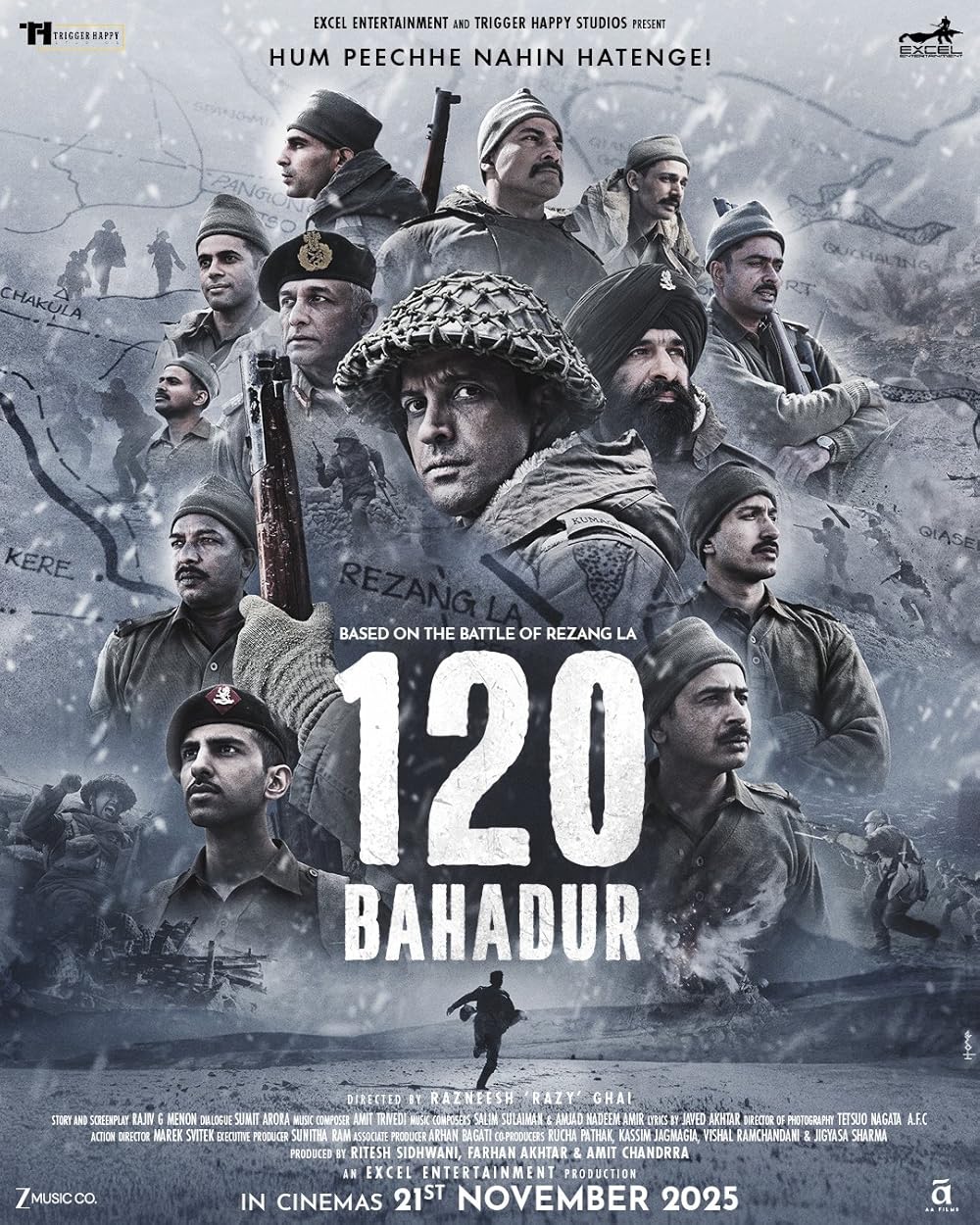
120 Bahadur 

Genre: War Drama Year: 2025 | Duration: 160 mins | Director: Razneesh Ghai|  Medium: Theatre (PVR Cinemas) | Trailer: HERE | Language: Hindi | Cast: Farhan Akhtar, Raashil Khanna, and others | My rating: 3.5/5

120 Bahadur is based on the real-life sacrifice of the 120 soldiers of Charlie Company, 13 Kumaon Regiment of the Indian Army at the Battle of Rezang La during the 1962 Sino-Indian War. It chronicles the extraordinary courage of 120 Indian soldiers who stood their ground against 3000 Chinese troops. The film focuses on Major Shaitan Singh Bhati (played by Farhan Akhtar), showcasing the grit, sacrifice, and valour of soldiers fighting in the brutal cold and high altitude of Ladakh. The story is narrated through the memories of a surviving soldier, and it unfolds as a tribute to the heroism of a band of brothers whose courage came at the highest cost.  

The film’s strongest suit is its war sequences and immersive realism. The battle sequences at Rezang La, rifle fire, bayonet charges, final close-quarters combat, the harsh terrain, bone-chilling cold, and the almost claustrophobic desperation when ammunition runs out are realised with a fierce intensity that’s rare for many modern Hindi war films.  The film features brilliant cinematography by Tetsuo Nagata, with breathtaking shots of snow-covered mountains, freezing desolation, and the starkness of high-altitude warfare.  The film mostly avoids glorifying war for its own sake and is a sober portrayal of the events. This sincerity gives the film humility as it doesn’t frame itself as a triumphant spectacle, but a respectful tribute and remembrance. 

Farhan Akhtar delivers a thoughtful performance. He largely avoids the larger-than-life histrionics often associated with Bollywood war heroes. Instead, he feels rooted, authoritative yet human, decisive yet burdened.  At the same time, the supporting cast, many of them lesser-known actors, bring the infantrymen to life with grit, camaraderie, humour, and vulnerability. Their messy friendships, small conversations, homesickness, and occasional fears humanise what might otherwise have been just a war drama with guns and trenches.  

However, the film seemed to have weak character development; their individual stories were barely sketched out. This makes certain deaths feel less impactful emotionally, more like casualties on a battlefield than deeply personal losses. Because of that, while the collective sacrifice hits home, personal grief and tragedy often don’t. The film’s narrative isn’t always smooth, as flashbacks to family life, interspersed with the lead-up to battle, sometimes break the tension. The prelude drags at times, and the buildup to the climax lacks the steady escalation that such stories need for maximum impact.  

I felt that the depiction of Chinese soldiers has been overly simplified and tends to lean towards caricature: monolithic, villainous, almost cartoonish, robbing them of nuance or complexity. This weakens the moral weight of the conflict and reduces it to a binary ‘good vs evil’ war movie. In parts, storytelling relies heavily on familiar Bollywood popular drama of last-minute motivational speeches, montage-heavy sequences, formula flashbacks and emotional beats, which keep the film from feeling fully original.  

120 Bahadur is not a perfect film, but it is an earnest, important one. It doesn’t glamourise war, and it doesn’t demand you leave the theatre cheering mindlessly. Instead, it makes you reflect on duty, courage, and sacrifice. As a cinematic recreation of a tragic but heroic moment in India’s history, the film succeeds more often than it fails. Its war sequences are unflinching and immersive; its portrayal of brotherhood and sacrifice is heartfelt; its lead performance is measured and credible.

But beneath the combat and solemn patriotism, it made me think that India’s rural society holds the backbone of India’s defence forces. The film also has a sociological moment where rural identity, class, caste, and nationhood intersect. The men of Charlie Company came largely from agrarian communities, especially the Ahir (Yadav) belt of Haryana and Western UP. Their lives before the war were shaped by farming cycles, monsoon anxieties, livestock, joint families, and deeply rooted village cultures. The film becomes a testament to how rural young men, in search of dignity, livelihood, and service, become the face of national defence but rarely the face of national storytelling.

Despite its narrative shortcomings, 120 Bahadur performs a cultural service of returning Rezang La to public consciousness.

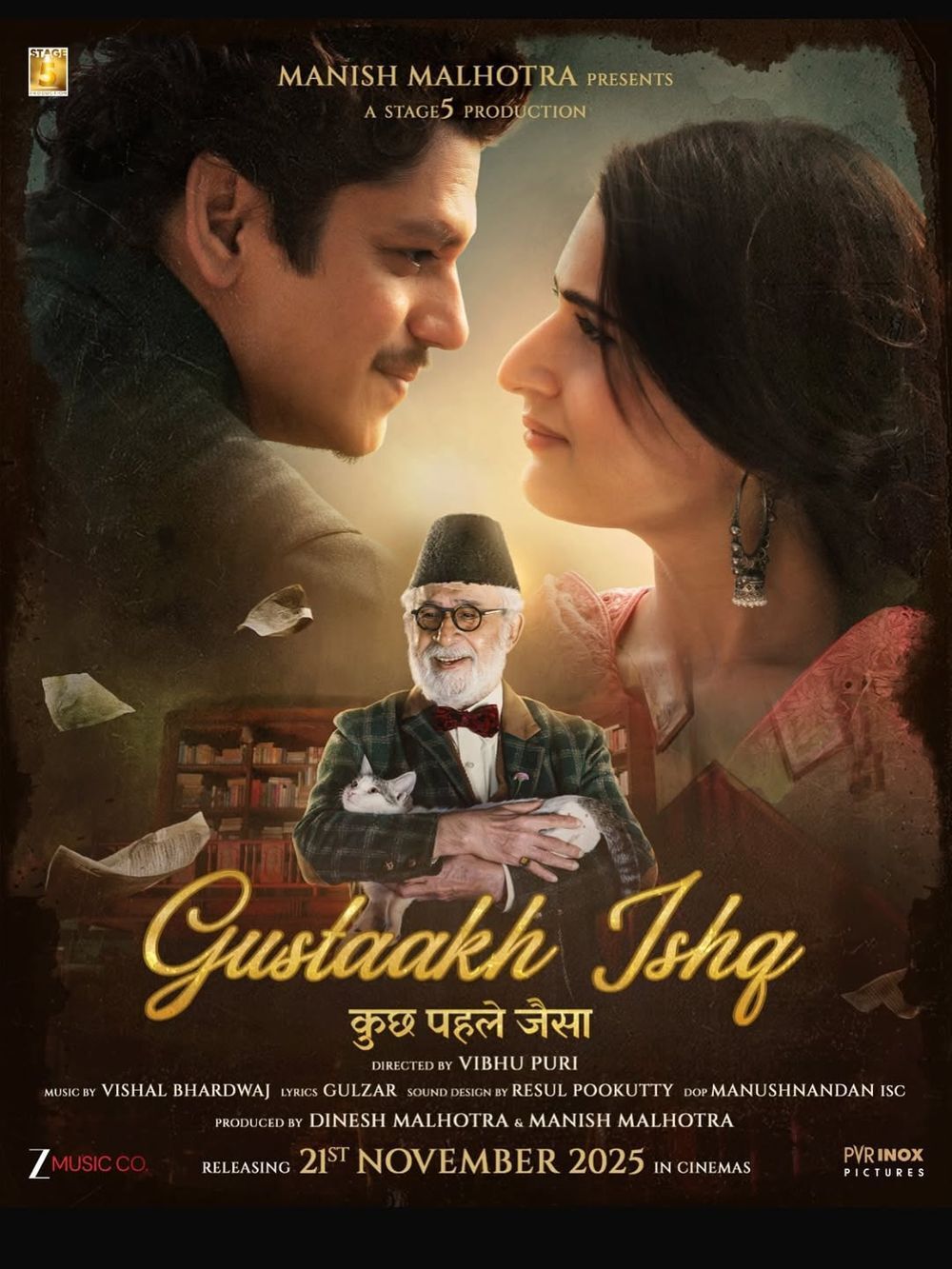
Gustaakh Ishq

Genre: Romance Year: 2025 | Duration: 128 mins | Director: Vibhu Puri |  Medium: Theatre (PVR Cinemas) | Trailer: HERE | Language: Hindi | Cast: Naseeruddin Shah, Vijay Varma, Fatima Shaikh, and others | My rating: 4/5

Gustaakh Ishq evokes the spirit of mid-20th-century Urdu-Hindi cinema full of ‘mushaira’ evenings, old printing presses, dusty lanes and small towns of India, peeling walls, hearts heavy with memories, understated longing and emotional restraint. It is a romance steeped in nostalgia, where even silence has a voice. The film beautifully interweaves mood, texture and poetry. There are moments when the film feels like a delicate ghazal, which is slow, heartfelt, and rich in unspoken emotions. As one of the song’s shayari goes,

Such lines, and many others woven through the film, give it a lyrical soul. The music with songs like ‘Ul Jalool Ishq’ and ‘Aap Is Dhoop Mein’ sprinkles the narrative with the charm and warmth of classic romance.

Set in the crumbling lanes of a North Indian town, the film’s lead character, Nawabuddin (Vijay Varma), a man desperate to save his late father’s printing press, seeks out an ageing, reclusive poet, Aziz Beg (Naseeruddin Shah), hoping to publish his forgotten poetry. Along the way, Nawabuddin becomes attracted to Aziz’s daughter Minni/Mannat (Fatima Sana Shaikh), and the old-world romance between generations, art and longing unfold.  Naseeruddin Shah is the emotional anchor of the film, and his character radiates dignity, nostalgia and weariness, carrying the weight of rueful regrets and mutable hope. Vijay Varma brings earnestness with his character’s love for verse and sincerity, offering a believable link across generations. And Fatima Sana Shaikh as Mannat becomes the soft heartbeat of the film.  

The film’s greatest strength lies in its texture and intimacy. The director’s gaze lingers lovingly on the details, creating a world that feels lived-in and emotionally honest. The cinematography does not chase beauty but rather discovers it in decay. The film is like a visual poem, which is its emotional backbone. Lines of poetry drift through the narrative like ghosts of feeling,

Conversations are sparse, glances that linger a second too long, gestures left unfinished, words swallowed, this sensibility, where silence itself feels accusatory, defines the emotional climate of the film.

The performances of all the actors deserve special mention. Naseeruddin Shah brings a weary grace to the role of someone who has lived too much and lost too often. His eyes carry entire libraries of regret. Vijay Varma’s portrayal of Nawabuddin anchors the film with sincerity and his yearning to preserve art in a world that no longer cares feels achingly real. Mannat, a woman whose stillness hides tremors of rebellion, played by Fatima Sana Shaikh with quiet strength, is the film’s most layered character.

One of the most striking aspects of the film is how it treats love. This is not love as possession or dramatic union. This is love as distance, as restraint, as something that exists more powerfully in what is unsaid. In one of the film’s most beautiful moments, this sentiment finds voice,

The background score deserves credit, where the music does not intrude, but it hums like an old wound. Songs are well placed when emotions can no longer be contained by silence. Lyrics feel like extensions of the characters’ inner lives rather than commercial breaks. One such line captures the film’s aching spirit,

Yet, for all its beauty, Gustakh Ishq is not without flaws. The screenplay sometimes confuses stillness with stagnation. Certain emotional turns are hinted at rather than explored, leaving the viewer wanting deeper psychological meaning. The bond between Nawabuddin and Minni, despite its lyrical foundation, sometimes feels emotionally underdeveloped in execution. Perhaps that is the nature of this film, as it is not designed to entertain as much as to envelop. It is more like a fog of memory and longing through which one must walk slowly. Another verse in the film captures this ethos perfectly,

For viewers used to fast-moving plots, clear romantic arcs, or dramatic catharsis, this film may feel meandering, slow, and even frustrating. The pacing demands patient acceptance of nuance, subtle gestures, and quiet sorrow. For those willing to surrender to its rhythm and appreciate the small pauses, soft glances, whispered verses and the ache between two silences, it offers genuine beauty.

If you appreciate cinema that smells of old books, handwritten letters, melancholic poetry and tender regret, and if you believe that sometimes love doesn’t demand grand gestures but hushed confession, the kind of love that bruises quietly rather than bleeding loudly, then this film will likely stay with you.

Tere Ishk Mein

Genre: Romance Year: 2025 | Duration: 167 mins | Director: Anand L Rai |  Medium: Theatre (PVR Cinemas) | Trailer: HERE | Language: Hindi | Cast: Dhanush, Kriti Sanon, and others | My rating: 4/5

I have a fascination with morbid romance, where passion is fierce and consuming, love and ruin walk hand in hand, and loss feels almost sacred. After a long time, I totally enjoyed a Bollywood film, Tere Ishk Mein, for its feverish, fractured, and fearless ode to obsessive love and loss. Anand Rai, as Director, and Dhanush and Kriti Sanon as actors have so beautifully portrayed the volatile landscape of love, messy and irrational, dark and bruised. It is a film that is less about romance and far more curious about what happens when love mutates, dissolves boundaries, and begins to reshape identity itself.

The film centres around Shankar (Dhanush), a young man navigating the emotional ruins of unrequited affection. His world is small, ordinary, burning with relentless restlessness, textured with the familiar lanes of Rai’s cinematic universe. When he falls in love with Mukti (Kriti Sanon), it is with the conviction of a man who sees devotion as delusional destiny. Dhanush’s performance is a masterclass. His portrayal of longing, with shoulders slightly slumped, eyes rimmed with unspoken ache, voice cracking in the in-between spaces of sentences, is brilliant. He brings a fragile humanity that compels empathy even when the character’s choices spiral into moral greyness. There are moments when Shankar’s yearning feels suffocating, and moments when it feels heroic. In several scenes, especially those dealing with solitude and heartbreak, the camera lingers on his face with cruel intimacy. He allows vulnerability to show across the frame, leaving behind emotional aftershocks.

The film’s leading lady, Mukti (Kriti Sanon), is a girl caught between affection, caution, and the burden of societal expectations. She is real, flawed, and aware of her own contradictions. Her emotional arc of moving from curiosity to confusion to a painful clarity is one of the more grounded aspects of the film. What stands out is that Mukti is not a passive recipient of Shankar’s affection. She pushes back, speaks for herself, asserts her boundaries, and refuses to become a prop for his emotional turbulence. In many ways, her character reminded me that intensity does not equal righteousness.

Rai’s filmmaking has always been rooted in the everyday—narrow streets, chaotic homes, lived-in locations where life unfolds in all its contradictions. In Tere Ishk Mein, he retains this aesthetic but adds a layer of psychological depth. His director truly excels in designing silences. Some of the best moments in the film are those where nothing is said: an unfinished sentence, a doorway half-shut, a glance held for one second too long. These are the moments when the film transcends melodrama and ventures into introspection.

What distinguishes this film from typical love stories is its willingness to confront the darker territories of attachment. The film does not glorify suffering, nor does it portray persistence as virtue. Instead, it presents a sobering reality that love can be transformative, but it can also be corrosive if it becomes entitlement.The climax, which is raw, unsettling and necessary, is where the film truly earns its place. It is neither triumphant nor tragic in a conventional sense. Rather, it is painfully truthful. It is a rare mainstream film that lets discomfort linger. A must-watch if you enjoy a turbulent exploration of love.