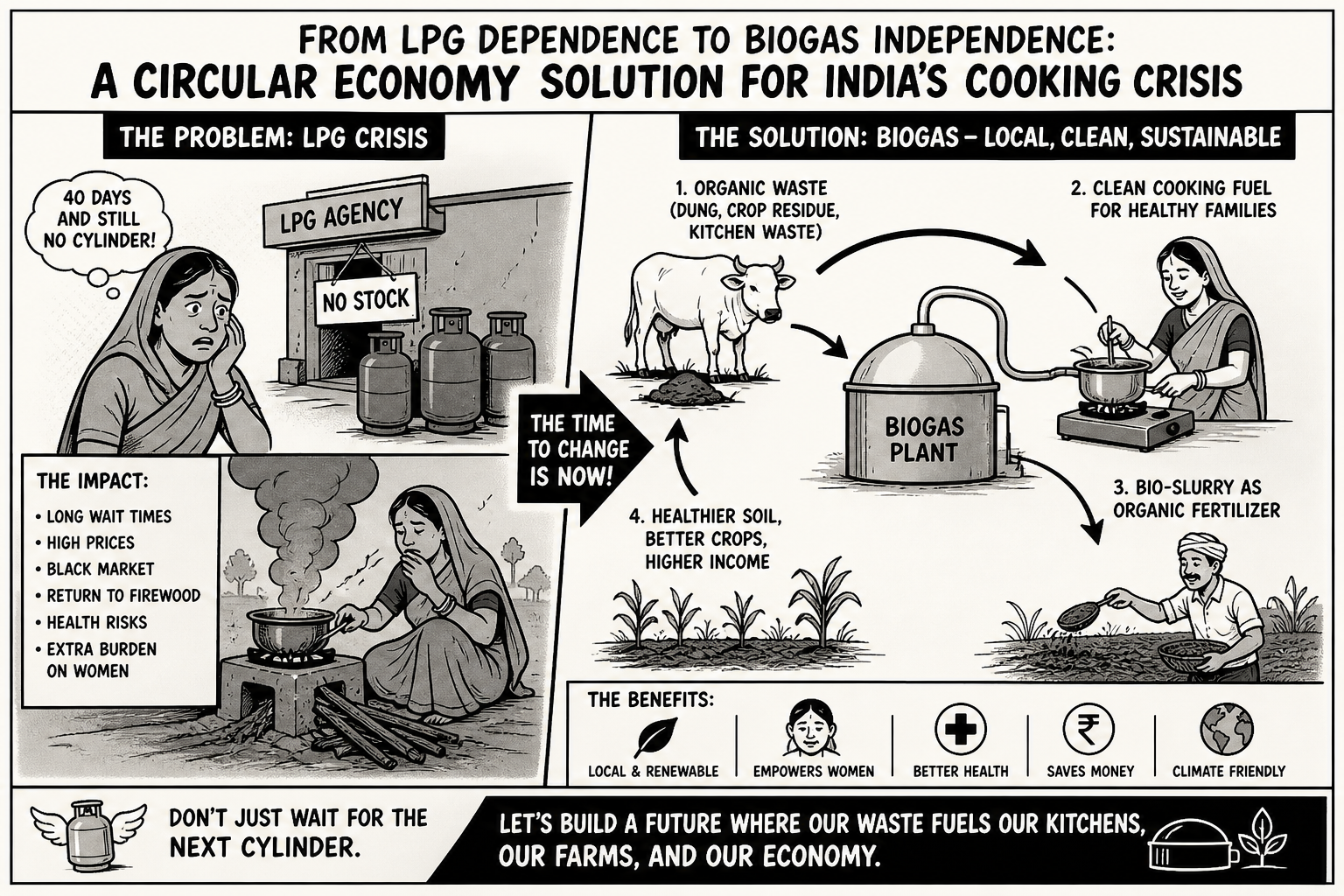
Circular economy solution for India’s cooking crisis

For the past decade, India’s clean cooking revolution was symbolised by a powerful image in the form of a woman in a rural village receiving her first LPG connection under the Pradhan Mantri Ujjwala Yojana (PMUY). It represented dignity, health, convenience, and liberation from the unpaid drudgery of firewood collection, respiratory illness, and smoky kitchens where women spent hours inhaling toxic fumes while cooking over firewood and dung cakes. And to be fair, it was a transformational policy intervention because it solved a critical access problem by expanding LPG connections to millions of low-income households. But as is often the case with development policy, solving access did not fully solve sustainability. 

The recent conflict in West Asia has disrupted global energy supply chains and exposed India’s dangerous dependence on imported cooking fuel. With tensions around Iran and the closure of the Strait of Hormuz, India, where nearly 60% of LPG demand is met through imports, and over 90% of those imports typically transit through Hormuz, has found itself in an avoidable crisis. LPG supplies have tightened, transportation costs have increased, and delays in refill deliveries have become common in many rural districts and smaller towns. In several places, households are reportedly waiting over 40 days for a cylinder refill. Prices have surged, black market sales have flourished, and many low-income families are being pushed back toward firewood, charcoal, and kerosene. India is facing its first wave of ‘energy migrants’ as LPG shortages and soaring fuel prices have triggered reverse migration from cities to villages, especially from the major industrial hubs, including Delhi, Mumbai and Surat. A clean cooking transition built on imported fossil fuel has suddenly begun to look alarmingly vulnerable.

India imports a substantial share of its LPG requirements, and a large portion of these imports move through geopolitically sensitive shipping routes. While India is considered a leader in clean cooking access, millions of households remain dependent on an international supply chain shaped by wars, shipping disruptions, currency fluctuations, and global oil politics. The rural poor, as always, bear the highest burden of this volatility. A delayed LPG refill in an urban apartment may be an inconvenience, but in rural India, it often means a family returns to collecting wood, spending additional hours on unpaid labour, or cutting back on cooked meals altogether. Small roadside eateries reduce their menu options, and migrant workers spend more on food. Development gains achieved over the years begin reversing quietly, one delayed cylinder at a time.

Today, the villages struggling with LPG shortages often possess enormous untapped energy resources sitting in plain sight. Across rural India, cattle dung, agricultural residue, poultry waste, kitchen scraps, and other organic materials are abundantly available. India has one of the world’s largest livestock populations, producing massive quantities of dung every single day. Much of this waste is either left to decompose openly, releasing methane into the atmosphere, or converted into traditional dung cakes that burn inefficiently and create harmful smoke. What if this waste could instead become a reliable source of clean cooking fuel? That is precisely where biogas emerges not merely as an alternative, but as a strategic necessity.

Biogas is produced through anaerobic digestion, a process where organic waste decomposes in oxygen-free chambers and releases methane-rich gas that can be used for cooking. The leftover slurry becomes high-quality organic fertiliser. This is an excellent circular economy model where households generate fuel from waste while simultaneously reducing fertiliser costs for farming. For rural families, this means lower dependence on LPG refills, lower household expenditure, improved sanitation, reduced smoke exposure, and additional agricultural benefits. Unlike LPG, biogas is hyperlocal as it does not depend on international shipping routes, refinery outputs, or geopolitical stability. Unlike firewood, it burns cleanly. Unlike solar cookers, it works regardless of weather or time of day. Unlike electric induction stoves, it does not depend on stable electricity supply, which remains inconsistent in many rural areas. In a world increasingly shaped by supply chain disruptions, biogas offers resilience.

India does not need to invent this model from scratch because proven examples already exist. In parts of Rajasthan, Maharashtra, Gujarat, Karnataka, Punjab, and several other Indian states, communities have successfully adopted household and community biogas systems. Villages linked to dairy cooperatives have demonstrated how cattle waste can be transformed into reliable cooking fuel. Some communities have significantly reduced their dependence on LPG altogether. During recent supply disruptions, such villages and farming households were largely insulated from shortages because their cooking fuel was produced locally. No waiting for gas agencies, no inflated black-market prices, and no dependence on international conflict. Their kitchens continue to function because their fuel is local.

What makes India’s underinvestment in biogas particularly frustrating is that the policy architecture already exists. The government has long operated biogas programs through the Ministry of New and Renewable Energy, and initiatives like Sustainable Alternative Towards Affordable Transportation (SATAT) have promoted compressed biogas (CBG). Yet these efforts have often remained fragmented, underfunded, and treated as niche rural welfare programs rather than core components of national energy security. India tends to think big when discussing energy with large refineries, strategic petroleum reserves, international supply agreements, and mega infrastructure. These are important; however, true resilience often comes from decentralisation. A household biogas unit in a rural village may seem small compared to an oil refinery, but millions of such units can collectively create enormous national resilience.

Imagine if even a quarter of India’s livestock-owning rural households had access to functional biogas systems. Or village-level community digesters serving clusters of homes where individual ownership is not feasible. Imagine schools, Anganwadis, hostels, and community kitchens using biogas generated from local organic waste. Think of self-help groups running maintenance services for biogas units as local enterprises. Imagine MGNREGA funding village-level renewable energy infrastructure. Suddenly, biogas can move from being a sustainability experiment to becoming a serious economic and strategic asset.

The climate benefits further strengthen this strategy. Methane emissions from unmanaged livestock waste contribute significantly to global warming. Capturing this methane for productive use helps reduce greenhouse gas emissions. Every cubic meter unit of biogas reduces 2 tons CO2e/year. Reduced firewood usage can lower deforestation pressures. Bio-slurry reduces dependence on chemical fertilisers, moving towards sustainable agriculture. Lower LPG consumption reduces fossil fuel imports. Biogas sits at the intersection of climate policy, rural livelihoods, women’s empowerment, waste management, and energy security, a rare policy intervention that solves multiple problems simultaneously. Biogas directly contributes to SDG 5 (Gender Equality), SDG 7 (Affordable and Clean Energy), and Sustainable Energy for All (SE4ALL). It also delivers results that contribute to SDG 1 (Poverty Eradication), SDG 3 (Good Health and Well-being), and SDG 13 (Climate Action).

The current LPG crisis should serve as a warning. The war in the Middle East did not create India’s vulnerability, merely exposed it. A country aspiring to become a global economic power cannot allow millions of household kitchens to remain hostage to international conflict. Energy security cannot only be discussed in terms of crude oil imports and electricity generation. It must also include the daily cooking needs of ordinary citizens. The woman waiting 40 days for an LPG cylinder in a rural village is experiencing energy insecurity in its most human form. India’s future energy strategy must become far more diversified. LPG will continue to play an important role, particularly in urban areas and transitional markets. But it cannot remain the singular answer for rural cooking energy. Biogas offers India local control that imported LPG can never provide. It transforms waste into wealth, dependency into resilience, and vulnerability into self-reliance. In a century likely to be shaped by geopolitical instability, climate disruptions, and fragile global supply chains, the most strategic energy resource may not be buried deep underground or shipped across oceans. It may be sitting quietly in rural backyards, waiting for India to finally recognise its potential.

Gold Rush

As the festive season in India is ongoing, jewellers across India are ready, investors tracking bullion prices, and families waiting eagerly for the most “auspicious” day of the year to buy gold. Dhanteras, celebrated two days before Diwali, has long been associated with the purchase of the precious metal, a tradition believed to bring prosperity and good fortune. Similar buying frenzies occur during Akshaya Tritiya, weddings, Karwa Chauth, and harvest festivals, when gold is not merely an adornment but a cultural marker of wealth and status.

Market reports celebrate the crores spent, but beneath the sparkle lies a complex story of culture, aspiration, and economics. Is festival gold-buying a timeless symbol of financial prudence and cultural continuity, or is it a cycle of consumption propelled by social pressure, marketing, and habit?

India’s love affair with gold is centuries old. From the time of the Indus Valley civilisation to the Mauryan emperors to our modern nuclear families, gold has been a medium of exchange, a store of value, and a token of spiritual significance. For millions, gold is not just metal, it is Lakshmi, the goddess of wealth herself. Dhanteras literally means “the thirteenth day of wealth,” and families believe that buying gold on this day invites abundance.

This cultural reverence made economic sense in a pre-banking era. Gold’s intrinsic value and portability provided a hedge against famine, emergency, and currency devaluation. Rural households, lacking access to formal savings mechanism, used jewellery as insurance and collateral. Even today, India remains the world’s second-largest consumer of gold, with annual demand often exceeding 700–800 tonnes. For many, gold remains the most trusted form of intergenerational wealth transfer.

Yet, today’s festival buying is no longer just about family heirlooms or prudent savings. It has evolved into a multi-billion-rupee economic event. According to trade bodies like the All-India Gem and Jewellery Domestic Council, Dhanteras sales often spike by 20–25% year-on-year, depending on price trends. In 2024, for example, despite gold hovering at record highs of around INR61,000 per 10 grams, jewellers reported robust demand, with many urban consumers opting for lighter designs or digital gold to keep up with tradition.

Specific estimates for festival (especially Dhanteras) sales in recent years help show the proportion of demand tied to ritual buying. During Dhanteras in 2024, around 20-22 tonnes of gold were sold, worth nearly INR 16,000 crore. The full jewellery sector during the festival period saw sales in the INR 18,000-20,000 crore.

The annual figures show India’s gold demand continues to be immense, though shifting in nature,

  • In 2024, India’s total gold demand rose to around 802.8 tonnes, up from 761 tonnes in 2023.  
  • The value of gold purchases in 2024 was estimated at INR 5.15 lakh crore (~US$60-70 billion depending on gold price).  
  • Jewellery demand in 2024 was ~ 563 tonnes, with the non-ornamental purchases (coins/bars) making up ~ 239 tonnes.   

These numbers reflect overall demand, not just festival or Dhanteras purchases, but festivals remain a major driver. The data show that although overall demand has often crept upward in value terms (driven by price inflation), the volume of jewellery demand has at times fallen or stagnated. For example, in 2024 jewellery tonnage demand dropped ~2% compared to 2023 even as value increased.

Targeted marketing plays a huge role. Advertisements link gold to auspiciousness and emotional milestones, “Gift prosperity,” “Secure her future,” “Start your Diwali with gold.” Social media influencers and celebrity endorsements reinforce the message that a festival without gold is incomplete. This creates a powerful psychological loop: buying gold is not just desirable, it is expected.

The Dhanteras gold rush is fuelled by a mix of fear and aspiration. Gold retains a near-mystical aura as a hedge against uncertainty. Global financial instability, inflation, and geopolitical tensions often send prices higher, reinforcing the perception of gold as a “safe haven.” For middle-class families, a few grams bought every year feels like both a celebration and a safety net.

But there is also the quieter pressure of status. Weddings, festivals, and social gatherings often showcase jewellery as a measure of success. The fear of “falling behind” relatives or neighbours can nudge families, especially in smaller towns and rural areas, into stretching budgets and even getting into debt trap to maintain appearances. What was once a hedge against uncertainty can change into a source of financial strain.

From a macroeconomic perspective, India’s gold obsession is a double edged sword. While the jewellery industry supports millions of jobs, from miners to artisans to retailers, it also represents a massive outflow of capital. India imports more than 90% of its gold, spending billions of dollars in foreign exchange each year. Economists have long argued that this “dead investment” locks up household savings in a non-productive asset, diverting funds from sectors like manufacturing, infrastructure, or technology that could generate higher returns and employment.

For individual households, the opportunity cost is equally significant. A family buying gold at festival-time may forgo investing in equity markets, mutual funds, or even bank deposits that could provide compounding growth. Gold prices, while generally stable over the long term, are not immune to volatility as we are witnessing now with gold prices rising to INR 120K+ per 10 grams. The metal offers no dividends or interest; its value lies only in resale or emotional satisfaction.

Beyond economics lies an often-ignored cost, the environmental impact of gold mining. Extracting gold is an energy-intensive process that generates toxic waste and contributes to deforestation, soil erosion, and water pollution. Globally, gold mining is associated with mercury contamination and significant carbon emissions. While India imports much of its gold, domestic refining and artisanal mining also pose environmental challenges.

Consumers rarely connect their festival purchases to these ecological consequences. The cultural narrative of purity and prosperity masks the fact that every bangle and coin carries a hidden footprint. Ethical sourcing, such as recycled gold or fair-trade certifications, is slowly gaining traction among urban, environmentally conscious buyers, but remains a niche segment.

As India’s economy digitises, a quiet transformation is underway. Younger consumers, especially in cities, are exploring alternatives to physical gold. Digital gold platforms, gold exchange-traded funds (ETFs), and sovereign gold bonds (SGBs) allow individuals to invest in gold without worrying about purity, storage, or theft.

These products offer flexibility and sometimes better returns. Sovereign gold bonds, for instance, pay annual interest and are exempt from capital gains tax if held to maturity. Yet they also challenge the cultural core of gold-buying: there is no ornament to wear, no glitter to display, no festive ritual of walking into a jewellery shop on Dhanteras. For many families, the emotional experience is as important as the investment itself. Still, the shift is undeniable. Digital gold platforms have reported double-digit growth during recent festivals, particularly among younger investors who value convenience and liquidity over tradition.

So where does this leave the Indian consumer? To dismiss festival gold-buying as mere superstition would be simplistic. Traditions provide continuity, identity, and joy. For rural households with limited access to financial products, gold remains a practical and trusted savings tool.

But to ignore the economic, environmental, and social pressures embedded in this ritual is equally shortsighted. When a practice once rooted in prudence becomes a compulsive annual expense, it risks becoming a trap. The symbolism of prosperity can mask financial strain, and the celebration of abundance can conceal environmental degradation. Festivals can retain their joy without becoming economic burdens. A few grams of gold bought with intention, rather than compulsion, can honour tradition while respecting modern realities.

Dhanteras will always hold a special place in the Indian calendar. The sight of families entering jewellery shops, and elders blessing the new purchase is undeniably heartwarming. Yet it is worth remembering that true prosperity lies not in the weight of gold but in the wisdom of choice.

As India strides into a digital, climate conscious future, perhaps the most auspicious act is not buying more gold, but buying it mindfully acknowledging its beauty, its history, and its hidden costs. The goddess of wealth, after all, smiles brightest on those who balance tradition with thoughtfulness.

Buy thoughtfully. Celebrate responsibly. Live consciously.

Laminated bamboo furniture

Laminated bamboo furniture is a modern invention but has already become popular in many countries. It is produced from molded bamboo components and to the uninitiated eye the furniture is unrecognizable as having been produced from bamboo. A huge range of furniture can be produced, such as table and chairs, bookshelves, beds, cabinets and recliners. The furniture is durable, practical and has a modern appearance and in recent years elegant designs have been produced in China and Japan. Read the full post HERE

Bamboo for sustainable economic development

Bamboo is an important means for generating income and improving the nutritional status of over 2 billion poor and disadvantaged people. It also provides the resource base for expanding Small and Medium Enterprise sector, providing employment and income generating opportunities to alleviate poverty. As such it constitutes an excellent entry point for local poverty alleviation initiatives. Read the full post HERE