Circular economy solution for India’s cooking crisis

For the past decade, India’s clean cooking revolution was symbolised by a powerful image in the form of a woman in a rural village receiving her first LPG connection under the Pradhan Mantri Ujjwala Yojana (PMUY). It represented dignity, health, convenience, and liberation from the unpaid drudgery of firewood collection, respiratory illness, and smoky kitchens where women spent hours inhaling toxic fumes while cooking over firewood and dung cakes. And to be fair, it was a transformational policy intervention because it solved a critical access problem by expanding LPG connections to millions of low-income households. But as is often the case with development policy, solving access did not fully solve sustainability. 

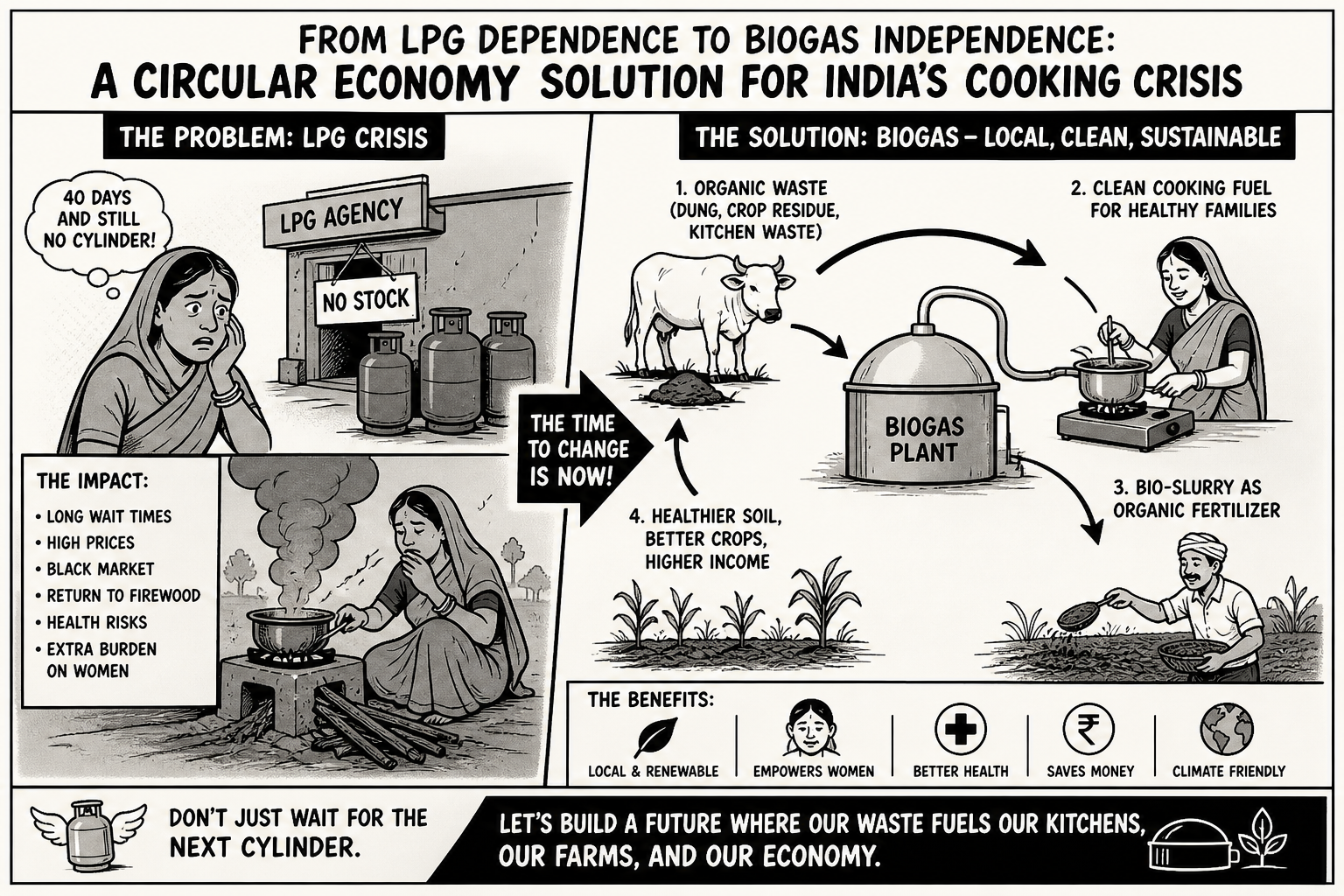
The recent conflict in West Asia has disrupted global energy supply chains and exposed India’s dangerous dependence on imported cooking fuel. With tensions around Iran and the closure of the Strait of Hormuz, India, where nearly 60% of LPG demand is met through imports, and over 90% of those imports typically transit through Hormuz, has found itself in an avoidable crisis. LPG supplies have tightened, transportation costs have increased, and delays in refill deliveries have become common in many rural districts and smaller towns. In several places, households are reportedly waiting over 40 days for a cylinder refill. Prices have surged, black market sales have flourished, and many low-income families are being pushed back toward firewood, charcoal, and kerosene. India is facing its first wave of ‘energy migrants’ as LPG shortages and soaring fuel prices have triggered reverse migration from cities to villages, especially from the major industrial hubs, including Delhi, Mumbai and Surat. A clean cooking transition built on imported fossil fuel has suddenly begun to look alarmingly vulnerable.

India imports a substantial share of its LPG requirements, and a large portion of these imports move through geopolitically sensitive shipping routes. While India is considered a leader in clean cooking access, millions of households remain dependent on an international supply chain shaped by wars, shipping disruptions, currency fluctuations, and global oil politics. The rural poor, as always, bear the highest burden of this volatility. A delayed LPG refill in an urban apartment may be an inconvenience, but in rural India, it often means a family returns to collecting wood, spending additional hours on unpaid labour, or cutting back on cooked meals altogether. Small roadside eateries reduce their menu options, and migrant workers spend more on food. Development gains achieved over the years begin reversing quietly, one delayed cylinder at a time.

Today, the villages struggling with LPG shortages often possess enormous untapped energy resources sitting in plain sight. Across rural India, cattle dung, agricultural residue, poultry waste, kitchen scraps, and other organic materials are abundantly available. India has one of the world’s largest livestock populations, producing massive quantities of dung every single day. Much of this waste is either left to decompose openly, releasing methane into the atmosphere, or converted into traditional dung cakes that burn inefficiently and create harmful smoke. What if this waste could instead become a reliable source of clean cooking fuel? That is precisely where biogas emerges not merely as an alternative, but as a strategic necessity.

Biogas is produced through anaerobic digestion, a process where organic waste decomposes in oxygen-free chambers and releases methane-rich gas that can be used for cooking. The leftover slurry becomes high-quality organic fertiliser. This is an excellent circular economy model where households generate fuel from waste while simultaneously reducing fertiliser costs for farming. For rural families, this means lower dependence on LPG refills, lower household expenditure, improved sanitation, reduced smoke exposure, and additional agricultural benefits. Unlike LPG, biogas is hyperlocal as it does not depend on international shipping routes, refinery outputs, or geopolitical stability. Unlike firewood, it burns cleanly. Unlike solar cookers, it works regardless of weather or time of day. Unlike electric induction stoves, it does not depend on stable electricity supply, which remains inconsistent in many rural areas. In a world increasingly shaped by supply chain disruptions, biogas offers resilience.

India does not need to invent this model from scratch because proven examples already exist. In parts of Rajasthan, Maharashtra, Gujarat, Karnataka, Punjab, and several other Indian states, communities have successfully adopted household and community biogas systems. Villages linked to dairy cooperatives have demonstrated how cattle waste can be transformed into reliable cooking fuel. Some communities have significantly reduced their dependence on LPG altogether. During recent supply disruptions, such villages and farming households were largely insulated from shortages because their cooking fuel was produced locally. No waiting for gas agencies, no inflated black-market prices, and no dependence on international conflict. Their kitchens continue to function because their fuel is local.

What makes India’s underinvestment in biogas particularly frustrating is that the policy architecture already exists. The government has long operated biogas programs through the Ministry of New and Renewable Energy, and initiatives like Sustainable Alternative Towards Affordable Transportation (SATAT) have promoted compressed biogas (CBG). Yet these efforts have often remained fragmented, underfunded, and treated as niche rural welfare programs rather than core components of national energy security. India tends to think big when discussing energy with large refineries, strategic petroleum reserves, international supply agreements, and mega infrastructure. These are important; however, true resilience often comes from decentralisation. A household biogas unit in a rural village may seem small compared to an oil refinery, but millions of such units can collectively create enormous national resilience.

Imagine if even a quarter of India’s livestock-owning rural households had access to functional biogas systems. Or village-level community digesters serving clusters of homes where individual ownership is not feasible. Imagine schools, Anganwadis, hostels, and community kitchens using biogas generated from local organic waste. Think of self-help groups running maintenance services for biogas units as local enterprises. Imagine MGNREGA funding village-level renewable energy infrastructure. Suddenly, biogas can move from being a sustainability experiment to becoming a serious economic and strategic asset.

The climate benefits further strengthen this strategy. Methane emissions from unmanaged livestock waste contribute significantly to global warming. Capturing this methane for productive use helps reduce greenhouse gas emissions. Every cubic meter unit of biogas reduces 2 tons CO2e/year. Reduced firewood usage can lower deforestation pressures. Bio-slurry reduces dependence on chemical fertilisers, moving towards sustainable agriculture. Lower LPG consumption reduces fossil fuel imports. Biogas sits at the intersection of climate policy, rural livelihoods, women’s empowerment, waste management, and energy security, a rare policy intervention that solves multiple problems simultaneously. Biogas directly contributes to SDG 5 (Gender Equality), SDG 7 (Affordable and Clean Energy), and Sustainable Energy for All (SE4ALL). It also delivers results that contribute to SDG 1 (Poverty Eradication), SDG 3 (Good Health and Well-being), and SDG 13 (Climate Action).

The current LPG crisis should serve as a warning. The war in the Middle East did not create India’s vulnerability, merely exposed it. A country aspiring to become a global economic power cannot allow millions of household kitchens to remain hostage to international conflict. Energy security cannot only be discussed in terms of crude oil imports and electricity generation. It must also include the daily cooking needs of ordinary citizens. The woman waiting 40 days for an LPG cylinder in a rural village is experiencing energy insecurity in its most human form. India’s future energy strategy must become far more diversified. LPG will continue to play an important role, particularly in urban areas and transitional markets. But it cannot remain the singular answer for rural cooking energy. Biogas offers India local control that imported LPG can never provide. It transforms waste into wealth, dependency into resilience, and vulnerability into self-reliance. In a century likely to be shaped by geopolitical instability, climate disruptions, and fragile global supply chains, the most strategic energy resource may not be buried deep underground or shipped across oceans. It may be sitting quietly in rural backyards, waiting for India to finally recognise its potential.

How sustainable is Sustainability?

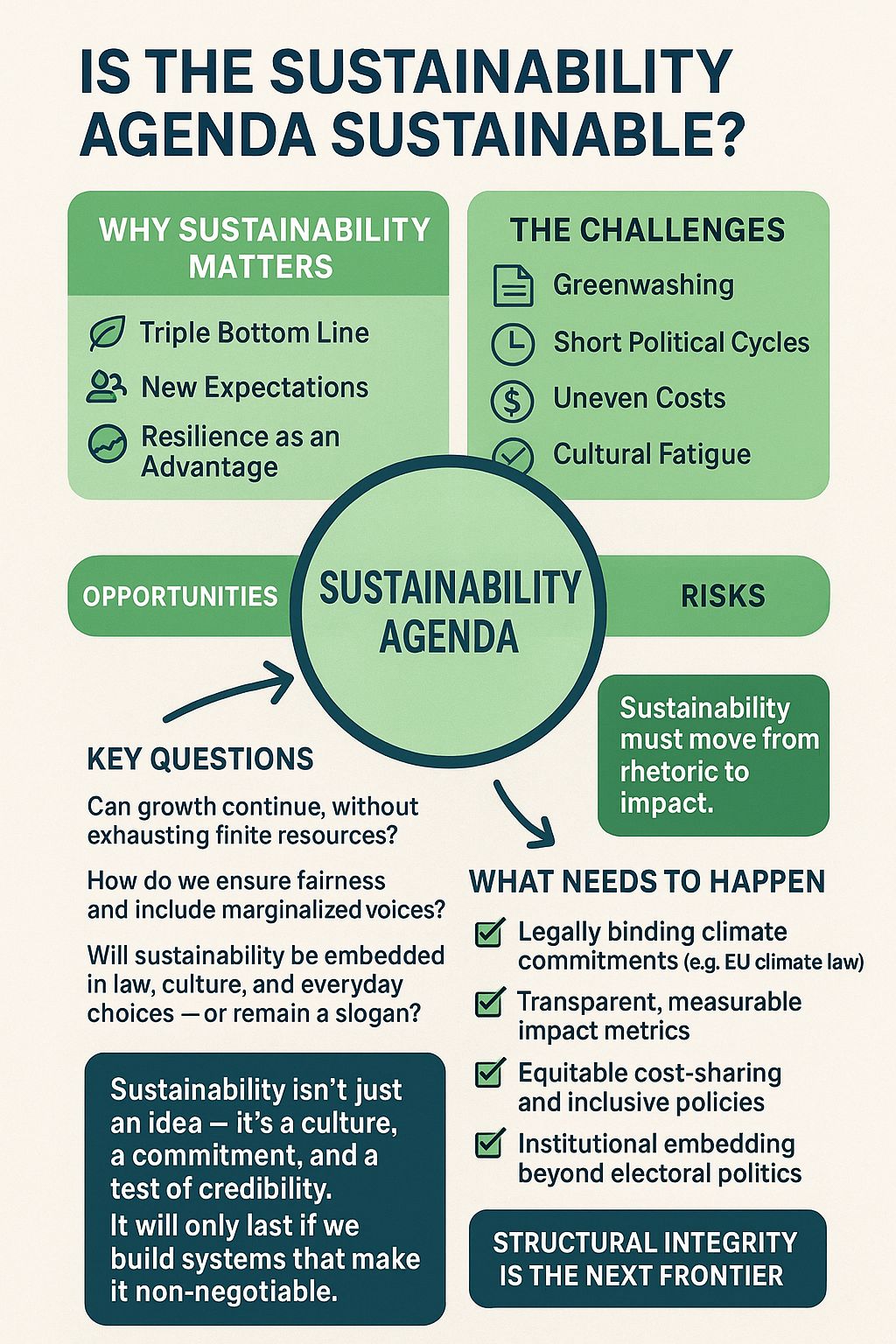
Few words have travelled as far and wide in recent decades as “sustainability”, and has certainly surpassed another overused (in recent past) term ‘social capital’ in usage! It has become synonymous with progress in corporate boardrooms, multilateral summits, government policies, NGO goals, and grassroots movements alike. From ESG scorecards to climate pledges, from net-zero roadmaps to community-led conservation, the language of sustainability has become universal. Every government strategy, corporate report, and grassroots initiative seems anchored in the promise of a more sustainable future. Yet beneath this consensus lies a paradoxical and uncomfortable question: ‘is the sustainability agenda itself sustainable?’

The modern sustainability agenda rests on a powerful proposition that economic growth, social equity, and environmental stewardship can be reconciled. This “triple bottom line” has mobilized unprecedented investment in renewable energy, green finance, and inclusive business models. It has inspired younger generations to demand more from institutions. And it has reframed long-term resilience as a competitive advantage, not a trade-off. But the very breadth of the agenda also makes it fragile. Sustainability risks becoming a catch-all phrase, diluted by overuse and co-opted for public relations more than systemic change. “Greenwashing” scandals, short political cycles, and the uneven costs of climate transitions all threaten to erode public trust. Without credibility and consistency, the agenda risks collapsing under its own ambition.

Sustainability requires commitments that extend far beyond the horizon of electoral politics. Yet in many countries, climate targets or ESG mandates are vulnerable to reversal when governments change. Contrast this with the European Union’s legally binding climate law, a structural safeguard that makes sustainability less of a political preference and more of a shared contract. Unless sustainability is institutionally embedded, it remains hostage to short sightedness.

Green growth advocates argue that economies can decouple prosperity from resource use. The rapid expansion of renewable energy, circular economy models, and impact investing provide evidence of possibility. Yet sceptics highlight that global consumption continues to outpace planetary boundaries. The sustainability agenda will endure only if it reconciles with the fundamental question of growth Vs limits. Can infinite growth coexist with finite resources?

No agenda, however well-intentioned, survives if it is perceived as unjust. For sustainability to be sustainable, it must embody fairness that includes redistributing costs, creating inclusive opportunities, and acknowledging diverse voices, particularly from the Global South. Social justice and legitimacy must go hand in hand.

Ultimately, sustainability is not just a strategy, it is a cultural shift. The more it embeds in consumer choices, organizational values, and educational systems, the harder it becomes to reverse. Yet cultural fatigue is real. When “sustainability” is reduced to a buzzword on every product label, development projects, and corporate brochure, it risks losing meaning. The agenda must therefore move from rhetoric to demonstrable impact, measured transparently and communicated honestly.

The sustainability agenda is both fragile and resilient. Fragile because it depends on long-term alignment across politics, markets, and societies, an alignment often in short supply. Resilient because it has transcended niche environmentalism to become a mainstream expectation that governments and corporations cannot ignore.

Its endurance will depend not on visionary statements but on institutional embedding, equitable policies, and a relentless focus on credibility. At its best, sustainability can serve as the organising principle of a new social contract, aligning business, government, and citizens toward long-term collective wellbeing. Sustainability will only be sustainable if it delivers, not someday, but today.

The next frontier is not about asking companies, governments, or communities to “do more” on sustainability. It is about demanding structural integrity – mechanisms, institutions, and accountability frameworks that ensure sustainability survives political shifts, economic pressures, and cultural fatigue.

Renewable ENergy Open Innovation Platform

RENOIP: Renewable ENergy Open Innovation Platform

This idea was submitted for 2011 Echoing Green Fellowship by Manu Mayank.

Describe your idea for social change in one single sentence.

 Our idea for social change is to facilitate and promote disruptive innovations in green technologies to create sustainable futures, by harnessing the capabilities of Web 2.0.

Describe your idea for social change in one single paragraph.

RENOIP aspires to become an open platform for the promotion of innovation in renewable energy and preferred purchasing for enterprises in the fields of renewable energy, with a view to helping enterprises to improve faster and better. The aim is to support all forms of innovation, improve competence, build a robust knowledge repository, and promote entrepreneurship in the field of renewable energy, focusing on tackling the great societal challenges of today for sustainable tomorrow.

What specific problem in the world are you trying to solve?  Where possible, use statistics and references to identify the size and scope of the problem. 

Meeting future energy needs in a sustainable way requires innovative breakthroughs to efficiently generate, store, and transmit energy. Innovation expertise is scattered and there’s no common platform for sharing new developments that could be widely used, especially in developing countries. There’s a sub-optimal exploitation of scientific research results and rarely get translated into market innovations. Renewable energy requires innovation-based-growth that is open for applications globally.

What, specifically, will be your programs or products?  Who will you work with? 

RENOIP is a platform being developed to handle innovation and preferred purchasing in the green energy domain. It will use existing social networks to involve new people and problem-solvers to apply their abilities on solving interesting problems. RENOIP will focus on integrated innovation through (i) a wiki- based knowledge management system, (ii) strong workflow-based problem solving and innovation system that will allow problem owners and solvers alike to interact throughout the life-cycle of a  new project or problem solution, (iii) consolidated directory of relevant experts and enterprises, (iv) product directory and development of a technology that will recommend products and innovative solutions to problems thus saving experts from reinventing the wheel, (v) Information dissemination through e-magazine that will feature resource driven by the community around green energy to keep everyone updated and in sync with the latest technologies.

Describe the impact you hope to achieve.  In what time frame? What specific metrics will help you determine whether your work is making a difference?

The innovation both in technologies & systems to harness renewable energy will thus create a progression of spin-offs affecting fields as diverse as agriculture, real estate, space exploration, and social policy. It will also produce secondary social and economic benefits. RENOIP aims to solve at least 100 issues for enterprises in the field of renewable energy in its first year of operation, and will attract 250 users and 20 enterprises monthly to join the platform. We intend to collect feedback of the end users through a variety of channels including social media, and physical feedback gathering through enterprise partners. We also intend to support social enterprises with resources to measure direct and indirect socio-economic impact of implementing the innovative practices. We are working on developing a set of indicators to map solutions, innovations, usefulness, and turn around, etc, which could be used to measure the impact of RENOIP in quantifiable terms.

How does this approach represent bold innovation versus the status quo? 

RENOIP plans to create a bridge between demand for and supply of green solutions in renewable energy sector by addressing specific technology problems and market failures that still hamper the wider take-up of energy innovation. It will support the emerging renewable energy markets by strengthening the innovation capacity of SMEs and Social Enterprises by bring global innovation capacity and knowledge through an open platform.  RENOIP has the ambition to become the foremost platform for enterprises, incubators and market facilitators, industry professionals, technical research centres, innovation experts, and investors, which will enable them to discuss, develop, and exchange ideas and better practices and to contribute to a better understanding of the innovation patterns in renewable energy sector. It will contribute to the creation of an environment in which new renewable energy enterprises can start, grow and thrive, thus supporting the sustainable development of the sector.

How much money will this organization need in the next 12 months?  In the year after?  How much have you raised so far?  From whom?  How do you plan to get the rest?

We intend to operate on a lean budget, and require $25,000 for the first 12 months, with majority of the money being spent on development of the platform, and the rest budgeted for marketing the platform. In the second year of operations, RENOIP will require around $60,000 towards marketing & PR, technical maintenance, and personnel costs. We haven’t started fundraising yet. We are developing a ‘bird-eye-view’ prototype of the OIP and intend to use it for fundraising.  

Your interest in starting this organization makes you unlike most people.  What in your personal, academic, and/or work history compels you to dedicate your life to this idea at this time? 

As partners, we share a passion for Greentech, innovation and application of technology for development. We both hold graduate degrees from premier universities. Manu holds degrees in Economics, and Planning & Development (UQ, Australia), and has worked in the fields of Environment & Economic Development for over ten years spanning Asia, Oceania, and Africa. Since 2006, his focus area has also included renewable energies (Bioenergy and solar), and he thinks that there’s an acute need for innovation that is openly available for creating wider impact from renewable energy projects in developing countries like India. Manu also has experience developing a wiki-based Knowledge Platforms on NTFPs and Bioenergy. Dipankar holds degrees in Computer Science Engineering (IITDelhi), and has founded or worked-with several brilliant technology and social startups. He has created innovative platforms like ‘Kwippy’, which had over 20,000 users & ‘ElectroSocial’, a social media platform and co-founded along with Manu ‘Green venture camp’ to promote cleantech startups, and STIR-e to promote youth social entrepreneurs in India.

What skills or experiences demonstrate that you will be able to attract money, people, and other resources to your idea?

Our combined extensive skills and experiences in technology, Greentech, startups and fundraising makes us a unique team for generating both financial and non financial resources for our idea. We also have a brief but relatively successful history of being startup entrepreneurs, promoting new ideas, and have built a strong network of experts. Manu has successful experiences in raising several million dollars for environment and development through international donors and corporations like IFAD and Ikea.  Dipankar has built a good network and rapport with angel investors inIndiawho are interested in innovative, web-based startups solving real-world problems.  We already are in discussion with six highly-esteemed experts to come on board of advisors for RENOIP. We are confident that we will be able to raise required resources for our idea to make it real and successful.  

What evidence do you have of your ability to overcome challenges and adversity?

While working with rural communities in different parts of Indiafor building their sustainable livelihoods through the use of bamboo, Manu tackled and overcame everyday challenges of terrain, language, and resources through his patience, acumen, and communication skills to help build successful rural enterprises benefiting thousands of rural poor and especially women. Dipankar having lost his father at a young age, has always worked with the odds stacked up against him due to lack of support, but still managed to get through the toughest technical school in India and has carved out an entrepreneurial career for himself, which is inspirational. For last three years we have faced many business and financial challenges and have overcome them through our team efforts, resilience, and a small but dependable social network. Our past experiences of dealing with life’s and work’s challenges & adversities has prepared us to evaluate the situation and take rational decisions to minimize it’s impact if not negate it.