Circular economy solution for India’s cooking crisis
May 11, 2026 Leave a comment
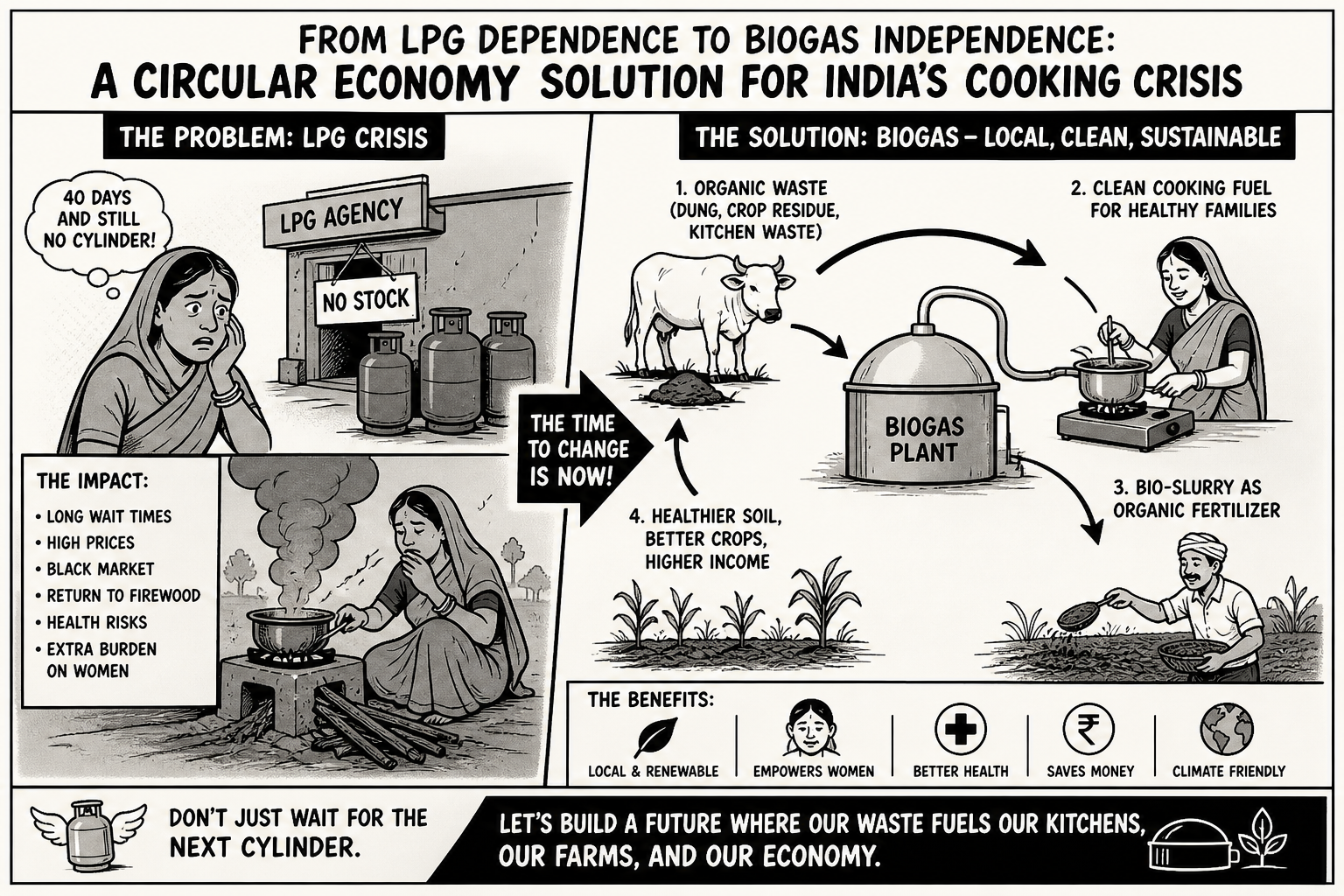
For the past decade, India’s clean cooking revolution was symbolised by a powerful image in the form of a woman in a rural village receiving her first LPG connection under the Pradhan Mantri Ujjwala Yojana (PMUY). It represented dignity, health, convenience, and liberation from the unpaid drudgery of firewood collection, respiratory illness, and smoky kitchens where women spent hours inhaling toxic fumes while cooking over firewood and dung cakes. And to be fair, it was a transformational policy intervention because it solved a critical access problem by expanding LPG connections to millions of low-income households. But as is often the case with development policy, solving access did not fully solve sustainability.
The recent conflict in West Asia has disrupted global energy supply chains and exposed India’s dangerous dependence on imported cooking fuel. With tensions around Iran and the closure of the Strait of Hormuz, India, where nearly 60% of LPG demand is met through imports, and over 90% of those imports typically transit through Hormuz, has found itself in an avoidable crisis. LPG supplies have tightened, transportation costs have increased, and delays in refill deliveries have become common in many rural districts and smaller towns. In several places, households are reportedly waiting over 40 days for a cylinder refill. Prices have surged, black market sales have flourished, and many low-income families are being pushed back toward firewood, charcoal, and kerosene. India is facing its first wave of ‘energy migrants’ as LPG shortages and soaring fuel prices have triggered reverse migration from cities to villages, especially from the major industrial hubs, including Delhi, Mumbai and Surat. A clean cooking transition built on imported fossil fuel has suddenly begun to look alarmingly vulnerable.
India imports a substantial share of its LPG requirements, and a large portion of these imports move through geopolitically sensitive shipping routes. While India is considered a leader in clean cooking access, millions of households remain dependent on an international supply chain shaped by wars, shipping disruptions, currency fluctuations, and global oil politics. The rural poor, as always, bear the highest burden of this volatility. A delayed LPG refill in an urban apartment may be an inconvenience, but in rural India, it often means a family returns to collecting wood, spending additional hours on unpaid labour, or cutting back on cooked meals altogether. Small roadside eateries reduce their menu options, and migrant workers spend more on food. Development gains achieved over the years begin reversing quietly, one delayed cylinder at a time.
Today, the villages struggling with LPG shortages often possess enormous untapped energy resources sitting in plain sight. Across rural India, cattle dung, agricultural residue, poultry waste, kitchen scraps, and other organic materials are abundantly available. India has one of the world’s largest livestock populations, producing massive quantities of dung every single day. Much of this waste is either left to decompose openly, releasing methane into the atmosphere, or converted into traditional dung cakes that burn inefficiently and create harmful smoke. What if this waste could instead become a reliable source of clean cooking fuel? That is precisely where biogas emerges not merely as an alternative, but as a strategic necessity.
Biogas is produced through anaerobic digestion, a process where organic waste decomposes in oxygen-free chambers and releases methane-rich gas that can be used for cooking. The leftover slurry becomes high-quality organic fertiliser. This is an excellent circular economy model where households generate fuel from waste while simultaneously reducing fertiliser costs for farming. For rural families, this means lower dependence on LPG refills, lower household expenditure, improved sanitation, reduced smoke exposure, and additional agricultural benefits. Unlike LPG, biogas is hyperlocal as it does not depend on international shipping routes, refinery outputs, or geopolitical stability. Unlike firewood, it burns cleanly. Unlike solar cookers, it works regardless of weather or time of day. Unlike electric induction stoves, it does not depend on stable electricity supply, which remains inconsistent in many rural areas. In a world increasingly shaped by supply chain disruptions, biogas offers resilience.
India does not need to invent this model from scratch because proven examples already exist. In parts of Rajasthan, Maharashtra, Gujarat, Karnataka, Punjab, and several other Indian states, communities have successfully adopted household and community biogas systems. Villages linked to dairy cooperatives have demonstrated how cattle waste can be transformed into reliable cooking fuel. Some communities have significantly reduced their dependence on LPG altogether. During recent supply disruptions, such villages and farming households were largely insulated from shortages because their cooking fuel was produced locally. No waiting for gas agencies, no inflated black-market prices, and no dependence on international conflict. Their kitchens continue to function because their fuel is local.
What makes India’s underinvestment in biogas particularly frustrating is that the policy architecture already exists. The government has long operated biogas programs through the Ministry of New and Renewable Energy, and initiatives like Sustainable Alternative Towards Affordable Transportation (SATAT) have promoted compressed biogas (CBG). Yet these efforts have often remained fragmented, underfunded, and treated as niche rural welfare programs rather than core components of national energy security. India tends to think big when discussing energy with large refineries, strategic petroleum reserves, international supply agreements, and mega infrastructure. These are important; however, true resilience often comes from decentralisation. A household biogas unit in a rural village may seem small compared to an oil refinery, but millions of such units can collectively create enormous national resilience.
Imagine if even a quarter of India’s livestock-owning rural households had access to functional biogas systems. Or village-level community digesters serving clusters of homes where individual ownership is not feasible. Imagine schools, Anganwadis, hostels, and community kitchens using biogas generated from local organic waste. Think of self-help groups running maintenance services for biogas units as local enterprises. Imagine MGNREGA funding village-level renewable energy infrastructure. Suddenly, biogas can move from being a sustainability experiment to becoming a serious economic and strategic asset.
The climate benefits further strengthen this strategy. Methane emissions from unmanaged livestock waste contribute significantly to global warming. Capturing this methane for productive use helps reduce greenhouse gas emissions. Every cubic meter unit of biogas reduces 2 tons CO2e/year. Reduced firewood usage can lower deforestation pressures. Bio-slurry reduces dependence on chemical fertilisers, moving towards sustainable agriculture. Lower LPG consumption reduces fossil fuel imports. Biogas sits at the intersection of climate policy, rural livelihoods, women’s empowerment, waste management, and energy security, a rare policy intervention that solves multiple problems simultaneously. Biogas directly contributes to SDG 5 (Gender Equality), SDG 7 (Affordable and Clean Energy), and Sustainable Energy for All (SE4ALL). It also delivers results that contribute to SDG 1 (Poverty Eradication), SDG 3 (Good Health and Well-being), and SDG 13 (Climate Action).
The current LPG crisis should serve as a warning. The war in the Middle East did not create India’s vulnerability, merely exposed it. A country aspiring to become a global economic power cannot allow millions of household kitchens to remain hostage to international conflict. Energy security cannot only be discussed in terms of crude oil imports and electricity generation. It must also include the daily cooking needs of ordinary citizens. The woman waiting 40 days for an LPG cylinder in a rural village is experiencing energy insecurity in its most human form. India’s future energy strategy must become far more diversified. LPG will continue to play an important role, particularly in urban areas and transitional markets. But it cannot remain the singular answer for rural cooking energy. Biogas offers India local control that imported LPG can never provide. It transforms waste into wealth, dependency into resilience, and vulnerability into self-reliance. In a century likely to be shaped by geopolitical instability, climate disruptions, and fragile global supply chains, the most strategic energy resource may not be buried deep underground or shipped across oceans. It may be sitting quietly in rural backyards, waiting for India to finally recognise its potential.
If this article made you think differently about energy security, sustainability, or India, subscribe to my blog for one article every week in your mailbox.
(Cover image has been generated using AI)
(Disclaimer: The opinions expressed are those of the author and do not purport to reflect the views or opinions of any organisation, foundation, CSR, non-profit or others.)


