Ghost Eye

Author: Amitav Ghosh | 336 Pages | Genre: Fiction | Publisher: HarperCollins | Year: 2025 | My Rating: 8/10

Ghost Eye by Amitav Ghosh is an intriguing addition to his body of work, blending his characteristic climate change concerns with elements of magical realism, memory, and metaphysical inquiry. Known for novels such as The Shadow Lines, River of Smoke and Jungle Nama, Ghosh has consistently explored the intersections of history, migration, and environment. In Ghost-Eye, he extends this exploration into more experimental terrain, weaving together reincarnation, psychological investigation, and climate activism into a multi-layered non-linear narrative that spans continents and decades.

At the heart of the novel lies a deceptively simple yet deeply unsettling premise of a young girl named Varsha Gupta, raised in a strict vegetarian Marwari household in late-1960s Calcutta, who suddenly insists on eating fish, which is entirely alien to her upbringing. More disturbingly, she claims to remember a past life in which fish was part of her staple diet, suggesting that she may be a ‘case of the reincarnation type.’ This premise immediately situates the novel within a liminal space between rationality and spiritual belief, a tension that drives much of the narrative.

In the early sections of the book, Ghosh meticulously constructs the world of the Gupta household, capturing the cultural rigidity and social milieu of Calcutta’s elite Marwari community. The disruption caused by Varsha’s insistence on fish is not merely dietary but existential as it challenges the family’s worldview and opens a door to questions they are ill-equipped to answer. Enter Dr Shoma Bose, a psychologist studying reincarnation cases, whose rational framework is gradually destabilised by Varsha’s revelations. Through Shoma, Ghosh explores the limits of scientific reasoning when confronted with phenomena that resist empirical categorisation.

What elevates Ghost Eye beyond a simple psychological mystery is its expansive temporal and spatial scope. The narrative moves fluidly between 1960s Calcutta, Sundarbans, and contemporary Brooklyn, where the story resurfaces decades later through Shoma’s nephew, Dinu. This dual timeline allows Ghosh to play with past and present, tradition and modernity, belief and scepticism. The transition is seamless, and the intergenerational narrative adds depth to the central mystery, transforming it into a broader meditation on memory and continuity.

Ghosh uses the motif of reincarnation not merely as a plot device but as a lens through which to examine ecological and ethical questions. The idea of cyclical existence mirrors the cycles of nature, suggesting an interconnectedness between human lives and the environment. As the narrative unfolds, it becomes increasingly clear that Varsha’s story is linked to larger concerns about environmental degradation and climate change. The involvement of environmental activists in the latter part of the novel underscores this connection, tying the metaphysical elements of the story to urgent real-world issues.

Ghosh’s descriptions of Calcutta and the Sundarbans are vivid and immersive, evoking a strong sense of place. The sensory richness in the depiction of food, landscapes, and everyday life grounds the more fantastical elements of the narrative, making them feel plausible within the world he has created. The novel’s magical realism is subtle rather than overt, emerging organically from the characters’ experiences rather than being imposed upon them.While the buildup is compelling and the thematic layers are rich, the ending feels somewhat rushed and less satisfying than the preceding narrative. The resolution of the central mystery, which promises a profound revelation, instead arrives with a sense of abruptness, leaving some threads insufficiently explored. Despite this limitation, Ghost Eye succeeds in pushing the boundaries of Ghosh’s narrative style. It represents a departure from his more historically anchored novels, venturing into speculative and metaphysical boundaries between science and spirituality, memory and imagination, human life and the natural world. The blending of genres creates a unique reading experience that is both engaging and thought-provoking. 

Jungle Nama: A Story of the Sundarban

Jungle Nama: A Story of the Sundarban

by Amitav Ghosh | 88 Pages | Genre:  Literary Fiction | Publisher: Fourth Estate | Year: 2021 | My Rating: 8.5/10

“All you need do, is be content with what you’ve got, to be always craving more, is a demon’s lot.”
― Amitav Ghosh, Jungle Nama

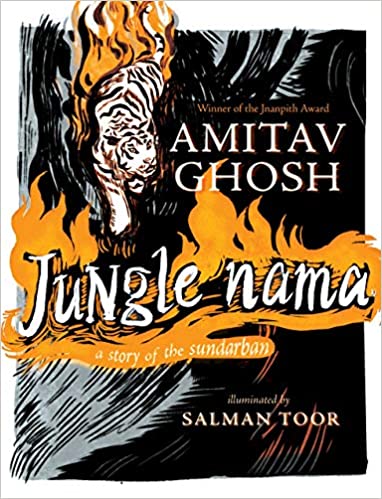
“Jungle Nama” by Amitav Ghosh is a captivating verse adaptation of a Bengali folktale from the Sundarbans, the world’s largest mangrove forest shared between India and Bangladesh. Written in a lyrical, rhythmic style, and illustrated by Salman Toor, the book tells the story of “Bon Bibi,” a benovelent goddess of the Sundarbans who safeguards the jungle and its people, and her conflict with Dokkhin Rai, a powerful demon-like figure who seeks to exploit the forest’s riches.

Ghosh’s decision to render this ancient tale in verse brings a unique musicality to the story, echoing the cadence of oral storytelling introducing music to current speech that has kept the folktale alive for generations. His prose is imbued with both reverence for the source material and a contemporary sensibility that makes the story accessible to a modern audience. Accompanying the text are hauntingly beautiful illustrations by artist Salman Toor, whose work enhances the mystical and otherworldly atmosphere of the Sundarbans and its lore.

Beyond its enchanting style, Jungle Nama explores timeless themes of balance between nature and humanity, the perils of human greed, and the importance of respecting natural boundaries. Ghosh subtly draws parallels to modern issues like climate change and environmental degradation, suggesting that the ancient wisdom in the Bon Bibi story holds valuable lessons for today’s world. Through Bon Bibi’s character, he raises questions about stewardship, sustainability, and the price of human ambition.

The book is more than a poetic retelling; it’s an immersive experience that connects readers to both nature and folklore. Ghosh’s evocative language and Toor’s illustrations work in harmony to capture the spirit of the Sundarbans and its lore, making this book a visually and intellectually rich addition to Ghosh’s body of work. The poem-like style of the book follows twelve syllables in each line, and each couplet has twenty-four syllables. After each line there is a natural pause or a caesura, replicating the cadence of the original legend.

This book by one of my all-time favourite authors is a mesmerizing read for anyone interested in myth, poetry, linguistic hybridity, and environment, offering a rare glimpse into a world where nature and spirituality are deeply intertwined.

The Shadow Lines

shadow-linesThe Shadow Lines

by Amitav Ghosh | 288 Pages | Genre: Fiction| Publisher: Penguin Books India| Year: 1988 | My Rating: 8.5/10

“He said to me once that one could never know anything except through desire, real desire, which was not the same thing as greed or lust; a pure, painful and primitive desire, a longing for everything that was not in oneself, a torment of the flesh, that carried once beyond the limits of one’s mind to other times and other places, and even, if one was lucky, to a place where there was no border between oneself and one’s imagine in the mirror.”

— Amitav Ghosh, The Shadow Lines

Amitav Ghosh captures the lines connecting time and events, and people with each other bound by ties of blood and history. This work of fiction is narrated by and follows the life of a young boy growing up in Calcutta with his grand mother and parents, and later in Delhi and London for his higher education. His Grandmother and Mayadebi are sisters, who grew up in Dhaka pre-partition. After the death of her husband, grandmother works at a school to raise her son without depending upon any charity, while Mayadebi marries a Diplomat and lives a life of luxury. Two characters plays pivotal role in the narrator’s life are Ila, a distant cousin of his from Mayadebi’s side to whom he is attracted yet his yearnings go unrequited, and Tridib, who’s Maya’s son. The story unfolds through flashbacks, then progresses occasionally in the present.

This book with numerous characters and intricate web of memories moving back and forth, is my Read of the Week.

River of Smoke

150px-River_of_smoke“Opium is like the wind or the tides: it is outside my power to affect its course. A man is neither good nor evil because he sails his ship upon the wind. It is his conduct towards those around him – his friends, his family, his servants – by which he must be judged”

– Amitav Ghosh, River of Smoke

River of Smoke, is a novel on trade, empire, and cultural encounter in the age of the Opium Wars. The story is set in Canton in the 1830s, where the novel shifts from the sea-bound drama of Sea of Poppies (first in the Ibis trilogy ) to a more contemplative, cosmopolitan world shaped by commerce and ideas.

Canton, in this story is neither completely Chinese nor European, it’s a place where merchants, sailors, painters, and exiles coexist uneasily. Characters such as the opium trader Bahram Modi and the painter Robin Chinnery are not heroic figures but moral intermediaries, caught between profit and conscience. Through them, Ghosh explores how global capitalism takes root not only through violence, but also through everyday transactions, friendships, and compromises.

The novel is dense, patient, and immersive, demanding attentive reading. Historical detail is worn lightly, yet it is a critique of imperial greed and cultural misunderstanding. Unlike conventional historical fiction, River of Smoke resists dramatic climax, choosing instead to trace the slow, inexorable drift toward catastrophe.

‘River of Smoke’, a brilliant historical fiction set in late 19th century China is my “Read of the week”.