The cost of saying Yes
June 8, 2026 Leave a comment
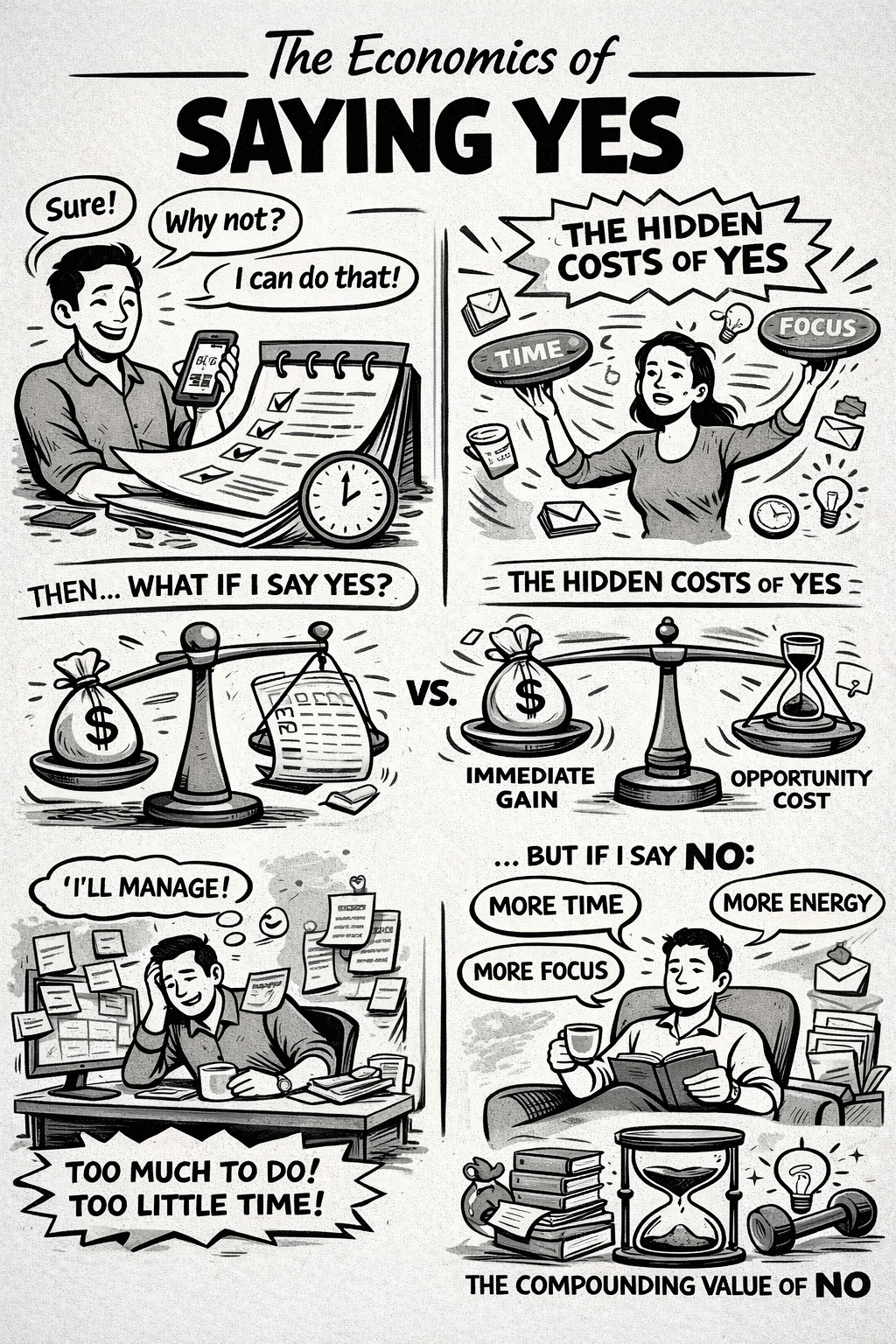
I used to think that saying ‘yes’ was a virtue as it made me feel useful, reliable, even noble at times. I often ended up saying yes to a meeting, yes to a request, yes to a friend, yes to a ‘quick call,’ yes to a ‘small favour,’ yes to that extra responsibility that would ‘hardly take any time.’ My life looked like a well diversified portfolio of yeses. And like many portfolios built on optimism rather than fundamentals, it was collapsing. No one teaches you this early on in life, but every yes is a transaction. It has a cost, a return, and often hidden liabilities. Unlike money, the currency you are spending here is time, attention, and energy, and those accounts don’t send monthly statements! They just end up depleting until one day you find yourself staring at your calendar, wondering why everything feels full and nothing feels meaningful.
When someone says, ‘Can you just hop on a quick call?’ it sounds harmless, as ‘quick’ is a very reassuring word. It suggests efficiency, minimal disruption, and a small and contained transaction. In reality, a ‘quick call’ is rarely just a call. It is context switching, mental preparation, the call itself, the afterthoughts, and the residual distraction that lingers long after the call ends. Economists would call this a hidden cost, and I call it the reason my day disappears in fragments. I remember agreeing to review a document for a colleague. ‘It won’t take long,’ they said, and they were technically correct, as the act of reviewing took about only 20 minutes. But the real cost was closer to an hour. I had to pause what I was doing, understand a different context, switch cognitive gears, and then find my way back to my original work. The 20-minute task came with a 40-minute tax. Multiply that across a week, and you begin to understand how entire days vanish without a trace.
Then there is the opportunity cost of the yes you don’t see. In economics, every choice comes with the value of the next best alternative you give up. When I say yes to a meeting at 6 PM, I am not just committing to that meeting, I am also saying no to my evening unwind, a conversation with family, reading, thinking, or simply doing nothing. The problem is, I don’t feel that loss immediately, and so I consistently undervalue what I am giving up. This is how you end up living a life where your time is fully allocated but poorly invested. I once agreed to attend a weekend workshop because it sounded interesting and, more importantly, because it felt rude to decline. That weekend, I missed a relaxing lunch at home that I didn’t realise I needed. The workshop was fine, but if I am honest, it wasn’t worth what I gave up. The return on that yes was modest, but the opportunity cost was high. The economy of my time had a deficit, which I wasn’t accounting for properly.
If saying yes were purely an economic decision, we would all be much better at it, but it is also deeply social. We say yes because we want to be liked, and we don’t want to disappoint someone. We say yes because somewhere along the way, we learned that being agreeable is a sign of being good. There is also a subtle reputational economy at play, and saying yes signals availability, cooperation, and enthusiasm. It makes you look like a team player, a dependable friend, a responsive colleague. Saying no, on the other hand, feels risky as it might signal disinterest, arrogance, or boundaries. And so, we keep saying yes, not because it makes sense, but because it feels safer. I have done this more times than I can count—agreed to calls I didn’t need to be on, events I didn’t want to attend, responsibilities that stretched me thinner than I should have allowed. Each yes was small, reasonable, and socially acceptable, and together, they created a life that felt crowded but curiously unfulfilling.
There is also the law of diminishing returns quietly operating in the background. The first few yeses in your day are productive as they move things forward, create value, and strengthen relationships. But beyond a certain point, each additional yes adds less value and more strain. The sixth meeting of the week on the same thing is not as useful as the first. The fifth commitment in a day is not as meaningful as the second. The twentieth favour you agree to does not make you twenty times more helpful, and only makes you feel exhausted. I realised this one evening when I found myself in a meeting, nodding at the right moments, contributing just enough to appear engaged, but mentally somewhere else entirely. I wasn’t adding value anymore and was just present in body, absent in mind. That was a negative return on yes, a clear sign that my internal economy was out of balance.
There is a phrase I have used liberally in my life, ‘I will manage.’ It is a beautiful phrase because it is optimistic, confident, and slightly heroic. It suggests resilience, capability, and a willingness to take things on. It is also, more often than not, a lie. ‘I will manage’ is what we tell others when we overcommit. It is what we tell ourselves when we ignore constraints. It is the verbal equivalent of taking on more debt without checking your balance, which keeps accumulating steadily. Until one day, you are not managing, only barely coping, moving from one commitment to another with a vague sense of urgency and a constant feeling of being behind.
If saying no is so rational, why is it so difficult? Because no is final and forces you to prioritise. Yes, on the other hand, keeps options open as it delays decision making. It allows you to feel helpful without immediately confronting the cost. There is also a psychological discomfort in saying no. It creates a moment of tension, however brief, between you and the other person, and we are wired to avoid that tension. But every time we avoid that small discomfort, we create a larger one for ourselves later. The stress simply shifts location from a brief external awkwardness to a prolonged internal burden.
What I have slowly come to realise is that no has compounding benefits. The first few noes feel awkward, even slightly uncomfortable. You second guess yourself, wondering if you were too blunt, too inflexible, or too selfish. But over time, your calendar starts to breathe, your days have space, and your work becomes more focused. Your relationships become more intentional because you are choosing them, not squeezing them in. When I started saying no more consciously, I noticed a real shift. I had time to think, to read, to do things without constantly rushing to the next commitment. The quality of my yeses improved because they were fewer and more deliberate.
For me, saying no is not about rejecting others, but more about protecting something. Sometimes it is protecting my time, energy, attention, and occasionally, my sanity. Instead of thinking, ‘I am letting someone down,’ I think, ‘I am choosing where to show up fully with intent.’ Of course, saying no does not require bluntness or indifference. There is an art to it, though I am still in the learning phase. A thoughtful no acknowledges the request but remains clear about the boundary. You need not overexplain or apologise excessively. ‘I won’t be able to take this on right now.’ Or ‘I would love to, but I don’t have the bandwidth this week.’ Or ‘I am focusing on a few priorities at the moment, so I’ll have to pass.’ These are decisions and not rejections, and they make life coherent.
The goal is not to eliminate yes, but to make it meaningful again. A well placed yes to a project you care about, a conversation that matters, a moment that enriches your life has immense value. But for that yes to exist, it must be protected by many noes. In economics, scarcity creates value, therefore, if your yes is abundant, it is cheap. If it is scarce, it is meaningful. I still say yes, probably more than I should, as old habits die hard. But I am more aware now, as I try to pause a little longer before responding. I ask myself simple questions, like what is the real cost, what am I giving up, and is this the best use of my time right now? Sometimes the answer is still yes, but increasingly, it is no. In the end, the economics of saying yes is not about maximising how much you can take on. It is about optimising what truly matters, because a life filled with yeses may look productive from the outside, but a life shaped by thoughtful noes is a life that actually adds up.
If this essay made you pause and think about your life and the hidden cost of being a ‘YES’ person, subscribe to my blog for one article every week in your mailbox.
(Cover image is generated using AI)