Ghost Eye
April 27, 2026 Leave a comment
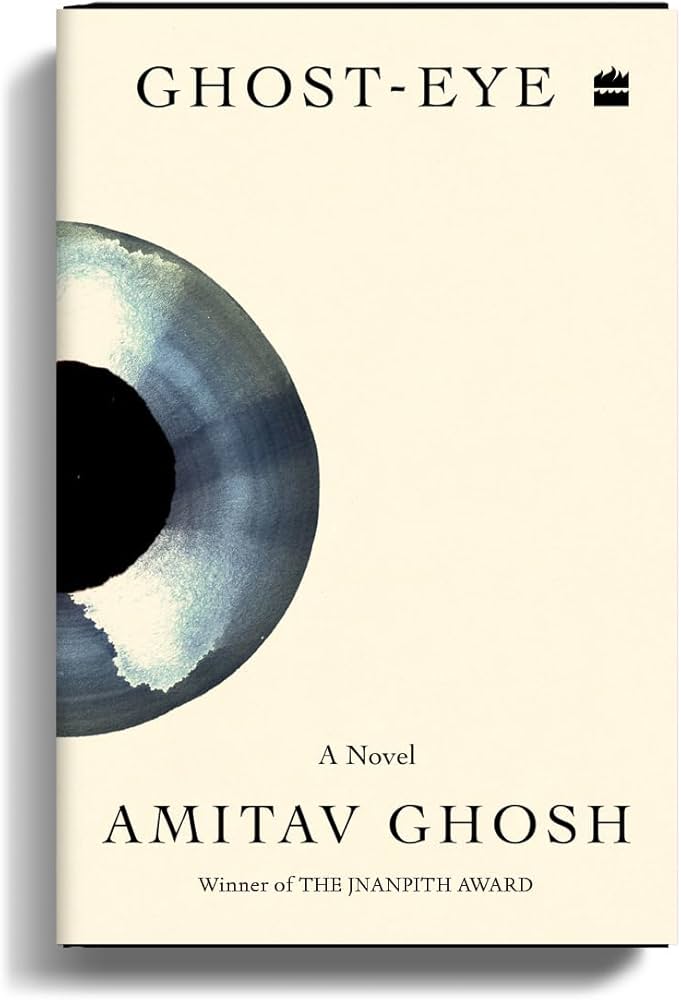
Author: Amitav Ghosh | 336 Pages | Genre: Fiction | Publisher: HarperCollins | Year: 2025 | My Rating: 8/10
“Seems to me that you’ve gotta be in a place you know well, and if that place knows you too, it’ll help you.”
― Amitav Ghosh, Ghost Eye
Ghost Eye by Amitav Ghosh is an intriguing addition to his body of work, blending his characteristic climate change concerns with elements of magical realism, memory, and metaphysical inquiry. Known for novels such as The Shadow Lines, River of Smoke and Jungle Nama, Ghosh has consistently explored the intersections of history, migration, and environment. In Ghost-Eye, he extends this exploration into more experimental terrain, weaving together reincarnation, psychological investigation, and climate activism into a multi-layered non-linear narrative that spans continents and decades.
At the heart of the novel lies a deceptively simple yet deeply unsettling premise of a young girl named Varsha Gupta, raised in a strict vegetarian Marwari household in late-1960s Calcutta, who suddenly insists on eating fish, which is entirely alien to her upbringing. More disturbingly, she claims to remember a past life in which fish was part of her staple diet, suggesting that she may be a ‘case of the reincarnation type.’ This premise immediately situates the novel within a liminal space between rationality and spiritual belief, a tension that drives much of the narrative.
In the early sections of the book, Ghosh meticulously constructs the world of the Gupta household, capturing the cultural rigidity and social milieu of Calcutta’s elite Marwari community. The disruption caused by Varsha’s insistence on fish is not merely dietary but existential as it challenges the family’s worldview and opens a door to questions they are ill-equipped to answer. Enter Dr Shoma Bose, a psychologist studying reincarnation cases, whose rational framework is gradually destabilised by Varsha’s revelations. Through Shoma, Ghosh explores the limits of scientific reasoning when confronted with phenomena that resist empirical categorisation.
What elevates Ghost Eye beyond a simple psychological mystery is its expansive temporal and spatial scope. The narrative moves fluidly between 1960s Calcutta, Sundarbans, and contemporary Brooklyn, where the story resurfaces decades later through Shoma’s nephew, Dinu. This dual timeline allows Ghosh to play with past and present, tradition and modernity, belief and scepticism. The transition is seamless, and the intergenerational narrative adds depth to the central mystery, transforming it into a broader meditation on memory and continuity.
Ghosh uses the motif of reincarnation not merely as a plot device but as a lens through which to examine ecological and ethical questions. The idea of cyclical existence mirrors the cycles of nature, suggesting an interconnectedness between human lives and the environment. As the narrative unfolds, it becomes increasingly clear that Varsha’s story is linked to larger concerns about environmental degradation and climate change. The involvement of environmental activists in the latter part of the novel underscores this connection, tying the metaphysical elements of the story to urgent real-world issues.
Ghosh’s descriptions of Calcutta and the Sundarbans are vivid and immersive, evoking a strong sense of place. The sensory richness in the depiction of food, landscapes, and everyday life grounds the more fantastical elements of the narrative, making them feel plausible within the world he has created. The novel’s magical realism is subtle rather than overt, emerging organically from the characters’ experiences rather than being imposed upon them.While the buildup is compelling and the thematic layers are rich, the ending feels somewhat rushed and less satisfying than the preceding narrative. The resolution of the central mystery, which promises a profound revelation, instead arrives with a sense of abruptness, leaving some threads insufficiently explored. Despite this limitation, Ghost Eye succeeds in pushing the boundaries of Ghosh’s narrative style. It represents a departure from his more historically anchored novels, venturing into speculative and metaphysical boundaries between science and spirituality, memory and imagination, human life and the natural world. The blending of genres creates a unique reading experience that is both engaging and thought-provoking.


