Why change cannot be delivered
July 27, 2026 Leave a comment
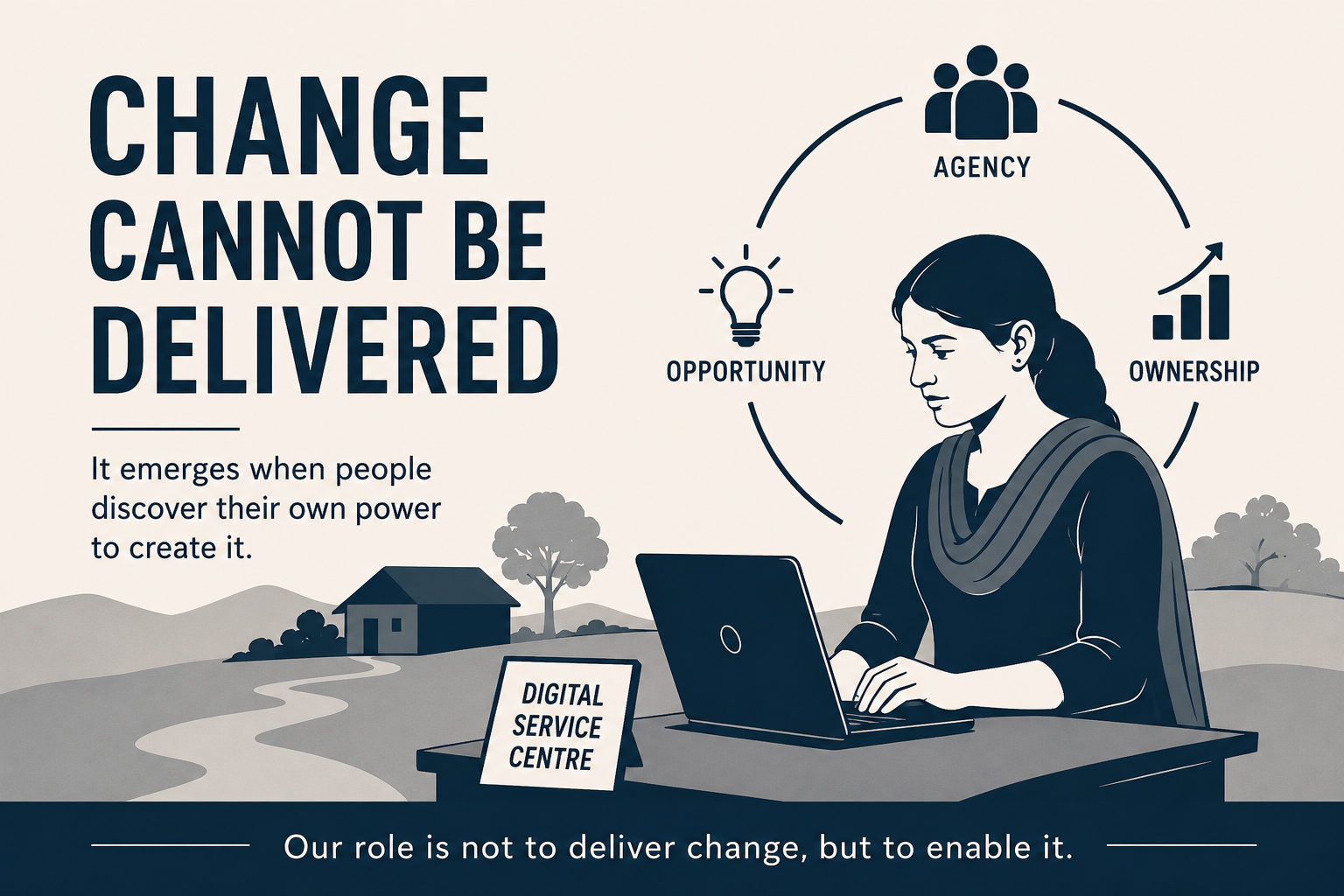
Five years ago, I met Priyanka, a young woman from a small village in the Latehar district of Jharkhand. Like many women in rural India, her world was defined by invisible boundaries. Opportunities were limited, mobility was constrained, and the digital revolution that was transforming urban India felt very distant from her daily reality. When she joined a rural digital entrepreneurship programme, she did not see herself as an entrepreneur. She simply wanted to learn how to use a laptop and perhaps earn a modest income.
Today, Priyanka runs two digital service centres in her village and around. On any given day, she helps scores of people access government schemes, apply for jobs, update documents, pay utility bills, and navigate digital platforms that would otherwise remain out of reach. Villagers who once travelled long distances and spent an entire day completing simple administrative tasks now walk a few minutes to seek her assistance. More importantly, young girls in the village consider her as their role model and hold upward career aspirations. They see someone who looks like them using digital tools to build a livelihood and create value for her community.
What changed in Priyanka’s life was not merely her income but her sense of agency. She stopped being a passive recipient of charity and became an active participant in shaping the future of her community. Her story reminded me of a lesson that I have encountered repeatedly over the past twenty years in development. Lasting change does not happen when we deliver solutions to people. It happens when people gain the confidence, capability, and opportunity to create solutions for themselves.
After 20+ years in development sector, this is the lesson I carry with the greatest conviction that change cannot be delivered to people. It emerges when people discover their own power to create it. We often treat it as something that can be designed, funded, managed, monitored, and delivered. We create theories of change, strategic plans, annual targets, dashboards, and impact indicators. We write proposals describing how communities will evolve over the next three or five years and convince ourselves that social transformation can be engineered with enough resources, expertise, and discipline. Yet the longer I have worked in this sector, the more I have realised that change is far more organic, unpredictable, and human than our project documents suggest.
When I began my career, I believed what many young professionals entering the development sector believe, that poverty could be reduced through good Programs alone, that social problems could be solved through smart interventions, and that institutions with the right intent could create pathways for people to improve their lives. I still believe in all of those things. What has changed is my understanding of where transformation actually comes from. After working across livelihoods, entrepreneurship, environmental sustainability, women’s empowerment, public health, education, and digital inclusion, I have come to a simple conclusion that development succeeds when people gain the agency to shape their own futures.
One of the first assumptions I had to unlearn was the idea that communities are primarily defined by what they lack. Development discussion is filled with the language of deficits. We identify needs, vulnerabilities, gaps, and constraints, and catalogue problems and design interventions to address them. While these exercises are important, they can also blind us to a more powerful reality. Communities possess knowledge, resilience, social capital, aspirations, and capabilities that outsiders frequently underestimate. Over the years, I have met women who built successful enterprises despite social barriers, farmers who adapted to environmental challenges long before climate resilience became a policy priority, and young people who created opportunities where experts saw only limitations. What distinguished these individuals was not the assistance they received but the agency they exercised. The most successful development programs I have witnessed were those that helped people discover their own capacity to act.
This may sound obvious, yet much of the development sector still operates as though change originates from institutions rather than individuals. We often speak of empowering communities as if empowerment is something that can be handed over like a grant or a training manual. Experience has taught me that empowerment is not delivered, but is unlocked. People change their lives when they begin to see themselves not as beneficiaries of someone else’s program but as active participants in shaping their own future.
Another lesson that I took years to fully appreciate is that projects produce outputs, while ecosystems create change. Development organisations have become increasingly sophisticated in measuring activities and outputs. We know how many people attended training programs, how many households received services, how many entrepreneurs were supported, and how many villages were covered. These numbers and accountability matter as funders and stakeholders deserve evidence that resources are being used effectively. Yet some of the most transformative changes I have witnessed had little to do with what was captured in a monitoring framework.
I have seen projects with impressive numbers disappear almost entirely once funding ended. I have also seen relatively modest initiatives continue creating value years after external support had ceased. The difference was rarely the size of the budget or the quality of the project design. More often, it was whether the intervention had strengthened the local ecosystem or not. Sustainable change emerges from relationships, institutions, markets, networks, and leadership. It emerges when communities develop the capacity to solve problems collectively, and when local actors begin driving progress themselves.
This is particularly true in the field of livelihoods and entrepreneurship, where I have spent much of my professional life. For decades, development programs have focused on training individuals, providing assets, or facilitating access to finance. These interventions are valuable, but they are rarely sufficient. Entrepreneurship does not flourish simply because someone acquires a skill. It flourishes when an entire ecosystem supports risk-taking, innovation, market access, mentorship, and growth. The future of development, especially in rural economies, lies in building environments where success becomes possible for many.
One of the more surprising lessons from my career concerns money. Having spent years raising resources for social programs, I have a deep appreciation for the role of funding in creating impact. Without resources, good ideas often remain aspirations. Yet after helping mobilise hundreds of crores for development initiatives, I have come to believe that development is rarely constrained primarily by money. That may sound like an unusual statement coming from someone whose responsibilities have included fundraising and partnership development, but experience repeatedly points in that direction.
Many social challenges that appear to be funding problems are, in reality, leadership problems, institutional problems, capability problems, or trust problems. Additional funding can accelerate progress when strong systems exist. It can also magnify inefficiencies when those systems are weak. Some of the most effective organisations I have come across were not the wealthiest. They were the ones who built credibility, nurtured talent, fostered partnerships, learned continuously, and remained deeply connected to the communities they served. Development ultimately depends on institutions, as strong institutions outlive projects, preserve knowledge, adapt to changing circumstances, and create platforms through which future generations can continue the work. Sustainable change requires institutions capable of sustaining momentum long after a grant agreement expires.
Another belief I have gradually become sceptical of is the sector’s fascination with innovation. Few words are used more frequently in development conversations today. Every conference, funding call, and strategy document seems to emphasise innovation as the pathway to impact. New technologies, new models, and new approaches are often celebrated as solutions to deeply entrenched social challenges. Innovation undoubtedly has value, and many important advances have emerged from creative thinking. Yet the longer I work in development, the more I believe that adaptation is often more important than innovation.
Communities do not need solutions that look impressive in presentations; rather, they need solutions that work within their realities. The most successful initiatives I have known were not necessarily the most innovative. They were the most adaptive and respected local contexts rather than attempting to impose external models. The development sector is full of examples where brilliant ideas failed because they ignored the realities of the people they were intended to serve. It is also full of examples where relatively simple approaches succeeded because they were grounded in local ownership and practical wisdom.
Perhaps the most important lesson of all is that ownership is the ultimate measure of impact. For many years, I believed that scale alone represented the highest aspiration in development. Reach more people, expand into more geographies, and increase the numbers. Scale is important, and the magnitude of global challenges demands ambition. Yet scale without ownership is fragile. Programs that depend indefinitely on external actors are vulnerable by design. Lasting change occurs when communities begin to see an initiative as their own, when local leaders emerge, when institutions take root, and when progress continues without constant external direction.
This requires a profound shift in how we think about our role as development practitioners. Too often, organisations position themselves as providers of solutions. A more useful role may be that of a catalyst, connector, facilitator, and investor in human potential. The objective is not to become indispensable, but to create the conditions under which communities can thrive independently. Success is not measured by how long people depend on us, but by how effectively people progress without us.
As I reflect on my 20+ years in this sector, I remain optimistic despite the scale of the challenges before us. Climate change, inequality, unemployment, public health crises, and social exclusion remain formidable problems. Yet I have seen enough examples of human ingenuity, resilience, and determination to believe that meaningful progress is possible. I have seen individuals transform their circumstances, communities build collective solutions, and institutions evolve into powerful vehicles for social change. These experiences have reinforced my conviction, which has only grown stronger with time.The future of development will not be determined solely by larger budgets, more sophisticated frameworks, or more ambitious programs. It will be determined by our ability to strengthen local institutions, nurture entrepreneurship, build resilient economic ecosystems, and trust communities to shape their own destinies. If twenty years have taught me anything, it is that change is not something we deliver to people. Change is something people create when they have the opportunity, confidence, and freedom to act. Our responsibility is not to direct that process. It is to help create the conditions that make it possible and then have the humility to step aside.
Disclaimer: The opinions expressed are those of the author and do not purport to reflect the views or opinions of any organisation, foundation, CSR, non-profit or others.
(Cover image is generated using AI)
Discover more from Manu Mayank
Subscribe to get the latest posts sent to your email.
 About Manu Mayank
