Why are we always mentally tired

There was a time when exhaustion was easier to identify. We worked long hours in physically demanding jobs, worked on farms under harsh weather, commuted through polluted industrial cities, or managed households without modern conveniences. Fatigue had a visible cause as the body had been pushed beyond its limits. Sleep was recovery; weekends were respite, and holidays meant genuine distance from work. Today, however, many of us wake up after a full night’s sleep, scroll through our phones before even leaving bed, drink expensive coffee, attend meetings from climate controlled offices, or increasingly, from the comfort of our homes and still feel mentally drained before the day has properly begun. While we are physically more comfortable than many generations before us, yet psychologically exhausted. We automate chores, outsource tasks, order meals at the tap of a screen, and have technologies that promise convenience at every turn. Yet an unshakable sense of mental fatigue persists. Somewhere between smartphones, hyper-connectivity, and the rise of productivity culture, rest stopped feeling restorative.

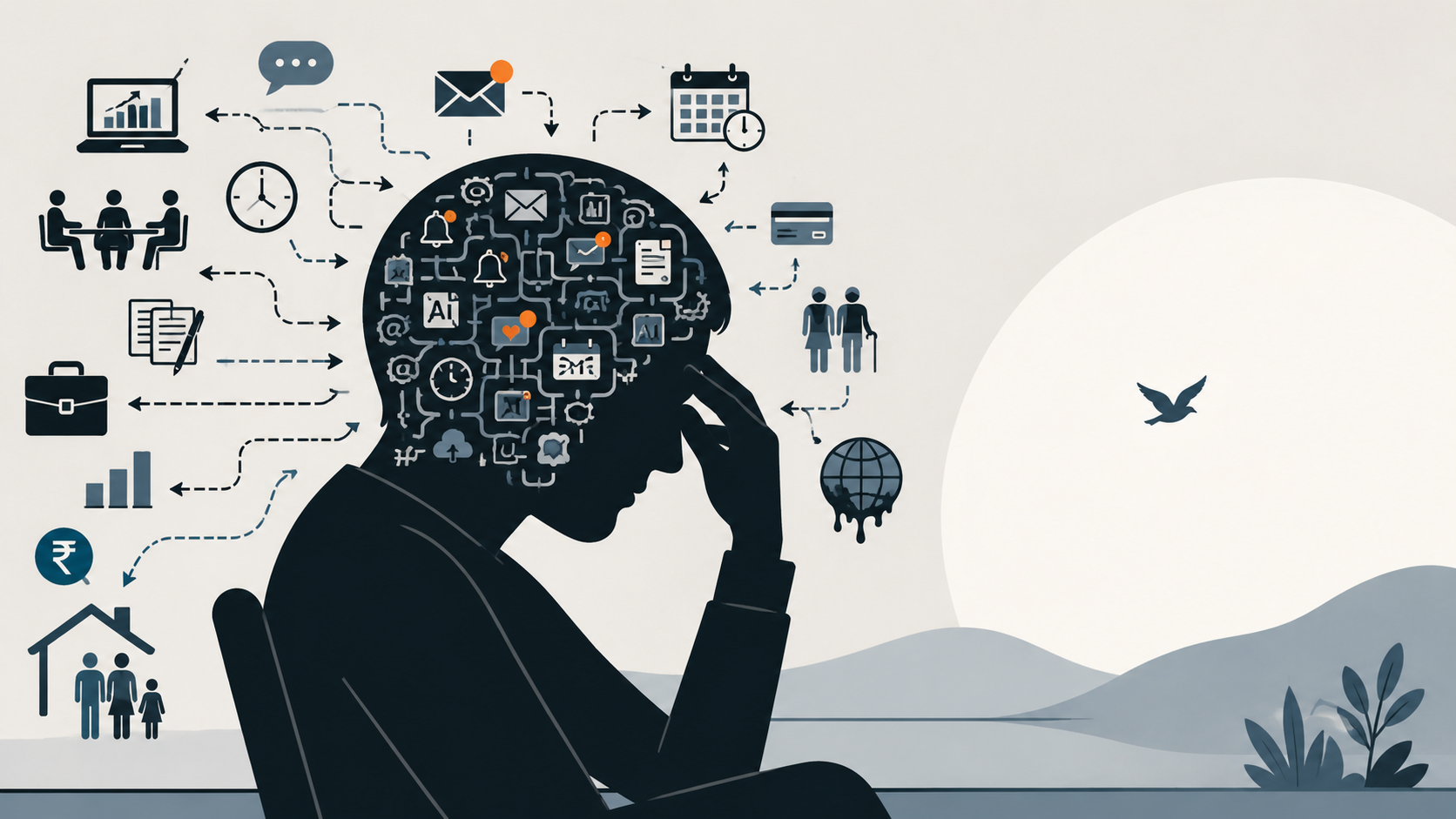
A major reason for this exhaustion is that much of modern work no longer looks like traditional labour. We may not be lifting heavy loads or working on factory floors, but our minds are constantly occupied by invisible labour. A typical day now involves hundreds of micro-decisions and mental calculations involving responding to emails, interpreting workplace messages, deciding whether to switch jobs, managing finances, maintaining health routines, learning new technologies, and staying professionally relevant in rapidly changing industries. Many white collar jobs are dominated by meetings, presentations, reporting systems, compliance paperwork, and endless communication loops that often create the feeling of working without producing anything tangible. Alongside this is the emotional labour of being perpetually available, maintaining workplace diplomacy, projecting enthusiasm on video calls, and managing social expectations. In India, this mental burden is often amplified by family structures and social pressures. A young professional in Bengaluru may simultaneously be managing a demanding job, financially supporting parents in Patna, paying off loans, and navigating expectations around marriage, property ownership, and children. The body may be still, but the mind rarely is.

Even rest has become strangely performative, as vacations are often curated for social media validation rather than genuine relaxation. People travel to scenic destinations only to spend significant time documenting the experience for Instagram. Meditation is increasingly packaged through apps that track streaks and productivity gains. Fitness devices convert sleep into measurable targets, making even rest feel like another metric to optimise. Reading books is replaced by listening to productivity podcasts at double speed. Leisure activities are routinely reframed as self-improvement exercises. Walking becomes hitting step goals, journaling becomes building mindfulness habits, and hobbies are often transformed into side hustles. Modern capitalism has shown an extraordinary ability to monetise downtime, and as a result many people return from vacations with travel fatigue, feeling as though they need another break to recover from their carefully curated break.

The smartphone has also fundamentally altered our relationship with boredom, and not for the better. For much of human history, boredom created opportunities for reflection and mental wandering. Waiting in line, sitting on a train, or standing at a bus stop often meant observing the world, thinking deeply, or simply letting the mind drift. Today, every idle moment is quickly filled by digital stimulation. We scroll while commuting, eating, waiting, and even during conversations. Notifications constantly interrupt our attention, creating an environment where our minds rarely experience stillness. Yet creativity, emotional processing, and deeper thinking often emerge during periods of mental quiet. Instead of such quiet, we are constantly consuming fragmented information like news updates, memes, political outrage, financial advice, celebrity gossip, and global crises, often within the span of a few minutes. The human brain was not designed to process wedding photos, economic anxieties, climate disasters, and viral dance videos in one endless stream.

The internet promised access to unlimited knowledge, but it also dramatically expanded the scale of social comparison. Earlier generations often compared themselves to neighbours, colleagues, or extended family members. Today, individuals compare their lives with influencers, entrepreneurs, celebrities, and strangers from across the globe. Social media ensures there is always someone younger, wealthier, more attractive, more successful, or apparently more fulfilled. This constant comparison fuels status anxiety. In India, where rapid economic mobility has transformed aspirations, this pressure can feel particularly intense. First-generation professionals moving from smaller towns to cities like Gurugram, Mumbai, or Hyderabad often carry the hopes of entire families. Success is rarely individual, as it is tied to broader expectations of upward mobility, making failure feel heavier and rest feel undeserved.

At the same time, many of the traditional institutions that once helped people cope with stress have weakened. Extended families are often geographically scattered. Friends have become fragmented, and neighbours frequently remain strangers. Young professionals frequently relocate for work, often living far from families and familiar support systems. Global cities create opportunity, but they can also intensify loneliness. Humans are deeply social beings, and managing life’s uncertainties without strong support systems creates an additional cognitive burden. Many people now seek connection through dating apps, therapy apps, social media, and digital entertainment that often provide temporary distraction but not necessarily meaningful belonging.

Technology has undoubtedly made life more convenient, but convenience should not be mistaken for ease. Ordering food online may save time, but it also introduces endless choices and decision fatigue. Streaming platforms eliminate the inconvenience of physical rentals but replace it with endless scrolling. Remote work reduces commuting but often erases boundaries between personal and professional life. Every convenience creates new layers of management. Earlier generations often had fewer options, which sometimes meant less mental clutter. Deciding what to eat for dinner today can involve navigating dietary preferences, delivery costs, health concerns, discount codes, and the occasional emotional justification that ordering biryani is a valid response to a difficult day, which, to be fair, it often is.

Perhaps most significantly, modern life is shaped by persistent uncertainty. Questions about job security, artificial intelligence, housing affordability, climate change, political instability, and retirement savings create a low-grade but constant sense of anxiety. These concerns are not abstract. Rising temperatures in Delhi, layoffs in technology sectors in Bengaluru, inflation affecting families in London and Lagos, and geopolitical instability all contribute to a sense that the future feels increasingly fragile. The human brain struggles with prolonged uncertainty, often interpreting it as a threat that demands constant vigilance.

The solutions to this exhaustion are unlikely to be found in another productivity hack or expensive wellness trend. What helps is often remarkably simple, like protecting boredom, taking walks without constant digital stimulation, nurturing relationships where no performance is required, setting boundaries with work, reducing unnecessary commitments, and accepting that not every aspect of life needs optimisation. Mental exhaustion is not always a sign of personal failure or poor discipline. In many cases, it is a rational response to systems designed to capture attention, maximise productivity, and blur the boundaries between labour and leisure. In a world that celebrates endless ambition, constant growth, and relentless hustle, perhaps the real skill of the future is learning how to preserve attention and protect mental stillness. It may involve resisting the urge to monetise every hobby, declining unnecessary busyness, and reclaiming genuine rest without guilt. In an era defined by noise, speed, and infinite demands on our attention, uninterrupted mental peace may be one of the rarest forms of luxury available and increasingly, one of the most necessary.

Why change cannot be delivered

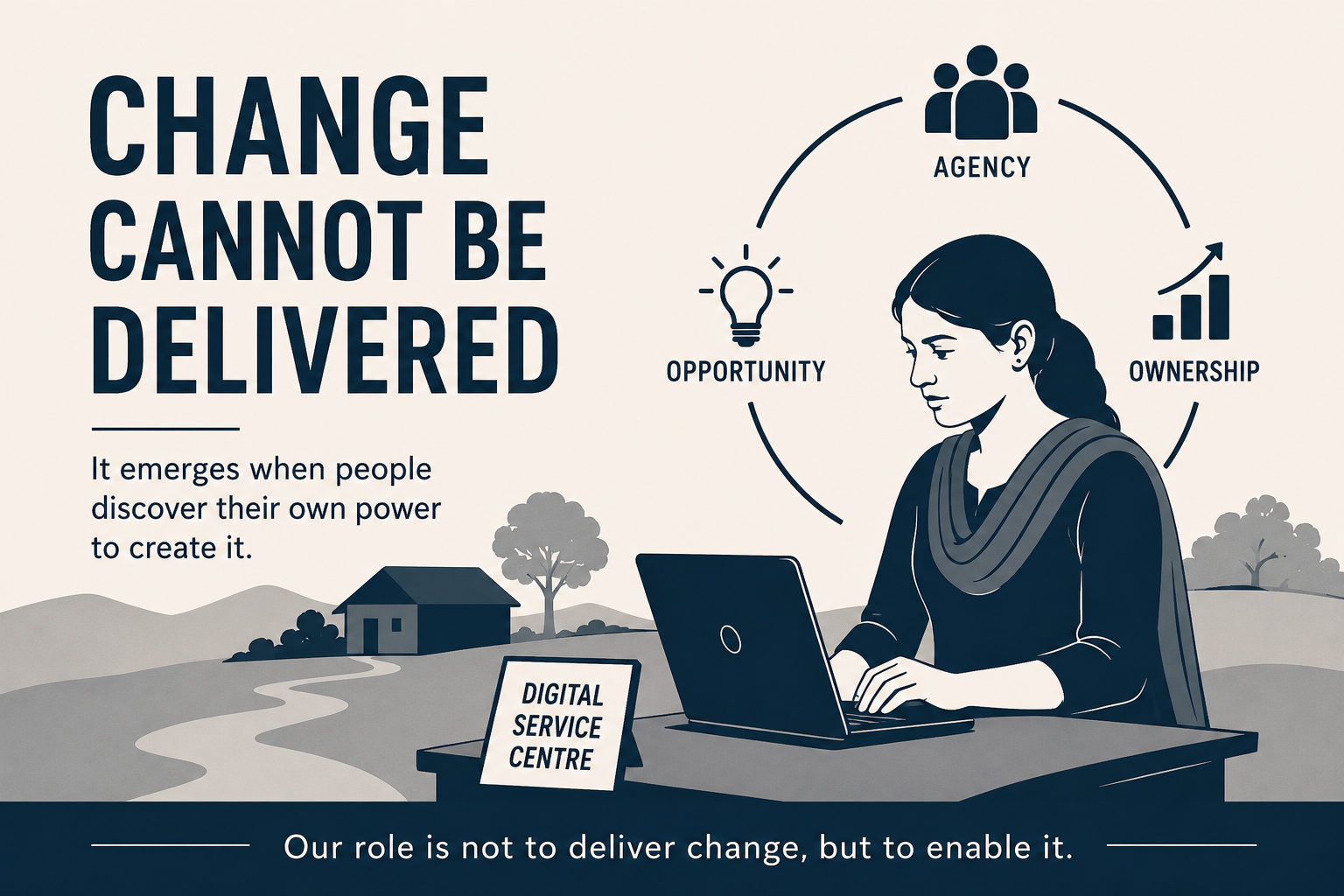
After 20+ years in development sector, this is the lesson I carry with the greatest conviction that change cannot be delivered to people. It emerges when people discover their own power to create it. We often treat it as something that can be designed, funded, managed, monitored, and delivered. We create theories of change, strategic plans, annual targets, dashboards, and impact indicators. We write proposals describing how communities will evolve over the next three or five years and convince ourselves that social transformation can be engineered with enough resources, expertise, and discipline. Yet the longer I have worked in this sector, the more I have realised that change is far more organic, unpredictable, and human than our project documents suggest.

When I began my career, I believed what many young professionals entering the development sector believe, that poverty could be reduced through good Programs alone, that social problems could be solved through smart interventions, and that institutions with the right intent could create pathways for people to improve their lives. I still believe in all of those things. What has changed is my understanding of where transformation actually comes from. After working across livelihoods, entrepreneurship, environmental sustainability, women’s empowerment, public health, education, and digital inclusion, I have come to a simple conclusion that development succeeds when people gain the agency to shape their own futures.

One of the first assumptions I had to unlearn was the idea that communities are primarily defined by what they lack. Development discussion is filled with the language of deficits. We identify needs, vulnerabilities, gaps, and constraints, and catalogue problems and design interventions to address them. While these exercises are important, they can also blind us to a more powerful reality. Communities possess knowledge, resilience, social capital, aspirations, and capabilities that outsiders frequently underestimate. Over the years, I have met women who built successful enterprises despite social barriers, farmers who adapted to environmental challenges long before climate resilience became a policy priority, and young people who created opportunities where experts saw only limitations. What distinguished these individuals was not the assistance they received but the agency they exercised. The most successful development programs I have witnessed were those that helped people discover their own capacity to act.

This may sound obvious, yet much of the development sector still operates as though change originates from institutions rather than individuals. We often speak of empowering communities as if empowerment is something that can be handed over like a grant or a training manual. Experience has taught me that empowerment is not delivered, but is unlocked. People change their lives when they begin to see themselves not as beneficiaries of someone else’s program but as active participants in shaping their own future.

Another lesson that I took years to fully appreciate is that projects produce outputs, while ecosystems create change. Development organisations have become increasingly sophisticated in measuring activities and outputs. We know how many people attended training programs, how many households received services, how many entrepreneurs were supported, and how many villages were covered. These numbers and accountability matter as funders and stakeholders deserve evidence that resources are being used effectively. Yet some of the most transformative changes I have witnessed had little to do with what was captured in a monitoring framework.

I have seen projects with impressive numbers disappear almost entirely once funding ended. I have also seen relatively modest initiatives continue creating value years after external support had ceased. The difference was rarely the size of the budget or the quality of the project design. More often, it was whether the intervention had strengthened the local ecosystem or not. Sustainable change emerges from relationships, institutions, markets, networks, and leadership. It emerges when communities develop the capacity to solve problems collectively, and when local actors begin driving progress themselves. 

This is particularly true in the field of livelihoods and entrepreneurship, where I have spent much of my professional life. For decades, development programs have focused on training individuals, providing assets, or facilitating access to finance. These interventions are valuable, but they are rarely sufficient. Entrepreneurship does not flourish simply because someone acquires a skill. It flourishes when an entire ecosystem supports risk-taking, innovation, market access, mentorship, and growth. The future of development, especially in rural economies, lies in building environments where success becomes possible for many.

One of the more surprising lessons from my career concerns money. Having spent years raising resources for social programs, I have a deep appreciation for the role of funding in creating impact. Without resources, good ideas often remain aspirations. Yet after helping mobilise hundreds of crores for development initiatives, I have come to believe that development is rarely constrained primarily by money. That may sound like an unusual statement coming from someone whose responsibilities have included fundraising and partnership development, but experience repeatedly points in that direction.

Many social challenges that appear to be funding problems are, in reality, leadership problems, institutional problems, capability problems, or trust problems. Additional funding can accelerate progress when strong systems exist. It can also magnify inefficiencies when those systems are weak. Some of the most effective organisations I have come across were not the wealthiest. They were the ones who built credibility, nurtured talent, fostered partnerships, learned continuously, and remained deeply connected to the communities they served. Development ultimately depends on institutions, as strong institutions outlive projects, preserve knowledge, adapt to changing circumstances, and create platforms through which future generations can continue the work. Sustainable change requires institutions capable of sustaining momentum long after a grant agreement expires.

Another belief I have gradually become sceptical of is the sector’s fascination with innovation. Few words are used more frequently in development conversations today. Every conference, funding call, and strategy document seems to emphasise innovation as the pathway to impact. New technologies, new models, and new approaches are often celebrated as solutions to deeply entrenched social challenges. Innovation undoubtedly has value, and many important advances have emerged from creative thinking. Yet the longer I work in development, the more I believe that adaptation is often more important than innovation.

Communities do not need solutions that look impressive in presentations; rather, they need solutions that work within their realities. The most successful initiatives I have known were not necessarily the most innovative. They were the most adaptive and respected local contexts rather than attempting to impose external models. The development sector is full of examples where brilliant ideas failed because they ignored the realities of the people they were intended to serve. It is also full of examples where relatively simple approaches succeeded because they were grounded in local ownership and practical wisdom.

Perhaps the most important lesson of all is that ownership is the ultimate measure of impact. For many years, I believed that scale alone represented the highest aspiration in development. Reach more people, expand into more geographies, and increase the numbers. Scale is important, and the magnitude of global challenges demands ambition. Yet scale without ownership is fragile. Programs that depend indefinitely on external actors are vulnerable by design. Lasting change occurs when communities begin to see an initiative as their own, when local leaders emerge, when institutions take root, and when progress continues without constant external direction.

This requires a profound shift in how we think about our role as development practitioners. Too often, organisations position themselves as providers of solutions. A more useful role may be that of a catalyst, connector, facilitator, and investor in human potential. The objective is not to become indispensable, but to create the conditions under which communities can thrive independently. Success is not measured by how long people depend on us, but by how effectively people progress without us.

As I reflect on my 20+ years in this sector, I remain optimistic despite the scale of the challenges before us. Climate change, inequality, unemployment, public health crises, and social exclusion remain formidable problems. Yet I have seen enough examples of human ingenuity, resilience, and determination to believe that meaningful progress is possible. I have seen individuals transform their circumstances, communities build collective solutions, and institutions evolve into powerful vehicles for social change. These experiences have reinforced my conviction, which has only grown stronger with time.The future of development will not be determined solely by larger budgets, more sophisticated frameworks, or more ambitious programs. It will be determined by our ability to strengthen local institutions, nurture entrepreneurship, build resilient economic ecosystems, and trust communities to shape their own destinies. If twenty years have taught me anything, it is that change is not something we deliver to people. Change is something people create when they have the opportunity, confidence, and freedom to act. Our responsibility is not to direct that process. It is to help create the conditions that make it possible and then have the humility to step aside.

Disclaimer: The opinions expressed are those of the author and do not purport to reflect the views or opinions of any organisation, foundation, CSR, non-profit or others.