Why are we always mentally tired

There was a time when exhaustion was easier to identify. We worked long hours in physically demanding jobs, worked on farms under harsh weather, commuted through polluted industrial cities, or managed households without modern conveniences. Fatigue had a visible cause as the body had been pushed beyond its limits. Sleep was recovery; weekends were respite, and holidays meant genuine distance from work. Today, however, many of us wake up after a full night’s sleep, scroll through our phones before even leaving bed, drink expensive coffee, attend meetings from climate controlled offices, or increasingly, from the comfort of our homes and still feel mentally drained before the day has properly begun. While we are physically more comfortable than many generations before us, yet psychologically exhausted. We automate chores, outsource tasks, order meals at the tap of a screen, and have technologies that promise convenience at every turn. Yet an unshakable sense of mental fatigue persists. Somewhere between smartphones, hyper-connectivity, and the rise of productivity culture, rest stopped feeling restorative.

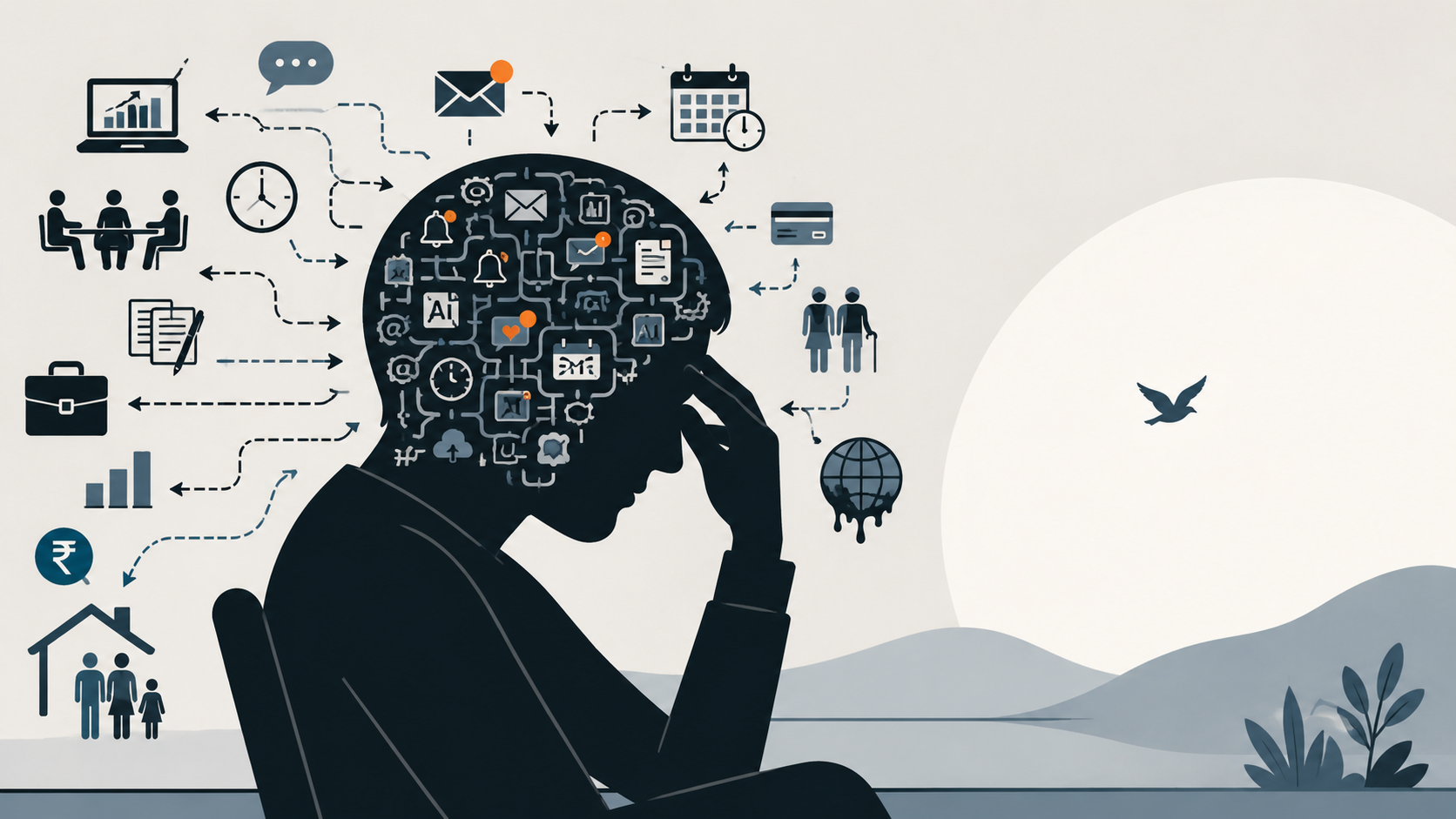
A major reason for this exhaustion is that much of modern work no longer looks like traditional labour. We may not be lifting heavy loads or working on factory floors, but our minds are constantly occupied by invisible labour. A typical day now involves hundreds of micro-decisions and mental calculations involving responding to emails, interpreting workplace messages, deciding whether to switch jobs, managing finances, maintaining health routines, learning new technologies, and staying professionally relevant in rapidly changing industries. Many white collar jobs are dominated by meetings, presentations, reporting systems, compliance paperwork, and endless communication loops that often create the feeling of working without producing anything tangible. Alongside this is the emotional labour of being perpetually available, maintaining workplace diplomacy, projecting enthusiasm on video calls, and managing social expectations. In India, this mental burden is often amplified by family structures and social pressures. A young professional in Bengaluru may simultaneously be managing a demanding job, financially supporting parents in Patna, paying off loans, and navigating expectations around marriage, property ownership, and children. The body may be still, but the mind rarely is.

Even rest has become strangely performative, as vacations are often curated for social media validation rather than genuine relaxation. People travel to scenic destinations only to spend significant time documenting the experience for Instagram. Meditation is increasingly packaged through apps that track streaks and productivity gains. Fitness devices convert sleep into measurable targets, making even rest feel like another metric to optimise. Reading books is replaced by listening to productivity podcasts at double speed. Leisure activities are routinely reframed as self-improvement exercises. Walking becomes hitting step goals, journaling becomes building mindfulness habits, and hobbies are often transformed into side hustles. Modern capitalism has shown an extraordinary ability to monetise downtime, and as a result many people return from vacations with travel fatigue, feeling as though they need another break to recover from their carefully curated break.

The smartphone has also fundamentally altered our relationship with boredom, and not for the better. For much of human history, boredom created opportunities for reflection and mental wandering. Waiting in line, sitting on a train, or standing at a bus stop often meant observing the world, thinking deeply, or simply letting the mind drift. Today, every idle moment is quickly filled by digital stimulation. We scroll while commuting, eating, waiting, and even during conversations. Notifications constantly interrupt our attention, creating an environment where our minds rarely experience stillness. Yet creativity, emotional processing, and deeper thinking often emerge during periods of mental quiet. Instead of such quiet, we are constantly consuming fragmented information like news updates, memes, political outrage, financial advice, celebrity gossip, and global crises, often within the span of a few minutes. The human brain was not designed to process wedding photos, economic anxieties, climate disasters, and viral dance videos in one endless stream.

The internet promised access to unlimited knowledge, but it also dramatically expanded the scale of social comparison. Earlier generations often compared themselves to neighbours, colleagues, or extended family members. Today, individuals compare their lives with influencers, entrepreneurs, celebrities, and strangers from across the globe. Social media ensures there is always someone younger, wealthier, more attractive, more successful, or apparently more fulfilled. This constant comparison fuels status anxiety. In India, where rapid economic mobility has transformed aspirations, this pressure can feel particularly intense. First-generation professionals moving from smaller towns to cities like Gurugram, Mumbai, or Hyderabad often carry the hopes of entire families. Success is rarely individual, as it is tied to broader expectations of upward mobility, making failure feel heavier and rest feel undeserved.

At the same time, many of the traditional institutions that once helped people cope with stress have weakened. Extended families are often geographically scattered. Friends have become fragmented, and neighbours frequently remain strangers. Young professionals frequently relocate for work, often living far from families and familiar support systems. Global cities create opportunity, but they can also intensify loneliness. Humans are deeply social beings, and managing life’s uncertainties without strong support systems creates an additional cognitive burden. Many people now seek connection through dating apps, therapy apps, social media, and digital entertainment that often provide temporary distraction but not necessarily meaningful belonging.

Technology has undoubtedly made life more convenient, but convenience should not be mistaken for ease. Ordering food online may save time, but it also introduces endless choices and decision fatigue. Streaming platforms eliminate the inconvenience of physical rentals but replace it with endless scrolling. Remote work reduces commuting but often erases boundaries between personal and professional life. Every convenience creates new layers of management. Earlier generations often had fewer options, which sometimes meant less mental clutter. Deciding what to eat for dinner today can involve navigating dietary preferences, delivery costs, health concerns, discount codes, and the occasional emotional justification that ordering biryani is a valid response to a difficult day, which, to be fair, it often is.

Perhaps most significantly, modern life is shaped by persistent uncertainty. Questions about job security, artificial intelligence, housing affordability, climate change, political instability, and retirement savings create a low-grade but constant sense of anxiety. These concerns are not abstract. Rising temperatures in Delhi, layoffs in technology sectors in Bengaluru, inflation affecting families in London and Lagos, and geopolitical instability all contribute to a sense that the future feels increasingly fragile. The human brain struggles with prolonged uncertainty, often interpreting it as a threat that demands constant vigilance.

The solutions to this exhaustion are unlikely to be found in another productivity hack or expensive wellness trend. What helps is often remarkably simple, like protecting boredom, taking walks without constant digital stimulation, nurturing relationships where no performance is required, setting boundaries with work, reducing unnecessary commitments, and accepting that not every aspect of life needs optimisation. Mental exhaustion is not always a sign of personal failure or poor discipline. In many cases, it is a rational response to systems designed to capture attention, maximise productivity, and blur the boundaries between labour and leisure. In a world that celebrates endless ambition, constant growth, and relentless hustle, perhaps the real skill of the future is learning how to preserve attention and protect mental stillness. It may involve resisting the urge to monetise every hobby, declining unnecessary busyness, and reclaiming genuine rest without guilt. In an era defined by noise, speed, and infinite demands on our attention, uninterrupted mental peace may be one of the rarest forms of luxury available and increasingly, one of the most necessary.

Mouse Trap

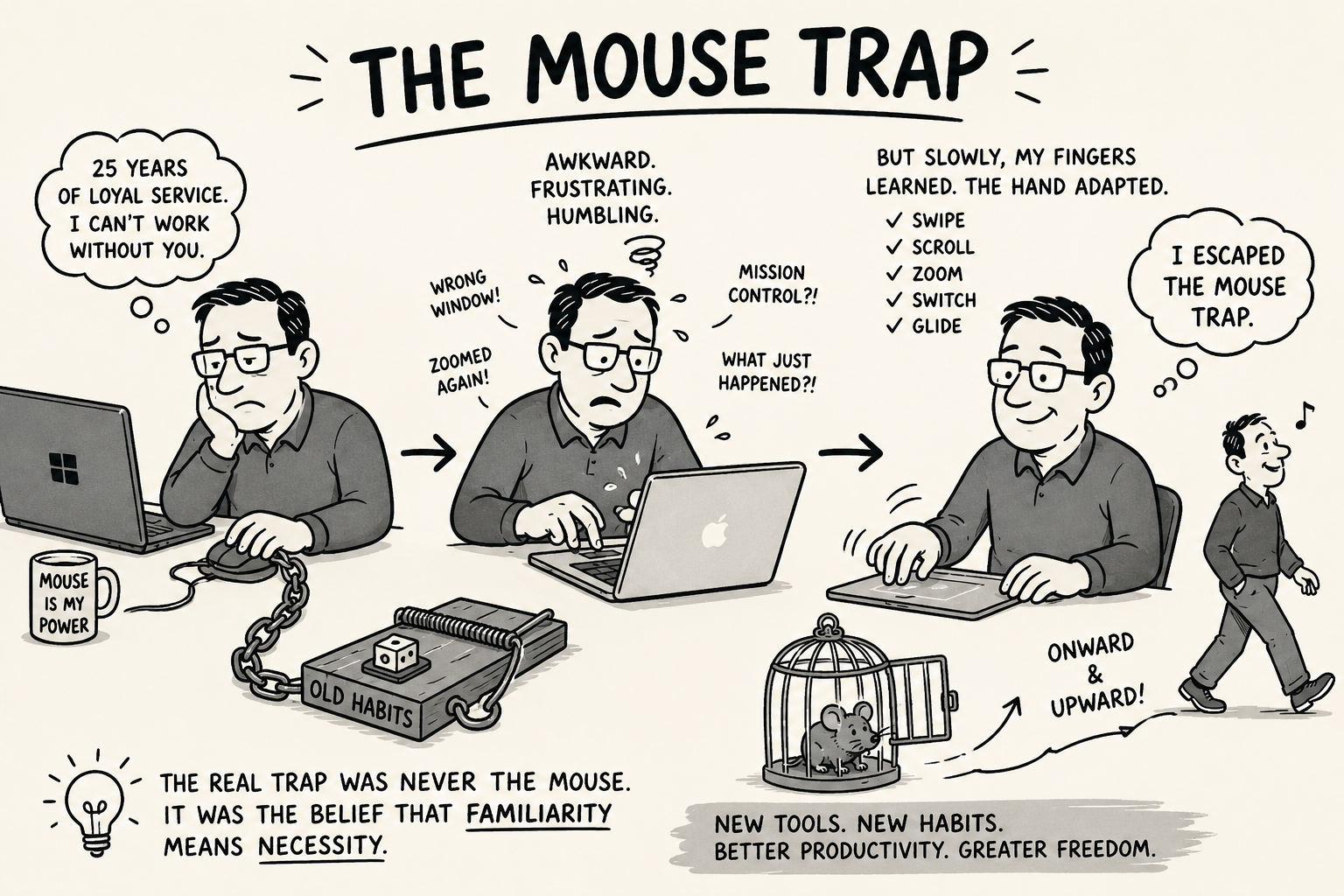
For nearly twenty-five years, my right hand lived under the dictatorship of a small plastic rodent. Ever since I started using a laptop in the early 2000s, the external mouse became less of an accessory and more of a prosthetic extension of my personality. I carried one everywhere with the seriousness of a surgeon transporting medical equipment. If the mouse stopped working, productivity stopped. I would stare helplessly at the laptop screen as though civilisation itself had collapsed. The cursor would sit frozen somewhere on the desktop while I performed the ancient ritual familiar to millions of people who are now in their 40s and beyond: unplugging, reconnecting, blowing imaginary dust from USB ports, replacing batteries, muttering mild abuses at technology, and questioning the moral decline of modern electronics.

Then, a few months ago, I migrated from a Windows laptop to an Apple MacBook and, almost overnight, stopped using the mouse altogether. This was not a carefully researched productivity decision inspired by Silicon Valley minimalism. It was partly convenience, partly curiosity, and partly the exhaustion of carrying chargers, adapters, dongles, cables, and a mouse that increasingly seemed like emotional baggage from another technological era.

The first few weeks were humiliating as the trackpad felt impossibly sensitive and suspiciously intelligent. My fingers moved awkwardly across the smooth surface as tourists would get lost in a foreign airport! Every gesture seemed to trigger unintended consequences. I would attempt a simple scroll and accidentally open Mission Control, launch three applications, rotate an image, zoom into microscopic text, and somehow arrive at a screen asking whether I wanted to configure developer settings for something I did not even know existed. The laptop appeared to possess psychic abilities combined with a dark sense of humour.

For someone in their south side of 40s, this discomfort carried a peculiar emotional weight. Young people experience technological incompetence casually. They tap randomly, experiment fearlessly, and assume mastery will eventually arrive. Older people experience incompetence as a threat to identity. We belong to a generation raised on the belief that adulthood means expertise, and by middle age, one is expected to know things. One manages organisations, handles finances, raises children, negotiates contracts, supervises teams, and gives life advice to younger people. Then, suddenly, a glass rectangle on a laptop defeats you because your fingers cannot perform a three-finger swipe correctly.

So naturally, the instinct is to retreat, return to the mouse, restore dignity, and re-enter familiar territory. But I persisted, partly out of stubbornness and partly because carrying the mouse now felt faintly embarrassing, like travelling with a typewriter ribbon in the age of cloud computing. Gradually, my hand learned before the brain consciously understood, and the fingers adapted. One morning, I realised I was gliding across applications effortlessly. Switching desktops, zooming, scrolling, highlighting text, navigating browsers, previewing files, and moving between workflows happened with a fluidity that felt almost elegant. The movement resembled playing an instrument and not operating machinery. And suddenly I realised that after 25-odd years, I had escaped the mouse trap!

The phrase sounds trivial until one recognises what the mouse actually symbolises for people my age. It represents an entire category of inherited habits that once made sense but now quietly reduce efficiency while masquerading as professionalism. In the early days of laptops, external mice were genuinely superior. Trackpads were terrible inventions that were tiny, unresponsive squares apparently designed by engineers conducting experiments on human frustration. Using a mouse was rational, productive, and serious. But technology evolved while our habits remained frozen in time.

Modern trackpads are astonishingly sophisticated. Yet millions of middle-aged professionals continue carrying wireless mice around with almost ceremonial devotion. Entire coffee shops are filled with grown adults performing elaborate setup procedures before beginning work: laptop out, mouse out, mousepad out, Bluetooth paired, dongle inserted, batteries checked, table space negotiated. Some carry ergonomic mice that resemble futuristic sculptures designed by Scandinavian orthopaedic surgeons. Others own travel mice, office mice, gaming mice, backup mice, and emergency spare batteries, all to avoid learning a slightly different movement of the fingers.

I realised that the mouse is not merely hardware, but more of a psychological infrastructure. People accumulate systems that once solved problems but eventually become obstacles disguised as preferences. We continue using workflows developed in another technological century because familiarity produces emotional comfort. The brain loves efficiency, but it loves predictability even more.

This explains why otherwise intelligent professionals stubbornly cling to outdated habits with almost ideological passion. One proudly announces, ‘I still do all my accounts manually in Excel.’ Another insists, ‘I need every document printed before I can read it properly.’ Someone refuses cloud storage because physical folders feel ‘safer.’ Others maintain endless email chains, paper diaries, complicated filing systems, or insist on in-person meetings for conversations that could be resolved in three messages and a shared document.

These are rarely productivity choices but are comfort rituals. The irony is that people above forty are often fully capable of adapting quickly. In fact, they frequently learn faster than younger users because they understand systems, context, and patterns better. The barrier is rarely intelligence and more of an emotional resistance to temporary incompetence. Somewhere after forty, many people unconsciously stop allowing themselves to become beginners. I know senior executives who manage budgets worth millions but cannot merge PDF files without assistance. I know academics capable of explaining complex philosophy who panic when asked to collaborate on online documents. I know entrepreneurs who built businesses from scratch but still call younger employees to ‘fix the Wi-Fi.’ These are not incapable people but are simply trapped inside technological identities formed decades ago.

The deeper issue is that modern economies increasingly reward adaptability over accumulated procedure. Knowledge now expires faster than ever, and entire industries transform within a decade. Artificial intelligence is already automating tasks that many professionals considered permanently human only a few years ago. In such a world, the most dangerous sentence after forty is not ‘I don’t know.’ It is ‘I have always done it this way.’That sentence quietly closes the future.

The strange thing is that our generation has already proven its adaptability many times over. We are perhaps the only generation that experienced analogue childhood and digital adulthood simultaneously. We used landlines, pagers, floppy disks, fax machines, CDs, USB drives, cloud storage, smartphones, and now invisible synchronisation systems operating somewhere in distant data centres we barely understand. Yet somewhere in middle age, many professionals unconsciously declare technological retirement while still expecting to remain professionally relevant for another twenty years.

What surprised me most after abandoning the mouse was not improved navigation speed, but the psychological shift that followed. Once the discomfort barrier was crossed, I became less intimidated by unfamiliar systems generally and started experimenting more freely. Keyboard shortcuts stopped feeling annoying and began feeling liberating. I approached software with curiosity instead of caution. One begins questioning inherited inefficiencies elsewhere in life, too. Do meetings really need to last an hour? Do I really need to check my email constantly? Do I really need fifty WhatsApp groups? Do I really need to preserve every professional habit developed in 2004 simply because it once worked?

Watch a child interact with new technology and understand it instinctively. There is no shame in experimentation, no fear of appearing foolish. They touch everything, fail repeatedly, laugh, retry, and eventually master the system through curiosity. Adults, especially middle-aged adults, approach new interfaces like diplomats entering hostile territory. We seek guarantees before experimentation because failure now feels reputational.

But perhaps productivity after 40 is not about optimisation at all. Perhaps it is about preserving beginnerhood. The willingness to temporarily appear incompetent may now be one of the most valuable professional skills of modern life. The transition is always awkward. During my early trackpad days, I frequently muttered at the laptop like an ageing cricket fan complaining about T20 leagues. I missed the mouse clicks, triggered accidental gestures and zoomed into absurd screen magnifications. At one point, I somehow rotated an image sideways and spent several minutes trying to restore civilisation. But adaptation has an invisible curve. Frustration suddenly became fluency, and my fingers learned what the ego resisted.

Now, when I see professionals unpacking increasingly elaborate mouse arrangements beside ultra-modern laptops, I feel less judgment and more recognition. I see a smaller version of the same human tendency that affects all of us, of carrying unnecessary tools because they once solved genuine problems. The real trap was never the mouse itself but was the assumption that long familiarity automatically equals permanent necessity. Finally, after 25 years, I finally escaped the mouse trap, and the amusing part is that the cage door had been open for years.