Economyths
July 20, 2026 Leave a comment
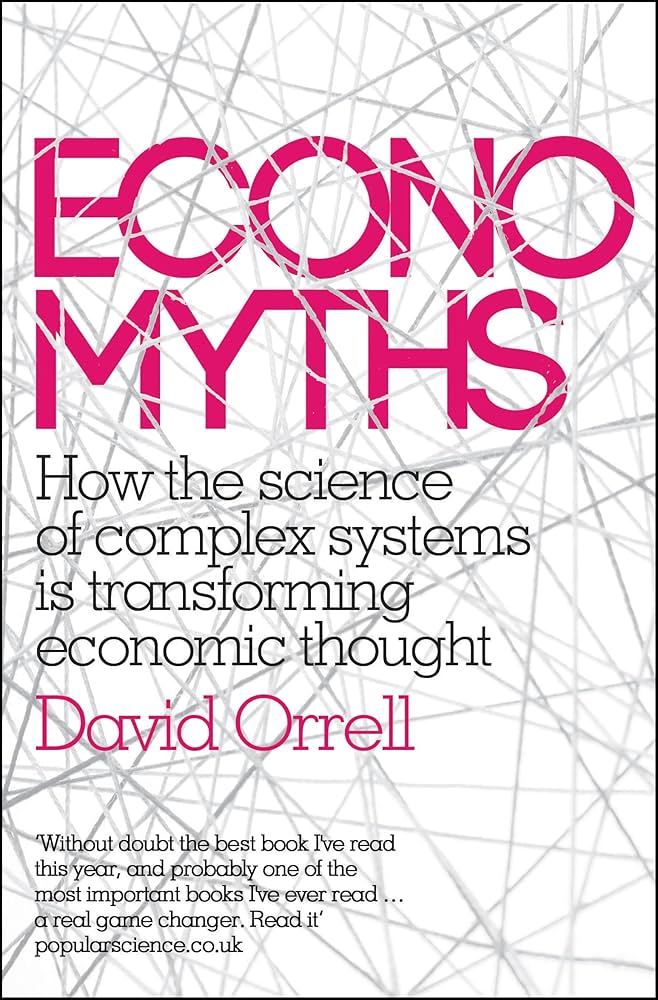
Author: David Orrell | 320 Pages | Genre: Non-Fiction | Publisher: Icon Books | Year: 2012 | My Rating: 8/10
“If economics has an equivalent of Newton’s law of gravity, it is the law of supply and demand.”
― David Orrell, Economyths
Every profession and subject has its myths, like medicine once believed illness was caused by imbalances of bodily humours! Astronomy once believed that Earth sat at the centre of the universe. Economics, despite its mathematical sophistication and Nobel Prizes, is no exception. David Orrell’s Economyths examine some of the stories modern economics tells us and ask whether they still deserve our trust.
What makes this book particularly engaging is that Orrell, a Canadian mathematician, is not writing as an economist defending one school of thought against another. Orrell approaches economics with the curiosity of an outsider and the scepticism of a scientist. He argues that many of the assumptions that underpin mainstream economic thinking are treated as objective truths when they are, in fact, useful stories, simplifications, and sometimes outright myths.
The book systematically dismantles ten such myths. Markets are not always efficient, people are not perfectly rational, money is not neutral, growth is not synonymous with wellbeing, and risk is not always measurable. These ideas may sound obvious after the financial crisis of 2008-09, market bubbles, and widening inequalities of recent decades, but Orrell demonstrates how they are deeply embedded in economic models, policy discussions, and public discussions.
One of the most refreshing aspects of the book is its insistence that economics is not a physics problem. Human societies are messy, emotional, political, and adaptive. Unlike atoms, people change their behaviour when circumstances change. They are influenced by culture, fear, aspiration, power, and relationships. Any attempt to reduce economic life to neat equations inevitably leaves something important out.
As someone working in the social development sector, I found myself reflecting on how often development conversations are shaped by economic assumptions that go unquestioned. We celebrate GDP growth while overlooking ecological degradation. We measure income while ignoring dignity, and optimise for efficiency while neglecting resilience. The book reminded me that the indicators we choose are never neutral, as they shape what we value and what we overlook.
The book encourages intellectual humility and reminds us that economic models are maps, not territories. Useful maps matter, but problems arise when we mistake them for reality itself. Reading Economyths also felt surprisingly relevant beyond economics. In many ways, the book is about the dangers of oversimplification. Whether in public policy, business strategy, or personal life, we often gravitate towards elegant frameworks because complexity is uncomfortable. Reality rarely conforms to tidy narratives, as the world is interconnected, dynamic, and often unpredictable.
The book questions whether economics is ultimately about how societies organise resources to support human development, and then what exactly are we optimising for? Wealth? Growth? Efficiency? Security? Sustainability? Happiness? The answer matters because different goals produce different systems and different outcomes.
More than a critique of economic theory, Economyths is a reminder that every model reflects a set of values. The challenge is not to abandon economics but to recognise its limits, question its assumptions, and remain open to perspectives that better capture the complexity of human life. I finished the book with greater scepticism toward economic certainties but also with greater appreciation for the importance of asking better questions. In a world increasingly driven by metrics, forecasts, and optimisation, that may be one of the most valuable lessons of all. Economyths is a thoughtful and provocative read for anyone interested in economics, public policy, development, business, or simply understanding the assumptions that quietly shape modern society.
Discover more from
Subscribe to get the latest posts sent to your email.
 About Manu Mayank
