Why everyone says, I am fine
July 6, 2026 Leave a comment
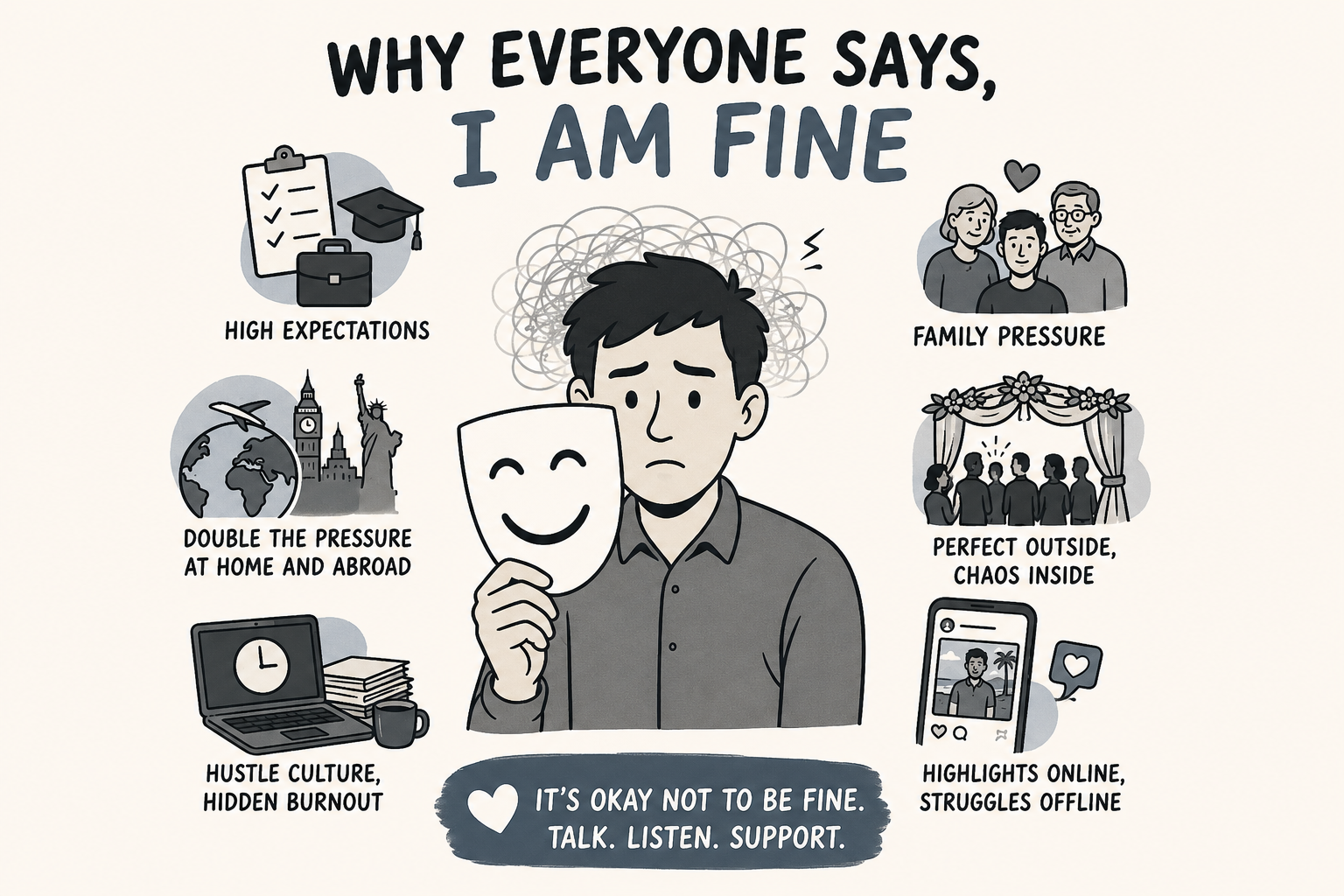
There is a performance that many people have mastered in modern life, of looking completely fine while quietly falling apart. It has become one of the most refined social skills of our time. You show up to work on time, reply to emails with professional warmth, attend weddings with coordinated outfits, post cheerful holiday photos, laugh at dinner parties, and reassure everyone that ‘all is well’ while your internal monologue resembles an emergency board meeting. Rent is rising, parents are ageing, careers feel uncertain, relationships are complicated, your back hurts for reasons your doctor politely describes as stress related, and you have not felt truly rested since sometime before the pandemic. Yet when someone asks how you are doing, the answer remains remarkably consistent, ‘Good, good. Just busy.’
Across the world, people are becoming increasingly fluent in this language of polished distress. Social media has trained us to curate competence, while professional culture rewards composure, and families often value stability over vulnerability. Entire societies function because millions of people continue showing up despite private exhaustion. But this performance feels particularly pronounced among Indians who are living both within India and across the global diaspora, where social expectations are often complex, relentless, and efficient at producing outward success alongside inward strain.
The Indian social script remains deeply achievement-oriented. From childhood, most of us are introduced to a familiar sequence of expectations that feels both culturally specific and globally recognisable, which includes performing well in school, attending a branded university/college, entering a respectable profession, earning well, marrying appropriately, buying property, caring for parents, raising successful children, and maintaining family honour while appearing effortlessly grateful for the opportunity. There are, of course, regional, class, and generational variations, but the broad architecture remains remarkably durable. Even among progressive urban families, conventional expectations often survive in modern packaging. Instead of explicit pressure to become a doctor or engineer, there may be subtle comparisons with cousins working at Google, Amazon, or investment firms in London. Marriage pressure may sound softer, but family Whatsapp groups can still function as passive-aggressive reminder systems.
The emotional burden becomes even more complicated because these expectations are rarely framed as pressure, as they are often presented as love, sacrifice, duty, and practical wisdom. Parents who invested heavily in their children’s education may genuinely believe they are guiding them toward security. Extended families may see their involvement as care. Communities may celebrate conformity because it appears stable. But good intentions do not eliminate psychological consequences. Many young professionals in Mumbai, Bengaluru, Delhi NCR, and Hyderabad are managing demanding careers while quietly navigating family expectations around marriage, caregiving responsibilities, home ownership, and financial support. They are often simultaneously trying to be globally competitive professionals and culturally responsible children. It is a difficult balancing act, made harder by the fact that neither side fully acknowledges the strain.
For Indians living overseas, the pressures often become even more complex. The immigrant success story remains one of the most celebrated narratives in many diaspora communities. The child of immigrants in the United States, Canada, the United Kingdom, or Australia may be expected to succeed professionally in highly competitive societies while also preserving cultural identity, supporting family back home, and remaining deeply connected to traditions that often become more rigid in migration. This produces a strange phenomenon where individuals feel pressure to excel in two worlds while fully belonging to neither. You are expected to understand tax laws in Seattle, maintain emotional fluency in Bihari family politics, and explain to relatives why you are still unmarried at 32 despite having what appears, on paper, to be an excellent and successful life!
Weddings deserve special mention as global showcases of curated wellbeing. Few events demonstrate collective emotional theatre quite like the fat Indian weddings. Families spend enormous amounts of money celebrating joy while quietly navigating interpersonal tensions, financial stress, unresolved conflicts, and logistical chaos. Guests arrive dressed magnificently, smiling for photographs that suggest a flawless communal celebration. Beneath the choreography, there may be sibling rivalries, debt, parental anxieties, and relatives evaluating everything from the food menu to life decisions. And though the wedding album looks immaculate, the emotional spreadsheet rarely does.
Professionally, employees are expected to remain productive through layoffs, economic uncertainty, technological disruption, and burnout. In India’s startup hubs and global financial centres alike, people casually describe 80-hour workweeks as ambition while quietly experiencing anxiety, insomnia, and emotional depletion. The language of hustle culture has simply provided respectable branding for exhaustion. Saying ‘I am slammed’ has become shorthand for importance. Saying ‘I am overwhelmed’ remains harder.
Social media has amplified all of this by turning life into a continuous public relations exercise. Platforms reward milestones like promotions, vacations, engagements, anniversaries, fitness transformations, children’s achievements, and entrepreneurial announcements. They are less enthusiastic about ambiguity, grief, stagnation, infertility struggles, career confusion, loneliness, or ordinary dissatisfaction. The result is a digital ecosystem where everyone appears to be thriving. You scroll through photographs of destination weddings in Udaipur, startup exits in San Francisco, babies in matching outfits, and beachfront holidays in Bali while sitting with your own uncertainty and wondering whether everyone else has somehow figured out adulthood.
Many people who appear successful are privately negotiating debt, loneliness, marital strain, workplace anxiety, fertility struggles, caregiving responsibilities, mental health challenges, or the exhausting task of meeting expectations they never consciously chose. The colleague who seems composed may be supporting parents through medical crises. The cousin posting anniversary photos may be managing deep relationship problems. The entrepreneur celebrating funding rounds may be unable to sleep. The family friend who constantly asks why you are not married may have spent years trapped in an unhappy marriage themselves. Human beings are remarkably skilled at editing their visible narratives.
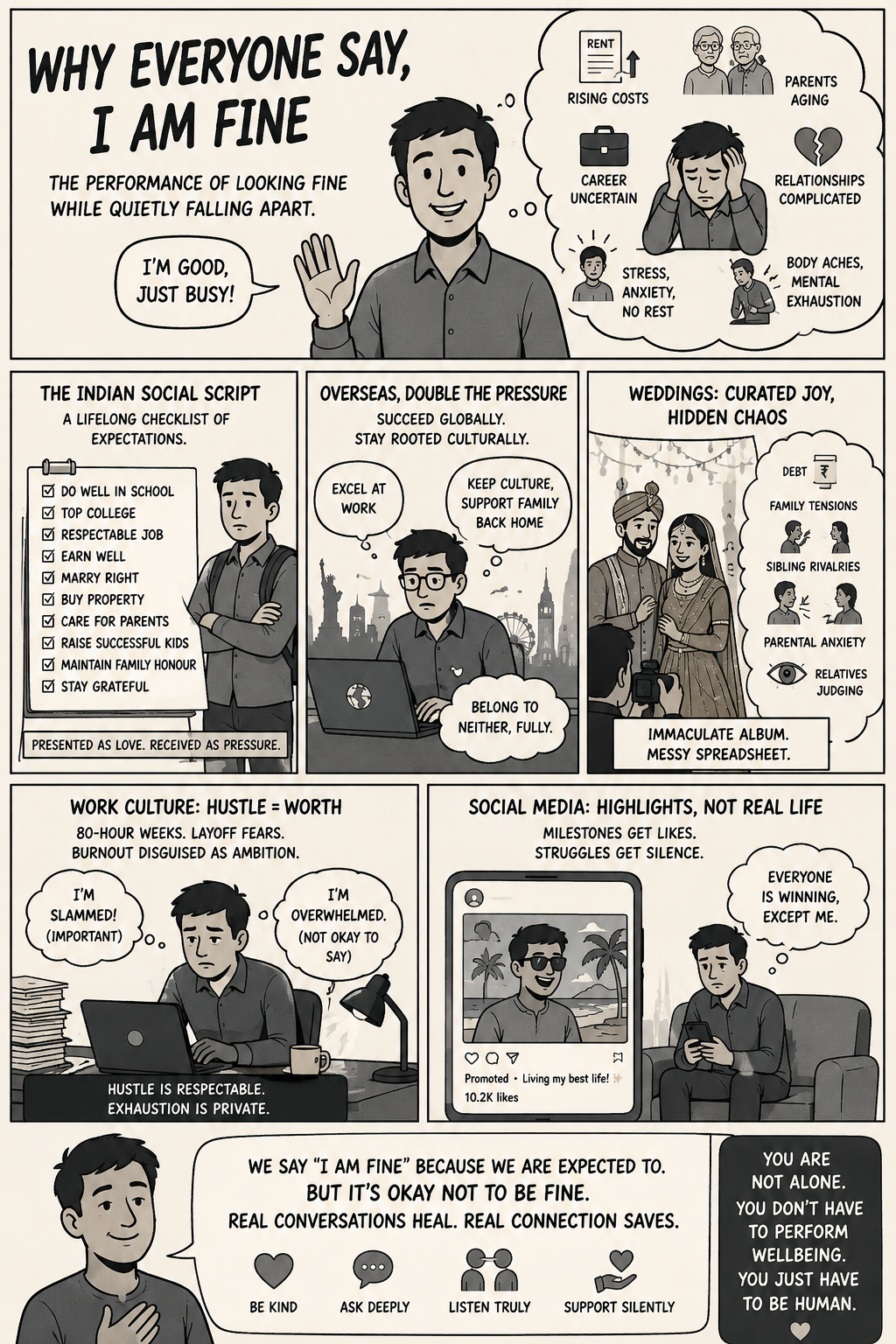
Indian society’s combination of collectivist expectations, rapid economic change, intergenerational obligations, and intense social comparison creates a particularly sophisticated ecosystem of invisible pressure. What makes this dynamic especially difficult is that many people feel guilty for acknowledging it. After all, they may have stable jobs, supportive families, educational privilege, or material comfort relative to previous generations. Gratitude becomes weaponised against honest emotional reflection. ‘What do you have to complain about?’ remains one of the most efficient ways to shut down vulnerability in many households.
The irony is that a genuine connection often begins the moment someone drops the performance. When one friend admits they are burnt out, another confesses they are anxious. When someone speaks honestly about marriage pressure, career confusion, depression, caregiving exhaustion, or loneliness, others often respond with relief rather than judgment. The collective illusion begins to weaken. Perhaps the challenge of modern adulthood is not learning how to appear fine. Most people have already mastered that skill. The real challenge is building lives, friendships, workplaces, and families where ‘I’m not okay right now’ does not feel like a social failure.Behind many polished LinkedIn profiles, family portraits, wedding photographs, and cheerful Whatsapp updates lies the same truth that everyone looks fine because that is what society often rewards. But many are carrying far more than they show, and sometimes the most radical act of honesty is answering ‘How are you?’ with something closer to the truth.
If this article made you pause, reflect, or quietly say, ‘this feels familiar,’ you are not alone. Share it with someone who always says, ‘I am fine,’ and maybe start the kind of conversation we all need more of. Subscribe to my blog for one reflective article every week in your mailbox. It’s free!
(The two images used are generated using AI)

