I have a fascination with morbid romance, where passion is fierce and consuming, love and ruin walk hand in hand, and loss feels almost sacred. After a long time, I totally enjoyed a Bollywood film, Tere Ishk Mein, for its feverish, fractured, and fearless ode to obsessive love and loss. Anand Rai, as Director, and Dhanush and Kriti Sanon as actors have so beautifully portrayed the volatile landscape of love, messy and irrational, dark and bruised. It is a film that is less about romance and far more curious about what happens when love mutates, dissolves boundaries, and begins to reshape identity itself.
The film centres around Shankar (Dhanush), a young man navigating the emotional ruins of unrequited affection. His world is small, ordinary, burning with relentless restlessness, textured with the familiar lanes of Rai’s cinematic universe. When he falls in love with Mukti (Kriti Sanon), it is with the conviction of a man who sees devotion as delusional destiny. Dhanush’s performance is a masterclass. His portrayal of longing, with shoulders slightly slumped, eyes rimmed with unspoken ache, voice cracking in the in-between spaces of sentences, is brilliant. He brings a fragile humanity that compels empathy even when the character’s choices spiral into moral greyness. There are moments when Shankar’s yearning feels suffocating, and moments when it feels heroic. In several scenes, especially those dealing with solitude and heartbreak, the camera lingers on his face with cruel intimacy. He allows vulnerability to show across the frame, leaving behind emotional aftershocks.
The film’s leading lady, Mukti (Kriti Sanon), is a girl caught between affection, caution, and the burden of societal expectations. She is real, flawed, and aware of her own contradictions. Her emotional arc of moving from curiosity to confusion to a painful clarity is one of the more grounded aspects of the film. What stands out is that Mukti is not a passive recipient of Shankar’s affection. She pushes back, speaks for herself, asserts her boundaries, and refuses to become a prop for his emotional turbulence. In many ways, her character reminded me that intensity does not equal righteousness.
Rai’s filmmaking has always been rooted in the everyday—narrow streets, chaotic homes, lived-in locations where life unfolds in all its contradictions. In Tere Ishk Mein, he retains this aesthetic but adds a layer of psychological depth. His director truly excels in designing silences. Some of the best moments in the film are those where nothing is said: an unfinished sentence, a doorway half-shut, a glance held for one second too long. These are the moments when the film transcends melodrama and ventures into introspection.
What distinguishes this film from typical love stories is its willingness to confront the darker territories of attachment. The film does not glorify suffering, nor does it portray persistence as virtue. Instead, it presents a sobering reality that love can be transformative, but it can also be corrosive if it becomes entitlement.The climax, which is raw, unsettling and necessary, is where the film truly earns its place. It is neither triumphant nor tragic in a conventional sense. Rather, it is painfully truthful. It is a rare mainstream film that lets discomfort linger. A must-watch if you enjoy a turbulent exploration of love.
A few of my friends, family members, and a couple of my colleagues gift me books, often on my birthdays, and sometimes in between. I inherited a love for reading from my parents, especially my mother and my grandfather, both of whom have been voracious readers. I received my first book as a birthday gift from my father when I was in school. It was ‘The History of Western Philosophy’ by Bertrand Russel.
Few gifts in life feel as personal, thoughtful, and lasting as a book. When someone hands you a neatly wrapped rectangle hiding a world within its covers, the gesture means more than just the promise of pages. It carries thought, intimacy, and a recognition of who you are. A book is not merely a gift; it shows understanding. For a book lover like me, it has always represented one of the highest forms of affection, a conversation without words, a silent connection of minds and feelings.
Books reflect both the giver and the receiver. A book requires careful thought, unlike routine gifts like perfume, gadgets, clothes, or vouchers. This act of choosing is intimate, showing familiarity not just with the recipient’s reading habits but also with their inner lives, beliefs, and hidden thoughts. When a friend gives you a book, they often imply, “This reminded me of you.” That unspoken message carries emotional weight. It suggests that they have seen you through the lens of a character, a philosophy, or a poem. It’s like the giver is handing you a mirror showing part of yourself, which possibly one you hadn’t noticed before.
For avid readers, this connection is unmatched as a new book means a new journey and a new companionship. Receiving it as a gift indicates that someone cared enough to guide you toward that path. I have always viewed books as a form of emotional currency. They are not consumed quickly or superficially; they unfold over days or weeks, creating a lasting connection between the giver and receiver. Each time you open a gifted book, you also revisit the memory of the person who gave it to you.
A note inside the cover, like “Hope you love this as much as I did” or “Read and Reflect,” becomes an emotional bookmark for years. Even after the friendship has changed, the note remains, tangible and unforgettable. The book turns into a keepsake of that moment, of that relationship. In this way, books gather layers of meaning beyond their content; they absorb personal histories.
Unlike many modern gifts that can age or fade, books age gracefully. A book received in your twenties might reveal new insights in your forties. A book of poetry shared during a tough year can later offer comfort. In this way, books outlast their occasions; they evolve with the reader. I have re-read several books in my ever-growing collection over the last 20 to 30 years, and each time, I have gleaned a deeper understanding and gained more from the same pages.
Receiving books from family carries a sense of heritage, adding another layer of intimacy and history. Parents who give books to their children often share not just stories but also values and perspectives. When a parent gifts their favourite childhood novel or a worn copy of a classic, it reflects continuity. It communicates, “This shaped me, and I hope it shapes you too.”
Books create a kind of generational dialogue in many homes. A shelf represents a lineage of thought, with dog-eared pages and underlined passages marking the intellectual footprints of those before us. When you receive a book from a family member, you are essentially invited into their memory, to share their inner world for a while. I often have long conversations with my mother about a book, discussing its theme, author, and philosophy. For a book lover, inherited or gifted books become sacred objects. They may have notes in fading ink, dates marking birthdays or milestones, or the faint scent of another home. They are pieces of family history, connected not just by blood but also by shared words and ideas.
Books exchanged among colleagues hold a subtler but equally significant meaning. In professional settings often focused on efficiency and formality, a book gift feels almost revolutionary, reminding us of our shared humanity. When a colleague gives you a book, it usually reflects admiration or intellectual connection. It might be a management classic that inspired them, a work of fiction that echoes your discussions, or a slim volume of essays that reminds them of your curiosity. This gesture crosses the impersonal barriers of the workplace. It conveys, “I see more in you than just your title. I recognise a mind worth connecting with.”
At a time of emails and digital interactions, such gestures feel refreshingly real. A physical book on your desk serves as a reminder of shared curiosity and trust, sometimes sparking discussions that go beyond work. For a book lover, receiving books is like receiving invitations to journeys, friendships, and moments of reflection. The smell of new pages, the design of a cover, and the promise of a new story all bring joy that few other gifts can match. When people give books to an avid reader, they validate and celebrate a part of their identity. It’s as if they are saying, “I respect your passion enough to contribute to it.”
Book lovers often remember who gave them which book. Their collections become social maps, each title linked to a person, a moment, or a story. That book from a college friend, that poetry collection from a sister, that biography from a mentor—they all combine to create an autobiography of relationships. Every gifted book is also an act of trust. It assumes that the receiver will take the time, reflect, and engage. By giving a book, one offers not instant pleasure but delayed joy. This trust that the recipient will fully experience those pages is deeply personal. Unlike digital or temporary gifts, books require solitude and contemplation. Receiving one gently reminds us of the value of slowing down in a fast-paced world. Perhaps this is why books promote patience, reflection, and empathy.
Moreover, books can be challenging gifts as they can push the reader’s perspectives, encourage new ideas, or even provoke discomfort. A well-chosen book can disrupt complacency while still showing care. This balance between affection and intellectual challenge makes gifting books a refined art. Over time, a personal library becomes a mosaic of gifts and acquisitions, but the gifted ones stand out. They are the volumes we seldom lend or part with. They carry signatures, notes, or memories that root them in our emotional landscape. There’s something almost sacred about rereading a book that once came wrapped in the hands of someone dear to us. The words on the page remain constant, but their meaning shifts as our memories of the giver change. At times, after the giver is gone, the book transforms into a presence, a voice that still echoes in the silence of our shelves.
Therefore, books are not just gifts; they also extend the presence of people. They traverse time, holding fragments of affection, thought, and memory. A gifted book is both a message and a monument as it says, “I thought of you,” and continues to do so long after. For a book lover, each gifted book is a quiet act of love—sometimes romantic, sometimes platonic, sometimes familial, but always genuine. It is a gift that does not fade and grows richer with each reading. In giving and receiving books, we engage in a timeless exchange, not of objects but of selves. Ultimately, every gifted book conveys one simple yet profound message: I see you, and for any reader, there is no greater gift than that.
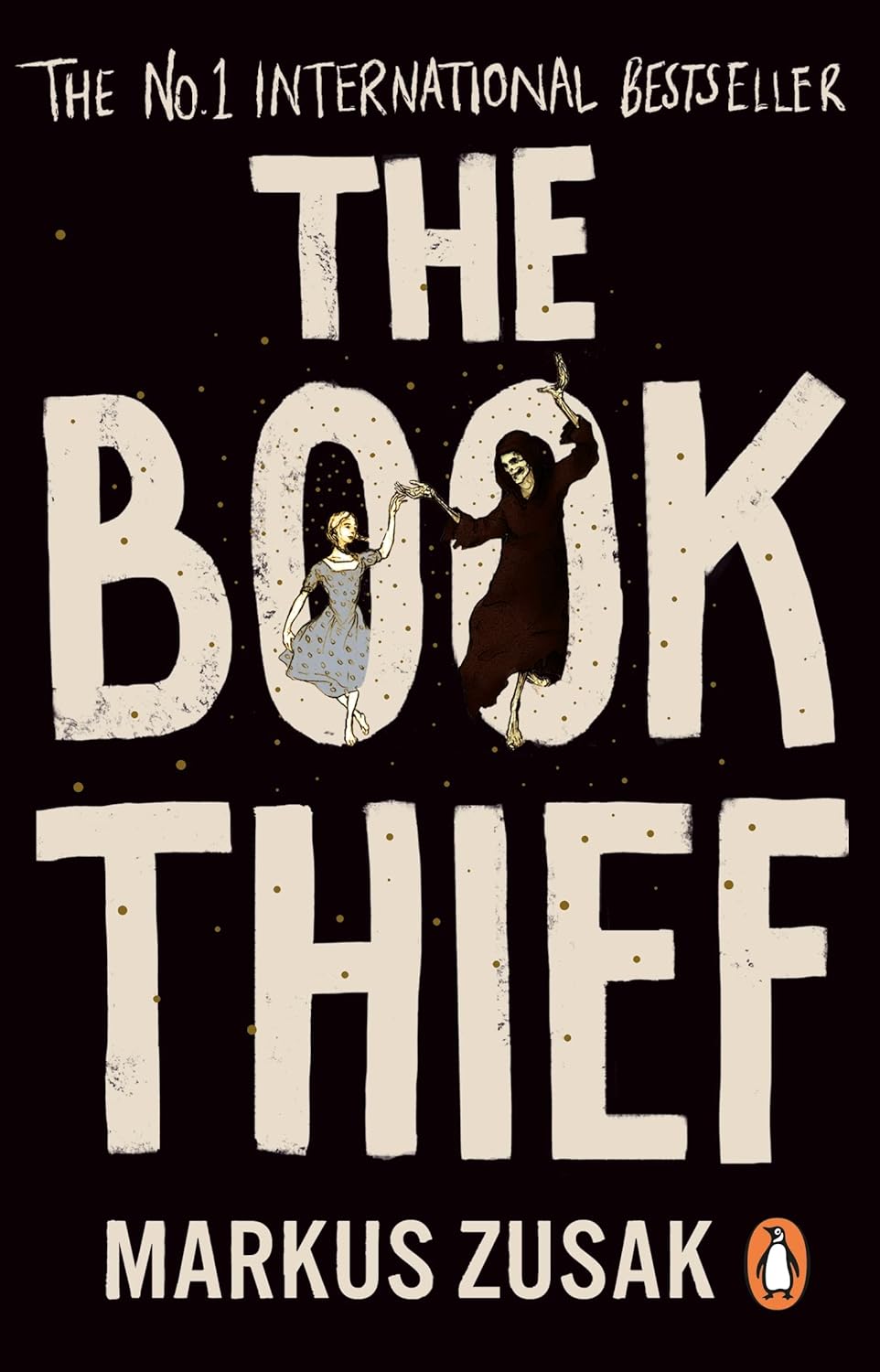
Author: Markus Zusak | 560 Pages | Genre: Historical Fiction | Publisher: First edition published by Alpha 2 Omega Books. My edition published by Penguin Random House (2018) | Year: 2005 | My Rating: 9/10
“The human heart is a line, whereas my own is a circle, and I have the endless ability to be in the right place at the right time. The consequence of this is that I’m always finding humans at their best and worst. I see their ugly and their beauty, and I wonder how the same thing can be both” ― Markus Zusak, The Book Thief
The Book Thief combines brutality and beauty with extraordinary grace, and I found it to be truly unique and spectacular. The novel is set in 1939 Nazi Germany, during World War II, where the story is a haunting exploration of love, loss, language, and the power of storytelling to preserve humanity. Narrated through the unexpected voice of Death, the novel redefines the familiar war narrative, which is both poetic and profoundly human.
The story centres on Liesel Meminger, a young girl sent to live with foster parents Hans and Rosa Hubermann in Molching, near Munich. After her brother dies en route to their new home in 1939, Liesel steals her first book, marking the beginning of her quiet rebellion through reading. Liesel’s foster father, Hans, patiently teaches her to read during late-night sessions in their basement. Liesel’s foster mother, Rosa, is gruff yet deeply protective. For Liesel, books become both a refuge and a means of resisting the Nazi regime’s manipulation of language.
When the Hubermanns shelter Max Vandenburg, a Jewish man fleeing Nazi persecution, Liesel’s world broadens. Her friendship with Max, rooted in fear and hope, highlights the power of imagination to endure hardship. Max’s stories, especially “The Word Shaker,” reinforce the novel’s central theme that ‘words can both harm and heal.’
The author’s decision to use Death as the narrator is both bold and effective. Death is portrayed as weary, compassionate, and reflective, observing humanity’s capacity for both cruelty and kindness. His tone shifts between irony and melancholy, providing both distance and intimacy. Death’s closing line, “I am haunted by humans,” underlines the novel’s meditation on human fragility and resilience.
Zusak removes sentimentality from tragedy through his narration by Death. I knew early in my reading that the story would end in loss, and Death tells plainly who will die, but this foreknowledge deepened rather than diminished my emotional investment. Zusak’s central theme of the power of language could not be more resonant. The Nazi regime weaponized words to manipulate a nation and justify genocide. In contrast, Liesel and Max reclaim language as a force for healing and remembrance. Books become tools of freedom, teaching Liesel not only literacy but empathy and defiance. There is also a profound theme of ordinary heroism. The Hubermanns, Liesel, and her friend Rudy Steiner resist in small, quiet ways, sharing bread with starving prisoners, hiding a Jew in their basement, refusing to let fear extinguish decency. These are acts of rebellion born not of ideology but of humanity.
The novel also explores how even in a time of death, there are moments of laughter, friendship, and love. It portrays war as a lived experience through the eyes of a child who learns too soon about loss but clings to hope through storytelling. Zusak’s prose is poetic, fragmented, and rhythmic, a departure from conventional realism. He uses vivid imagery and typographical experimentation, breaking the fourth wall and inserting short notes, sketches, and lists. These stylistic quirks mirror Death’s fragmented perception of events and add texture to the reading experience. Like his description of the sky as Death collects souls, “The sky was the colour of Jews.” It is shocking, ambiguous, and heartbreaking, capturing the moral weight of genocide in those six words. It made me pause at the sentence and page for a while, feeling the sentence rather than merely understanding. Liesel is one of contemporary literature’s most memorable protagonists, who is resilient, curious, and brave. Through her eyes, one can experience both the innocence of childhood and the disillusionment of war. Her evolution from an illiterate girl to a book thief who reads to others in bomb shelters symbolizes the redemptive arc of language.
The moral core of the novel, Hans Hubermann, embodies quiet courage. His act of painting over antisemitic graffiti and hiding Max is not grand heroism but the moral defiance of an ordinary man. Rosa, abrasive yet loving, offers a realism often absent in depictions of maternal figures. Rudy Steiner, Liesel’s best friend, brings youthful vitality and heartbreak into the story. His dream of kissing Liesel becomes a symbol of innocence stolen by war. Max, the Jewish fugitive, represents endurance and the power of imagination, writing his own story literally over the pages of “Mein Kampf,” transforming an instrument of hate into one of creation. Each character feels deeply human, flawed, frightened, and compassionate, and their relationships form the emotional spine of the novel.
The Book Thief focuses on ordinary citizens rather than soldiers or political figures. Zusak reminds us that history is lived by common people, those who make small moral choices every day. Since its first publication in 2005, The Book Thief has also been adapted into a film released in 2013. Its endurance over the years lies in its emotional honesty and narrative innovation. It teaches us that even in times of darkness, stories can keep the flame of humanity alive. The Book Thief is not just a story about war or death; it is about the defiance of the human spirit through words and empathy.
This novel reminded me that reading, too, is an act of resistance. It is a book that stays with you, not because of the horrors it depicts, but because of the beauty it finds amidst them. As Death himself observes, “It’s only small stories like this one that can make the bigger ones bearable.”
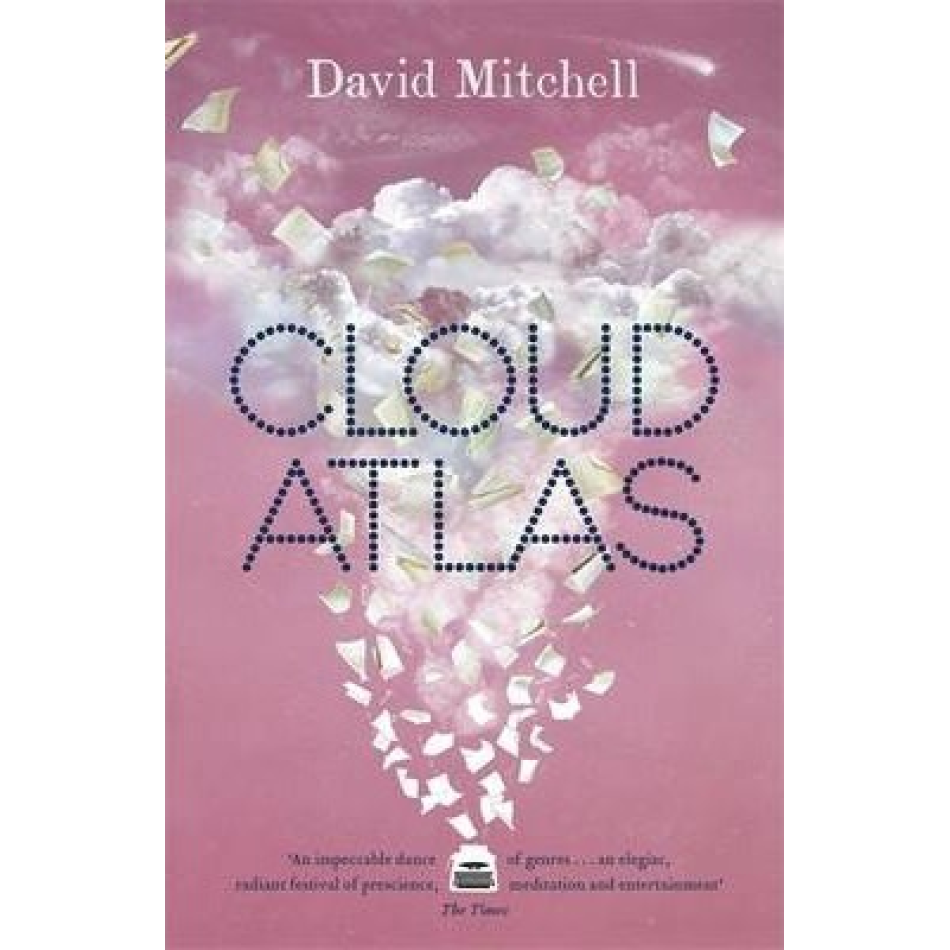
by David Mitchell | 544 Pages | Genre: Fiction | Publisher: Hodder & Stoughton | Year: 2004 | My Rating: 9.5/10
“A half-read book is a half-finished love affair.” ― David Mitchell, Cloud Atlas
Some novels entertain, others provoke. David Mitchell’s Cloud Atlas does both and then something rarer still, it bends the time itself! Since its publication in 2004, this novel has become a cult classic, not only for its intricate structure but also for its audacious attempt to string together the vast tapestry of human existence from past, present and future. The book is one of the most original, unusual, and polarising works on this century.
Mitchell presents us with six interconnected stories that span centuries and genres, a 19th-century Pacific voyage, letters from a young composer in Belgium, a taut thriller set in 1970s California, a satirical farce about a vanity publisher, the interrogation of a genetically engineered clone in a near-future Korea, and a tale told in a fractured dialect after civilization’s collapse. At first, these stories seem like discrete novellas. Yet as each thread is interrupted and later resumed, patterns begin to emerge, as symbols, names, and echoes that ripple across time.
Reading Cloud Atlas is like listening to a symphony in six movements. Each section has its own rhythm, its own instrumentation, yet together they build a haunting, resonant chorus about power, exploitation, love, and resilience. The stories have drama, thrill, humour and fantasy, and takes a deep look into the nature of humanity and moral choices. Mitchell’s message is clear but never heavy-handed, history is cyclical, cruelty and greed recur, but so too do acts of kindness, rebellion, and hope.
A movie was released in 2012 based on the adaptation of the book by the same name featuring Tom Hanks and Halle Berry. The main difference between the book and the movie is the structure and depth, with the book offering distinct, in-depth narratives and complexities, while the movie uses a faster, intercutting cinematic style that emphasizes visual connections and emotion over intellectual understanding, though sometimes oversimplifying plot points like Sonmi-451’s ending.
This brilliantly written book’s shift in style across the stories can be dizzying, and the patience it demands is substantial. But when the final notes fall into place, the reward is profound, a recognition that our lives, however fleeting, echo forward and backward, part of something infinitely larger.
Cloud Atlas is not just a novel, it is a meditation on the human nature, a daring cartography of time.
I am including some of my most favourite quotes from this book, which is totally worth mentioning with this review.
“Power, time, gravity, love. The forces that really kick ass are all invisible.”
“My life amounts to no more than one drop in a limitless ocean. Yet what is any ocean, but a multitude of drops?.”
“Anticipating the end of the world is humanity’s oldest pastime.”
Social media has evolved over the last decade and more so during and post COVID-19 from a casual means of communication to a complex social ecosystem where relationships are not only maintained but also publicly measured, performed, and often misunderstood. The act of tagging someone in a post or sending a reel now frequently carries more weight than the content itself and appears to be a new language of intimacy, loyalty, and belonging.
Human relationships were always forged and maintained through physical presence, shared experiences, and mutual conversation. While those elements still hold value, social media platforms like Instagram, WhatsApp, and Facebook have changed social interaction. Friendship seems to have become ‘performative’ and is now getting increasingly defined by our digital gestures, who we tag, send content to, and frequently react to on social media. The exchange of DMs, reels, memes, and story replies may seem petty, but they have become the new currency of connection. In this new digital age, being remembered in someone’s “share” list is a modern affirmation of your place in their emotional world where time is divided and attention is commodified. It’s no longer the maturity of the friendship built over years defining the strength of the connection, this new phenomenon has been affecting and afflicting across all age groups from teens to people in their 70s!
What used to be simple rules for friendship, like coffee, conversations, and sharing silly jokes over text, has now changed. Friendship is now measured in direct messages, tags, and who receives the meme first. It’s no longer just about being included; it’s about being the first and only one included. Because nothing says “you matter to me” like a cat video at 3 AM. Social media platforms promote visibility and engagement. As a result, users develop interaction patterns that reflect this trend. Relationships are increasingly maintained through small interactions: likes, reactions, emojis, replies, and short content exchanges. These replace deeper communication, creating the illusion of closeness without needing much time or vulnerability.
Algorithmic affection is growing. If you engage often with someone’s content, they will show up more in your feed, and vice versa. This strengthens some relationships while quietly undermining others. Sometimes, a drop in communication doesn’t stem from emotional distance but rather because an algorithm has quietly removed someone from your digital view. Social media has turned even the smallest actions into emotional signals that are often unintentional. Reels are like modern-day carrier pigeons of affection, flying through algorithmic skies and delivering 60 seconds of inside jokes, shared interests, or passive-aggressive messages.
A subtle but clear hierarchy has formed in social groups based on digital content. Who sees the funny video first? Who is tagged in the inside joke? Who gets included in close friends’ stories? These digital hierarchies provide new social cues about belonging, preference, and even exclusion. This change creates anxiety and social tension, particularly for those who often read omissions or changes in online behaviour as signs of personal problems. We’ve all experienced this. You’re casually scrolling through the group chat, dodging memes and unwanted life updates, when you notice that your friend has been sending reels, but not to you. Instead, they are sending them to someone else in your friend circle. Betrayal has never looked so clear.
With constant connectivity and “always on” friendships comes an unintended consequence: relational burnout. There was a time when friendships were tested by forgotten birthdays. Now, deep emotional hurt comes from not being tagged in a reel or story about something entirely unrelated. The pressure to respond quickly, stay updated, and keep up with every friend’s online persona can drain the joy of connection. Friendship, once based on depth, now often depends on speed and consistency, two measures that reflect platforms more than people. This urgency leads to miscommunication. A late reply, a missed tag, or a seen-but-not-responded reel can be seen as disinterest or rejection, even if the reason is trivial. As a result, friendships suffer not from real conflict but from imagined slights born from the overly sensitive nature of digital interaction.
Soon, new measures of connection and relationships will emerge, and platforms will introduce new tools to assess your FQ (Friendship Quotient). Measure these three indicators, and you’ll have your FQ. Like quarterly or annual performance reviews at school, these FQ levels will shape the future of friendship.
Quality of friendship = (number of reels received × frequency of tags) / number of mutual story reacts.
Closeness coefficient = number of times you get the reel before it appears on your public feed/total reels posted.
Emotional intimacy level = number of times and frequency they send you the reel with “this reminded me of you” instead of a lifeless emoji.
Despite the challenges, social media offers new ways to show care and share thoughts. A well-timed meme or relevant reel can bring laughter, validation, and a shared moment of joy across distances. In an increasingly busy and scattered world, these exchanges can be lifelines.
But, like all technologies, mindful use is essential. As we adjust to this new relational landscape, we should consider,
– Are we truly connecting, or just maintaining a facade of connection?
– Are we sharing to include others, or to show how close we are?
– Are we interpreting digital silence too severely, or using it too carelessly?
In the end, while the medium has changed, the need for empathy, intention, and presence remains the same. Whether through reels, texts, or face-to-face conversations, what we all want is simple: to be seen, to be valued, and to know we matter.