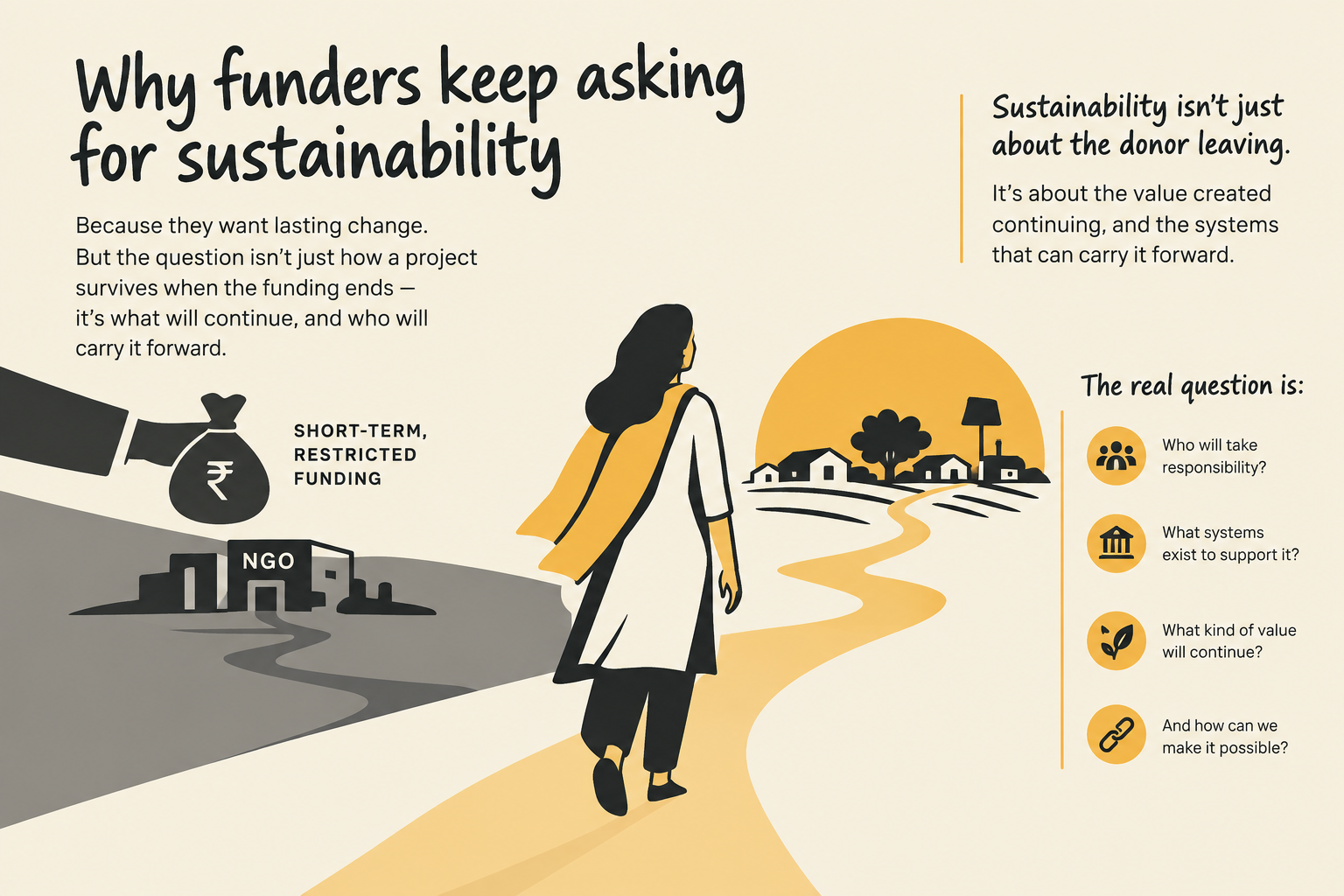
Why donors keep asking for sustainability

I have often been asked by the funding partners, ‘How will this project be sustained after the funding ends?’ While it is a reasonable question, it is also often the wrong one. The development sector has turned ‘sustainability’ into a synonym for ‘what will happen when the donor stops paying?’ The donors ask NGOs to build lasting solutions while often funding them through short-term, restricted projects that make long-term institutional and financial resilience harder to achieve. The real test of sustainability is the possibility of value created by the funding that can continue beyond the project cycle, and whether the economic, institutional or public systems exist to carry that value forward.

If a donor spends money on training women entrepreneurs, establishing community institutions, improving health services or creating livelihood opportunities, it is entirely reasonable to ask what happens when the grant ends. Nobody wants an intervention to disappear the moment the donor’s logo disappears from the last banner. But before asking how a project will survive without the donor, we should ask what exactly is supposed to continue, who is expected to take responsibility for it, and whether the conditions exist to make that possible.

A three-year project can be financially unsustainable but socially transformative, and it can end because its purpose has been achieved. A community institution can survive without the NGO but require continued public or market support. A livelihood intervention can become sustainable because participants increase their incomes, while the organisation delivering it remains dependent on philanthropy. And sometimes ‘sustainability’ simply means that the NGO promises to find another donor, which often is the least convincing of all. For years, development organisations have been encouraged to think about sustainability as an exit strategy. The donor funds the intervention often for 1-3 years, the NGO builds capacity, creates local ownership, establishes linkages and prepares an exit plan, and then the donor leaves and the model is expected to continue. While the logic is attractive, ending external funding and creating sustainability are not necessarily the same thing.

The OECD’s longstanding definition of sustainability in development evaluation focuses on the benefits of an intervention continuing after donor funding ends. That is a useful starting point, but it immediately raises a more important question of what will allow those benefits to continue? Government may take over, communities may contribute, users may pay, markets may generate revenue, or another institution may assume responsibility. Or the intervention may change behaviour or strengthen systems sufficiently that continued external support is no longer necessary. These are fundamentally different pathways, yet grant proposals often treat sustainability as a generic quality that can be added through a paragraph near the end of a concept note.

Consider a women’s entrepreneurship program that trains 5,000 rural women, organises producer collectives, provides business support and connects them to markets. If a donor asks how the program will be sustained after three years, the answer depends entirely on the model. Perhaps producer collectives will become commercially viable, or an anchor company will continue purchasing from the enterprises, while the financial institutions in the entrepreneurial ecosystem will provide working capital, and women will eventually pay for business services. Each possibility requires a different intervention design. If sustainability depends on markets, the project must build a viable market proposition. If it depends on government, public institutions need to be involved from the beginning. If it depends on producer collectives, those organisations need governance, capital and commercial capability. If another donor will be required, the project should be honest about that rather than presenting donor substitution as financial sustainability.

Donors increasingly expect NGOs to be resilient, adaptive and financially sustainable, while many NGOs are funded through short-term, restricted project grants that make precisely that difficult. Recent evidence from Bridgespan’s 2025 research, based on responses from 460 nonprofits and interviews with 51 nonprofit leaders, funders and intermediaries from India, found growing movement towards multiyear funding and greater recognition of core organisational costs, but continuing gaps in organisational development and financial reserves, particularly among smaller and non-metro organisations. Earlier Bridgespan research found that 83% of Indian NGOs surveyed had difficulty securing funding for indirect costs, while more than half had fewer than three months of reserves. Only 18% said they invested adequately in organisational development. Another analysis of 40 relatively well-funded Indian nonprofits found that actual core costs ranged from 5% to 51% of total costs and averaged 19%, while the average coverage provided by key donors was only 9%.

Funders ask organisations to be resilient while funding them as if their only legitimate expenditure is the activity that can be photographed and counted. Donor grants fund the field worker but not always enough of the management system that supports the field worker, training but not necessarily the organisational learning required to improve it, and program delivery while hesitating to fund reserves. Funders ask NGOs to diversify their funding while providing little unrestricted money with which to build their fundraising capacity. Then, three years later, the funder asks why NGOs are not sustainable.

Instead of asking an NGO, ‘How will you sustain this project when our funding ends?’, donors should instead ask, ‘What needs to be true for the benefits of this intervention to continue, and what role should our funding play in creating those conditions?’ This question recognises that philanthropy is often most useful when it finances a transition between two states. A grant can demonstrate that an idea works, absorb early-stage risk, strengthen institutions, develop markets, improve technology or support innovations that government and commercial finance are not yet prepared to fund. The grant should help create the conditions for the next stage. That may mean public financing, market revenue, community ownership, institutional adoption, commercial investment or another form of philanthropy. The appropriate pathway will vary by intervention, for example, a rural entrepreneurship program and a community health program should not be expected to arrive at sustainability through the same route.

This also means donors should sometimes be prepared to fund the less glamorous parts of sustainability. Financial systems are not exciting, NGO reserves are not photogenic, good middle management rarely features in impact stories, and neither do information systems, HR, audit, leadership development or fundraising capacity. Yet these capabilities determine whether an organisation can survive shocks, retain good people, manage resources and deliver programs consistently. Flexible funding is therefore not necessarily the opposite of accountability. It can be an investment in the organisational capacity required to deliver accountability well. A strong organisation with adequate systems and reserves may actually be better positioned to manage restricted program funding, and respond to changing circumstances and protect donor resources.

Then there’s another very important aspect of development programs, where everything cannot be sustained. Some projects end and achieve the desired results/purpose during their lifecycle. A delivery model may become obsolete, a technology may get replaced, a program may fail to produce meaningful results, or a community may no longer need an external intermediary. Continuing to fund something simply because it has existed for five years is institutional inertia and not sustainability.

The objective should therefore be sustainable value, not sustainable projects. This matters because many development challenges are systemic. Poverty, women’s economic exclusion, malnutrition, tuberculosis, climate vulnerability and the lack of decent employment cannot generally be ‘solved’ by a three-year project. At best, a project can change part of the system like improve a service, strengthen an institution, alter incentives, demonstrate a model, influence policy or help people acquire assets and capabilities.

Sometimes the honest answer will be that an intervention requires long-term funding, and there is nothing inherently unsustainable about that. Governments continuously spend money on education, public health, roads, social protection and environmental management. We do not ask whether a public hospital will become financially self-sustaining after three years, but are more interested in it producing sufficient public value to justify continued investment. Perhaps philanthropy should adopt some of the same logic. A community health program that requires continued financing may still be highly valuable if it prevents disease at a cost society is willing to pay. A program supporting children with special needs may never generate revenue, yet its social value can be substantial. 

So sustainability cannot always mean, ‘Can this generate its own revenue?’ That is a business-model question. For many social interventions, the better question is that, Who has a legitimate reason and capacity to pay for this value over the long term? The answer is an appropriate combination of market, government, communities, and philanthropy as per the need. This also places a responsibility on NGOs to become more honest in how they answer sustainability questions. A reassuring paragraph about capacity building, community ownership and exit strategies is not necessarily a credible plan. It’s better to be honest about it and say that the interventions may require continued public expenditure, or a livelihood project would need several more years beyond the grant cycle before it can cover its operating costs, and show the pathway. If another donor will be required, explain why and what will be different by then.

Sustainability becomes more credible when it is treated as a theory of how an intervention will continue to create value, rather than as a promise that the NGO will somehow find money after the current grant ends. We have turned a ,legitimate development objective into a ritual of grant writing. Every proposal has a sustainability section, a sustainability framework, and an exit strategy. Yet none of these, by themselves, answers the fundamental question of what will make this intervention continue to work when the source of money ends. A serious answer requires thinking about incentives, markets, institutions, behaviour, public finance, community ownership and organisational capability. It may require more than one source of funding and more than one institution. It may take five years rather than three. It may require unrestricted funding rather than another tightly earmarked project grant. And sometimes it may require accepting that the value created by a program is important enough to warrant continued investment. Perhaps, then, donors should stop treating sustainability as the final question in a grant proposal, but should be one of the first. So, instead of ‘How will you survive without us?’, the donor should ask, ‘What will exist, who will own it, who will pay for it, who will maintain it, and what should our role be when the grant ends to make the impact sustainable?’ While these are harder questions, I think, they can also lead to better projects. The most sustainable thing a donor can fund is NGOs capability, institution, market, public system or community ownership that makes the original grant less necessary over time.

Why Philanthropy Needs to Evolve

Philanthropy has been a force for good across continents, building hospitals, funding schools and universities, feeding communities in crises, taking action to solve social challenges, and underwriting research. While intending to create positive and lasting change in people’s lives and strengthening communities, often, take the form of that giving is the classic ‘donor → beneficiary’ pipeline, which has serious limits. When well-meaning philanthropic entities simply transfer money or material goods to presumed beneficiaries without sharing power, listening deeply, or tracking outcomes with humility, aid can be inefficient, short-lived, and even harmful. To move from transactional charity to transformative social change, philanthropy must evolve toward participatory, locally led, and evidence-based models that empower communities to define problems, choose solutions, and steward resources. Several philanthropic models need to evolve into a new, pluralistic philanthropy that can deliver better, fairer, and more sustainable impact.

The donor-beneficiary model often centres on donors’ priorities. Funders set agendas, design programs, select implementing partners, and measure success by indicators they choose, often from a distance. This creates several structural problems, like,

  • Power asymmetry occurs when donors decide what counts as a problem and which solutions are legitimate. Communities become recipients rather than partners, and local knowledge is sidelined, reducing relevance and local ownership.
  • Templates developed for ease of scale often ignore social-cultural and political nuances at the local level. Programs that look good in donor reports may fail on the ground due to ‘One-size-fits-all interventions.’
  • Short funding horizons and volatility of donors with grants tied to campaign cycles, leftover funds, or financial year budgets can stop abruptly, leaving services unsustainable and organisations stranded.
  • When philanthropy substitutes for systemic public investment, it can relieve governments of responsibility or create dependency among groups who lack the voice to advocate for longer-term change.
  • Donors are accountable to boards or taxpayers, with limited accountability to the communities they aim to serve; evaluation is often internal and narrowly framed.

These limitations are not theoretical as reviews of philanthropic practice repeatedly find that participation is often performative, i.e., consultation exercises without power transfer. Scholarly and practitioner literature has called out the gap between rhetoric and sustainable commitment to community-led approaches. This is the moment for a pivot to an evolved philanthropic approach that can complement the traditional giving through,

  1. Participatory and community-led decision-making: Communities should help set priorities and co-design programs. Participatory grant-making moves power to those closest to problems, bringing lived experience into funding decisions and increasing the legitimacy and likely effectiveness of interventions.
  • Local leadership and capacity building: Funding should invest in local institutions (community groups, cooperatives, NGOs, social enterprises), and not only project outputs. That means unrestricted core support, leadership development, and multi-year commitments that enable organisations to mature and adapt.
  • Data-driven learning and accountability: Rigorous use of data and learning systems can help tailor solutions, track impact, and course correct. Data must be used ethically, with local ownership and attention to privacy and power dynamics.

When combined, this approach will shift philanthropy from a mere supplier of goods to an enabler of agency. Some good practices from around the world show how participatory and locally led philanthropy can function in practice, and who can act as torchbearers for philanthropic communities in their regions.

Indian philanthropic institutions combine traditional grant-making with newer models. Tata Trusts has invested heavily in the Data-Driven Governance (DELTA: Data, Evaluation, Learning, Technology, and Analysis) framework for strengthening local governance and planning. Their approach works with government entities and communities to build data systems that inform local decision-making rather than impose external solutions. This demonstrates how philanthropy can facilitate evidence-based public systems while engaging local institutions rather than bypassing them.  

Azim Premji University and Foundation have made community engagement in educational work prominent, emphasising long-term partnerships with local schools and communities rather than one-off interventions. Their community engagement model underscores the importance of listening, iterative learning, and strengthening public institutions rather than substituting for them.  

In Southeast Asia, funder collaboratives demonstrate a shift from isolated donors to pooled funds that support locally relevant priorities. The Asia Community Foundation’s 30×30 Southeast Asia Ocean Fund, launched in January 2025, is a recent example. The fund pools resources to protect coastal and marine ecosystems with an emphasis on inclusion and equity, supporting local stewards and communities rather than exporting conservation blueprints. Collaborative funds like this allow donors to align with regional expertise, reduce duplication, and focus on communities affected by interventions.  

The USA has been an incubator for participatory grant-making experiments. Major foundations and movements, spurred by crises such as the COVID-19 pandemic and racial-justice mobilisations, have explored models that transfer decision-making authority to communities. For instance, mainstream philanthropic institutions like Ford Foundation have published reflections on why participatory grant-making mattered during crises and how it can be institutionalised, noting its capacity to surface local priorities and accelerate equitable responses. While the U.S. landscape is mixed (with many foundations still operating traditionally), the growing body of practice shows that community-led funding can be both rapid and rights-respecting when donors cede control.  

The literature and practice of participatory and community-led philanthropy are growing across Africa, rooted in traditional values of solidarity, mutuality, and shared support. Researchers and practitioners have documented participatory grant-making and community governance innovations, arguing that ceding decision rights to local actors helps align funding with local priorities and sustains outcomes. While capacity and infrastructure challenges exist, the momentum toward locally governed funding systems is notable in contexts where external donors historically dominated the agenda. Recent examples of participatory grant-making (such as Harambee in Kenya, Ujamaa in Tanzania, and Ubuntu across the continent) synthesise these trends and highlight both promise and challenges.  

Participation, local leadership, and data are crucial for effective philanthropy because they shift power dynamics, increase relevance and impact, and improve decision-making based on evidence rather than assumption. This approach moves away from traditional, top-down models toward more equitable, efficient, and sustainable processes. Participatory philanthropy and grant-making processes will lead to,

  • Greater relevance when communities help design interventions, uptake and adaptation increase. Local actors understand cultural norms, political constraints, and practical hurdles that external project designers often miss.
  • Sustainability of programs that are owned by communities beyond the grant cycle. Unrestricted support and capacity building enable organisations to respond flexibly to emerging needs.
  • Data systems that include local stakeholders enable rapid feedback loops, like what’s not working can be quickly spotted and fixed, and successes can be scaled responsibly, improving impact through iterative learning.
  • Participatory philanthropy is not neutral, as it intentionally rebalances power by giving those affected by problems a say in solutions.
  • Cost-effectiveness through local knowledge increases returns on investment.

To evolve to the new and effective models of philanthropy, funders should take practical steps such as shifting money and power by moving a significant percentage of grant money into participatory processes and community-governed pools. They should offer multi-year, unrestricted funding and simplify application and reporting requirements. Investing in intermediary infrastructure is crucial, so supporting local philanthropy platforms, community foundations, and capacity builders, incubators, and accelerators who can channel funds and help communities administer grants is essential. Building data partnerships with communities by funding local data systems, such as community scorecards, participatory monitoring, and open data platforms that are owned and governed by communities, while ensuring ethical data practices, is also important. Co-designing evaluation frameworks with community actors to develop success metrics that prioritise outcomes valued by the community, such as economic stability, dignity, and local governance, rather than just donor KPIs, is very much required. Additionally, funders should reward adaptive learning by creating grant mechanisms that allow for iteration of ‘pilot-learn-adapt-scale’ rather than penalising change as ‘failure.’ Lastly, funders should role model humility and plan for their responsible exit by strengthening local institutions so they can sustain without perpetual external support.

However, it’s important to understand that not every ‘participatory’ label signals a real transfer of power. Donors must avoid superficial practices, like convening consultations for optics, creating advisory committees without decision rights, or funding only projects that align with preselected agendas. Genuine participation requires structural changes like in the boards, budgets, and governance processes, that reflect shared authority.

Philanthropy has great potential to speed up solutions to poverty, climate change, governance problems, and social inequality. To shift from charity to meaningful change, funders need to be willing to relax control, invest in local leaders, and support strong, community-led data and learning systems. Examples from India, Southeast Asia, the U.S., and Africa demonstrate various approaches such as data partnerships that improve governance, pooled funds that empower local stewards, and participatory grant making that changes who makes decisions. Effective, equitable, and sustainable change emerges when those affected by problems help define and lead the response. Philanthropy’s evolution from a one-way pipeline of resources to a platform for shared power is not just desirable, it’s necessary if we want charitable funding to do more than temporarily relieve suffering. They must catalyse systems that let communities thrive on their own terms.

Navigating the Road to Sustainability for Nonprofits in India

Source: Idea taken from Foraker group model

Sustainability has become a buzzword across industries, and for nonprofits in India, it’s more than just a trend—it’s a necessity! Sustainability in the nonprofit sector is a critical issue that encompasses not only environmental stewardship but also financial stability, organizational resilience, and long-term impact. Nonprofits, by their nature, are dedicated to addressing social, economic, and environmental challenges, often with limited resources and high expectations. With India’s rapid economic shifts and evolving social landscape, understanding and overcoming these hurdles is essential for nonprofits striving to make a lasting difference.

Key Challenges Facing Nonprofits in India

1. Funding Instability:  One of the most significant challenges facing nonprofits is financial instability. Nonprofits rely heavily on donor contributions, government grants, and CSR grants, which can be unpredictable and subject to economic fluctuations. Furthermore, many donors prefer to fund specific projects rather than general operations, leaving nonprofits vulnerable to financial shortfalls. The global economy, changing donor priorities, and a lack of diversified income streams often impact an organization’s ability to plan and execute long-term projects. This gets further compounded by competition among nonprofits for limited resources.

Nonprofits must constantly innovate and demonstrate their impact to attract and retain donors. This requires significant investment in fundraising and partnership strategies, donor relations, and marketing, which are resource-intensive and divert attention from core mission activities, often resulting in chicken-egg situations.

2. Administrative and Operational Inefficiencies:  Many nonprofits in India struggle with limited administrative resources and inefficient operational practices. Limited resources lead to outdated technologies, inefficient processes, and a lack of professional expertise. Inefficiencies in management, compliance, accounting, and reporting undermine the effectiveness of programs and reduce transparency, negatively impacting stakeholders and donors’ trust. This is more challenging for smaller organizations with limited administrative capacity.

3. Regulatory and Compliance Maze: Managing the complex regulatory landscape in India is challenging for nonprofits. Compliance with legal requirements, such as the Foreign Contribution Regulation Act (FCRA) and the Goods and Services Tax (GST), requires careful attention to detail and significant administrative effort. Changes in regulations and stringent reporting requirements add to the administrative burden. Staying compliant while adapting to new regulations can strain organizational resources and divert attention from mission-critical activities.

4. Capacity Building and Skill Gaps: The nonprofit sector often faces challenges related to human resources. There is a growing need for skilled professionals who can handle strategic planning, fundraising, and program management, leading to organizational sustainability. The sector often faces challenges in attracting and retaining skilled professionals due to budget constraints and lower salaries compared to the private sector.

Capacity building requires investing in learning and development for employees. However, many organizations lack the resources to provide comprehensive training programs or to hire experienced professionals. This often limits their ability to effectively manage programs, drive strategic initiatives, and ensure organizational growth.

5. Measuring Impact: Measuring and presenting evidence-backed impact is essential for donor confidence and organizational effectiveness. Nonprofits need to develop robust monitoring and evaluation frameworks to assess the outcomes and effectiveness of their programs. However, many organizations struggle with setting up these systems due to limited resources and expertise.

 Strategies for Enhancing Sustainability

1. Diversifying Funding Sources: To address funding instability, nonprofits need to explore multiple revenue streams. This includes engaging in social entrepreneurship and blended finance opportunities, establishing partnerships with businesses, leveraging online crowdfunding platforms, and digital fundraising. Creating a diversified funding base helps in reducing dependency on a single source and enhances financial stability.

2. Leveraging and Embracing Technology: Technology offers significant opportunities for enhancing operational efficiency and reach. Digital tools can streamline administrative processes, improve data management, and facilitate better communication with stakeholders through online platforms and social media. Adopting technology also opens avenues for online fundraising and virtual program delivery such as webinars, workshops, and training.

3. Building Stronger Partnerships: Collaboration with other nonprofits, governmental agencies, and private sector organizations can amplify the impact of initiatives and improve sustainability. Strategic partnerships can provide access to additional resources, expertise, and networks. Strategic alliances can also lead to cost savings through shared services and joint initiatives. By working together, organizations can leverage each other’s strengths, reduce duplication of efforts, and achieve greater impact.

4. Investing in Human Capital: Prioritizing the development of human resources is crucial for organizational growth and sustainability. Nonprofits should invest in training and capacity-building programs for their staff and volunteers through training programs, workshops, and professional development opportunities. Creating a culture of continuous learning and career advancement opportunities can enhance program delivery, improve management practices, organizational resilience, and employee retention. Leadership development is particularly important for long-term sustainability. Cultivating strong leaders within the organization can drive strategic planning, innovation, and effective decision-making.

5. Enhancing Transparency and Accountability: Building trust with stakeholders through transparency and accountability is essential for long-term success. Nonprofits should adopt the best practices in financial management, regularly publish impact reports, and engage in open communication with donors and stakeholders. Transparency not only attracts more funding but also strengthens community support. Implementing robust internal controls and conducting regular audits can help maintain financial integrity and accountability. Additionally, engaging stakeholders in decision-making processes and soliciting feedback can enhance organizational credibility and responsiveness.

6. Adopting Sustainable Practices: Integrating sustainability into program design and organizational operations can drive long-term impact. Nonprofits should consider the environmental impact of their activities and seek to minimize their footprint. This might involve adopting green practices, such as reducing waste, conserving energy, and promoting eco-friendly initiatives. Sustainable practices also include ensuring the long-term viability of programs. This involves designing initiatives that can be sustained over time, building local capacity, and fostering community ownership. By promoting sustainability within programs, nonprofits can create a transformative impact.

The road to nonprofit sustainability is full of challenges, but with innovation, partnership, and a commitment to continuous improvement, nonprofits can navigate these challenges and continue to make a meaningful impact on society.  As the sector is continuously evolving, embracing sustainability will be key to ensuring that nonprofits can adapt to changing circumstances continue to remain steadfast in their mission, and drive positive social change for years to come.

Disclaimer: The opinions expressed are those of the author and do not purport to reflect the views or opinions of any organization, foundation, CSR, non-profit or others

Impact Funding in the time of COVID-19

Photo source: The New Humanitarian

The global pandemic COVID-19 has triggered the most severe economic recession in nearly a century and is causing enormous damage to people’s health, jobs, and well-being. It has changed the social sector landscape and will continue to impact the sector for the next few years. In the short term, since March 2020, change in the funding trends is already being witnessed by non-profits, especially of the CSR in India, with majority of them contributing to the PM Cares, CM Relief Funds and contributions towards local relief work like food and PPE distribution. The unexpected crisis created due to migrant labour returning to their home states, we are witnessing some of the bigger CSRs channeling their funds towards ‘Rehabilitation during and post COVID-19’ phase with a focus on re-skilling, sustainable livelihoods and job creation, BCC, and food & nutrition security.

Until the next 12-18 months, there will be opportunities for partnerships under the ‘rehabilitation lens’ across geographies, but more focused on states like Bihar, Uttar Pradesh, Madhya Pradesh, Chhattisgarh, Odisha, Assam, and Jharkhand. Apart from relief & rehabilitation, Health (preventive health, strengthening local health systems at block and village levels, and co-morbidity diseases like TB, HIV/AIDS, Diabetes, etc.) and Education (especially working with a sudden increase in out-of-school-children due to in-migration, and skilling School teachers in rural and sub-urban India in virtual classrooms, course development and delivery, and digital communication) are other areas, where donor funds are potentially going to be invested. In other areas, especially environment and climate change (unless CSRs & foundation’s core focus is environment), it is bound to be severe funding cuts (40%-60% from pre-COVID times) over short to mid-term.

Non-profits need to continue building strong partnership with their existing CSR Partners, to continue getting support to even those projects that are not COVID aligned, and build new partnerships using COVID aligned models. It is expected that Government funding will increase and so will partnership opportunities in most of the areas like livelihoods, education and health using innovative implementation mechanisms and digital communication. The World Bank has announced large assistance programs for India, which will be implemented through state governments and may bring non-profits with the opportunities of large partnerships between now and 2025. The current changed funding trend will more or less continue in 2021. However bigger CSR and foundations will see a potential downside of 30-50% in their funding allocations.

As restrictions are being eased world-wide, the path to global economic recovery remains highly uncertain with 6-7.5% negative growth in 2020, it is expected to climb back to around 2.8-3% in 2021 and move slowly towards recovery. In the long run, 2022-25, when both national and international economies are strongly on the recovery path, it is expected that several international aid agencies, which had stopped direct funding in Indian development sector, once again will open a window for 3-5 years of funding, and number of funding opportunities for India and other developing countries will increase. Historically, post mega disaster comes the golden period of funding for impact sector. It is a phase, and it too shall pass. Together, we will continue to drive change and together we will prevail.

Disclaimer: The opinions expressed are those of the author and do not purport to reflect the views or opinions of any organization, foundation, CSR, non-profit or others.