Humans, AI, and the Singularity
September 13, 2026 Leave a comment
For decades, artificial intelligence (AI) belonged to the margins of intellectual conversation in India. It appeared occasionally in science fiction paperbacks, in obscure academic journals, and in the late-night philosophical arguments of university students who spent more time debating the future than preparing for exams. Today AI has escaped the lab and entered dining table conversations. Hardly a day passes without newspapers carrying stories about machine learning, humanoid robots, generative AI, autonomous weapons, AI tutors, AI doctors, AI girlfriends, AI layoffs, or the looming question of whether machines may someday surpass human intelligence altogether.
I read these reports with fascination and a peculiar sense of déjà vu. They take me back more than thirty years, to conversations I had as a young student with my peers and professors about singularity, machine consciousness, and the possibility that intelligence itself might eventually become independent of biology. Back then, those conversations were treated as the eccentricities of a teenager. Most people dismissed them as fantasy, a youthful obsession fed by too much science fiction and too little realism. However, today many of the same questions have escaped philosophy departments and entered boardrooms, parliaments, military doctrines, and ordinary households.
Over the years, I discovered that very few people took such conversations seriously. In fact, until now, I have met only two individuals who shared similar views with genuine conviction: a young computer scientist then in his twenties, and a CEO of a major technology company then in his sixties, around 2010. One represented the restless optimism of a generation growing up with intelligent machines, and the other carried the hard-earned realism of someone who had spent decades building technology at scale. Despite the difference in age and experience, both sensed the same thing, that humanity may be approaching a transition far larger than another technological cycle.
The idea of technological singularity was always unsettling because it challenged one of humanity’s oldest assumptions that intelligence is uniquely human and therefore naturally tied to human control. The singularity hypothesis suggested something far more radical that technological systems could eventually improve themselves at a pace beyond human comprehension, producing an intelligence that exceeds human cognitive capability. At the time, in 1993-96, even discussing such ideas in India invited amused smiles. We were a country still grappling with unreliable electricity, landline waiting lists, and typewriters in government offices. To talk about self-improving machines in that era sounded absurdly premature.
But history has a habit of moving slowly for decades and then suddenly all at once. The internet changed how humans accessed information, and smartphones changed how humans interacted with information. AI now threatens to change what information itself means. This is not another technological wave comparable to social media or e-commerce, but it can potentially bring a civilizational shift. The printing press democratised knowledge, electricity mechanised labour, and the internet connected humanity. I think AI may redefine cognition itself. That is why the current AI moment feels fundamentally different. ChatGPT, Gemini, Claude, and other emerging systems are doing something historically unprecedented as they are beginning to perform tasks once considered exclusively intellectual. They write essays, generate code, compose music, summarise legal documents, diagnose diseases, create artwork, conduct research, and converse with startling fluency.
Many critics comfort themselves by pointing out AI’s current flaws, as it hallucinates, lacks emotional depth, and cannot truly ‘understand.’ But this criticism misses the larger pattern of technological evolution. Early automobiles were unreliable and slower than horses on rough roads. Technologies mature exponentially while human intuition remains linear. We judge the future by the limitations of the present, forgetting how quickly those limitations disappear.
This is why singularity debates no longer feel theoretical. The unsettling part is not that AI can already imitate human capabilities; instead, it is the speed at which it is improving. Systems that seemed miraculous two years ago already appear primitive today. The interval between breakthrough and obsolescence is shrinking dramatically. Humanity is accustomed to gradual adaptation, and it seems that AI may deny us that luxury.
The greatest immediate threat from AI may not be killer robots, instead, it may prove to be social destabilisation. Human societies are built on meaning, and not only economics. Work is not only about income; it is also about identity, dignity, and social relevance. What happens when millions discover that cognitive labour, which was once considered secure from automation, is no longer uniquely valuable? For decades, developing countries like India viewed knowledge work as the path to upward mobility. Entire generations were told to study harder because intellectual labour was future-proof. But AI is beginning to challenge precisely that very foundational assumption.
Industrial automation disrupted blue-collar work first, and AI may disrupt white-collar work next. Lawyers, designers, coders, writers, analysts, accountants, customer support executives, and even educators are already witnessing AI-assisted transformation. Some roles will evolve, others may disappear entirely, and new professions will emerge. But transitions of this magnitude are never painless. History celebrates innovation retrospectively while ignoring the generations displaced during the process.
India possesses one of the world’s youngest populations and also has one of the largest digital workforces. AI could dramatically increase productivity and democratize access to education, healthcare, governance, and entrepreneurship. Rural women entrepreneurs, local language interfaces, AI-powered agricultural advisory systems, and intelligent public services could transform development outcomes. Yet AI could simultaneously intensify inequality if access, ownership, and benefits remain concentrated among a small technological elite.
Technology itself is never neutral, and it reflects the priorities of those who build and deploy it. This is where India’s conversation on AI remains surprisingly shallow. Much of our discussion still focuses on whether AI will make us globally competitive. The urgent questions are political: who controls AI infrastructure? Whose languages does AI understand? Whose biases does it inherit? Which jobs become expendable? Who captures the economic gains? What happens to human agency in societies increasingly mediated by algorithms?
The deeper issue is that AI is forcing humanity to confront uncomfortable truths about itself. For centuries, intelligence has formed the basis of human exceptionalism. We accepted that machines could outperform us physically because intellect remained our final frontier. But if machines begin outperforming humans cognitively in many domains, our understanding of value may fundamentally change. Perhaps that is why AI discussions evoke such emotional intensity.
Every technological revolution reshapes not only economies but human psychology. Industrialisation changed family structures, television changed attention spans, and social media altered social validation itself. AI may reshape cognition, creativity, and even interpersonal relationships in ways we barely understand. Already, many people interact more comfortably with algorithms than with neighbours. And yet, despite these anxieties, I remain cautiously optimistic. Not because AI will automatically produce a better world, but because humanity has repeatedly demonstrated an extraordinary capacity for adaptation. The printing press triggered religious wars and political upheaval before enabling mass literacy. Electricity displaced industries before creating entirely new economies. The internet generated misinformation and addiction but also democratized knowledge and communication on an unprecedented scale.
AI, too, will produce both liberation and disruption. We are entering an era where ethical frameworks, governance systems, educational models, and labour structures designed for the industrial age may no longer suffice. Yet our political systems remain trapped in short electoral cycles while technological acceleration operates exponentially. This mismatch worries me more than the machines.
Thirty years ago, singularity debates felt abstract because technological reality lagged far behind imagination. Today, imagination struggles to keep pace with reality, and that shift alone should humble us. Human civilisation may be approaching one of its most consequential transitions since the Industrial Revolution, yet our collective response often oscillates between hype and distraction.
Perhaps the most important question is not whether AI will surpass human intelligence, but the more important question is whether humanity can develop the wisdom necessary to coexist with technologies more powerful than any we have previously created. Intelligence without wisdom is dangerous, whether biological or artificial. And maybe that is the defining feature of our age. For the first time in history, humanity is no longer merely imagining intelligent machines; we are living alongside their early forms. The distance between science fiction and social reality has collapsed dramatically within a single generation. The singularity may still be decades away, or perhaps it may never arrive in the dramatic form as futurists have predicted. But one thing is certain that AI is no longer a peripheral technological development. It is becoming the central force shaping economics, politics, labour, warfare, creativity, and perhaps eventually even human identity itself. The question is no longer whether AI will change civilisation, but whether civilisation is prepared for what AI may become.
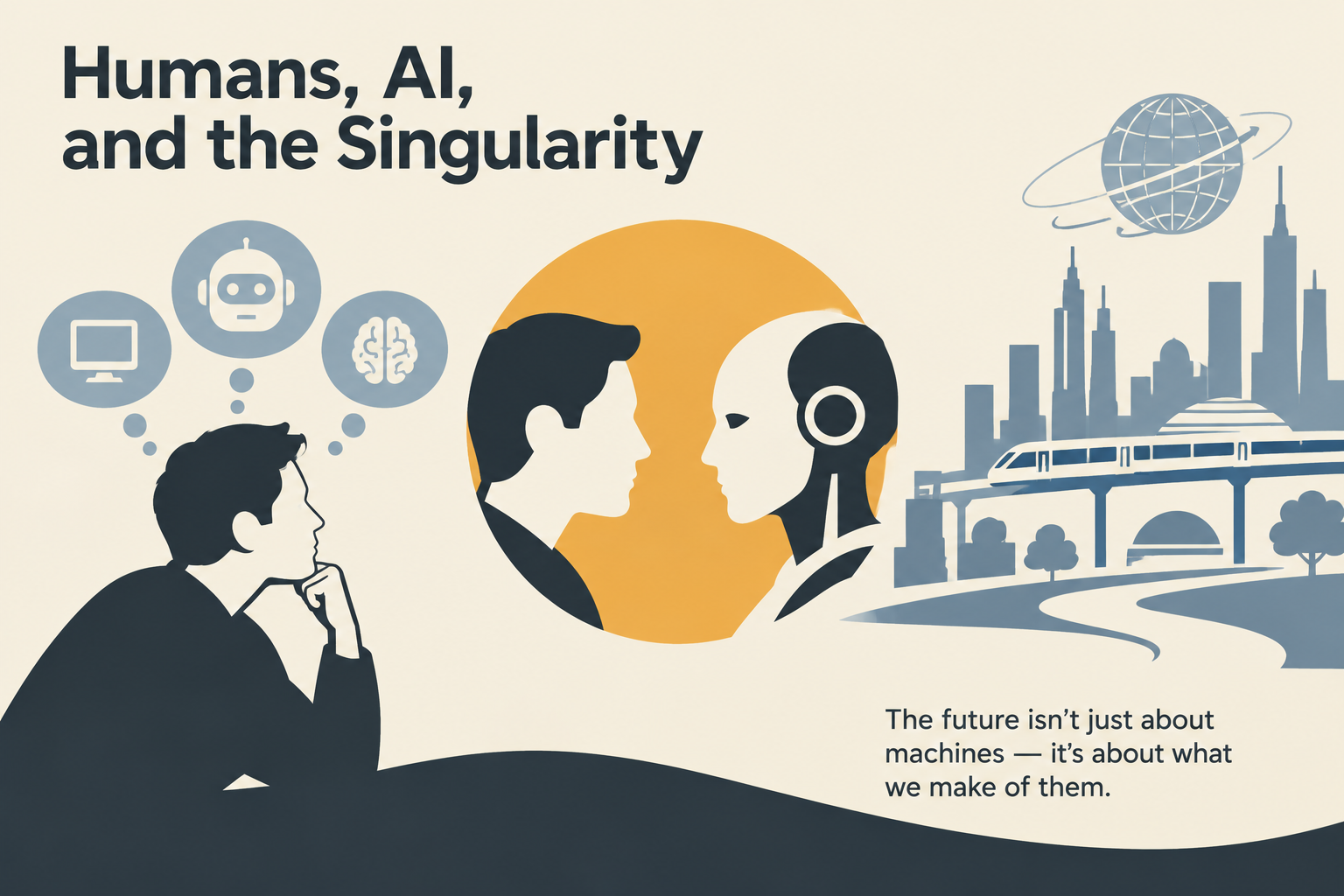
(The cover image is generated using AI)

