Invisible Entrepreneurs
September 7, 2026 Leave a comment

Across rural India and much of the developing world, millions of women wake up before dawn, manage households, tend to livestock, cultivate small plots of land, process food, stitch garments, rear poultry, trade locally, and keep families economically afloat through a variety of income generating activities. Despite their relentless productivity, most of this work does not count as ‘business’ in policy frameworks, financial systems, or even social imagination. These women are workers, contributors, and risk takers, but are rarely recognised as entrepreneurs. Their labour remains invisible, undervalued, and structurally excluded from the very systems meant to promote enterprise and growth.
The invisibility of rural women entrepreneurs is not accidental. It is the outcome of deeply entrenched economic definitions, gender norms, institutional biases, and measurement failures that collectively erase women’s work from formal recognition. To understand why rural women’s enterprises remain unseen, one must look beyond individual capability or ambition and examine how ‘business’ itself is defined, counted, and legitimised.
Entrepreneurship has a narrow and exclusionary definition. In mainstream economics, a business is typically imagined as a registered entity, operating from a distinct workspace, producing for markets beyond the household, employing labour, and generating measurable profits. This definition immediately excludes most rural women, whose enterprises are often home-based, seasonal, informal, and interwoven with domestic responsibilities. When a woman processes grains, sells homemade snacks, stitches clothes for neighbours, weaves handloom products, or rears goats for periodic sale, her work is seen as an extension of household duty rather than economic activity. The fact that it generates income is treated as incidental, not central.
This conceptual blindness is further reinforced by national accounting systems. Gross Domestic Product calculations and labour force surveys systematically undervalue or exclude unpaid and semi-paid work. Women’s labour in family farms, household enterprises, and informal trade is often categorised as ‘assisting’rather than ‘ownership’ work. Even when women contribute substantial labour and decision-making, land titles, business ownership, and enterprise registration are typically in men’s names. As a result, women disappear statistically, even when they are economically indispensable.
Social norms further deepen this invisibility, as in many rural societies, men are perceived as breadwinners and women as caregivers, regardless of actual income contribution in the households. When a man sells produce in the market, he is seen as doing business. When a woman does the same, it is often framed as ‘helping’ the family. Earnings generated by women are frequently pooled into household income, while men’s earnings are recognised as individual contribution. This asymmetry strips women of entrepreneurial identity and reinforces the idea that their work lacks independent economic value.
The location of women’s work also plays a critical role in its invisibility. Because women’s enterprises are commonly home-based, they blur the line between productive and reproductive labour. The home, traditionally associated with unpaid care work, becomes a site where economic activity is rendered invisible simply because it does not conform to spatial norms of business. While a shop has legitimacy, a kitchen does not; a workshop is considered productive, but a courtyard is not. This spatial bias penalises women whose mobility is restricted by safety concerns, social norms, accessibility, or caregiving responsibilities.
Most rural women operate outside formal regulatory frameworks, not as their choice but by necessity. Registration processes are complex, documentation-heavy, and poorly aligned with women’s realities. Limited literacy, lack of identity documents, absence of land titles, and dependence on male family members make formalisation difficult. Formal financial institutions, in turn, rely on formal registration to extend business credit, insurance, and market linkages. This creates a vicious cycle, where women remain informal because systems exclude them, and systems exclude them because they remain informal.
Despite extensive evidence that women are reliable borrowers and effective managers of small enterprises, rural women face disproportionate barriers to credit and access to formal business financing. Collateral requirements favour land and property ownership, which women rarely possess. Credit histories are tied to formal transactions that women are excluded from. Even microfinance, often celebrated as a solution, has limits. Loans are frequently used for household consumption rather than enterprise expansion, and women bear repayment responsibility without gaining corresponding control over assets or profits. Financial inclusion without entrepreneurial recognition risks turning women into financial intermediaries rather than empowered business owners.
Rural women tend to operate at the lowest end of value chains, engaged in production rather than aggregation, branding, or marketing. They sell in local haats (markets), through informal networks, or to middlemen who capture most of the value. Because their scale is small and operations fragmented, their economic contribution is dismissed as marginal. Yet, collectively, these micro-enterprises form the backbone of rural economies, sustaining food systems, crafts, services, and local trade.
The development sector itself has played an ambivalent role in reinforcing invisibility. Programs targeting rural women often frame entrepreneurship as a social development or empowerment intervention rather than a serious economic strategy. Women are encouraged to ‘supplement’ household income, and not to build scalable enterprises. Training focuses on skills rather than markets, confidence rather than capital, participation rather than profit. While these interventions have value, they inadvertently reinforce the idea that women’s enterprises are secondary and subsistence-oriented and not engines of growth.
Most measurement surveys and impact assessments rely on indicators that fail to capture women’s economic realities. Metrics such as revenue, employment generation, or formal registration overlook non-monetary contributions, seasonal income, risk mitigation, and household-level decision making. Women’s enterprises are often judged against male norms of entrepreneurship, setting them up to appear less productive or ambitious, when in fact they operate under entirely different constraints. When women’s work is not recognised as business, they are excluded from policy support, denied access to finance, overlooked in market development initiatives, and marginalised in economic planning. This exclusion perpetuates gender gaps in income, assets, and agency. It also represents a massive loss to economies that fail to harness the full potential of half their population.
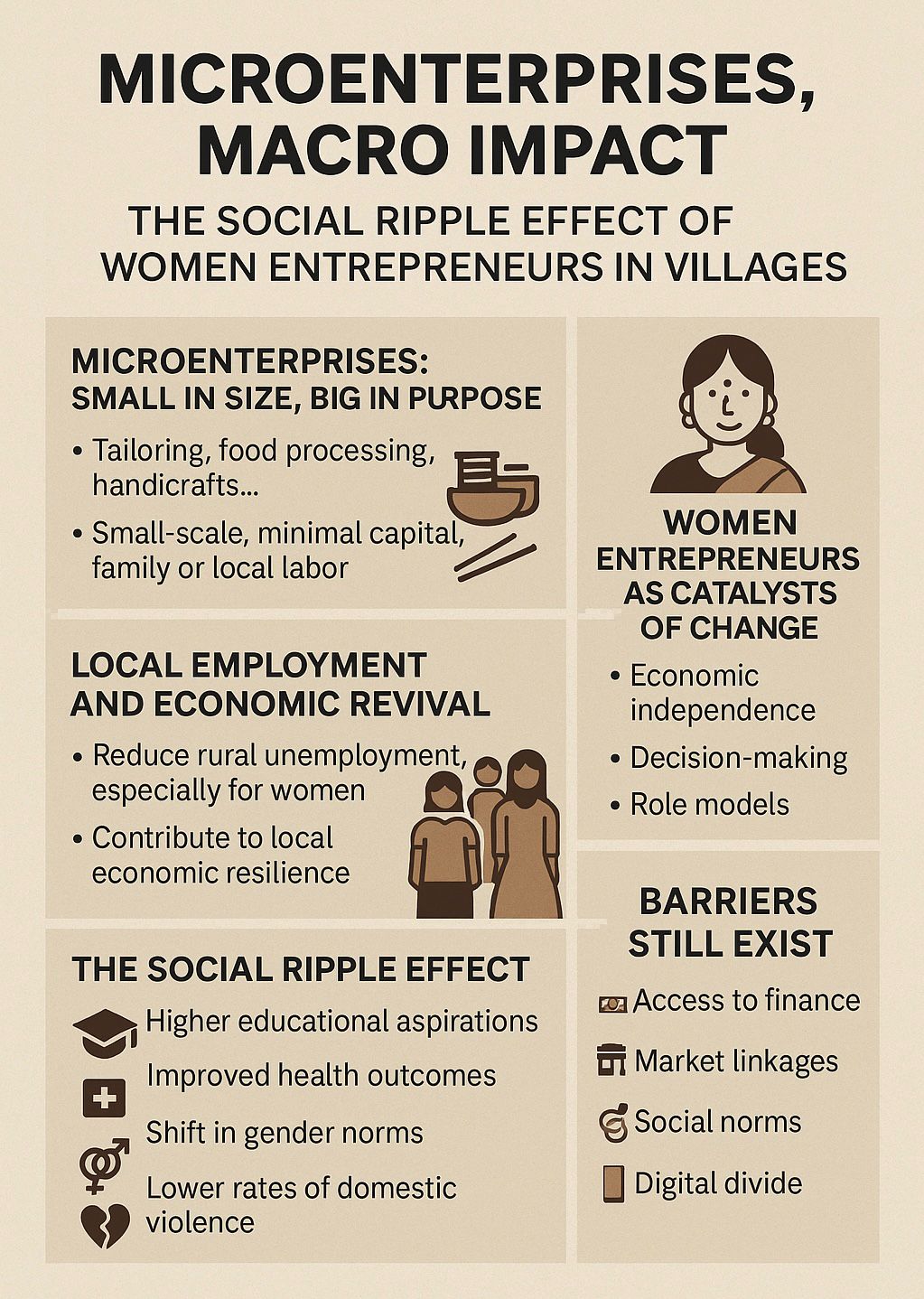
There is growing evidence that recognising and supporting rural women entrepreneurs yields significant economic and social returns. Studies show that women are more likely to reinvest earnings in nutrition, education, and health, creating intergenerational benefits. Women-led enterprises contribute to local resilience, especially in contexts of climate stress, migration, and economic shocks. Yet, without recognition, these benefits remain undervalued and underleveraged. Changing this reality requires a fundamental shift in how entrepreneurship is conceptualised and operationalised. Definitions of business must expand to include informal, home-based, and collective enterprises. Economic contribution should be measured not only by scale and formality, but by sustainability, resilience, and impact. Data systems must be redesigned to capture women’s work accurately, including unpaid and semi-paid labour, joint ownership, and household enterprises.
Institutional reforms are needed to lower barriers to formalisation without penalising informality. Simplified registration, group-based enterprises, and recognition of alternative forms of collateral can help bring women into formal systems on their own terms. Financial products must be tailored to women’s enterprise cycles, risk profiles, and asset constraints. Credit should be linked to capacity building, market access, and asset ownership, not just repayment discipline. Market interventions must move beyond production to address value chains holistically. Supporting aggregation, branding, digital access, and collective bargaining can help women capture greater value. Technology, if designed with women’s realities in mind, can play a transformative role by reducing mobility constraints and expanding market reach. However, as experience shows, access alone is insufficient without confidence, trust, and institutional support.
Finally, social norms must be confronted directly, as recognition is not only a technical issue but a cultural one. When communities, families, and institutions begin to see women as entrepreneurs rather than helpers, power dynamics shift. Legal recognition, public visibility, and role models matter, and so does language. Calling women ‘business owners’ instead of beneficiaries is a political act, and not just semantics. Invisibility is not a natural state, and is produced through choices about what counts, who counts, and whose work is valued. Rural women have always been entrepreneurs in practice, even if not in name. Making their work visible is not about charity or inclusion alone, but it is about economic realism. Until rural women’s enterprises are recognised, measured, and supported as legitimate businesses, development efforts will continue to underestimate both the problem and the potential.
If this essay made you reflect on rural development, women’s entrepreneurship and human potential, subscribe to my blog for one new article in your inbox every week. It’s free!
(Disclaimer: The opinions expressed are those of the author and do not purport to reflect the views or opinions of any organisation, foundation, CSR, non-profit or others.)
The cover image is generated using AI